
Walk into any home-improvement store and you will see two very different-looking electrical wires on the shelf: coils of flat, jacketed cable labeled “Romex” and spools of single wires labeled “THHN.” They look interchangeable to a beginner, but they are different products governed by different NEC articles, and choosing the wrong one can fail an inspection — or worse, create a hazard.
Here is the plain-English difference, where each one is allowed, and which you should reach for on your project.
Romex: A Cable Assembly, Not Just a Wire
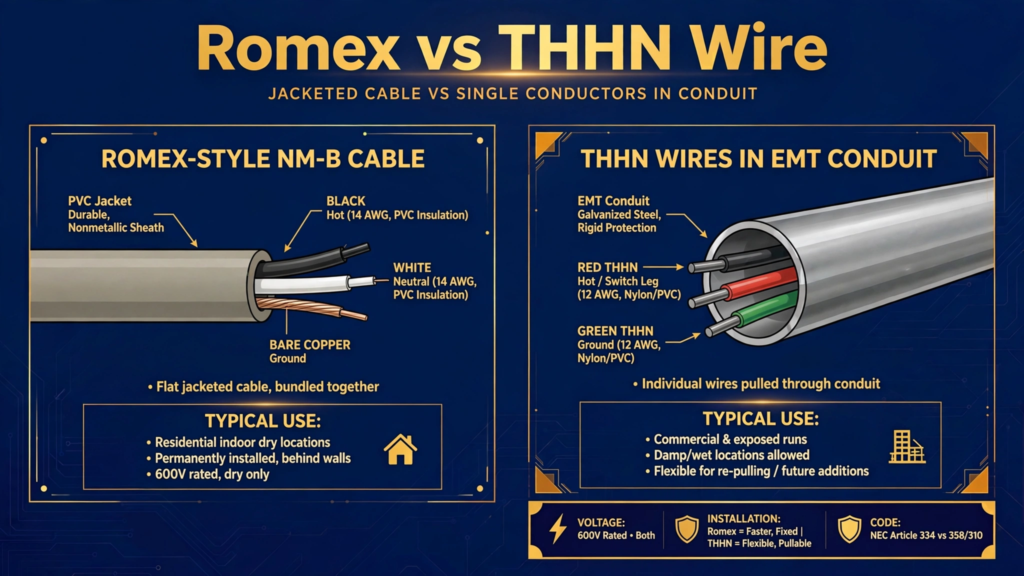
“Romex” is the trade name for Type NM-B, nonmetallic-sheathed cable. It is a factory-built assembly: two or more insulated conductors plus a bare equipment grounding conductor, all wrapped inside one continuous PVC outer jacket. A cable stamped “12-2 NM-B,” for example, contains a black hot, a white neutral, and a bare ground.
NM cable is covered by NEC Article 334. The individual conductors inside are rated 90°C, but the code limits the cable’s usable ampacity to the 60°C column — a conservative margin because the outer jacket traps heat. It is intended for residential branch circuits run through dry locations: inside walls, through wood studs, and across attics. It is not permitted in wet locations, and running it exposed outdoors is off-limits.
For the correct size on a given breaker, use our NEC wire size chart.
THHN: A Single Conductor for Raceways
THHN stands for Thermoplastic High Heat-resistant Nylon-coated. Unlike Romex, THHN is a single insulated wire — one copper or aluminum conductor with a PVC base layer and a thin nylon jacket that makes it slick for pulling through conduit. It is covered by NEC Article 310.
THHN is rated 90°C in dry locations, and most THHN sold today is dual-rated THHN/THWN-2, which keeps the 90°C rating in wet locations too. Because it is a bare single conductor, it generally must be installed inside a raceway such as EMT, PVC, or flexible conduit when run in open walls or exposed areas. Pulling loose THHN through an open stud bay without a raceway is a code violation. (One fun fact: the conductors inside NM-B cable are very often THHN-rated wires themselves — but the finished cable is still governed by the NM-B rules, not the THHN rules.)
Romex vs THHN: Head-to-Head Comparison
| Feature | Romex (NM-B) | THHN |
|---|---|---|
| Product form | Multi-conductor cable assembly in PVC jacket | Single insulated conductor |
| NEC article | Article 334 | Article 310 |
| Temperature rating | Conductors 90°C; ampacity limited to 60°C column | 90°C dry; THHN/THWN-2 rated 90°C wet too |
| Installation | Run directly through studs and joists, no conduit needed indoors | Must be in conduit or raceway for exposed runs |
| Wet locations | Not permitted | Permitted if dual-rated THHN/THWN-2, in conduit |
| Typical use | Residential branch circuits | Conduit runs, commercial, panels, outdoor feeders |
| Pulling new wire later | Difficult — would need new cable run | Easy — pull additional conductors through existing conduit |
Which Should You Use?
Choose Romex (NM-B) when:
- You are wiring new residential branch circuits inside dry walls, attics, or basements.
- You want fast, economical installation — one cable pull covers hot, neutral, and ground.
- The run stays in dry or damp locations protected from physical damage (see our electrical wiring overview for routing basics).
Choose THHN in conduit when:
- The run goes outdoors, underground, through a garage, or anywhere exposed to moisture or damage.
- You are wiring a commercial space, a detached building, or a panel feeder.
- You may need to add or replace conductors later — conduit makes future pulls easy. Read up on conduit wiring systems before you start.
A note on colors: regardless of which product you choose, conductor identification matters. Our wiring color codes guide covers what black, white, green, and red mean in US wiring.
Can you run Romex inside conduit?
Technically the NEC allows NM cable in conduit for short protective sleeves (NEC 334.15(B)), but stuffing long runs of Romex through conduit is a bad idea. The jacketed cable traps heat, eats up conduit fill quickly, and is miserable to pull. If you are using conduit, strip out of the NM mindset entirely and use individual THHN/THWN-2 conductors sized for the circuit.
FAQs
Is Romex the same as THHN?
No. Romex is a brand name for NM-B cable — a complete assembly of conductors inside a jacket. THHN is an insulation rating for an individual wire. The wires inside a Romex cable may carry a THHN rating, but the cable as a whole follows the NM-B rules of NEC Article 334.
Can THHN be used outdoors?
Yes, if it is dual-rated THHN/THWN-2 and installed in a proper raceway. Plain THHN without the “W” rating is dry-location only. Always check the printing on the wire jacket and confirm the rating with your locally adopted NEC edition.
Why does NM-B limit ampacity to the 60°C column?
The bundled jacket traps heat around the conductors. The 60°C limit (for example, 12 AWG = 20 amps, 14 AWG = 15 amps) provides a safety margin at terminations and device connections, which in residential work are commonly rated 60°C or 75°C.
Can I pull Romex through conduit for an outdoor run?
Not as a substitute for proper outdoor wiring — NM-B is not rated for wet locations, and conduit outdoors is considered a wet location. Use individual THHN/THWN-2 conductors in the conduit instead.
Which is cheaper, Romex or THHN in conduit?
Romex is almost always cheaper for residential indoor runs because there is no conduit or fittings to buy and installation is faster. THHN in conduit costs more up front but pays off where protection, moisture resistance, or future changes are needed.
Conclusion
Romex (NM-B) is the workhorse for dry, indoor residential branch circuits; THHN is the single conductor you pull through conduit for everything else — outdoor runs, commercial work, and places that need physical protection. They are governed by different NEC articles (334 vs. 310), so treat them as different products. When in doubt about location ratings or conduit fill, check with a licensed electrician and your locally adopted NEC edition.


