
Every plug and outlet in North America follows the NEMA numbering system — codes like 5-15R and 14-50R stamped on receptacles. Once decoded, you can instantly tell a plug’s voltage, amperage, and purpose.
This guide teaches you to read any NEMA code, charts the configurations you will actually encounter in US homes, and explains how to match plugs to circuits safely. New circuits should always be installed or verified by a licensed electrician under your locally adopted NEC edition.
How to Read a NEMA Code
A code like NEMA 5-15R breaks into four parts:
| Part | Example | Meaning |
|---|---|---|
| First number | 5 | Configuration family — defines voltage, number of poles and wires |
| Second number | 15 | Amperage rating (15, 20, 30, 50, or 60) |
| Letter suffix | R | P = plug (male), R = receptacle (female outlet) |
| Leading L (optional) | — | L = locking (twist-lock) version, e.g. L14-30R |
So 5-15R is a 125-volt, 15-amp receptacle; 14-50P is a 125/250-volt, 50-amp plug; L14-30R is a locking 30-amp receptacle. Blade patterns are deliberately non-interchangeable across voltages and amperages — a safety feature that makes it physically impossible to connect equipment to the wrong supply. For plug basics, see our what is a plug guide.
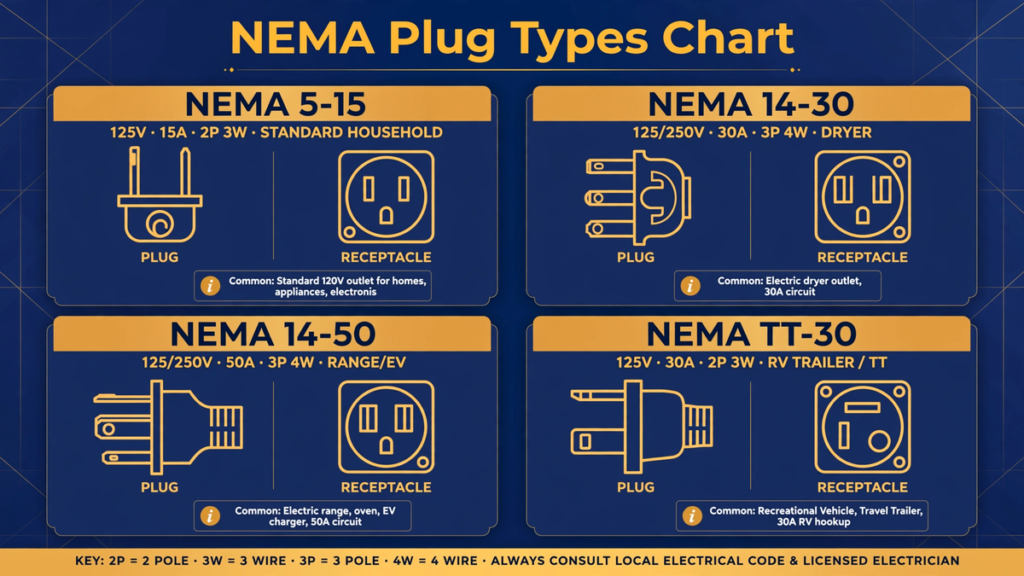
NEMA Plug Types Chart
| NEMA Code | Voltage | Amps | Wires | Common Use |
|---|---|---|---|---|
| 1-15P | 125V | 15A | 2-wire, ungrounded | Legacy 2-prong lamps and small devices |
| 5-15R / 5-15P | 125V | 15A | 2-pole, 3-wire grounded | Standard US household outlet |
| 5-20R / 5-20P | 125V | 20A | 2-pole, 3-wire grounded | 20A circuits; T-slot accepts 15A and 20A plugs |
| 6-15R / 6-20R | 250V | 15 / 20A | 2-pole, 3-wire grounded | Window AC units, shop tools, small 240V loads |
| 6-30R / 6-50R | 250V | 30 / 50A | 2-pole, 3-wire grounded | Welders, kilns, some EV chargers (no neutral) |
| 10-30R / 10-50R | 125/250V | 30 / 50A | 3-wire, ungrounded (legacy) | Old dryers and ranges — existing installations only |
| 14-30R / 14-30P | 125/250V | 30A | 3-pole, 4-wire grounded | Modern electric clothes dryers |
| 14-50R / 14-50P | 125/250V | 50A | 3-pole, 4-wire grounded | Electric ranges, RV parks, Level 2 EV charging |
| TT-30R / TT-30P | 125V | 30A | 2-pole, 3-wire grounded | RV and travel trailer shore power (“RV 30”) |
| L5-30R | 125V | 30A | Locking, 3-wire grounded | Generators, RVs, marine shore power |
| L6-30R | 250V | 30A | Locking, 3-wire grounded | Generators, industrial equipment |
| L14-30R | 125/250V | 30A | Locking, 4-wire grounded | Portable generators, transfer switches |
The Configurations You Will Actually Meet
Household outlets: 5-15R and 5-20R
The 5-15R is the standard duplex receptacle in every American home — 125 volts, 15 amps. The 5-20R adds a T-shaped neutral slot so it accepts 20-amp plugs too; you will see it on dedicated 20-amp kitchen, laundry, and workshop circuits. A 15-amp plug fits a 20-amp receptacle, but a 20-amp plug cannot fit a 15-amp receptacle. Learn more in our electrical socket guide.
Small 240V loads: the 6-series
NEMA 6 configurations are 250-volt with two hots and a ground but no neutral — for pure 240V equipment. The 6-15R and 6-20R serve large window air conditioners and shop machinery; the 6-50R is the classic welder outlet, also used by some EV chargers that need no neutral.
Dryers and ranges: 10-series vs 14-series
Older homes have 10-30R (dryer) and 10-50R (range) receptacles — three-wire and ungrounded, with the neutral doubling as the equipment ground. New installations must use the four-wire grounded 14-series: 14-30R for dryers, 14-50R for ranges. Under NEC 250.140, the old three-wire connection is permitted only for existing installations. When replacing a dryer cord, match the cord to the receptacle — 3-prong for 10-30R, 4-prong for 14-30R.
RVs: TT-30
The TT-30 is a 120-volt, 30-amp receptacle standard at campgrounds and RV parks — 120V only, despite the 30-amp rating.
Locking connectors: the L-series
An L prefix means twist-lock: the plug inserts and rotates to lock, so vibration cannot pull it loose. L5-30 and L14-30 are standard on portable generators — the L14-30R’s four wires (two hots, neutral, ground) deliver both 120V and 240V, making it the typical generator-to-transfer-switch inlet.
Matching Plugs to Circuits Safely
Three rules keep NEMA devices safe. First, receptacle, breaker, and wire must agree: a 14-50R needs a 50-amp breaker with 6 AWG copper; a 14-30R needs a 30-amp breaker with 10 AWG copper (see our wiring color codes guide for conductor identification). Second, never modify a plug or use cheater adapters to defeat the blade pattern — the pattern is the safety system. Third, when buying a replacement cord or receptacle, match the NEMA code exactly and follow the manufacturer’s instructions per NEC 110.3(B).
FAQs
What does the R stand for in 5-15R?
R = receptacle (the outlet), P = plug: 5-15R is the outlet, 5-15P the plug that fits it.
What is the difference between 10-30R and 14-30R dryer outlets?
The 10-30R is an older three-wire ungrounded outlet; the 14-30R is the modern four-wire grounded outlet with a separate ground pin. New installations must use 14-30R; 10-30R is permitted only in existing installations.
Which NEMA outlet do I need for EV charging?
The 14-50R is most common for Level 2 home EV charging (50 amps, 240V). Some chargers use the 6-50R, which omits the neutral. Follow the charger manufacturer’s specified receptacle and circuit size.
Can I plug a 15-amp device into a 20-amp outlet?
Yes — the 5-20R accepts both 15-amp and 20-amp plugs. The reverse is impossible: a 20-amp plug’s horizontal blade will not fit a 15-amp receptacle.
What does the L mean in L14-30R?
L designates a locking (twist-lock) connector — the plug twists to lock so vibration cannot pull it loose, common on generators and industrial equipment.
Conclusion
NEMA codes are compact: family number for voltage/wiring, second number for amperage, P/R for plug/receptacle, L for locking. With the chart above you can identify any common US outlet — from the humble 5-15R to the 14-50R feeding an EV charger — and verify it is matched to the right breaker and wire. For new installations or any doubt, have a licensed electrician do the work under your locally adopted NEC edition; the official code is published by the NFPA.