
A fuel cell is a device that turns the chemical energy in a fuel directly into electricity, without burning anything. Feed it hydrogen and oxygen, and it gives you electricity, heat, and water — and it keeps going for as long as the fuel keeps flowing.
Fuel cells already power cars, buses, forklifts, hospitals, and spacecraft. They are quiet, efficient, and clean at the point of use, which is why carmakers and power companies have invested billions in them. This guide explains what a fuel cell is, how it works, the main types, and where the technology makes sense today.
What Is a Fuel Cell?
A fuel cell is an electrochemical cell that converts the chemical energy of a fuel and an oxidizing agent into electricity through a pair of redox reactions. In most fuel cells the fuel is hydrogen and the oxidizer is oxygen from the air. The cell has three main parts: an anode, a cathode, and an electrolyte that sits between them and lets ions pass through while blocking electrons.
A fuel cell looks a lot like a battery, and it works on similar chemistry. The big difference is that a battery stores its fuel inside itself and runs flat when the chemicals are used up, while a fuel cell is fed fuel from the outside. As long as hydrogen and oxygen keep arriving, a fuel cell keeps making electricity. That is why fuel cells can run for weeks or months without stopping, and why a fuel cell car can be refueled in minutes instead of recharged for hours.
The idea is old. The first fuel cell was built by Sir William Grove in 1838, and Francis Thomas Bacon built a practical version in 1932. The technology proved itself in space: alkaline fuel cells provided power and drinking water on the Apollo Moon missions and on the space shuttle. Today the same idea powers cars, buses, forklifts, and buildings.
How a Fuel Cell Works
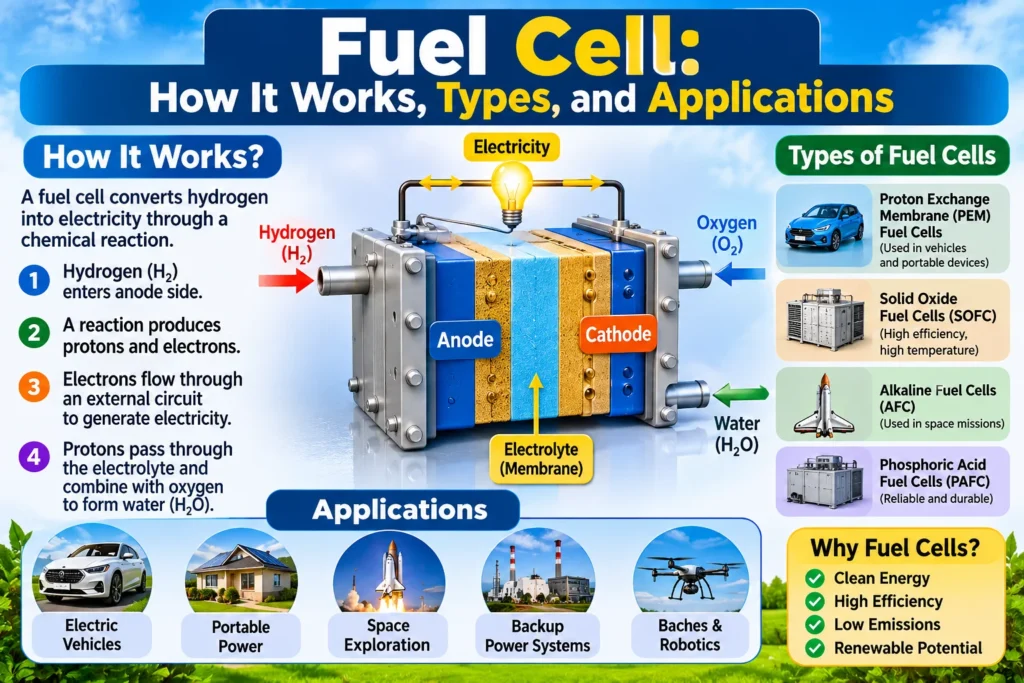
A hydrogen fuel cell works in three steps. At the anode, a platinum catalyst splits each hydrogen molecule into two protons and two electrons: 2H2 → 4H+ + 4e-. The protons pass straight through the electrolyte, but the electrons cannot. They are forced to travel around an external circuit, and that flow of electrons is the electric current that powers a motor or a light.
At the cathode, the protons, the electrons, and oxygen from the air meet and combine into water: O2 + 4H+ + 4e- → 2H2O. Add the two half-reactions together and the overall reaction is simple: 2H2 + O2 → 2H2O. The only products are electricity, water, and a little heat.
A single cell makes only about 0.6 to 0.7 volts under load, far too little to run anything useful. So cells are stacked in series to raise the voltage and in parallel to raise the current. A fuel cell stack in a car might contain several hundred cells. The stack produces direct current (DC), which drives the motor directly or is fed to an inverter for AC equipment. Around the stack sits the balance of plant: pumps, blowers, sensors, and controls that feed hydrogen and air at the right rate, remove water, and keep the temperature steady.
Here is a worked example. Take a stack of 300 cells, each making 0.7 V. Wired in series, the stack voltage is 300 × 0.7 V = 210 V. If the stack delivers 200 A, the power is P = V × I = 210 V × 200 A = 42,000 W, or 42 kW — enough for a small car at highway speed.
Now think about the fuel. One kilogram of hydrogen holds about 33.3 kWh of chemical energy. A car that carries 5 kg of hydrogen has about 166 kWh of energy on board. At 50 percent efficiency, the fuel cell turns that into about 83 kWh of electricity. A car that uses 0.25 kWh per mile can then drive about 330 miles — close to the real-world range of a Toyota Mirai, which is rated at just over 400 miles on a full tank.

Main Parts of a Fuel Cell
- Anode: the negative electrode, where hydrogen is split into protons and electrons.
- Cathode: the positive electrode, where oxygen, protons, and electrons combine into water.
- Electrolyte: the layer between the electrodes that conducts ions but blocks electrons. In a PEM fuel cell it is a thin polymer membrane; in a solid oxide fuel cell it is a ceramic.
- Catalyst: usually platinum, spread in a thin layer on the electrodes to speed up the reactions.
- Gas diffusion layer: a porous carbon layer that spreads hydrogen and oxygen evenly over the electrodes.
- Flow-field plates: metal or graphite plates that feed gas to each cell, carry current away, and connect the cells in a stack.
- Current collectors: conductors that carry the current from the stack to the external circuit.
- Balance of plant: the pumps, blowers, humidifier, and controls that keep the fuel, air, water, and temperature in the right range.
Types of Fuel Cells
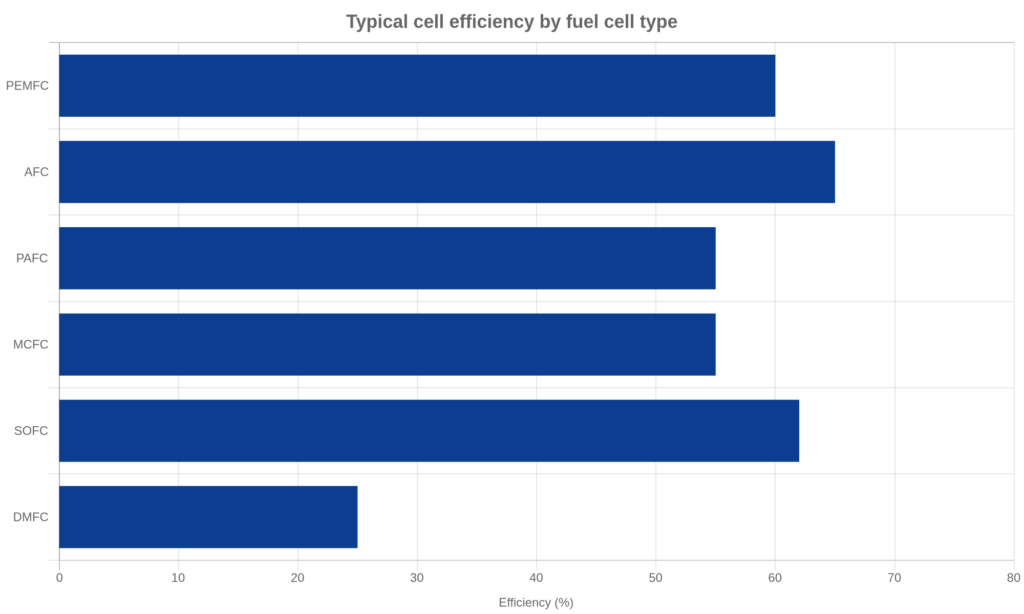
Fuel cells are grouped by the electrolyte they use, because the electrolyte sets the operating temperature, the fuel it can use, and the best application. The table below compares the six main types.
| Type | Electrolyte | Operating temperature | Cell efficiency | Typical power | Common uses |
|---|---|---|---|---|---|
| PEMFC (proton-exchange membrane) | Polymer membrane (Nafion) | 50–100 °C | 50–70% | 1 W–500 kW | Cars, buses, forklifts, portable power |
| AFC (alkaline) | Aqueous potassium hydroxide | Below 80 °C | 60–70% | 10–200 kW | Spacecraft (Apollo, space shuttle) |
| PAFC (phosphoric acid) | Phosphoric acid | 150–200 °C | 55% | Under 10 MW | Stationary power, combined heat and power |
| MCFC (molten carbonate) | Molten carbonate | 600–650 °C | 55% | Up to 100 MW | Large stationary power plants |
| SOFC (solid oxide) | Ceramic (yttria-stabilized zirconia) | 800–1,000 °C | 60–65% | Under 100 MW | Stationary power, auxiliary power |
| DMFC (direct methanol) | Polymer membrane | 90–120 °C | 20–30% | 100 mW–1 kW | Portable electronics, small devices |
The proton-exchange membrane fuel cell (PEMFC) is the most common type in vehicles because it starts quickly, runs at a low temperature, and is compact. Solid oxide and molten carbonate cells run hot, so they take minutes to start, but they are very efficient and can run on natural gas, which makes them better for stationary power plants. Alkaline fuel cells are the oldest type and powered the Apollo spacecraft, but they are sensitive to carbon dioxide, so they need pure oxygen instead of air.
Fuel Cell vs Battery
A fuel cell and a battery both make electricity from chemistry, but they store and deliver energy in opposite ways. A battery is a closed box: the chemicals are inside, and when they are used up the battery is flat and must be recharged. A fuel cell is an open system: the fuel arrives from a tank outside the cell, so it runs as long as the tank has fuel.
That difference shapes where each one wins. Batteries are simple, cheap, and efficient for storing energy, which is why they dominate phones, laptops, and most electric cars. Fuel cells make sense where refueling time matters or where a vehicle runs almost nonstop. A hydrogen car refuels in about five minutes, and a fuel cell forklift can be refueled in three minutes and then work a full shift, while a battery forklift must stop to swap or recharge its battery. Fuel cells also beat batteries on range for heavy vehicles: a hydrogen bus or truck can travel hundreds of miles without a huge, heavy battery.
On the other hand, a battery is more efficient end to end. A fuel cell system turns about 40 to 60 percent of the hydrogen’s energy into electricity, and making the hydrogen costs energy too. A battery electric car converts about 80 to 90 percent of the grid electricity into motion. So for a small car that charges at home overnight, a battery is usually the better choice. For a bus, a truck, a train, or a ship that needs long range and fast refueling, a fuel cell can be the better one.
Where Fuel Cells Are Used
- Cars and buses: hydrogen fuel cell cars such as the Toyota Mirai and Hyundai Nexo travel more than 300 miles on a tank and refuel in about five minutes. Fuel cell buses run in cities in Japan, Europe, and the United States.
- Forklifts and warehouse vehicles: more than 50,000 hydrogen forklifts were in use worldwide by 2024, because a three-minute refuel beats a long battery recharge in a busy warehouse.
- Stationary power: fuel cell systems provide primary and backup power for hospitals, schools, hotels, data centers, and office buildings. Some run on natural gas and also supply heat, reaching about 85 percent total efficiency in combined heat and power.
- Portable power: small fuel cells charge phones, power remote sensors, and run camping equipment.
- Space: alkaline fuel cells powered the Apollo missions and the space shuttle, producing electricity and drinking water for the crew.
- Trains and ships: hydrogen fuel cell trains run on non-electrified lines, and fuel cell ferries and ships are in service or under construction.
Advantages and Limitations
Fuel cells are efficient: a fuel cell converts 40 to 60 percent of its fuel’s energy into electricity, roughly double the efficiency of a typical internal combustion engine, and with heat recovery the total can reach 85 percent. They are quiet, have no moving parts in the stack itself, and produce only water at the point of use, so they emit no soot or nitrogen oxides where they run. They are also scalable: add more cells to a stack for more power, or add more hydrogen to a tank for more range.
The biggest limitation is the hydrogen itself. More than 95 percent of the world’s hydrogen is made by steam methane reforming from natural gas, which releases carbon dioxide, so a fuel cell car is only as clean as its hydrogen. Truly green hydrogen, made by splitting water with renewable electricity, is still only about 1 percent of production. Hydrogen is also hard to store: it is the lightest element, so it must be compressed to very high pressure or cooled to a liquid, and a hydrogen tank takes up more space than a gasoline tank for the same energy. Fuel cells are also expensive, mainly because they use platinum catalysts, and they wear out: an automotive fuel cell is expected to last about 5,000 hours, or 150,000 miles, and current systems reach roughly half of that. Finally, there are very few hydrogen filling stations outside California, Japan, and parts of Europe, which limits where fuel cell cars can be used.
Related reading: Battery Types: Complete Guide for Electrical Students and Beginners
Related reading: Types of Sensors: A Complete Guide to How Sensors Work and Where They Are Used
Frequently Asked Questions
What is a fuel cell in simple terms?
A fuel cell is a device that makes electricity from a fuel, usually hydrogen, and oxygen, without burning anything. Hydrogen goes in one side, oxygen goes in the other, and electricity and water come out.
How long does a fuel cell last?
An automotive fuel cell is designed to last about 5,000 hours, or roughly 150,000 miles. Current systems reach about half of that in real use. Stationary fuel cells can run for tens of thousands of hours because they operate at a steady load.
What fuel does a fuel cell use?
Most fuel cells use hydrogen. Some types, such as solid oxide and molten carbonate cells, can also run on natural gas or methanol, which are reformed into hydrogen inside the system.
Are fuel cells better than batteries?
It depends on the job. Batteries are cheaper and more efficient for small cars and short trips. Fuel cells win for long range, fast refueling, and heavy vehicles such as buses, trucks, and forklifts that run almost nonstop.
Do fuel cells produce any pollution?
At the point of use, a hydrogen fuel cell produces only water and heat. Whether it is clean overall depends on how the hydrogen was made: hydrogen from natural gas releases carbon dioxide during production, while hydrogen made from water using renewable electricity is nearly pollution-free.
Conclusion
A fuel cell turns fuel into electricity cleanly and quietly, without combustion and without moving parts in the stack. It is not a battery: it does not store energy, it converts it, for as long as fuel keeps flowing. That makes it a strong choice for vehicles that need long range and fast refueling, and for buildings that need clean, reliable power and heat.
The technology still has real hurdles: most hydrogen is made from natural gas, platinum catalysts are expensive, and filling stations are scarce. But where those problems are solved, fuel cells already work — in cars, buses, forklifts, hospitals, and spacecraft — and they are likely to keep growing as green hydrogen gets cheaper.
For a deeper reference on how fuel cells work and the main types, see https://en.wikipedia.org/wiki/Fuel_cell