
A sensor is a device that detects a change in its environment and turns that change into a signal a system can use. Without sensors, machines would be blind: a thermostat could not feel temperature, a car could not see an obstacle, and a factory could not tell whether a tank was full.
What Is a Sensor?
A sensor converts a physical quantity, such as temperature, pressure, light, or motion, into an electrical signal. That signal is then conditioned, processed, and used to control something or to inform a person.
How a Sensor Works
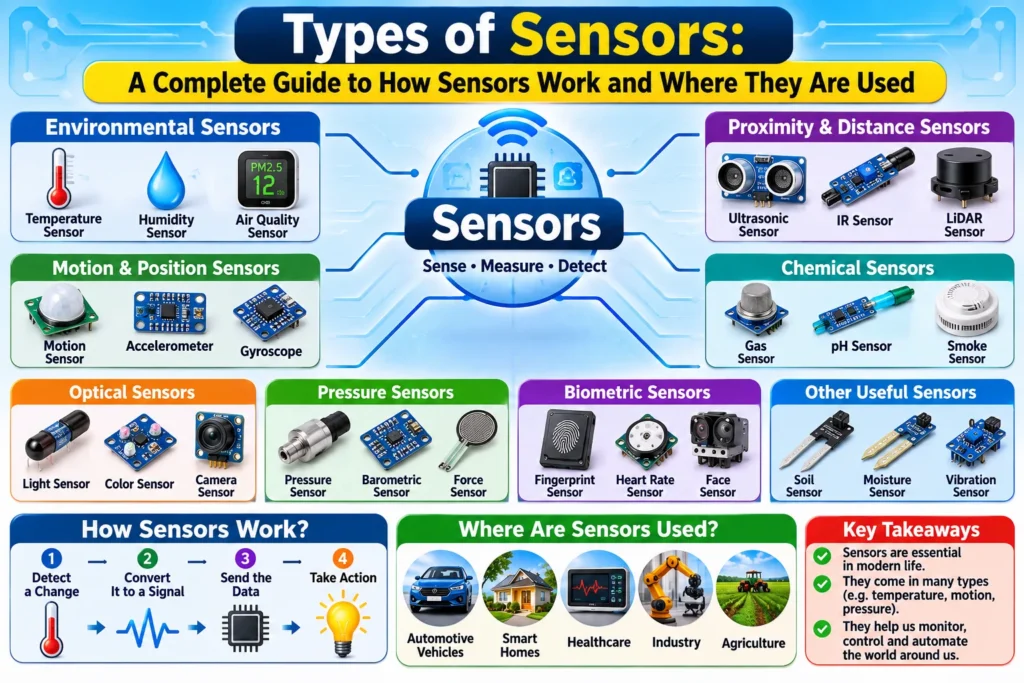
Most sensors follow the same four-step chain. First, a sensing element reacts to the quantity being measured. A thermistor changes resistance with temperature, a strain gauge changes resistance when it is stretched, and a photodiode changes current when light falls on it. Second, a transducer stage turns that physical change into an electrical quantity, usually voltage, current, resistance, or capacitance. Third, signal conditioning cleans up the result: it amplifies a small signal, filters out noise, and shifts it into the range an analog-to-digital converter can read. Fourth, a controller, display, or actuator uses the result, switching a heater off, sounding an alarm, or logging the value for later analysis.
The output can be analog or digital. An analog sensor gives a continuous signal, such as 0 to 5 V or 4 to 20 mA, that varies smoothly with the measured quantity. A digital sensor gives a switched output or a coded value, such as a pulse train whose frequency rises with flow rate, or a serial data word from a temperature chip. Analog outputs are simple and fast, while digital outputs resist electrical noise and connect directly to microcontrollers and programmable logic controllers.

Types of Sensors
Sensors are usually grouped by the quantity they measure. The main families are listed below, and each one includes many subtypes for different ranges, accuracies, and environments.
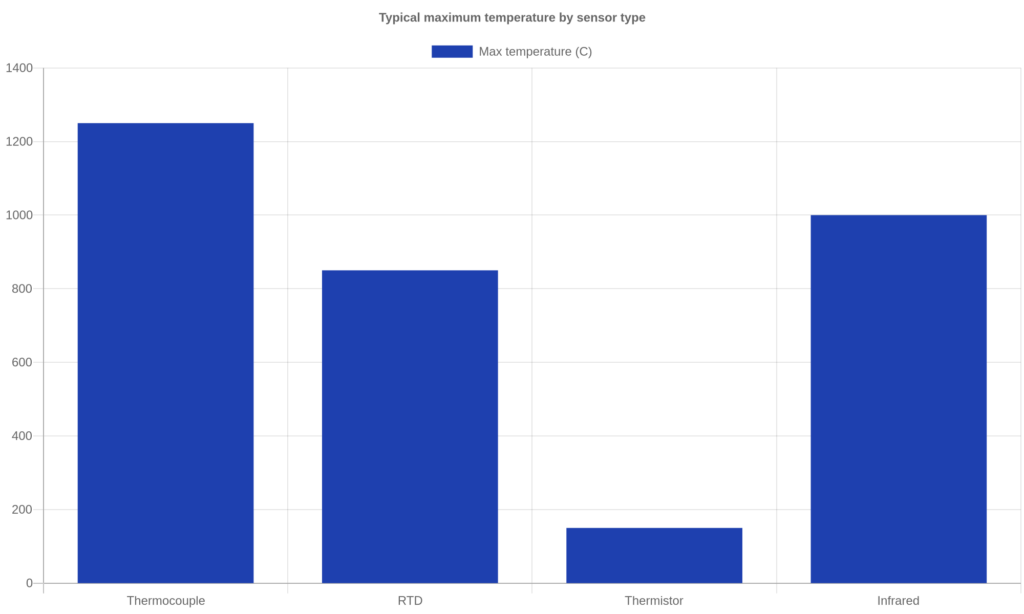
- Temperature sensors: thermocouples, resistance temperature detectors (RTDs), thermistors, and infrared sensors. They monitor motors, batteries, ovens, HVAC systems, and process lines.
- Pressure sensors: piezoresistive, capacitive, and piezoelectric types. They measure air, water, oil, and gas pressure in pumps, pipelines, tires, and hydraulic systems.
- Proximity and position sensors: inductive, capacitive, ultrasonic, and Hall-effect sensors. They detect objects without contact, count parts on a conveyor, and measure shaft position.
- Motion and vibration sensors: accelerometers, gyroscopes, and vibration switches. They track movement in phones, robots, vehicles, and rotating machinery.
- Light and optical sensors: photodiodes, phototransistors, light-dependent resistors, and image sensors. They run automatic lighting, barcode readers, cameras, and solar trackers.
- Gas and chemical sensors: electrochemical, semiconductor, and infrared gas sensors. They detect carbon monoxide, methane, oxygen, and humidity in homes and industry.
- Flow sensors: turbine, ultrasonic, thermal, and differential-pressure types. They measure liquid and gas flow in water systems, fuel lines, and chemical plants.
- Force, load, and level sensors: strain-gauge load cells and ultrasonic or float level sensors. They weigh products, measure tank levels, and monitor structural loads.
Analog vs Digital Sensors
The choice between analog and digital is a trade-off, not a rule. Analog sensors give fine, continuous detail and respond quickly, which suits simple control loops and older equipment. Digital sensors add a small processor inside the housing, so they can filter, calibrate, and send a clean value over I2C, SPI, UART, or a fieldbus. That makes wiring simpler in large systems, because many digital sensors can share one bus. In practice, many modern sensors are hybrid: the sensing element is analog, but the output is digitized inside the sensor before it reaches the controller.
Key Sensor Specifications
A datasheet tells you whether a sensor will work in your application. Read these specifications before you buy or install one.
- Range: the smallest and largest values the sensor can measure, for example -40 to 125 degrees C for an industrial temperature sensor.
- Sensitivity: how much the output changes for a given change in the input, such as 10 mV per degree C.
- Accuracy: how close the reading is to the true value, often given as a percentage of full scale or in absolute units.
- Resolution: the smallest change the sensor can detect, such as 0.1 degrees C for a digital temperature sensor.
- Response time: how fast the output follows a change in the input. A fast thermocouple reacts in milliseconds; a large probe can take seconds.
- Hysteresis: the difference in output when the same value is approached from above and from below. Low hysteresis gives more repeatable readings.
- Repeatability and stability: whether the sensor gives the same reading under the same conditions, and whether it drifts over months of use.
Where Sensors Are Used
Sensors are everywhere, often unnoticed. In a home, they run thermostats, smoke alarms, motion lights, and washing machines. In a car, they measure wheel speed for anti-lock brakes, oxygen in the exhaust for engine control, and distance for parking assistance. In industry, they monitor temperature, pressure, vibration, and flow on production lines, and they feed data to control systems that keep processes safe and efficient. In healthcare, they measure heart rate, blood oxygen, blood pressure, and glucose. In agriculture, soil-moisture and weather sensors help farmers irrigate only when crops need water, saving both water and energy.
How to Select the Right Sensor
Start with the measurement itself: what quantity, what range, and what accuracy do you need? Then check the environment. A sensor in a hot, wet, or dusty place needs a sealed housing and a wide temperature rating, while a laboratory sensor can be lighter and cheaper. Check the output next: does your controller accept 0 to 10 V, 4 to 20 mA, or a digital bus? Then consider power, size, mounting, and cost, including calibration and maintenance over the life of the product. A sensor that is cheap to buy but drifts every month can cost more than a stable one. When in doubt, test two candidates side by side under real conditions before committing to one.
Related reading: What Is a Thermocouple and How Does It Work?
Related reading: What Is a Diode and How Does It Work?
Related reading: What Is an Inductor and How Does It Work?
| Sensor type | Measures | Typical output | Example use |
|---|---|---|---|
| Temperature | Temperature | Voltage, resistance | Motor, HVAC |
| Pressure | Pressure | 4-20 mA, voltage | Pumps, pipelines |
| Proximity | Presence, distance | Digital switch | Conveyor counting |
| Motion | Acceleration, rotation | Digital, pulse | Robotics, vehicles |
| Gas | Gas concentration | Voltage, digital | Air quality, safety |
Frequently Asked Questions
What is the difference between a sensor and a transducer?
A sensor detects a physical quantity and produces a usable signal, while a transducer is the broader term for any device that converts one form of energy into another. Every sensor contains a transducer, but not every transducer is a sensor: a loudspeaker, for example, is a transducer that converts electrical energy into sound, but it does not sense anything.
What is the most common type of sensor?
Temperature sensors are among the most common, because almost every machine, building, and process needs temperature control or monitoring. Thermocouples and thermistors appear in ovens, motors, batteries, HVAC systems, and medical devices, and they are often the cheapest and most reliable option.
How do sensors communicate with a controller?
Small systems use analog voltage, 4 to 20 mA current loops, or digital buses such as I2C and SPI. Larger industrial systems use fieldbus protocols, Modbus, or industrial Ethernet. Wireless sensors use Wi-Fi, Bluetooth, LoRa, or Zigbee to send readings to a gateway or cloud platform.
Why do sensors need calibration?
Calibration compares a sensor reading with a known reference and corrects any error. Sensors drift with age, temperature, and use, so regular calibration keeps readings accurate. In safety and quality work, calibration is often required by standards and must be recorded.
Can one sensor measure more than one quantity?
Yes. Many modern sensors combine several measurements in one package, such as temperature and humidity, or acceleration and rotation. These combined sensors save space and wiring, but each measurement still has its own range and accuracy, so check the datasheet for every quantity you need.
Conclusion
Sensors are the link between the physical world and the electronic systems that control it. They measure temperature, pressure, motion, light, and much more, then turn those measurements into signals that controllers can act on. Choosing the right sensor means matching its type, range, accuracy, and output to the job, and checking that it can survive the environment where it will work. As systems become more connected, sensors will keep getting smaller, smarter, and more important, from smart homes and electric vehicles to factories and hospitals. For a deeper reference on sensor terminology and measurement, see the National Institute of Standards and Technology: https://www.nist.gov/