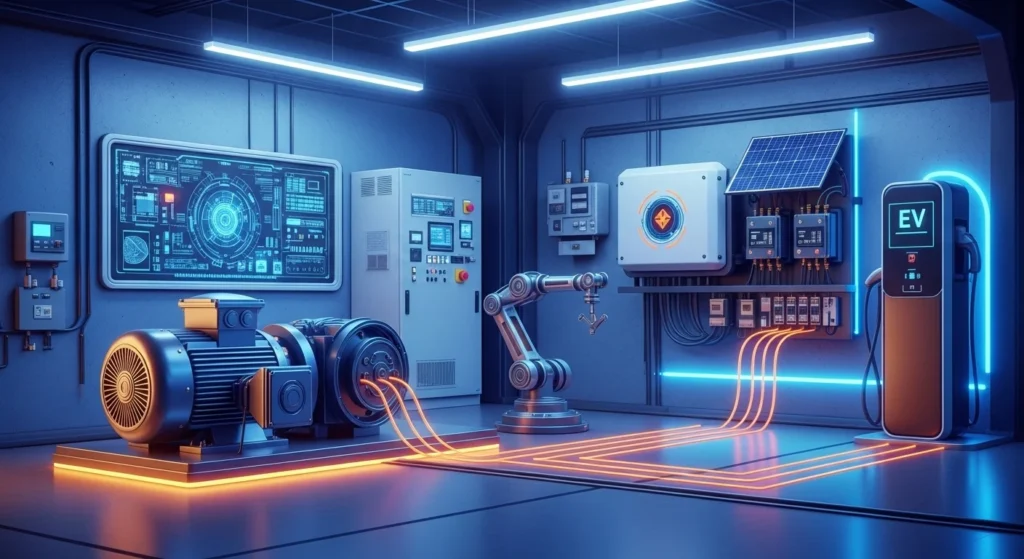

Imagine you enter an industrial plant for the first time. Large motors are running conveyor belts, transformers are stepping down voltage, generators are supplying backup power, and control panels are managing everything automatically. At first, it may look complicated. But when you understand machines and devices step by step, everything becomes logical and clear.
For electrical students, engineers, technicians, and beginners, learning machines and devices topics is not optional. It is the foundation of electrical engineering. Without understanding how machines convert energy and how devices control and protect systems, you cannot design, install, or maintain electrical systems safely.
In this complete guide, we will explain what Machines & Devices Topics mean, their working principles, types, components, applications, advantages and disadvantages, and future trends. You will also learn the difference between electrical machines and electrical devices, and how to choose the right equipment for your work.
Let’s begin with the basics and build your knowledge like a strong electrical system.
2. What is Machines & Devices Topics?
Machines & Devices Topics refer to the study of electrical machines and electrical devices used to generate, convert, control, and utilize electrical energy.
Clear Definition
Electrical machines are equipment that convert energy from one form to another, such as:
- Electrical to mechanical (motor)
- Mechanical to electrical (generator)
Electrical devices are components that control, protect, measure, or regulate electrical systems.
Simple Explanation
- A motor rotates a fan.
- A generator produces electricity.
- A circuit breaker protects from overload.
- A transformer changes voltage level.
All these are part of machines and devices topics in electrical engineering.
Practical Example
In a water pumping system:
- Motor → Runs the pump
- Contactor → Controls motor
- Overload relay → Protects motor
- Transformer → Adjusts voltage
Each machine and device has a clear role.
3. Machines & Devices Working Principle
The machines & devices working principle depends on energy conversion and electromagnetic laws.
Step-by-Step Basic Working
- Electrical energy flows in a conductor.
- A magnetic field is created.
- Interaction between magnetic field and current produces motion.
- Motion or rotation converts energy.
Easy Analogy
Think of a bicycle dynamo:
- You rotate the wheel (mechanical energy).
- The dynamo converts it into electrical energy.
- The light glows.
Similarly:
- Motor → Electricity makes rotation.
- Generator → Rotation makes electricity.
Most electrical machines follow basic electromagnetic principles:
- Magnetic field
- Current flow
- Mechanical motion
Electrical devices, on the other hand, work by:
- Detecting current or voltage
- Interrupting or controlling flow
- Protecting circuits
4. Types / Classification
Machines and devices can be classified into two main groups.
Electrical Machines
These convert energy.
1. DC Machines
DC machines are electrical machines that operate using direct current (DC) electricity. These machines can work either as a DC generator or as a DC motor. A DC generator converts mechanical energy into electrical energy, while a DC motor converts electrical energy into mechanical energy. DC machines are widely used in industries, transportation systems, laboratories, and power control applications because they provide excellent speed control and high starting torque. The basic construction of a DC machine includes important parts such as the armature, field winding, commutator, brushes, yoke, and poles. The working principle of DC machines is based on electromagnetic induction and the interaction between magnetic fields and electric current. In a generator, mechanical rotation produces electricity, while in a motor, electric current creates rotational motion. DC machines are classified into different types such as shunt machines, series machines, and compound machines depending on the connection of the field winding. One major advantage of DC machines is their smooth and accurate speed control, which makes them suitable for cranes, elevators, rolling mills, electric vehicles, and machine tools. They also provide strong starting torque, especially in series motors. However, DC machines require regular maintenance because of the brushes and commutator, which experience wear during operation. They are also more expensive and less commonly used than AC machines in modern large-scale power systems. Despite this, DC machines remain important in many industrial and engineering applications where variable speed control and reliable performance are required. Overall, DC machines are essential electrical devices that play a major role in converting energy efficiently in various electrical and mechanical systems.
- DC Motor
- DC Generator
Used in battery systems and variable speed control.
2. AC Machines
AC machines are electrical machines that work on alternating current (AC). These machines are widely used in homes, industries, and power systems because AC power is easy to generate, transmit, and control. AC machines are mainly divided into two types: AC generators (alternators) and AC motors. An AC generator converts mechanical energy into electrical energy, while an AC motor converts electrical energy into mechanical energy. These machines are the backbone of modern electrical power systems and are used in almost every sector of electrical engineering.
The working principle of AC machines is based on electromagnetic induction. When a conductor rotates inside a magnetic field, an alternating voltage is produced. In motors, when AC supply is given to the stator winding, it creates a rotating magnetic field that causes the rotor to rotate. This simple but powerful principle makes AC machines highly efficient and reliable for continuous operation.
AC machines are classified into synchronous machines and induction machines. Synchronous machines run at constant speed, while induction machines run at slightly less than synchronous speed. Induction motors are the most commonly used motors in industries because they are simple, durable, and low maintenance.
The main components of AC machines include the stator, rotor, windings, shaft, bearings, and cooling system. Each part plays an important role in smooth and efficient operation.
AC machines offer many advantages such as high efficiency, low maintenance, long life, and simple construction. However, they have some disadvantages like limited speed control in basic systems and high starting current in some motors.
They are used in fans, pumps, compressors, elevators, air conditioners, industrial machines, and power plants. In modern technology, AC machines are also used in electric vehicles, automation systems, and renewable energy systems like wind turbines.
Overall, AC machines are essential electrical devices that support almost all modern electrical power and industrial applications due to their efficiency, reliability, and simple operation.
- Induction Motor
- Synchronous Motor
- Alternator
Common in industries and power plants.
3. Transformers
Transformers are static electrical devices used to transfer electrical energy from one circuit to another without changing the frequency. They work on the principle of electromagnetic induction and are mainly used to increase (step-up) or decrease (step-down) voltage levels in AC power systems. Transformers are one of the most important components in electrical power transmission and distribution systems because they help in efficient long-distance power transfer with minimum energy loss.
The working principle of a transformer is based on mutual induction. When alternating current flows through the primary winding, it creates a changing magnetic field in the core. This magnetic field induces voltage in the secondary winding. If the number of turns in the secondary winding is more than the primary, the voltage increases (step-up transformer). If it is less, the voltage decreases (step-down transformer). This process ensures safe and efficient voltage control in electrical networks.
Transformers are mainly classified into different types such as step-up transformers, step-down transformers, isolation transformers, power transformers, and distribution transformers. Each type is designed for specific applications depending on voltage and load requirements.
The main components of a transformer include the core, primary winding, secondary winding, insulation, and cooling system. The core is made of laminated silicon steel to reduce energy losses, while windings are made of copper or aluminum to carry current efficiently.
Transformers offer many advantages such as high efficiency, no moving parts, low maintenance, and reliable operation. However, they also have some limitations like high initial cost, size, and inability to operate on DC supply.
They are widely used in power plants, electrical grids, industries, electronic devices, and renewable energy systems. From charging mobile phones to transmitting electricity across cities, transformers play a vital role in modern electrical systems.
Overall, transformers are essential devices in electrical engineering that ensure safe voltage conversion, efficient power distribution, and stable operation of electrical networks.
- Step-up Transformer
- Step-down Transformer
Used to increase or decrease voltage.
Electrical Devices
These control or protect systems.
1. Switching Devices
- Switch
- Contactor
- Relay
Control current flow.
2. Protection Devices
- Circuit Breaker
- Fuse
- Overload Relay
Protect against faults.
3. Measuring Devices
- Voltmeter
- Ammeter
- Multimeter
Measure electrical values.
5. Main Components
Although different machines have different designs, most share common components.
For Electrical Machines
1. Stator
- Stationary part
- Produces magnetic field
2. Rotor
- Rotating part
- Produces motion
3. Windings
- Copper coils
- Carry electric current
4. Shaft
- Transfers mechanical power
For Electrical Devices
1. Contacts
- Open or close circuit
2. Coil (in relays/contactors)
- Creates magnetic field
3. Insulation
- Prevents short circuit
4. Housing
- Protects internal parts
Each component has a specific function in overall performance.
6. Machines & Devices Advantages and Disadvantages
Advantages of Machines & Devices
| S. No | Advantage | Explanation |
|---|---|---|
| 1 | High Efficiency | Machines convert energy into useful work with less loss compared to manual work |
| 2 | Time Saving | Devices complete tasks much faster than human effort |
| 3 | Reduced Human Effort | Machines reduce physical strain and make work easier |
| 4 | High Productivity | More output can be produced in less time |
| 5 | Accuracy | Devices perform operations with better precision and fewer errors |
| 6 | Continuous Operation | Machines can work for long hours without fatigue |
| 7 | Cost Effective in Long Term | Although initial cost is high, maintenance cost is low over time |
| 8 | Safety Improvement | Machines reduce risk in dangerous or heavy-duty operations |
| 9 | Consistency | Same quality output is maintained in repeated operations |
| 10 | Automation Support | Modern machines can be integrated with automatic control systems |
| 11 | Heavy Load Handling | Machines can lift or process loads that humans cannot handle |
| 12 | Energy Utilization | Proper machines optimize energy use and reduce wastage |
Advantages
- Efficient energy conversion
- Reliable operation
- Long service life
- Easy control with modern systems
- Suitable for small to large applications
Real-World Benefits
- Motors run factories
- Transformers power cities
- Protection devices prevent fires
- Generators provide backup during outages
Disadvantages / Limitations of Machines & Devices
| S. No | Disadvantage / Limitation | Explanation |
|---|---|---|
| 1 | High Initial Cost | Machines and devices require high investment for purchase and installation |
| 2 | Maintenance Cost | Regular servicing, repair, and spare parts increase overall cost |
| 3 | Dependence on Power Supply | Most machines cannot work without electricity or fuel |
| 4 | Technical Skill Required | Skilled operators are needed to handle and maintain machines |
| 5 | Risk of Breakdown | Mechanical or electrical failure can stop the whole system |
| 6 | Safety Hazards | Improper use may cause accidents or electrical/mechanical injuries |
| 7 | Environmental Impact | Some machines produce noise, heat, or pollution |
| 8 | Limited Flexibility | Machines are designed for specific tasks and cannot easily adapt |
| 9 | Job Reduction | Automation may reduce manual labor jobs in some industries |
| 10 | Complex Design | Advanced machines are difficult to understand and operate for beginners |
| 11 | Replacement Cost | Damaged parts or outdated machines can be expensive to replace |
| 12 | Dependency on Technology | Over-reliance on machines can reduce human skill development |
- Initial cost can be high
- Requires maintenance
- Energy losses occur (heat loss)
- Overloading can cause damage
- Complex systems need trained technicians
Understanding machines & devices advantages and disadvantages helps in proper planning.
7. Machines & Devices Applications
Machines & devices applications are everywhere.
Home Applications
- Ceiling fan (motor)
- Refrigerator (compressor motor)
- Voltage stabilizer
- Circuit breaker
Industrial Applications
- Conveyor systems
- CNC machines
- Industrial motors
- Transformers
- Protection relays
Modern Technology Applications
- Solar inverters
- Electric vehicles
- Smart grids
- Automation systems
- Robotics
Electrical machines and devices are the backbone of modern civilization.
8. Comparison Section
Difference Between Electrical Machines and Electrical Devices
| Feature | Electrical Machines | Electrical Devices |
| Function | Convert energy | Control or protect |
| Example | Motor, Generator | Relay, Breaker |
| Moving Parts | Usually yes | Usually no |
| Power Handling | High | Low to medium |
| Complexity | More complex | Less complex |
The difference between electrical machines and electrical devices mainly lies in energy conversion versus control function.
9. Selection Guide
Choosing the correct machine or device is important.
1. Identify Application
- Motor for pump
- Transformer for voltage change
- Breaker for protection
2. Check Power Rating
- Voltage rating
- Current rating
- Frequency
3. Consider Environment
- Indoor or outdoor
- Dusty or clean area
- High temperature or normal
4. For Beginners
- Start with small systems
- Learn nameplate details
- Follow safety standards
Never select equipment without checking rating specifications.
10. Common Problems & Solutions
Q1: Why does a motor overheat?
Reason:
- Overload
- Poor ventilation
- Low voltage
Solution:
- Reduce load
- Improve cooling
- Check supply voltage
Q2: Why does a circuit breaker trip frequently?
Reason:
- Short circuit
- Overcurrent
- Faulty device
Solution:
- Inspect wiring
- Measure load current
- Replace damaged equipment
Q3: What is the difference between motor and generator?
Motor converts electrical to mechanical.
Generator converts mechanical to electrical.
Q4: Why does transformer hum?
Reason:
- Magnetic vibration
Solution:
- Ensure proper mounting
- Check core tightness
11. Future Trends
The electrical industry is evolving quickly.
1. Smart Machines
- IoT-enabled motors
- Remote monitoring
2. Energy Efficient Devices
- High-efficiency motors
- Low-loss transformers
3. Automation & AI Integration
- Smart relays
- Programmable controllers
4. Renewable Energy Systems
- Solar generators
- Wind turbines
- Battery storage systems
The future focuses on efficiency, automation, and sustainability.
12. Conclusion
Machines & Devices Topics form the core of electrical engineering. From motors and generators to relays and breakers, each component plays an important role in energy conversion, control, and protection. Understanding the machines & devices working principle, machines & devices applications, and machines & devices advantages and disadvantages builds a strong technical foundation.
As a student or technician, always focus on practical learning. Study ratings, understand functions, and follow safety rules. Electrical machines power the world, and electrical devices keep it safe and controlled.
Master these topics step by step, and you will grow confidently in your electrical career.