
Imagine a large city where thousands of homes, hospitals, factories, and offices require electricity every second. Power plants must produce this electricity efficiently while reducing fuel consumption and environmental impact. Traditional power plants generate electricity but often waste a significant amount of heat energy during the process. Engineers began searching for ways to use that wasted heat to produce additional power.
This challenge led to the development of the Combined Cycle Power Plant, one of the most efficient power generation systems used today. Instead of allowing exhaust heat to escape into the atmosphere, this system captures it and uses it to generate extra electricity.
Combined cycle technology is widely used in modern energy systems because it increases efficiency and reduces fuel usage. Many countries rely on combined cycle plants to produce large amounts of electricity with lower emissions compared to older technologies.
In this article, you will learn about the Combined Cycle Power Plant working principle, its types, major components, advantages and disadvantages, and real-world applications. This guide is written in simple language so electrical students, engineers, technicians, and beginners can easily understand how this powerful technology works.
What is a Combined Cycle Power Plant? Complete Explanation
A Combined Cycle Power Plant (CCPP) is an advanced type of power generation system that produces electricity by using two thermodynamic cycles in one integrated setup. These two cycles are the gas turbine cycle and the steam turbine cycle. The main purpose of combining these cycles is to improve efficiency and reduce energy wastage by utilizing heat that would normally be lost in a conventional power plant.
In a simple single-cycle gas turbine plant, fuel is burned to produce high-temperature gases that rotate a turbine and generate electricity. However, a large amount of heat remains in the exhaust gases after they leave the turbine. In a combined cycle power plant, this waste heat is not released into the environment. Instead, it is captured and used to produce steam, which then drives a second turbine to generate additional electricity. This makes the overall system much more efficient compared to traditional power plants.
Working Principle of Combined Cycle Power Plant
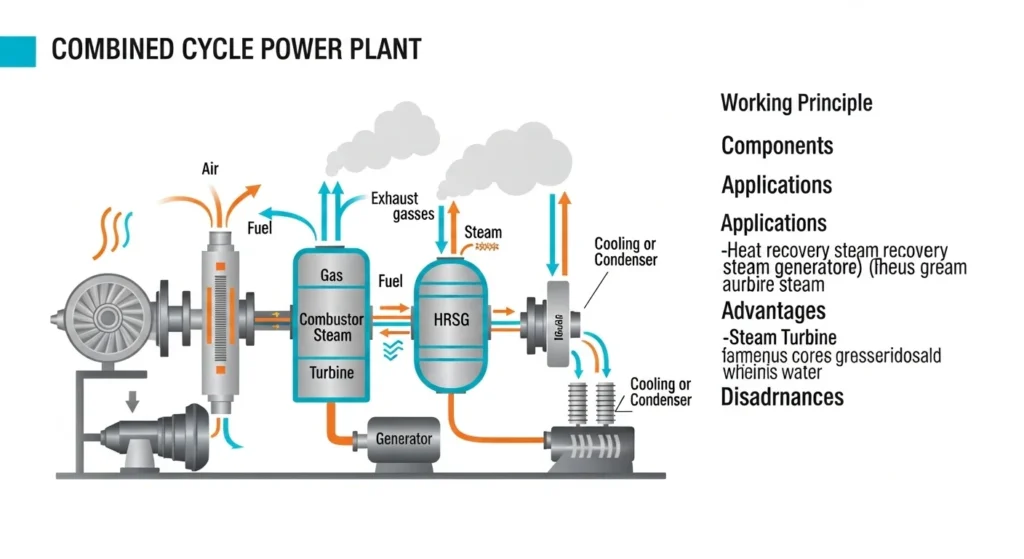
The working principle of a combined cycle power plant is based on energy recovery and reuse. The process begins in the gas turbine section, where natural gas is burned with compressed air to produce high-pressure, high-temperature gases. These gases rotate the gas turbine, which is connected to a generator and produces electricity.
After passing through the gas turbine, the hot exhaust gases are directed into a Heat Recovery Steam Generator (HRSG). The HRSG captures the remaining heat and uses it to convert water into high-pressure steam. This steam is then sent to a steam turbine, where it expands and rotates the turbine blades, producing additional electricity. After this process, the steam is condensed back into water and reused in the cycle.
By combining both cycles, the plant extracts maximum energy from the same fuel source, significantly improving overall efficiency.
Simple Understanding
A combined cycle power plant can be understood through a simple analogy:
Imagine cooking food on a stove. First, you cook a main dish using direct heat. Instead of turning off the stove, you use the remaining heat to cook another dish. This way, no energy is wasted.
Similarly, a combined cycle power plant uses the same fuel energy twice—first in a gas turbine and then in a steam turbine—to produce more electricity from the same input.
Practical Example
Most modern natural gas power plants use combined cycle technology. These plants are highly efficient and environmentally friendly compared to traditional coal-based thermal power plants. A well-designed combined cycle power plant can achieve efficiency levels of 60% or more, whereas conventional steam power plants typically operate at around 35–40% efficiency.
Because of this high efficiency, combined cycle power plants are widely used for large-scale electricity generation in modern power systems, especially where natural gas is available.
A Combined Cycle Power Plant is a highly efficient electricity generation system that combines gas and steam turbine cycles to maximize energy output. By utilizing waste heat from the gas turbine, it produces additional power through a steam turbine, making the system more economical, efficient, and environmentally friendly. This technology plays a vital role in modern power generation and is widely adopted across the world for sustainable energy production.
Combined Cycle Power Plant Working Principle: Step-by-Step Explanation
The working principle of a Combined Cycle Power Plant (CCPP) is based on the efficient use of energy by recovering waste heat from a gas turbine and using it to generate additional electricity through a steam turbine. This process significantly improves overall plant efficiency because the same fuel energy is used twice in two different stages.
A combined cycle power plant operates in two main cycles: the gas turbine cycle and the steam turbine cycle. Both cycles work together in an integrated system to maximize power output and minimize energy loss.
Air Compression
The process begins when atmospheric air enters the compressor. Here, the air is compressed to a high pressure. This high-pressure air is necessary for efficient combustion in the next stage.
Fuel Combustion
In the combustion chamber, fuel such as natural gas is injected and mixed with the compressed air. The mixture is ignited, producing extremely high-temperature and high-pressure gases.
Gas Turbine Rotation
These hot gases are then directed onto the blades of the gas turbine. As the gases expand, they cause the turbine to rotate at high speed. This mechanical energy is used to drive a generator, which produces electricity in the first stage.
Exhaust Heat Recovery
After passing through the gas turbine, the exhaust gases still contain a large amount of heat energy. Instead of releasing this waste heat into the atmosphere, it is directed into a Heat Recovery Steam Generator (HRSG).
Steam Production
Inside the HRSG, the remaining heat from the exhaust gases is used to convert water into high-pressure steam. This step is crucial because it recovers energy that would otherwise be lost.
Steam Turbine Operation
The high-pressure steam is then sent to a steam turbine. As the steam expands, it rotates the turbine blades, producing additional mechanical energy. This turbine is connected to a second generator, which produces extra electricity.
Simple Analogy
A Combined Cycle Power Plant can be understood like cooking two meals using the same heat source. First, you cook the main dish on a stove. Instead of wasting the remaining heat, you use it to warm or cook another dish.
Similarly, in a CCPP, the energy from fuel is used first in the gas turbine and then reused in the steam turbine instead of being wasted.
The working principle of a Combined Cycle Power Plant is based on energy recovery and reuse. By combining a gas turbine cycle with a steam turbine cycle, the plant efficiently converts fuel into electricity in two stages. This results in higher efficiency, lower fuel consumption, and reduced environmental impact, making it one of the most advanced and widely used power generation systems in modern energy infrastructure.
4. Types / Classification
Combined cycle power plants can be classified based on configuration and operating design.
Single-Shaft Combined Cycle
Single-shaft combined cycle is an advanced power generation system used in modern thermal and gas power plants to produce electricity more efficiently. In this system, a gas turbine and a steam turbine are mechanically connected to a single common shaft, which drives one electrical generator. This design is different from multi-shaft combined cycle systems, where gas and steam turbines operate on separate generators. The main idea of a single-shaft combined cycle is to improve efficiency, reduce fuel consumption, and produce more electrical power from the same amount of fuel. The working principle starts with the gas turbine, where natural gas or fuel is burned to produce high-temperature gases. These gases rotate the gas turbine, which is directly connected to the generator. Instead of wasting the hot exhaust gases, they are passed into a heat recovery steam generator (HRSG). The HRSG converts waste heat into steam, which is then used to run the steam turbine on the same shaft. This combined rotation increases overall power output significantly. One of the major advantages of single-shaft combined cycle systems is high efficiency, often reaching above 55–60%, which is much higher than traditional thermal power plants. It also reduces greenhouse gas emissions because less fuel is required for the same electricity production. These systems are widely used in large-scale power plants and industrial energy systems where stable and continuous power supply is needed. However, the system is more complex in design and requires advanced control systems for synchronization of both turbines. Maintenance can also be more expensive due to integrated mechanical coupling. Despite these challenges, single-shaft combined cycle technology is considered one of the most efficient and reliable methods for modern electricity generation. It plays a major role in meeting growing global energy demands while improving fuel efficiency and reducing environmental impact in power engineering applications.
In this design, the gas turbine, steam turbine, and generator are connected to a single shaft.
Features
- Compact design
- Easier synchronization
- Suitable for smaller plants
Multi-Shaft Combined Cycle
Multi-shaft combined cycle is an advanced power generation system used in modern thermal power plants to produce electricity with high efficiency and flexibility. In this system, the gas turbine and steam turbine operate on separate shafts, each connected to its own generator. This is different from a single-shaft combined cycle system, where both turbines share one common shaft. The multi-shaft design allows independent operation of gas and steam turbines, which improves maintenance flexibility and system reliability. The working principle begins with the gas turbine, where fuel such as natural gas is burned to produce high-temperature gases. These gases rotate the gas turbine and generate electricity through its generator. Instead of wasting the exhaust heat, it is directed into a heat recovery steam generator (HRSG), which produces steam. This steam then drives a separate steam turbine connected to another generator, producing additional electricity. One of the main advantages of multi-shaft combined cycle systems is operational flexibility, as each turbine can run independently depending on power demand. It also allows easier maintenance because one turbine can be serviced while the other continues operating. This system is widely used in large power plants, industrial facilities, and energy stations where variable load conditions are common. It also offers high efficiency and reduced fuel consumption compared to traditional thermal plants. However, the system requires more space, additional equipment, and complex coordination between multiple generators, which can increase installation cost. Despite these challenges, multi-shaft combined cycle technology is highly efficient, reliable, and widely adopted in modern power generation for stable and large-scale electricity production.
In this configuration, gas turbines and steam turbines operate with separate generators.
Features
- Higher flexibility
- Better for large-scale power plants
- Easier maintenance
Integrated Combined Cycle
Integrated combined cycle is a modern and highly efficient power generation system that combines different energy conversion processes into one unified setup to produce electricity with maximum efficiency and reduced fuel consumption. In this system, a gas turbine and a steam turbine work together along with a heat recovery steam generator (HRSG), but the entire process is designed in an integrated and optimized way to improve overall performance, reduce energy loss, and increase power output. The working principle starts with the gas turbine, where fuel such as natural gas is burned to produce high-pressure, high-temperature gases. These gases rotate the turbine and generate electricity through a generator. Instead of releasing the hot exhaust gases into the environment, they are directed into the HRSG, which captures waste heat and converts it into steam. This steam is then used to run a steam turbine, producing additional electricity from the same fuel source. The key feature of an integrated combined cycle system is its advanced coordination between all components, including turbines, heat recovery systems, and control units, ensuring maximum efficiency and smooth operation. This system is widely used in large power plants, industrial energy facilities, and modern grid systems where high efficiency and low emissions are required. One of the major advantages of integrated combined cycle technology is its high fuel efficiency, often exceeding 60%, along with reduced environmental impact due to better fuel utilization. It also helps in lowering operational costs and improving energy sustainability. However, the system is complex, requires advanced engineering design, and has higher installation and maintenance costs. Despite these challenges, integrated combined cycle systems are considered one of the most advanced and reliable solutions for modern electricity generation, supporting global energy demands with improved efficiency, cleaner output, and better performance compared to traditional power plants.
This advanced design integrates different energy systems, such as coal gasification with combined cycle technology.
Features
- Improved efficiency
- Lower emissions
- Advanced technology
Main Components of a Combined Cycle Power Plant: Complete Explanation
A Combined Cycle Power Plant (CCPP) consists of several key components that work together in an integrated system to generate electricity efficiently. Each component plays a specific role in converting fuel energy into electrical energy while maximizing the use of waste heat. Understanding these components helps in clearly explaining how the plant achieves high efficiency compared to conventional power plants.
Gas Turbine
The gas turbine is the primary component of the first stage of power generation. It converts the energy of high-temperature, high-pressure gases into mechanical energy. These gases are produced after fuel combustion and cause the turbine blades to rotate at high speed. This rotation drives a generator and produces electricity.
Compressor
The compressor is responsible for increasing the pressure of incoming atmospheric air before it enters the combustion chamber. High-pressure air is essential for efficient fuel combustion. The compressor is mechanically connected to the gas turbine shaft, allowing continuous operation.
Combustion Chamber
The combustion chamber is where fuel such as natural gas is mixed with compressed air and burned. This process produces extremely hot and high-pressure gases. These gases are then directed toward the gas turbine to generate mechanical energy.
Heat Recovery Steam Generator (HRSG)
The HRSG is one of the most important components in a combined cycle system. It captures the waste heat from the gas turbine exhaust gases and uses it to produce steam. This process ensures that no useful energy is wasted and significantly improves the overall efficiency of the plant.
Steam Turbine
The steam turbine forms the second stage of power generation. The high-pressure steam produced in the HRSG expands through the turbine blades, causing them to rotate. This mechanical energy is then used to generate additional electricity through a connected generator.
Generator
The generator converts mechanical energy from both the gas turbine and steam turbine into electrical energy. It plays a critical role in delivering usable electricity to the power grid. In many plants, separate generators are used for each turbine system.
Condenser
The condenser cools the steam exiting the steam turbine and converts it back into water. This water is then reused in the system, improving efficiency and reducing water consumption. The condensation process helps maintain continuous and stable operation of the steam cycle.
The main components of a Combined Cycle Power Plant work together in a coordinated system to maximize energy conversion and efficiency. From the compressor and combustion chamber to the HRSG and steam turbine, each part plays a vital role in ensuring that both gas and steam cycles produce electricity effectively. This integrated design makes combined cycle power plants one of the most efficient and widely used technologies in modern power generation systems.
6. Advantages
The Combined Cycle Power Plant advantages and disadvantages must be understood to evaluate its efficiency.
Advantages
- Very high efficiency compared to traditional power plants
- Lower fuel consumption
- Reduced greenhouse gas emissions
- Better use of waste heat energy
- Faster startup time compared to coal plants
- Lower operating costs in the long term
- Suitable for large-scale electricity production
These benefits make combined cycle plants popular in modern power generation.
7. Disadvantages / Limitations
Despite many advantages, combined cycle plants have some limitations.
- High initial installation cost
- Requires skilled operation and maintenance
- Dependence on natural gas supply
- Performance may decrease in extremely hot climates
- Complex design compared to simple cycle plants
Engineers must consider these factors when planning new power plants.
Applications of Combined Cycle Power Plants: Complete Guide
Combined Cycle Power Plants (CCPPs) are widely used in modern power systems because they offer high efficiency, reliable operation, and lower fuel consumption. These plants are designed to meet large-scale electricity demands while maintaining stable performance. Their ability to generate more power from the same fuel makes them an important part of today’s energy infrastructure.
Power Generation for Cities
One of the main applications of combined cycle power plants is supplying electricity to urban areas. Many countries use these plants to generate large amounts of power for residential buildings, commercial centers, and public infrastructure. Because they operate efficiently and continuously, they are ideal for meeting the high energy demand of cities.
Industrial Power Supply
Industries require a constant and stable supply of electricity for machines, production lines, and heavy equipment. Combined cycle power plants are capable of providing reliable and high-capacity power needed by manufacturing plants, factories, and industrial zones. Their efficiency helps reduce energy costs for large-scale industrial operations.
Grid Support and Stability
Combined cycle power plants play an important role in maintaining the stability of national and regional power grids. They can quickly adjust their power output based on demand changes, helping to balance supply and load in the system. This flexibility makes them valuable for preventing power shortages and maintaining grid reliability.
Integration with Modern Energy Systems
In modern energy networks, combined cycle plants are often used alongside renewable energy sources such as solar and wind power. Since renewable energy can be variable, combined cycle plants help provide backup and continuous power supply, ensuring a stable and uninterrupted electricity flow.
Combined cycle power plants have a wide range of applications in today’s energy systems. From powering cities and industries to supporting national grids and renewable energy integration, they play a crucial role in modern electricity generation. Their high efficiency, flexibility, and reliability make them one of the most important technologies in global power production.
9. Comparison Section
Difference Between Combined Cycle Power Plant and Simple Cycle Power Plant
| Feature | Combined Cycle Power Plant | Simple Cycle Power Plant |
|---|---|---|
| Efficiency | Very high (50–60%+) | Lower (30–40%) |
| Energy Use | Uses waste heat | Waste heat is lost |
| Power Output | Higher electricity generation | Lower power generation |
| Complexity | More complex system | Simple design |
| Cost | Higher installation cost | Lower installation cost |
This table clearly shows the difference between simple cycle and combined cycle power plants.
Selection Guide for Combined Cycle Power Plants: Key Factors Explained
Choosing the right type of power plant is an important decision in power system planning. A Combined Cycle Power Plant (CCPP) is selected based on several technical, economic, and environmental factors. These factors ensure that the plant operates efficiently, safely, and in a cost-effective manner while meeting electricity demand.
Fuel Availability
One of the most important factors in selecting a combined cycle power plant is the availability of fuel. These plants work best where there is a steady and reliable supply of natural gas. Since natural gas is the primary fuel used in gas turbines, uninterrupted supply is essential for continuous and efficient operation. Areas with limited gas resources may not be suitable for this type of plant.
Power Demand Requirements
The level of electricity demand also plays a major role in selection. Combined cycle power plants are ideal for large cities, industrial zones, and high-demand regions because they can generate large amounts of electricity efficiently. Their ability to produce high output makes them suitable for base-load and intermediate-load power requirements.
Environmental Regulations
Environmental impact is another key consideration. Combined cycle power plants produce lower emissions compared to coal-fired thermal plants, making them more environmentally friendly. Regions with strict environmental regulations often prefer CCPPs because they help reduce greenhouse gas emissions and air pollution.
Budget and Investment Cost
Although the initial investment cost of a combined cycle power plant is relatively high due to advanced equipment and technology, it offers lower operating costs in the long term. High efficiency and reduced fuel consumption help recover the investment over time, making it economically beneficial in the long run.
Space and Infrastructure Requirements
Combined cycle power plants require a significant amount of space for gas turbines, steam turbines, HRSG systems, cooling systems, and supporting infrastructure. Therefore, sufficient land availability is necessary for proper installation and safe operation of the plant.
Selecting a combined cycle power plant depends on fuel availability, power demand, environmental regulations, budget, and space requirements. When these factors are carefully evaluated, CCPPs become a highly efficient and reliable choice for modern electricity generation. Their ability to deliver high power output with lower emissions makes them a preferred solution for sustainable energy development.
Common Problems and Solutions in Combined Cycle Power Plants
Like any large power generation system, a Combined Cycle Power Plant (CCPP) can face operational issues over time. These problems usually affect efficiency, reliability, and overall performance. Understanding these common issues and their solutions helps in maintaining smooth and continuous power generation.
Q1: Why does a combined cycle power plant lose efficiency?
A combined cycle power plant may lose efficiency due to several factors such as turbine blade wear, poor fuel quality, fouling in heat exchangers, or insufficient maintenance practices. Over time, mechanical components experience degradation, which reduces their performance and heat transfer efficiency.
Solution:
Efficiency can be maintained by performing regular inspections, using high-quality fuel, cleaning turbine blades and heat exchangers, and following a strict maintenance schedule. Predictive maintenance techniques also help identify early signs of performance loss.
Q2: What happens if the HRSG fails?
The Heat Recovery Steam Generator (HRSG) is a critical part of the combined cycle system. If it fails or becomes inoperative, the plant loses its ability to generate steam for the steam turbine. As a result, the system can only operate as a simple gas turbine power plant, which significantly reduces overall efficiency and power output.
Solution:
Regular maintenance, proper water treatment, and monitoring of exhaust gas conditions help prevent HRSG failure. Installing backup monitoring systems can also improve reliability.
Q3: How can efficiency be improved in a combined cycle power plant?
Efficiency can be improved by optimizing operating conditions and maintaining equipment in good condition. The use of advanced turbine technology, improved combustion systems, and high-performance heat recovery systems can significantly enhance plant efficiency.
Solution:
Regular maintenance, upgrading turbine components, using clean and high-quality fuel, and implementing modern control systems all contribute to improved efficiency.
Q4: Is combined cycle power generation reliable?
Yes, combined cycle power plants are considered highly reliable when properly designed and maintained. Their dual-cycle system provides stable and continuous power generation, and modern control systems help manage operations efficiently.
Solution:
Ensuring proper maintenance, using quality components, and applying real-time monitoring systems enhances long-term reliability and operational stability.
Common problems in combined cycle power plants mainly relate to efficiency loss, HRSG issues, and equipment wear. However, with proper maintenance, advanced technology, and good operational practices, these issues can be effectively managed. As a result, combined cycle power plants remain one of the most efficient and reliable sources of large-scale electricity generation in modern power systems.
Future Trends in Combined Cycle Power Plants: Modern Innovations and Developments
The field of power generation is continuously evolving to meet increasing energy demands while reducing environmental impact. Combined Cycle Power Plants (CCPPs) are also undergoing major technological advancements. These improvements focus on increasing efficiency, reducing emissions, and integrating cleaner energy sources into the power system. The future of combined cycle technology is expected to be more sustainable, intelligent, and environmentally friendly.
Advanced Gas Turbines
One of the major future developments in combined cycle plants is the use of advanced gas turbines. Modern turbines are being designed to operate at higher temperatures and pressures, which significantly improves thermal efficiency. These improvements allow more energy to be extracted from the same amount of fuel, reducing fuel consumption and increasing overall power output.
Hydrogen Fuel Integration
In the future, combined cycle power plants may increasingly use hydrogen as a clean fuel alternative to natural gas. Hydrogen combustion produces little to no carbon emissions, making it a promising solution for reducing environmental pollution. Many research projects are already focusing on modifying gas turbines to operate efficiently with hydrogen or hydrogen-natural gas blends.
Carbon Capture Technology
Another important trend is the integration of carbon capture and storage (CCS) systems. These technologies are designed to capture carbon dioxide emissions produced during combustion before they are released into the atmosphere. Captured CO₂ can then be stored underground or reused in industrial applications, helping reduce the environmental impact of power generation.
Integration with Renewable Energy Systems
Future combined cycle power plants will play a key role in supporting renewable energy sources such as solar and wind power. Since renewable energy is variable and depends on weather conditions, combined cycle plants can provide backup power and grid stability. This hybrid approach ensures a continuous and reliable electricity supply while increasing the share of clean energy in the grid.
The future of combined cycle power plants is focused on improving efficiency, reducing emissions, and supporting sustainable energy systems. With advancements such as high-efficiency gas turbines, hydrogen fuel adoption, carbon capture technologies, and renewable energy integration, these plants will become even more environmentally friendly and technologically advanced. As a result, combined cycle power plants will continue to play a vital role in the global transition toward cleaner and more efficient power generation.
13. Conclusion
The Combined Cycle Power Plant is one of the most efficient and advanced technologies used for modern electricity generation. By combining gas turbine and steam turbine cycles, it captures waste heat and converts it into additional power.
This system significantly improves efficiency, reduces fuel consumption, and lowers environmental impact compared to traditional thermal power plants. Understanding the Combined Cycle Power Plant working principle, major components, and real-world applications is important for electrical students, engineers, and technicians.
Although the technology requires higher initial investment and complex design, its long-term benefits make it a preferred solution for large-scale power generation.
As energy demand continues to grow, combined cycle plants will remain an essential part of modern power systems while new technologies further improve their performance and sustainability.