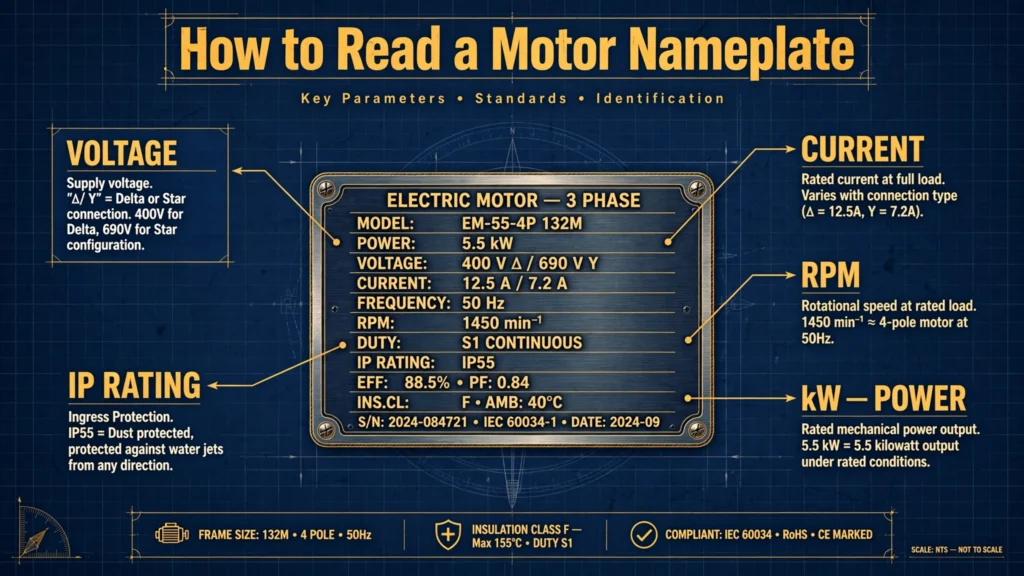

That small metal plate riveted to every electric motor is not decoration — it is the motor’s identity card. It tells you the voltage to apply, the current it will draw, how fast it spins, how much overload it tolerates, and how it must be protected. Wire a motor without reading its nameplate and you risk anything from nuisance tripping to a burned-out winding.
Yet most people glance at the plate, see a wall of abbreviations — V, A, Hz, cos φ, IP55, S1, F — and give up. This guide decodes every parameter on a typical three-phase induction motor nameplate, explains what each one means in practice, and shows how to use the data to select protection and starters.
What Is a Motor Nameplate and Why It Matters
A motor nameplate is a metal (or durable plastic) label fixed to the motor frame by the manufacturer. It lists the motor’s rated electrical and mechanical characteristics — the conditions under which the manufacturer guarantees performance. Standards like IEC 60034 and NEMA MG-1 define exactly what must appear.
You need the nameplate whenever you: select a breaker, contactor, or overload relay; choose a DOL starter or VFD; verify supply compatibility; troubleshoot overheating or tripping; or replace a motor with an equivalent. Guessing any of these values is how motors die young.
Voltage, Phase, and Frequency
- Rated voltage (V): e.g. 400 V Δ / 690 V Y. Dual-voltage motors can be connected in delta for the lower voltage or star for the higher. Applying 690 V to a 400 V delta winding will destroy it; applying 400 V to a 690 V winding gives weak, overheating operation.
- Phase (Ph): 1 or 3. Single-phase motors need a capacitor or shaded-pole starting arrangement; three-phase motors run directly from a three-phase supply.
- Frequency (Hz): 50 or 60 Hz. Running a 50 Hz motor on 60 Hz makes it spin 20% faster (speed ∝ frequency) — bearings, fans, and driven equipment may not tolerate it. The V/Hz ratio should stay roughly constant.
Power, Current, and Power Factor
- Rated output power: given in kW (IEC) or HP (NEMA) — e.g. 15 kW. This is mechanical shaft output, not electrical input. The electrical input is higher because of efficiency losses.
- Full-load current (FLA / In): e.g. 29.5 A. The current drawn at rated output. Size cables, breakers, and overload relays from this value — it is the single most used number on the plate.
- Power factor (cos φ): e.g. 0.85. The ratio of real power to apparent power. If you want the full story of real vs apparent power, see our kW vs kVA explainer. You can cross-check: for three-phase, P = √3 × V × I × cos φ × η.
Speed, Poles, and Slip
- Rated speed (RPM): e.g. 1460 rpm. This is the actual full-load speed, slightly below synchronous speed.
- Poles: e.g. 4P. Synchronous speed = 120 × f ÷ poles: a 4-pole motor on 50 Hz has a synchronous speed of 1500 rpm.
- Slip: the difference between synchronous and actual speed (here 40 rpm, or 2.7%). Slip is normal and necessary — an induction motor cannot develop torque at exactly synchronous speed.
Service Factor (SF)
The service factor — e.g. SF 1.15 — is the multiplier of rated power the motor can handle continuously without damage. A 15 kW motor with SF 1.15 can run at 17.25 kW continuously. But there is no free lunch: running in the service-factor zone raises current, temperature, and shortens insulation life. Treat SF as emergency headroom, not a design target.
Insulation Class and Temperature Rise
- Insulation class: e.g. Class F. Classes (A, E, B, F, H) define the maximum winding temperature the insulation withstands — Class F = 155 °C, Class H = 180 °C.
- Temperature rise: often the motor is rated Class F insulation but only a Class B rise (80 K) — meaning it runs cooler than its insulation allows, which greatly extends life. Every 10 °C reduction roughly doubles insulation life (the Arrhenius rule of thumb).
Duty Type, IP Rating, and Frame
- Duty (S1–S10): S1 = continuous running duty (most general motors). S2 = short-time, S3 = intermittent periodic, and so on. A crane hoist motor might be S3 40% — it must rest between cycles.
- IP rating: e.g. IP55 — protection against dust and water jets. First digit = solids, second = liquids. A washdown-area motor needs IP65 or better.
- Frame size: e.g. 160L. Standardized dimensions for shaft height, mounting holes, and flange — critical when replacing a motor so the new one physically fits.
- Mounting (IM code): e.g. IM B3 (foot-mounted), IM B5 (flange-mounted).
Efficiency, Connection, and Extras
- Efficiency (η / IE code): e.g. 92.1% / IE3. Higher IE classes (IE4, IE5) waste less energy — a major running-cost factor for motors that run 24/7.
- Connection diagram: Δ/Y symbols or a small wiring diagram showing terminal links for each voltage.
- Bearing sizes, lubrication intervals, serial number, manufacturing date, weight — invaluable for maintenance planning and warranty claims.
Putting It All Together: A Practical Example
Suppose the plate reads: 15 kW, 400 V Δ, 50 Hz, 29.5 A, 1460 rpm, cos φ 0.85, IP55, S1, Class F, IE3. From this you can:
- Select the breaker: 29.5 A FLA → a 32–40 A motor-protection breaker with adjustable thermal trip set at 29.5 A.
- Size the contactor: AC-3 duty contactor rated ≥ 30 A.
- Set the overload relay: thermal overload dialed to 29.5 A.
- Choose cable: 6 mm² copper (or per local code for ~30 A).
- Verify the supply: 400 V three-phase, 50 Hz — and connect the terminal links in delta.
- Check the environment: IP55 suits a dusty workshop but not high-pressure washdown.
One plate, and the entire protection scheme falls out of it. That is why experienced engineers photograph the nameplate before they touch anything else.
Frequently Asked Questions
What is FLA on a motor nameplate?
FLA (full-load amperes) is the current the motor draws when delivering its rated shaft power at rated voltage and frequency. It is the basis for sizing cables, breakers, contactors, and overload relays.
What does IP55 mean on a motor?
IP55 means the motor is dust-protected (5) and protected against water jets from any direction (5). It suits most industrial environments but not submersion or high-pressure washing.
Can I run a 50 Hz motor on 60 Hz?
The motor will spin about 20% faster, draw different current, and its fan and bearings will be stressed. It is sometimes acceptable with manufacturer approval and re-rating, but never assume — check first.
What is the difference between S1 and S3 duty?
S1 is continuous duty — the motor can run at rated load indefinitely. S3 is intermittent periodic duty (e.g., S3 40%), meaning it runs in cycles with rest periods and would overheat if run continuously.
Why do motors have two voltages on the nameplate?
Dual-voltage motors (e.g., 400 V Δ / 690 V Y) can be connected in delta for the lower voltage or star for the higher one. The terminal box contains links you arrange per the diagram.
What does IE3 efficiency mean?
IE3 is the “Premium Efficiency” class under IEC 60034-30. Higher classes (IE4 Super Premium, IE5 Ultra Premium) convert more input power into shaft power and less into heat, cutting electricity costs.
Final Thoughts
A motor nameplate compresses the manufacturer’s entire engineering specification into a few square inches: voltage, current, speed, protection class, duty, and efficiency. Learn to read it fluently and you will size protection correctly, avoid the classic delta/star mistakes, and troubleshoot like a professional. As any nameplate standard — and manufacturers like ABB — will confirm, the plate is the contract between the motor’s designer and you. Read it before you wire it, photograph it before you service it, and never let a motor run on guessed values.