
Power transformers are among the most expensive and critical pieces of equipment in any electrical network. A single undetected internal fault can destroy a transformer worth hundreds of thousands of dollars — and shut down power for entire neighborhoods. That is why transformers rated above a certain size carry a clever, century-old guardian: the Buchholz relay.
Named after its inventor Max Buchholz, who developed it in 1921, this gas-actuated protection device watches over oil-immersed transformers around the clock. It can smell trouble — literally — by detecting the gases that internal faults release into the transformer oil, and it reacts in two stages: first a warning, then a full trip that disconnects the transformer before catastrophic damage occurs.
What Is a Buchholz Relay?
A Buchholz relay is a gas- and oil-actuated protective device installed on oil-filled transformers equipped with a conservator tank. Its job is to detect incipient (developing) faults inside the transformer tank — the kind of slow, hidden problems that electrical protection like overcurrent relays often miss until it is too late.
Unlike a circuit breaker or a fuse that reacts to abnormal current, the Buchholz relay reacts to abnormal gas and oil movement. When a fault such as overheating, arcing, or insulation breakdown occurs inside the tank, it decomposes the insulating oil and solid insulation, releasing gases. These gases rise, collect in the relay chamber, and trigger its alarm and trip mechanisms.
If you are new to protective devices in general, it helps to first understand what a relay is and how a transformer works before diving into the details below.
Where Is the Buchholz Relay Installed?
The relay is mounted in the short pipe that connects the transformer’s main tank to the conservator (the small expansion tank sitting above the main tank). This pipe is deliberately installed at a slight incline — typically 3 to 7 degrees — so that any gas released inside the main tank naturally travels upward along the pipe toward the conservator, passing straight through the relay chamber on its way.
This placement is the whole genius of the design: every gas bubble generated by an internal fault must pass through the relay before it can reach the conservator. The relay therefore “sees” all gas activity inside the tank.
Buchholz relays are standard equipment on oil-filled transformers rated roughly 800 kVA and above, and they are especially common on large power transformers in substations and industrial plants.
Construction of a Buchholz Relay
Though it looks like a simple cast housing from the outside, the inside of a Buchholz relay contains a carefully arranged set of mechanical parts:
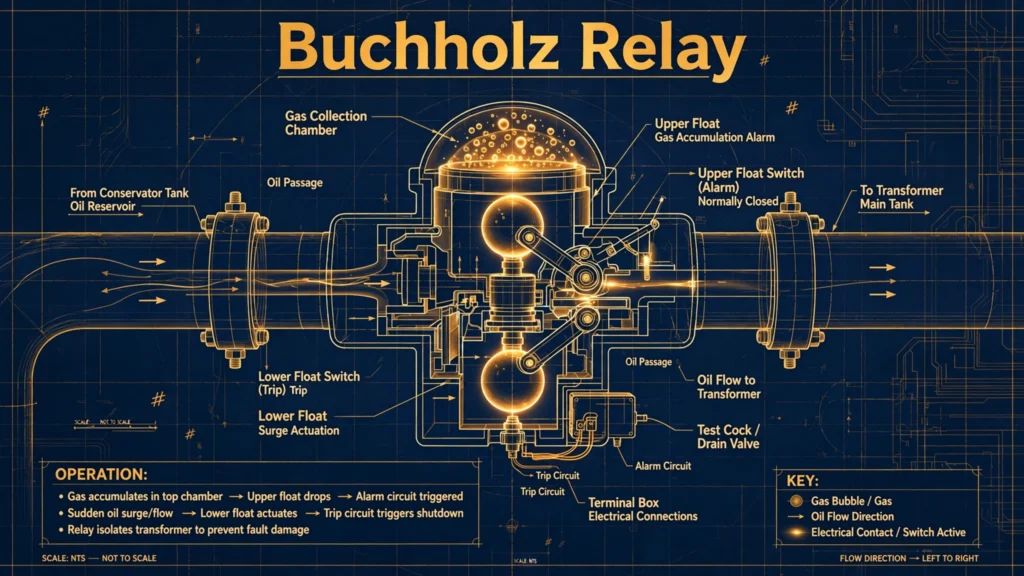
- Main chamber: A sturdy, oil-filled cast housing (usually aluminum alloy) with glass inspection windows on the sides so operators can see the oil level and any collected gas inside.
- Upper float element (alarm stage): A hinged float in the upper part of the chamber, connected to a mercury switch or reed switch. It responds to slow gas accumulation.
- Lower flap or float element (trip stage): A vane or hinged flap positioned in the direct path of oil flow near the bottom of the chamber. It responds to sudden, violent oil surges.
- Electrical contacts: Two separate sets of contacts — one wired to an alarm circuit, the other to the trip circuit of the transformer’s circuit breaker.
- Test cock and gas sampling valve: A small petcock on top of the housing used to release collected gas for analysis and to perform functional tests.
- Terminal box: A weatherproof box on the housing where the alarm and trip wiring connections are made.
The two elements operate independently, giving the relay its famous two-stage behavior.
Working Principle: How It Detects Faults
The Buchholz relay works in two distinct stages depending on the severity of the fault.
Stage 1: Alarm (Slow Gas Accumulation)
Minor or developing faults — such as slight overheating, a loose connection, or early insulation deterioration — release gas slowly. The gas bubbles rise through the inclined pipe and collect at the top of the relay chamber, gradually displacing the oil downward.
As the oil level in the chamber drops, the upper float tilts downward with it. At a preset level, the float closes its mercury switch, completing the alarm circuit. A warning bell rings or an annunciator lamp lights up in the control room, telling operators: “something is developing inside this transformer — investigate.”
Crucially, the transformer keeps running at this stage. The alarm simply buys time for inspection, oil testing, and gas analysis before the problem escalates.
Stage 2: Trip (Sudden Oil Surge)
Severe faults — such as a short circuit between turns, a flashover, or a major insulation failure — generate a large volume of gas almost instantly. This creates a violent surge of oil rushing from the main tank toward the conservator through the relay.
The surge slams into the lower flap, deflecting it in the direction of oil flow. The flap’s movement closes the trip contacts, which energize the trip coil of the transformer’s circuit breaker. The breaker opens and the transformer is disconnected from the supply within milliseconds, limiting damage.
This two-stage design is what makes the Buchholz relay so valuable: it warns early and acts decisively.
Types of Faults It Can Detect
The relay is sensitive to any internal condition that produces gas or disturbs the oil:
- Inter-turn short circuits in the windings
- Core faults, including loose laminations and circulating currents
- Overheating of windings or core due to overloading
- Bad electrical contacts and loose joints inside the tank
- Insulation failure between windings or between winding and core
- Oil leakage that drops the oil level below the relay
- Air ingress and moisture contamination
Experienced engineers even analyze the collected gas to diagnose the fault. As a rough guide: whitish or grey gas often points to decomposing paper insulation, yellowish gas suggests wood or varnish involvement, and dark or blackish gas indicates the oil itself has broken down. A laboratory dissolved-gas analysis gives a far more precise diagnosis.
Applications
You will find Buchholz relays wherever large oil-immersed transformers operate:
- Power transmission and distribution substations — on power and distribution transformers
- Industrial plants — steel mills, refineries, and manufacturing facilities with captive transformers
- Renewable energy installations — step-up transformers at solar and wind farms
- Railway and metro traction substations — where transformer reliability is safety-critical
Any oil-filled transformer with a conservator tank in the 800 kVA-plus range is a candidate. Smaller distribution transformers typically rely on simpler protection because the cost of a Buchholz relay is harder to justify at small ratings.
Testing and Maintenance
A protection device is only useful if it works when needed, so Buchholz relays are tested periodically:
- Air injection test: Air is slowly injected into the relay through the test cock. The rising “gas” should first trigger the alarm float, and a stronger injection simulating an oil surge should operate the trip flap. Both contacts are verified with a continuity tester or by observing the control-room annunciation.
- Gas sampling: Collected gas is drawn off through the sampling valve and checked for flammability and color, which helps diagnose developing faults.
- Mechanical inspection: The floats, hinges, and mercury switches are checked for free movement, and the glass windows are cleaned so the oil level stays visible.
- Wiring check: Alarm and trip circuits are tested end-to-end up to the breaker trip coil.
Maintenance is otherwise minimal — the relay has no power supply of its own and no electronics to fail, which is part of its enduring appeal after more than a century of service.
Advantages and Limitations
Advantages:
- Detects incipient faults long before they become catastrophic
- Simple, robust mechanical design with no auxiliary power required
- Provides both early warning (alarm) and decisive action (trip)
- Gas sampling aids fault diagnosis
Limitations:
- Only works on oil-immersed transformers with a conservator tank
- Cannot detect faults in bushings or external connections outside the main tank
- Relatively slow for extremely violent faults compared to differential protection
- Mechanical vibration or earthquakes can occasionally cause false operation
- Requires the connecting pipe to be correctly inclined during installation
For these reasons, the Buchholz relay is normally used alongside electrical protection such as differential and overcurrent relays — mechanical gas detection plus electrical fault detection gives layered, dependable protection.
Frequently Asked Questions
What is the main function of a Buchholz relay?
Its main function is to detect internal faults in oil-immersed transformers by sensing gas accumulation (alarm stage) and sudden oil surges (trip stage), warning operators early and disconnecting the transformer during severe faults.
Why is the Buchholz relay connected at an angle?
The connecting pipe is inclined at about 3 to 7 degrees so that gas released anywhere inside the main tank naturally rises along the pipe toward the conservator, passing through the relay chamber where it can be detected.
What is the difference between the alarm and trip contacts?
The alarm contact closes when gas slowly accumulates and lowers the oil level past the upper float — it only warns. The trip contact closes when a violent oil surge deflects the lower flap — it trips the circuit breaker and disconnects the transformer.
On which transformers is a Buchholz relay used?
It is used on oil-filled transformers fitted with a conservator tank, typically rated 800 kVA and above, including power and distribution transformers in substations and industrial installations.
Can a Buchholz relay detect all transformer faults?
No. It cannot detect faults outside the main oil tank, such as bushing flashovers or faults in external connections. It is normally combined with differential and overcurrent protection for complete coverage.
How do you test a Buchholz relay?
By injecting air through the test cock: slow injection should operate the alarm float, and vigorous injection simulating an oil surge should operate the trip flap. Gas samples are also drawn off periodically for analysis.
Final Thoughts
The Buchholz relay is a brilliant example of simple physics solving a complex problem. With no electronics and no power supply, it quietly watches the oil of large transformers, raises the alarm at the first sign of trouble, and trips the breaker when disaster strikes. More than a hundred years after Max Buchholz invented it, it remains mandatory protection on large oil-filled transformers worldwide — proof that the best engineering ideas never go out of style.