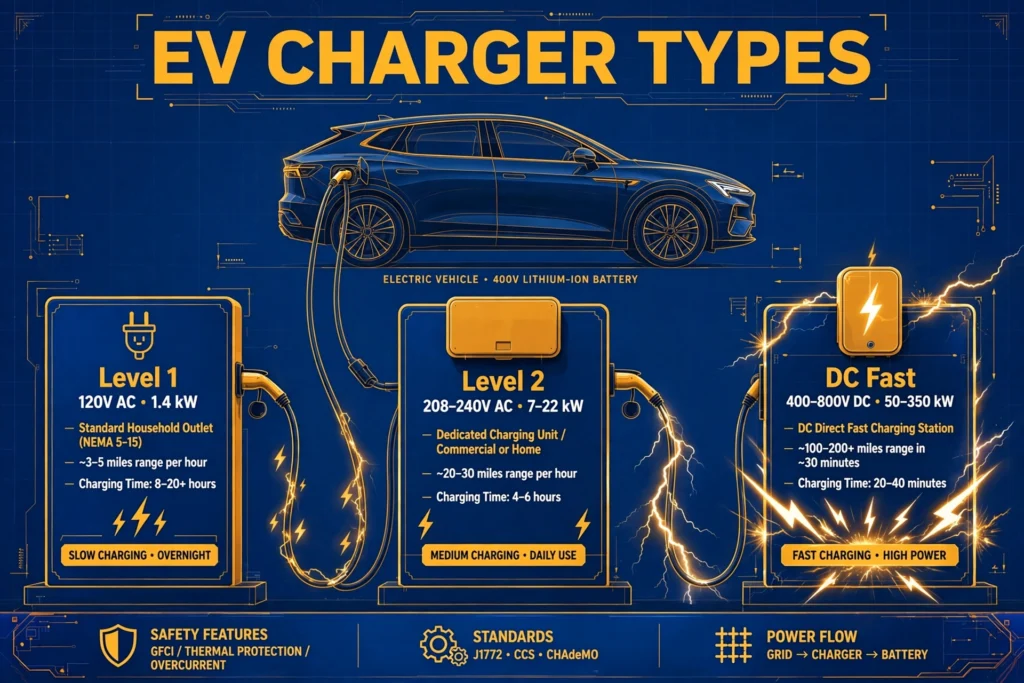

Electric vehicles are only as practical as the infrastructure that charges them. Whether you are an EV owner deciding what to install at home, an electrician wiring a commercial site, or simply curious about the technology, the first thing to understand is that not all EV chargers are the same. They differ enormously in power, speed, cost, and the electrical work they demand.
EV charging is standardized into three levels — Level 1, Level 2, and DC fast charging — each suited to a different situation. Choosing wrong means either waiting far too long for a charge or paying for capacity you never use. This guide explains how each type works, how fast it really charges, what connectors it uses, and what your electrical panel needs to support it.
How Does EV Charging Work?
At its core, EV charging is simple: electrical energy flows from the grid into the vehicle’s battery. But there is an important detail — EV batteries store DC (direct current), while homes and most buildings supply AC (alternating current). So every charge involves converting AC to DC somewhere.
Where that conversion happens defines the charger types. In Level 1 and Level 2 charging, the conversion happens inside the car, in a device called the onboard charger. The wall unit (technically called EVSE — electric vehicle supply equipment) is mostly a smart, safety-rated power outlet that talks to the car. In DC fast charging, the big AC-to-DC converter sits inside the charging station, and it feeds DC directly to the battery, bypassing the car’s onboard charger entirely. That is why DC fast chargers are the size of a refrigerator and cost tens of thousands of dollars, while a Level 2 home unit is a small wall box.
Charging speed is measured in kilowatts (kW). A useful rule: power (kW) x time (hours) = energy (kWh) added to the battery. A typical EV battery holds 40–100 kWh, and real-world efficiency is about 5–7 km per kWh. So a 7 kW charger adds roughly 35–50 km of range per hour. Understanding this simple relationship — the same power basics behind every electrical load — lets you sanity-check any charger’s claims.
Level 1 Charging: The Standard Outlet
What it is: Level 1 charging uses an ordinary household AC outlet — 230 V in most of the world (120 V in North America) — with the portable charging cable supplied with the car. No installation needed: plug the cable into any wall socket.
Power and speed: Typically 1.4–2.3 kW. That adds only about 8–12 km of range per hour. A full charge of a 60 kWh battery takes 25–40 hours.
When it makes sense: Level 1 works for plug-in hybrids with small batteries, or for drivers who cover very few kilometers daily and can leave the car plugged in overnight, every night. It is also the fallback option — the cable lives in the trunk for emergencies.
Limitations: The slow speed is the obvious one. There are also practical concerns: a standard outlet running at near-maximum current for 10+ hours heats up, so the socket and wiring must be in good condition. It should be on a dedicated circuit where possible, and extension cords are strongly discouraged — a long, thin extension cord under continuous load is a fire risk. For most EV owners, Level 1 is a stopgap, not a solution.
Level 2 Charging: The Home and Workplace Standard
What it is: Level 2 is a dedicated AC charging station operating at 230 V (single-phase) or 400 V (three-phase), hardwired or plugged into a dedicated high-current outlet. This is the wall box you see in garages, office parking lots, and shopping centers.
Power and speed: Home units typically deliver 3.7 kW (16 A single-phase), 7.4 kW (32 A single-phase), 11 kW (16 A three-phase), or 22 kW (32 A three-phase). At 7.4 kW, you add ~40–50 km of range per hour; a 60 kWh battery charges overnight in about 8 hours. Commercial 22 kW units can do it in under 3 hours — though the car’s onboard charger is often the limiting factor (many cars cap AC charging at 7–11 kW).
Electrical requirements: This is where an electrician earns their fee. A 7.4 kW charger needs a dedicated 32 A circuit with appropriately sized cable and a correctly rated circuit breaker — typically a 40 A MCB — plus residual current protection. A 22 kW three-phase unit needs a three-phase supply, which many older homes simply do not have; upgrading the service entrance can cost more than the charger itself. Load management matters too: a house with a 60 A main service cannot run a 32 A charger alongside electric showers and ovens without tripping — smart chargers with dynamic load balancing solve this by throttling charge current when the house load peaks.
When it makes sense: Level 2 is the right answer for the large majority of EV owners. Cars sit parked at home for 8–12 hours overnight — more than enough for a full charge at 7.4 kW. Workplaces and fleets use Level 2 for the same reason: vehicles dwell for hours, so moderate power is plenty.
DC Fast Charging: Speed on the Highway
What it is: DC fast chargers (also called Level 3) convert AC to DC inside the station and deliver high-voltage DC — typically 400 V or 800 V — straight to the battery, bypassing the onboard charger. These are the highway rest-stop chargers that make long road trips possible.
Power and speed: From 50 kW (older units) to 150–350 kW (modern ultra-fast stations). A 150 kW charger can take a compatible EV from 10% to 80% in 20–30 minutes — roughly 300+ km of range in the time it takes to drink a coffee. The very fastest 350 kW stations can add 100 km in about 3–5 minutes for 800 V-architecture vehicles.
Why charging slows down: You will notice the charge rate tapers as the battery fills. This is deliberate: lithium batteries accept charge fastest when nearly empty, and the battery management system reduces current above ~80% to protect cell longevity and manage heat. So “10–80% in 25 minutes” does not mean “0–100% in 30 minutes” — the last 20% can take as long as the first 80%.
Electrical requirements: A single 150 kW station draws as much power as a small apartment building. Sites need dedicated medium-voltage transformers, substantial switchgear, and demand-charge-aware utility contracts — electricity bills for fast-charging sites are dominated by peak demand charges, not just energy. Thermal management is critical: liquid-cooled cables are standard at 200+ A because air-cooled cables would be too thick to lift.
Battery considerations: Frequent DC fast charging generates more heat and stresses cells more than gentle AC charging. Modern battery management systems handle this well, but as a rule of thumb, daily fast charging will age a battery faster than nightly Level 2 charging. Use DC fast charging for trips; use Level 2 for daily life.
Connector Types
The plug on the end of the cable matters — and it varies by region:
- Type 1 (J1772): the North American/Japanese AC standard for Level 1 and 2.
- Type 2 (Mennekes): the European AC standard — the round seven-pin connector you see across the EU.
- CCS (Combined Charging System): adds two DC pins below the AC connector — CCS1 in North America, CCS2 in Europe. The dominant DC fast-charging standard in the West.
- CHAdeMO: the Japanese DC standard (Nissan Leaf era); being phased out in favor of CCS in most markets.
- NACS (Tesla): Tesla’s compact connector, now adopted by most automakers in North America for both AC and DC charging.
- GB/T: China’s national standard for AC and DC.
Adapters exist between some standards, but DC fast-charging adapters are limited — always check compatibility before a road trip in an unfamiliar region.
Comparison: Which Charger for Which Situation?
| Feature | Level 1 | Level 2 | DC Fast Charging |
|---|---|---|---|
| Power | 1.4–2.3 kW | 3.7–22 kW | 50–350 kW |
| Range per hour | 8–12 km | 20–130 km | 300–1500 km |
| Full charge (60 kWh) | 25–40 h | 3–8 h | 20–40 min (10–80%) |
| Installation | None (wall outlet) | Dedicated circuit + wall box | Commercial site + transformer |
| Typical cost | Cable included with car | $500–2,000 installed | $30,000–150,000+ |
| Best for | Emergencies, PHEVs | Home, workplace, fleets | Highway trips |
Practical Tips: Choosing and Installing
- Start with your driving: if you drive under 50 km a day, a 3.7–7.4 kW Level 2 unit covers you with overnight charging. Only consider 11–22 kW if your car supports it and you need fast turnaround.
- Check your panel first: have an electrician verify spare capacity before buying anything. The charger, cable, breaker, and labor often cost more than the wall box itself.
- Think about the future: running a slightly larger conduit and cable now is cheap; digging it up later is not. If you might add a second EV, plan for load sharing between two chargers.
- Solar pairing: a rooftop solar system plus a Level 2 charger is the cheapest “fuel” available — daytime solar generation can cover most of a typical commute. Our solar inverter guide explains the equipment that makes this possible.
- Do not undersize protection: EV chargers run at high current for hours. Use the correct breaker rating, proper cable sizing per Ohm’s law voltage-drop calculations, and a qualified installer. This is not a DIY extension-cord project.
FAQs
Can I charge an EV from a regular wall outlet?
Yes — that is Level 1 charging, using the portable cable supplied with the car. It works but is very slow (8–12 km of range per hour), so it suits plug-in hybrids or very low daily mileage. Make sure the outlet and wiring are in good condition, avoid extension cords, and preferably use a dedicated circuit.
Is DC fast charging bad for the battery?
Occasional fast charging is fine — battery management systems control temperature and current to protect the cells. But frequent DC fast charging does age batteries somewhat faster than gentle Level 2 charging, mainly due to heat. Best practice: fast-charge on road trips, Level 2 at home.
What is the difference between kW and kWh in EV charging?
kW (kilowatts) is power — how fast energy flows. kWh (kilowatt-hours) is energy — how much is stored. A 150 kW charger delivers energy at a rate of 150 kW; charging for 30 minutes at that rate adds about 75 kWh to the battery (minus losses and tapering).
Do I need three-phase power for a home EV charger?
No. Single-phase 7.4 kW chargers suit most homes and fully charge a typical EV overnight. Three-phase 11–22 kW units charge faster but need a three-phase supply, which many homes lack — upgrading the service can cost more than the charger.
Why does fast charging slow down after 80%?
Lithium batteries accept charge fastest when nearly empty. Above ~80%, the battery management system deliberately reduces current to limit heat and voltage stress, protecting long-term cell health. Charging from 80–100% can take nearly as long as 10–80%.
Can any EV use any fast charger?
Mostly, but check the connector. In Europe, CCS2 is nearly universal; in North America, NACS is becoming the standard with CCS1 adapters available. CHAdeMO is fading out. The car’s maximum DC charge rate also matters — a 50 kW-capable car gains nothing from a 350 kW station.
Conclusion
EV charger types are really about matching power to dwell time: Level 1 for the occasional top-up, Level 2 for the hours your car spends parked at home or work, and DC fast charging for the minutes it spends on the highway. For most owners, a 7.4 kW Level 2 home charger — properly installed on a dedicated circuit with correct protection — is the sweet spot of cost, convenience, and battery kindness.
As EV adoption grows, expect charging to get smarter rather than just faster: dynamic load balancing, solar-aware charging, and vehicle-to-grid services that let your car support the house. The fundamentals, though, stay the same — power, energy, and time, wired safely.