
Introduction
Walk through any factory and read the motor nameplates: “7.5 kW,” “15 kW,” “110 kW.” Now look at the transformer feeding that same factory: “500 kVA.” Both machines handle electric power — so why does the motor get rated in kW while the transformer gets kVA? Students memorize this as a rule, but the reason behind it is beautifully logical, and understanding it will sharpen your grasp of how motors really work.
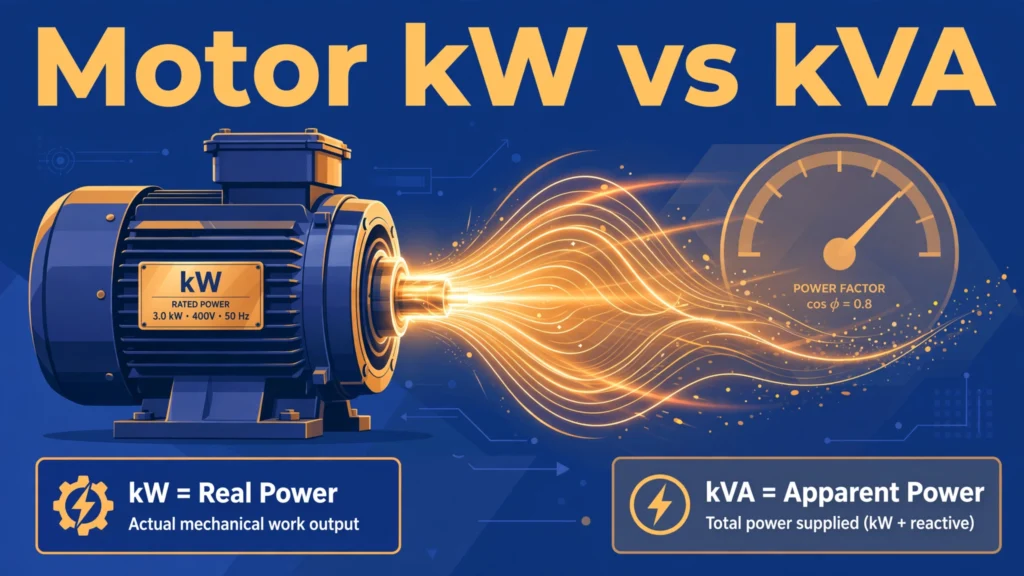
The short answer: a motor’s rating describes the useful work it delivers at its shaft — and useful work is real power, measured in kW. A pump buyer wants to know how many kilowatts of water power they get, not how many kilovolt-amperes swirl inside the windings.
In this guide, you will learn why motors are rated in kW instead of kVA, how the motor working principle turns electrical input into mechanical output, the difference between input kVA and output kW, how to read a motor nameplate like a professional, and how to select the right kW size for your load.
What Is a Motor kW Rating?
A motor’s kW rating is its rated mechanical output power at the shaft — the useful power the motor can deliver continuously to drive a load without overheating.
This is a crucial distinction: the kW on the nameplate is output, not input. A “15 kW motor” delivers 15 kW of mechanical power at its shaft. Because no machine is 100% efficient, the electrical input is always larger. With typical efficiency (η) of 0.9 and power factor of 0.85, that 15 kW motor actually draws about 15 ÷ (0.9 × 0.85) ≈ 19.6 kVA from the supply.
Practical example: a 7.5 kW pump motor lifts water all day. The 7.5 kW tells the buyer the pump’s hydraulic capability. The extra current drawn due to power factor and efficiency is the motor’s own internal affair — published separately on the nameplate as rated current, pf, and efficiency.
Working Principle
The motor working principle explains exactly why the output-based kW rating makes sense. Follow the energy step by step:
- Step 1 — Electrical power enters. The supply delivers apparent power (kVA) to the stator windings. Part of the current only magnetizes the iron core — this is reactive power (kVAR), doing no useful work.
- Step 2 — Losses subtract. Copper loss (I²R in windings), iron loss (core magnetization), and mechanical losses (friction, windage) all consume real power and turn into heat and noise.
- Step 3 — Mechanical power remains. What is left appears at the shaft as useful mechanical power: Pout = Pin − losses. This remainder is the rated kW.
The key formula ties it together for a three-phase motor: Pout(kW) = √3 × VL × IL × pf × η ÷ 1000. The power factor and efficiency are characteristics of the motor’s own design, already baked in by the manufacturer. So rating the motor by its guaranteed shaft output — the kW the user actually buys — is the most honest and useful number possible.
Types of Motor kW Ratings
Every motor family uses the kW (output) convention, though nameplate details vary slightly:
DC Motor kW Ratings
A DC motor’s nameplate shows output kW (or HP), rated armature voltage, and rated current. Since power factor does not exist in DC, the math is simpler: input power = V × I, and output kW = V × I × η ÷ 1000. DC motors are common in traction, cranes, and battery vehicles where speed control matters.
Single-Phase Induction Motor kW Ratings
Small single-phase motors (fans, pumps, washing machines, typically up to ~2.2 kW) carry output kW ratings plus rated voltage, current, and speed. Their power factor is modest (often 0.6–0.8), which is why a “1.5 kW” single-phase motor can draw noticeably more current than you might guess — the nameplate current tells the wiring story.
Three-Phase Induction Motor kW Ratings
The industrial workhorse. Nameplates show output kW, voltage (e.g. 415 V), rated current, power factor, efficiency, speed (rpm), and duty (e.g. S1 continuous). The difference between kW and kVA for motors is fully visible here: the kW is the shaft output you get, while the input kVA = kW ÷ (pf × η) is what the supply must provide. Both numbers live on the same nameplate, each answering a different question.
Main Components
Trace the power flow through the motor’s main components to see where kW is “born”:
Stator: the stationary windings where electrical input (kVA) enters. Copper loss here is the first subtraction from input power.
Rotor: the rotating part where electromagnetic torque is produced. Rotor copper loss and core loss take their share.
Shaft: the output point. Whatever power survives all losses emerges here as mechanical kW — this is what the rating guarantees.
Bearings and fan: friction and windage losses, plus the cooling fan’s own consumption, are the final deductions before the shaft.
Think of it as a pipeline: kVA flows in at the terminals, losses leak out along the way, and kW comes out at the shaft. The nameplate simply labels the end of the pipeline — the useful product.
Advantages
- Describes useful work: kW tells you exactly what the motor can do — lift, push, spin — which is what you are paying for.
- Easy load matching: a pump needing 7 kW of hydraulic power pairs directly with a 7.5 kW motor; no conversion needed.
- Standard sizes: motors come in standard kW steps (0.37, 0.75, 1.5, 2.2, 3.7, 5.5, 7.5, 11, 15…), making selection and replacement simple.
- Efficiency is separate: keeping pf and η as separate nameplate values lets engineers compute exact current and energy cost.
- Universal understanding: mechanical engineers, pump vendors, and electricians all speak kW fluently.
Disadvantages and Limitations
Rating motors in kW is the right choice, but it creates a few honest complications:
- Current is not obvious: you cannot wire a motor from kW alone — you need the nameplate current, or you must calculate I = (kW × 1000) ÷ (√3 × V × pf × η).
- Input kVA is larger: beginners are surprised that a 15 kW motor needs nearly 20 kVA of supply capacity.
- Efficiency varies with load: the rated kW assumes full load; a lightly loaded motor runs at lower efficiency and worse power factor.
- HP confusion: many regions still use horsepower (1 HP = 0.746 kW), so 10 HP ≈ 7.5 kW conversions are a daily chore.
- Duty matters: the kW rating assumes the stated duty (usually S1 continuous) — intermittent or crane duty changes what “15 kW” safely means.
Applications
Motor kW ratings drive selection across every industry. Typical motor applications by size:
- Small motors (0.37–2.2 kW): ceiling fans, washing machines, small pumps, blowers, drill machines.
- Medium motors (3.7–15 kW): agricultural pumps, air compressors, conveyors, machine tools, HVAC fans.
- Large motors (18.5–110 kW): industrial pumps, crushers, mills, large compressors, traction.
- Very large motors (above 110 kW): steel plants, cement mills, mine hoists, ship propulsion.
- Modern tech: electric vehicles rate their traction motors in kW (e.g. 100 kW EV motor), and robotics uses watt-level servo ratings — the same output-power logic at every scale.
Motor vs Transformer Rating Comparison
This table captures exactly why the two machines use different units:
| Feature | Motor (rated in kW) | Transformer (rated in kVA) |
|---|---|---|
| What the rating measures | Mechanical output at the shaft | Electrical throughput capacity |
| Why this unit | User buys useful work (real power) | Manufacturer can’t know load pf |
| Depends on power factor? | No — output is output | No — V × I only |
| Losses | Subtracted before the rating point | Define the rating point |
| Example | 15 kW motor delivers 15 kW mechanical | 100 kVA transformer carries 100 kVA |
How to Choose the Right Motor kW
Selecting motor kW is straightforward if you follow these steps:
- Step 1 — Find the load’s power demand. A pump curve, fan datasheet, or machine manual states the required shaft power — say 9 kW.
- Step 2 — Add a margin. Choose the next standard size up: 11 kW here. A 10–15% margin covers voltage dips and load variations.
- Step 3 — Check duty and service factor. For continuous S1 duty, rated kW is fine. For frequent starts or overloads, consider a higher service factor.
- Step 4 — Verify supply capacity. Compute input current from kW, pf, and η, and confirm cables, breaker, and transformer kVA can handle it.
- Beginner tips: do not massively oversize — a 15 kW motor driving a 5 kW load runs inefficiently with poor pf. Match the motor to the load, then add only a modest margin.
Common Problems and Solutions
Q1. What is the difference between HP and kW on a motor?
They are the same thing in different units: 1 HP (metric) = 0.736 kW, and 1 HP (British) = 0.746 kW. A “10 HP” motor is roughly a 7.5 kW motor. Always confirm which HP standard the nameplate uses.
Q2. How do I find the current from the kW rating?
Use I = (kW × 1000) ÷ (√3 × VL × pf × η) for three-phase. Example: 15 kW, 415 V, pf 0.85, η 0.9 → 15,000 ÷ (1.732 × 415 × 0.85 × 0.9) ≈ 27.3 A. Or simply read the nameplate current.
Q3. Why do two 10 kW motors draw different currents?
Because rated current also depends on power factor and efficiency, which differ by design. A premium-efficiency motor (higher η, better pf) draws less current for the same 10 kW output.
Q4. Can a motor deliver more than its rated kW?
Briefly, yes — motors have a service factor (often 1.15) allowing short overloads. But sustained overloading overheats the windings and voids the warranty. Size correctly instead.
Q5. If the rating is output kW, what kVA must my supply provide?
Input kVA = kW ÷ (pf × η). For the 15 kW example above: 15 ÷ (0.85 × 0.9) ≈ 19.6 kVA. Size your transformer, cables, and breaker for the kVA, not the kW.
Q6. Does a motor deliver rated kW at any speed?
No — rated kW is quoted at rated speed and rated voltage. With a VFD at reduced speed, available shaft power drops roughly with speed (for constant-torque loads), so check the drive’s derating guidance.
Future Trends
The kW rating convention is permanent, but motors are getting smarter around it. IE4 and IE5 super-premium-efficiency motors squeeze more shaft kW from each input kVA, cutting electricity bills. Variable-frequency drives now pair with almost every new motor, letting the same kW rating cover variable-speed duty efficiently. Built-in sensors report temperature, vibration, and actual shaft power in real time, so “15 kW” is becoming a verified live number rather than just a nameplate promise.
Conclusion
Motors are rated in kW instead of kVA because the rating describes the product you actually buy: useful mechanical power at the shaft. The power factor and efficiency are the motor’s own design characteristics, published separately on the nameplate, so the output kW stays clean and directly comparable — a 7.5 kW pump motor from any brand does the same job. You have learned the energy flow from input kVA through losses to output kW, how to convert between them, the motor vs transformer rating comparison, and a practical selection method with the golden rule: size cables and breakers for kVA, but match the load in kW. Keep both numbers in mind, and motor selection will never confuse you again.