
Every hour, more solar energy strikes the Earth than humanity uses in an entire year. Solar panels are the devices that capture a slice of that flood and turn it into electricity — silently, with no moving parts, and with lifespans measured in decades. But how does a flat blue-black rectangle actually convert sunlight into the power that charges your phone and runs your air conditioner?
The answer is the photovoltaic effect, a quantum process discovered in the 19th century and refined into one of the most important technologies of our time. This guide explains it step by step: what happens inside a solar cell when light hits it, how cells combine into panels and systems, and what determines how much power you really get.
What Is a Solar Panel?
A solar panel (photovoltaic module) is an assembly of solar cells wired together, laminated behind protective glass, and framed for mounting. A typical residential panel today is about 2 square meters, contains 108–144 half-cut cells, and is rated at 400–550 watts under standard test conditions.
The panel produces direct current (DC) electricity whenever light falls on it. That DC flows to a solar inverter, which converts it to the AC your home uses — or, in off-grid systems, into batteries for later use. The panel itself has no moving parts and no fuel supply; its only input is light.
The Photovoltaic Effect: Light Becomes Electricity
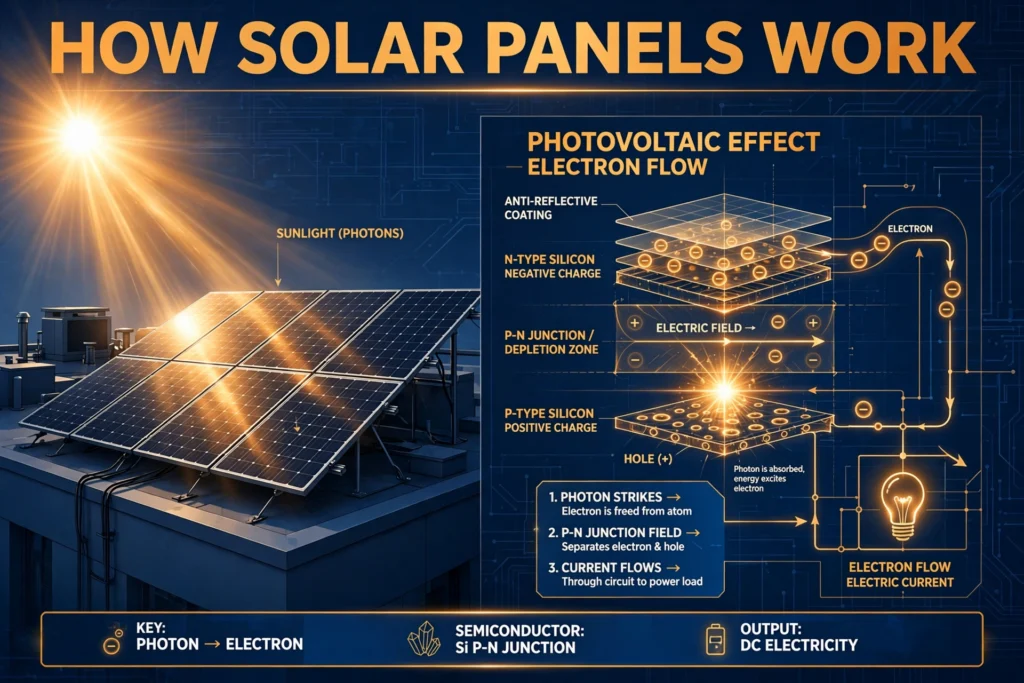
The photovoltaic effect is the heart of the whole technology. Here is what happens, in plain language:
- Photons arrive. Sunlight is a stream of tiny energy packets called photons. When they strike the solar cell, each photon carries a fixed amount of energy determined by its color (blue photons carry more than red ones).
- Electrons are knocked loose. The cell is made of silicon, a semiconductor. If a photon’s energy exceeds silicon’s band gap (about 1.1 electron-volts), it can knock an electron free from its atom, creating an electron and a positively charged “hole” — an electron-hole pair.
- An electric field separates them. The cell contains a built-in electric field at the junction between two differently treated silicon layers (more on this below). This field sweeps electrons one way and holes the other, before they can recombine.
- Current flows. Metal contacts on the front and back of the cell collect the separated charges. Connect a load, and electrons flow through the external circuit — that flow is electric current, and the separation across the junction provides the voltage (about 0.5–0.6 V per cell).
Photons with too little energy (infrared beyond silicon’s band gap) pass straight through and contribute nothing. Photons with excess energy knock electrons loose, but the surplus becomes heat. These two facts set the theoretical efficiency limit of a single-junction silicon cell at about 33% (the Shockley–Queisser limit); commercial panels achieve 20–23%, with the rest lost as heat, reflection, and electrical resistance.
Inside a Solar Cell: How It Is Built
A standard crystalline silicon cell is a thin wafer — about 160 micrometers thick, thinner than a sheet of paper — engineered in layers:
- N-type silicon (top layer): silicon doped with phosphorus, giving it extra free electrons (negative charge carriers). This thin “emitter” layer faces the sun.
- P-type silicon (base): silicon doped with boron, giving it extra holes (positive charge carriers). This thicker layer forms the bulk of the cell.
- The P-N junction: where the two layers meet, electrons diffuse across and create a permanent built-in electric field — the separator described above. This junction is the actual “engine” of the cell.
- Anti-reflective coating: a thin layer (usually silicon nitride, the source of the cell’s dark blue color) that traps more light instead of reflecting it.
- Metal contacts: a fine silver grid on the front collects current while blocking minimal light; a full aluminum layer on the back completes the circuit.
- Passivation layers (PERC and newer designs): reflect unabsorbed light back through the cell for a second chance and reduce electron losses at the rear surface, pushing efficiency from ~19% toward 23%.
Manufacturing starts with purified silicon ingots, sliced into wafers, doped in furnaces, coated, printed with contacts, and tested — a process that has become so efficient that panel prices have fallen roughly 90% since 2010.
From Cell to Panel to Power System
One cell makes only ~0.6 V and a few watts — useless alone. Scale-up happens in stages:
- Cells to panel: 60–144 cells are wired in series (voltages add) and parallel (currents add), then laminated between tempered glass, a polymer backsheet, and an aluminum frame. Bypass diodes are built into the junction box so that a shaded section does not drag down the whole panel.
- Panels to array: panels are wired in series strings to raise the voltage (typically 300–600 V DC for residential, up to 1500 V for utility scale), with strings paralleled for more current. Higher voltage means lower current for the same power — and, by Ohm’s law, dramatically lower cable losses.
- Array to system: the DC feeds an inverter (string inverter, microinverters, or power optimizers) that produces grid-synchronized AC. A meter tracks energy exported, and in many regions net-metering credits you for surplus power.
Shading deserves special attention: because cells in a string are in series, one shaded cell can choke the entire string’s current. This is why installers obsess over shade analysis — and why bypass diodes, microinverters, and optimizers exist.
What Determines a Panel’s Real Output?
The wattage on the label is measured under Standard Test Conditions (1000 W/m², 25 °C cell temperature) — conditions your roof rarely matches exactly. Real output depends on:
- Irradiance: power scales almost linearly with light intensity. Bright noon sun versus hazy morning makes an enormous difference.
- Temperature: counterintuitively, heat reduces output — typically −0.3% to −0.4% per °C above 25 °C cell temperature. A panel baking at 65 °C on a summer roof loses ~12–16% versus its rating. Good airflow under the panels helps.
- Angle and orientation: panels produce most when sunlight hits them close to perpendicular. In the northern hemisphere, a south-facing tilt roughly equal to your latitude is the classic rule of thumb.
- Shading and soiling: even partial shade or a layer of dust measurably cuts output — regular cleaning in dusty regions pays for itself.
- Age: panels degrade slowly, about 0.5% per year. A 25-year warranty typically guarantees at least 80–85% of original output — panels keep working for 30+ years.
System losses add up: inverter efficiency (~97%), wiring, soiling, temperature, and mismatch typically leave a real-world “performance ratio” of 75–85% of the panels’ rated DC capacity.
Where Solar Panels Are Used
- Rooftop residential systems: 3–10 kW arrays that offset household consumption, often paired with net metering.
- Commercial and industrial rooftops: hundreds of kilowatts on warehouses and factories, cutting daytime demand charges — the same demand peaks that hurt industrial power factor.
- Utility-scale solar farms: hundreds of megawatts feeding the grid through step-up transformers.
- Off-grid and remote power: telecom towers, water pumps, and rural electrification where grid extension is uneconomical.
- Specialized uses: solar-powered calculators, satellites (using ultra-efficient multi-junction cells), solar vehicles, and building-integrated photovoltaics like solar roof tiles.
FAQs
Do solar panels work on cloudy days?
Yes, but at reduced output — typically 10–30% of sunny-day production depending on cloud thickness. Panels respond to light, not heat, so a bright overcast day still generates meaningful power. They produce nothing at night.
Why are most solar panels blue or black?
The color comes from the anti-reflective silicon nitride coating plus the silicon itself. Monocrystalline cells look dark blue-black; polycrystalline cells have a speckled blue appearance from their multiple crystal grains. All-black panels use black backsheets and frames for aesthetics.
How long do solar panels last?
Physically, 30+ years — there is almost nothing to wear out. Electrically, they degrade ~0.5% per year, so after 25 years a panel typically still produces 80–87% of its original rating. Most manufacturers warranty 25 years of performance.
What is the difference between monocrystalline and polycrystalline panels?
Monocrystalline panels are cut from a single silicon crystal — more efficient (20–23%) and more expensive. Polycrystalline panels are cast from multiple crystals — slightly less efficient (15–18%) and cheaper. The market has shifted decisively toward mono, especially high-efficiency variants like TOPCon.
Can solar panels power a house at night?
Not directly — but paired with batteries, yes. A hybrid system stores daytime surplus in batteries for nighttime use. Without batteries, grid-tied systems draw from the grid at night (offset by daytime exports under net metering).
Do solar panels need direct sunlight, or is daylight enough?
Daylight is enough to generate power, but output tracks light intensity closely. Direct sun at the right angle gives rated output; diffuse daylight gives a fraction of it. Proper orientation and tilt exist precisely to maximize direct-sun hours.
Conclusion
A solar panel is applied quantum physics you can bolt to a roof: photons knock electrons loose in silicon, a built-in electric field at the P-N junction separates them, and metal contacts gather the resulting current. Cells become panels, panels become arrays, and inverters turn the whole DC harvest into the AC our world runs on.
No other mainstream power source is so simple at the point of generation — no turbines, no combustion, no moving parts. Understanding the photovoltaic effect is understanding why solar went from space-age exotic to the cheapest new electricity source in most of the world: the fuel is free, the physics is solid-state, and the only real engineering is capturing as much of that light as possible.