
Open any motor control panel and you will find two families of electromagnetic switches that look like cousins: contactors — big, blocky devices bolted to DIN rails — and relays — small plug-in cubes tucked into sockets. Beginners constantly mix them up, and the confusion is understandable: both use an electromagnetic coil to open and close contacts.
But they are built for very different jobs. Use a relay where a contactor belongs and its contacts will weld or burn within weeks; use a contactor where a relay belongs and you have wasted money and panel space. This guide explains exactly how contactors and relays differ, where each one belongs, and how to choose between them.
What Is a Contactor?
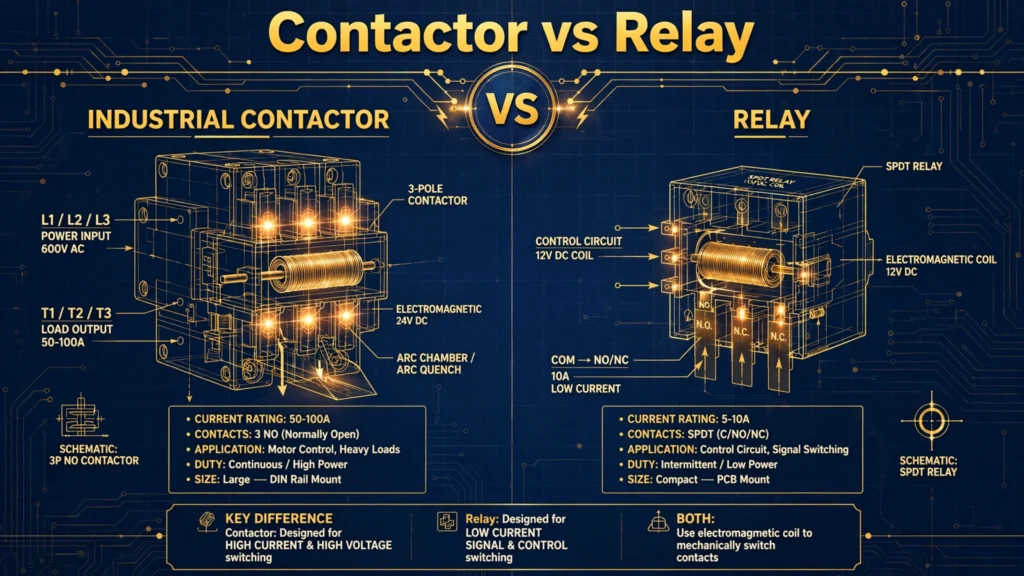
A contactor is a heavy-duty electromagnetic switch designed to switch high-power loads — typically motors, heaters, lighting banks and capacitor banks — thousands of times over its life. Our dedicated article explains the contactor in full detail, but the essentials are:
- High current ratings: commonly 9 A to hundreds of amps per pole.
- Power contacts: large silver-alloy contacts built to make and break load current, with arc chutes that stretch and extinguish the arc drawn when contacts open under load.
- Designed for frequent switching: rated for millions of mechanical operations and high electrical endurance under load.
- Auxiliary contacts: small extra contacts (NO/NC) for control logic — holding circuits, interlocking and status signaling.
- Standards: built to IEC 60947-4-1 with defined utilization categories (AC-3 for squirrel-cage motors, AC-1 for resistive loads).
In short: a contactor is the muscle that actually switches the power.
What Is a Relay?
A relay — or more precisely here, an electromagnetic relay — is a light-duty switch where a small coil current controls the switching of a separate circuit. See our full guide to the relay for the deep dive. Key traits:
- Low current ratings: typically milliamps to 5–16 A for general-purpose plug-in relays.
- Signal-level switching: designed for control circuits, logic, alarms and small loads — not for switching motors directly.
- Compact and cheap: plug-in bases make replacement a seconds-long job.
- Isolation: the coil circuit is electrically isolated from the contact circuit, so a 24 V DC PLC output can safely switch a 230 V AC lamp.
- Variety: control relays, timer relays, protection relays (overload, phase-failure) — a huge family beyond simple switching.
In short: a relay is the brain’s messenger — it carries signals, not power.
Contactor vs Relay: Key Differences at a Glance
| Feature | Contactor | Relay |
|---|---|---|
| Primary job | Switch high-power loads | Switch signals and small loads |
| Current rating | 9 A – 800+ A | mA – ~16 A |
| Voltage rating | Up to 690–1000 V AC | Typically up to 250–400 V |
| Arc suppression | Arc chutes / blowout magnets | None (or minimal) |
| Switching endurance | Millions of operations under load | High mechanical life, limited load-breaking capacity |
| Size | Large, DIN-rail or panel mounted | Compact, often plug-in |
| Auxiliary contacts | Dedicated add-on blocks | Built-in changeover contacts common |
| Overload protection | Pairs with overload relay (e.g. in starters) | Not designed for motor overload duty |
| Standard | IEC 60947-4-1 | IEC 61810 and others |
| Cost | Higher | Much lower |
| Typical load | Motors, heaters, capacitor banks | PLC I/O, lamps, alarms, logic |
Detailed Comparison
Current and power handling
This is the fundamental divide. A contactor’s contacts are massive silver-alloy pads sized to carry motor full-load current continuously and to interrupt that current safely — the arc drawn across opening contacts is stretched and cooled in arc chutes. A relay’s delicate contacts will pit, weld or vaporize if asked to break even a modest motor current repeatedly. Rule of thumb: if the load draws more than about 10 A or is a motor of any real size, you need a contactor.
Switching frequency and endurance
Contactors are engineered for duty: an AC-3 rated contactor switching a squirrel-cage motor is tested for well over a million electrical operations. General-purpose relays boast high mechanical life, but their electrical life collapsing under load current is the number that matters — switching a 2 kW heater with a 10 A relay will kill it far sooner than the datasheet’s headline figure suggests.
Safety and standards
Contactors comply with IEC 60947-4-1, which defines utilization categories (AC-1, AC-3, AC-4) that tell you exactly what kind of load the device is proven to switch. This matters for compliance and insurance in industrial panels. Relays follow different standards and are simply not certified for direct motor switching duty.
Control vs power circuit roles
In a typical DOL starter, both devices appear side by side and their roles are crystal clear: the contactor switches the three-phase motor power, while relays (start/stop auxiliary relays, timer relays) handle the control logic around it. They complement each other — they do not compete.
Where Each One Is Used
Use a contactor for:
- Direct switching of three-phase motors (DOL, star-delta and soft-starter bypass duty)
- Large resistive heaters and furnace elements
- Lighting contactors for commercial building circuits
- Capacitor bank switching for power factor correction
- Any load above ~10 A switched frequently
Use a relay for:
- Interfacing PLC outputs to higher-voltage control circuits
- Alarm and annunciation circuits
- Timer functions (on-delay, off-delay) in control sequences
- Small lamps, solenoids and signal switching
- Electrical isolation between control voltage levels (e.g. 24 V DC to 230 V AC)
Can a Relay Replace a Contactor?
Almost never for power switching — and attempting it is one of the most common panel-building mistakes. A relay switching a motor will suffer contact welding (contacts fuse shut so the motor cannot stop — a genuine safety hazard) or rapid contact erosion leading to early failure.
The legitimate exceptions prove the rule: solid-state relays (SSRs) can switch substantial loads, but they are a different technology (semiconductor, not electromagnetic) with their own thermal management needs. And a small relay can switch a contactor’s coil — that is precisely the control hierarchy relays are made for: relay → contactor coil → motor.
If you are ever tempted to “just use a bigger relay,” stop and size a proper contactor instead. The price difference is trivial compared to a welded contact that will not let go of a running motor.
Frequently Asked Questions
What is the main difference between a contactor and a relay?
A contactor is built to switch high-power loads like motors, with large contacts and arc suppression; a relay switches low-power signals and control circuits. Current rating and arc-handling capability are the decisive differences.
Can I use a relay instead of a contactor for a small motor?
Even small motors draw 6–8× starting current, which destroys relay contacts quickly through arcing and welding. Always use a contactor (with overload protection) for any motor beyond fractional-horsepower toys. The one safe relay-in-motor-circuit role is switching the contactor’s coil.
Why are contactors so much bigger than relays?
Size follows physics: carrying and interrupting tens or hundreds of amps needs large contact pads, strong springs, arc chutes and generous insulation clearances. A relay handling milliamps needs none of that, so it can be a fraction of the size.
What is an auxiliary contact on a contactor?
Auxiliary contacts are small NO/NC contacts mechanically linked to the contactor’s armature. They carry only control-circuit current and are used for hold-on (seal-in) circuits, interlocking, and signaling run status to lamps or PLCs. Need more? Clip-on auxiliary blocks add extra contacts.
Do contactors provide overload protection?
No — a contactor alone only switches. Motor overload protection comes from a paired thermal overload relay (the naming is confusing: despite the word “relay,” it is a protection device, not a switching relay) mounted to the contactor, as in a standard DOL starter assembly.
What does AC-3 rating mean on a contactor?
AC-3 is the IEC utilization category for switching squirrel-cage motors — including making and breaking the motor’s starting current. A contactor’s AC-3 rating (e.g. “AC-3, 18 A, 7.5 kW at 400 V”) tells you the largest motor it may switch. Always size contactors by their AC-3 rating for motor duty, not the higher AC-1 (resistive) figure.
Final Thoughts
Contactors and relays are partners, not rivals: relays think, contactors lift. Keep relays in the control circuit — logic, timing, signaling and isolation — and put contactors on the power circuit wherever real current flows. Respect that division, size the contactor to the motor’s AC-3 duty, and your panels will switch reliably for years instead of welding themselves into expensive failures.