
Introduction
Walk into any small workshop and press the green button on the wall: the lathe motor roars to full speed almost instantly, with a satisfying thump. No gentle ramp-up, no timer clicking through stages — just instant, full-voltage power. That is a DOL starter at work: the simplest motor starter ever invented, and still the most common one on the planet for small motors.
DOL stands for Direct-On-Line. As the name says, it connects the motor directly to the supply lines at full voltage. There is no reduced-voltage stage, no electronics — just a contactor, an overload relay, and two push buttons doing an honest, rugged job.
In this guide, you will learn the DOL starter working principle step by step, its main parts and wiring, the difference between DOL and star delta starters, its real advantages and disadvantages, where it should (and should not) be used, and how to troubleshoot its common faults.
What Is a DOL Starter?
A DOL (Direct-On-Line) starter is an electromechanical motor starter that applies full line voltage directly to the motor terminals at the moment of starting. The motor therefore draws its natural starting current — typically 6 to 8 times the full-load current — for the second or two it takes to accelerate.
Because of that heavy inrush, DOL starters are used for small motors only — generally up to about 5 HP (3.7 kW), sometimes up to 7.5 HP where the supply is strong. The supply must be stiff enough that the brief voltage dip does not disturb other equipment.
Practical example: a 2.2 kW, 415 V workshop pump with a full-load current of ~4.5 A will briefly draw 30–35 A at switch-on through its DOL starter, then settle to 4.5 A. A standard 16 A breaker and 2.5 mm² cable handle this easily — which is exactly why DOL is so popular for small machines.
Working Principle
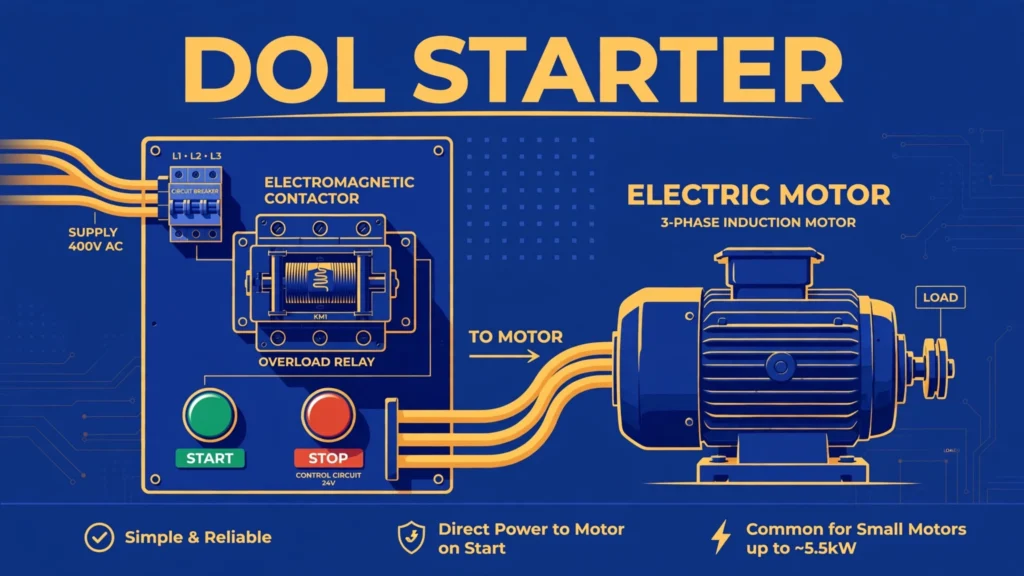
The DOL starter working principle is beautifully simple — a self-holding (seal-in) control circuit. Here is the exact sequence:
- Step 1 — Press START. The green push button is normally open (NO). Pressing it completes the contactor coil circuit (through the closed STOP button and overload relay contacts).
- Step 2 — Contactor pulls in. The energized coil slams the three main contacts closed, applying full 415 V directly to the motor. Simultaneously, an auxiliary NO contact closes in parallel with the START button.
- Step 3 — Seal-in. Release the START button — the motor keeps running because the auxiliary contact now “seals” the coil circuit. This is called the hold-on or seal-in circuit.
- Step 4 — Running. The motor accelerates at full torque to rated speed and draws normal full-load current.
- Step 5 — Press STOP. The red push button is normally closed (NC). Pressing it breaks the coil circuit, the contactor drops out, and the motor stops.
- Step 6 — Protection acts. If the motor overloads, the thermal overload relay’s NC contact opens the coil circuit and stops the motor. If supply power fails, the contactor drops out and stays out — the motor will not restart when power returns until START is pressed again. This built-in no-volt protection is a prized safety feature.
Types of DOL Starters
DOL starters come in a few standard forms, plus the all-important comparison with other starter types:
Three-Phase DOL Starter
The classic factory unit: a 3-pole contactor, a 3-pole thermal overload relay, an MCCB or MCB for short-circuit protection, and start/stop buttons in a sheet-steel enclosure. Covers motors from fractional HP up to ~5–7.5 HP at 415 V. This is the type mounted on workshop walls everywhere.
Single-Phase DOL Starter
For single-phase motors (domestic pumps, small compressors): a 2-pole contactor with a single-phase overload relay, often with an ammeter on the panel. The working principle is identical — full 230 V applied directly, with seal-in and overload protection.
Difference Between DOL and Star Delta Starters
The key difference between DOL and star delta starters is the starting voltage: DOL applies 100% voltage instantly, giving 6–8× starting current and 100% starting torque; star-delta starts at 58% voltage, giving only ~2× current but just 33% torque. DOL is simpler, cheaper, and better for loads needing strong starting torque — but it hammers the supply. Star-delta is gentler on the supply but useless for heavy starting loads. Choose DOL for small motors and tough starts; star-delta for bigger motors with easy starts.
Main Components
A DOL starter contains few parts, but each is essential:
Contactor: the electromagnetic switch — a coil that pulls in three main power contacts (plus auxiliary contacts for seal-in). Rated for AC-3 motor duty; this is the hardest-working part.
Thermal overload relay: a bimetallic device that mimics motor heating. Sustained overcurrent bends the bimetal and trips the NC contact, stopping the motor. Adjustable to the motor’s full-load current; resets manually or automatically.
MCB/MCCB: provides short-circuit and fault protection upstream. The overload relay cannot clear short circuits — the breaker does that job.
Start push button (green, NO): momentarily energizes the coil to start the motor.
Stop push button (red, NC): breaks the coil circuit to stop the motor; doubles as an emergency stop.
Enclosure: the steel or plastic box giving IP-rated protection against dust, water, and accidental touch.
Advantages
- Simplest starter made: a beginner can understand the entire circuit in an hour.
- Cheapest option: lowest purchase price and negligible maintenance cost.
- Full starting torque: 100% torque from the first instant — ideal for loaded starts.
- Compact: small enclosure fits anywhere, even on the machine itself.
- Built-in no-volt protection: the contactor drops out on power failure and will not auto-restart — a genuine safety feature.
- Very reliable: few parts, no electronics, decades of proven service.
- Easy troubleshooting: faults are visible and testable with a basic multimeter.
Disadvantages and Limitations
The DOL starter’s simplicity comes with honest trade-offs:
- Huge starting current (6–8× FLC): causes voltage dips that flicker lights and can trip upstream breakers on weak supplies.
- Mechanical shock: instant full torque jerks belts, couplings, and gears — accelerating wear on the driven machine.
- Not for large motors: above ~5–7.5 HP, the inrush is simply too violent for most low-voltage networks.
- Frequent starts overheat motors: every start dumps heat into the rotor; too many starts per hour can cook the windings.
- No speed control: it is strictly on/off — for variable speed you need a VFD.
- Supply authority limits: many utilities restrict DOL starting above a certain motor size; check local regulations.
Applications
DOL starter applications cover nearly every small-motor job in homes, farms, and factories:
- Water pumps: domestic and agricultural pumps up to ~5 HP — the single most common DOL application.
- Fans and blowers: ventilation fans, exhaust blowers, and cooling fans.
- Machine tools: lathes, drilling machines, and grinders in small workshops.
- Air compressors: small workshop compressors with unloaded starting.
- Conveyors: short, lightly loaded belt conveyors.
- Modern uses: HVAC package units, car-wash equipment, and small packaging machines still overwhelmingly use DOL starters for their simplicity and cost.
DOL Starter Comparison
How does DOL stack up against the alternatives? This table compares the common starter types:
| Feature | DOL starter | Star-delta starter | Soft starter | VFD |
|---|---|---|---|---|
| Starting voltage | 100% | 58% then 100% | Ramped 0–100% | Variable |
| Starting current | 6–8 × FLC | ~2–3 × FLC | 2–4 × FLC | ~1–1.5 × FLC |
| Starting torque | 100% | 33% | Adjustable | Full, controlled |
| Cost | Lowest | Low | Medium | Highest |
| Complexity | Very simple | Simple | Electronic | Electronic |
| Best for | Small motors, tough starts | Medium motors, easy starts | Smooth starts | Speed control |
How to Choose the Right DOL Starter
Selecting a DOL starter is easy if you follow these steps:
- Step 1 — Note the motor full-load current (FLC). Read it from the motor nameplate — e.g. 7 A for a 3.7 kW, 415 V motor.
- Step 2 — Size the contactor. Choose an AC-3 duty contactor rated at or above the FLC (a 9 A contactor for the 7 A motor).
- Step 3 — Select the overload relay. Pick a relay whose adjustment range covers the FLC (e.g. 6–10 A range), and set the dial to the FLC value.
- Step 4 — Choose the breaker. An MCCB/MCB rated above the starting inrush but able to clear short circuits — typically 2–3× FLC for motor duty.
- Step 5 — Check the supply. Confirm the transformer and cables tolerate the brief 6–8× inrush without excessive voltage dip.
- Beginner tips: never bypass the overload relay (“it trips too much” usually means a real overload); keep spare fuses and a spare contactor coil; and record the number of starts per hour — frequent jogging destroys motors.
Common Problems and Solutions
Q1. The contactor chatters (buzzes rapidly) instead of pulling in cleanly. Why?
Usually low or unstable coil voltage — a loose control-wire connection, an undersized control transformer, or a coil rated for the wrong voltage. Tighten all control terminals and verify the coil voltage matches the supply.
Q2. The overload relay trips every time the motor starts. What should I check?
First verify the relay setting equals motor FLC (not lower). Then check for genuine causes: excessive load, low supply voltage (raises current), too-frequent starts, or a failing motor bearing. Never just turn the dial up — find the cause.
Q3. The motor will not start at all — no sound, nothing. Where do I look?
Work backwards: is the MCCB on? Is the control fuse intact? Is the STOP button stuck open? Is the overload relay tripped (press reset)? Measure coil voltage while pressing START — no voltage means a control-circuit break; voltage present but no pull-in means a dead coil.
Q4. The contactor coil burnt out. What kills coils?
Overvoltage, sustained undervoltage (coil chatters and overheats), or age. Always replace with the exact coil voltage rating, and fix the underlying voltage problem or the new coil will die too.
Q5. Can a DOL starter protect against single-phasing?
Partially. A lost phase raises current in the remaining phases, and a correctly set thermal overload relay will eventually trip — but slowly. For reliable single-phase prevention, add a dedicated phase-failure relay, especially on important motors.
Q6. Why does the whole workshop lights dim when the big lathe starts?
That is the 6–8× DOL inrush dragging the voltage down on a weak supply. If it is objectionable, the motor is too big for DOL on that supply — consider a star-delta or soft starter, or a dedicated feeder.
Future Trends
The DOL starter will never fully disappear — for small motors it is simply unbeatable on price and reliability. What is changing is the intelligence around it: smart MCCBs now report current, energy, and trip history over Modbus; electronic overload relays give precise thermal modeling instead of bimetal guesswork; and IoT add-ons send “contactor worn” warnings before failure. The power circuit stays gloriously simple while the supervision goes digital. For new small-motor installations, DOL remains the default choice worldwide.
Conclusion
The DOL starter proves that the best engineering is often the simplest: full voltage, a contactor, an overload relay, and two buttons deliver instant full-torque starting with built-in no-volt safety. You have learned its working principle through the seal-in circuit, its main components, the difference between DOL and star delta starters, and honest DOL starter advantages and disadvantages — especially the 6–8× inrush that limits it to small motors. Remember the selection mantra: contactor at AC-3 ≥ FLC, overload relay set exactly at FLC, breaker for short circuits, and supply strong enough for the inrush. Respect those rules, and this humble starter will run your small motors faithfully for decades.