
Walk into any hardware store and the receptacle aisle looks confusing: 15-amp and 20-amp outlets that look nearly identical at nearly identical prices. They are not interchangeable in every situation, and the National Electrical Code draws a sharp line between them. Here is how to tell them apart, what the NEC requires, and which combinations are legal.
The Physical Difference: Spots the T-Slot
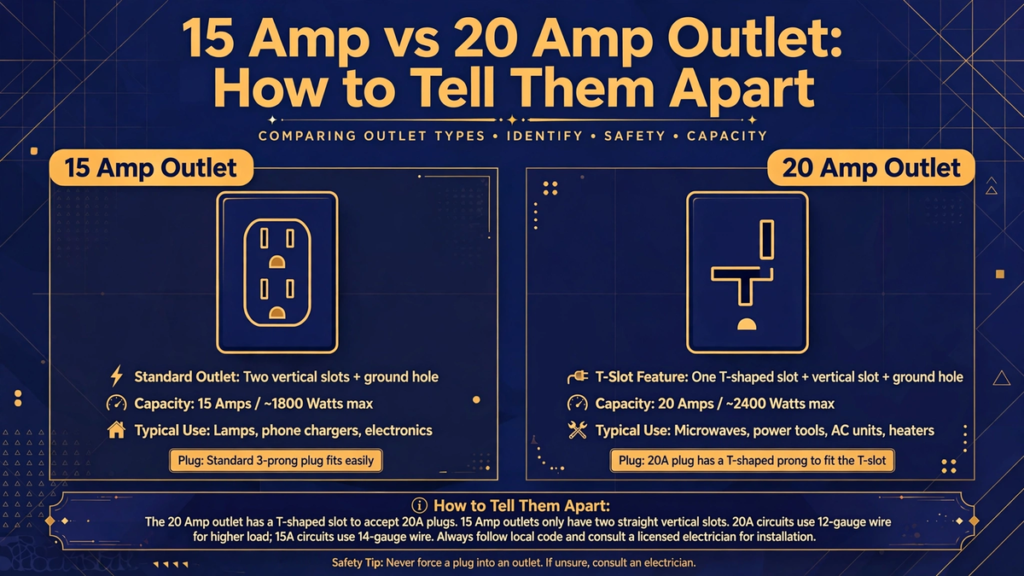
The easiest way to tell them apart is the neutral slot (the taller of the two vertical slots on a standard outlet):
- NEMA 5-15R (15-amp): two parallel vertical slots plus the round ground hole. This is the familiar outlet found in almost every US home.
- NEMA 5-20R (20-amp): the neutral slot is T-shaped — a horizontal bar extends from it, so the slot looks like a sideways “T”. This shape accepts both standard 15-amp plugs and the larger 20-amp plugs (which have one blade turned sideways).
The T-slot is not decoration. A 20-amp plug will not fit a 15-amp receptacle, which keeps a high-draw appliance off a circuit that cannot feed it. A 15-amp plug fits both. On most 20-amp duplex devices, both sockets carry the 20-amp face configuration.
Breaker, Wire, and Receptacle: What Must Match What
A branch circuit’s capacity is set by its weakest link — the breaker and the wire — not by the receptacle face:
| Circuit rating | Breaker | Wire (copper) | Max. continuous load (80%) |
|---|---|---|---|
| 15 amp | 15A | 14 AWG | 1,440 W at 120 V |
| 20 amp | 20A | 12 AWG | 1,920 W at 120 V |
Never put a 20-amp breaker on 14 AWG wire — the breaker protects the wire, and 14 AWG is only rated for 15 amps. For matching wire to breakers, see our NEC wire size chart and guide to circuit breaker types.
What the NEC Actually Allows (210.21)
NEC 210.21(B)(3) and its Table 210.21(B)(3) give the rules for receptacle ratings on multi-outlet branch circuits:
- On a 15-amp circuit: receptacles must be rated not over 15 amps. That means 15-amp receptacles only — a 20-amp receptacle on a general-purpose 15-amp circuit is not permitted, because its T-slot invites a 20-amp plug that the 14 AWG wiring cannot safely feed.
- On a 20-amp circuit: receptacles rated 15 or 20 amps are permitted, as long as the circuit supplies two or more receptacles. A standard duplex outlet counts as two receptacles, which is why nearly every kitchen and bathroom in America has 15-amp duplex receptacles on 20-amp circuits. The internal feed-through parts of a listed 15-amp duplex device are rated to pass the full 20 amps downstream.
- Single receptacle on a dedicated circuit: per 210.21(B)(1), a single receptacle on an individual branch circuit must have a rating not less than the branch-circuit rating — so the only receptacle on a 20-amp dedicated circuit must be a 20-amp receptacle.
The logic is load diversity: on a multi-outlet circuit the load spreads across several connection points, so no single 15-amp device should draw the full current. On a single-outlet circuit, one device could draw everything the breaker allows, so the receptacle must be rated for it.
Where Each One Is Typically Used
15-amp receptacles are the default for general circuits in living rooms, bedrooms, hallways, and offices — cheaper, and every common household plug fits them.
20-amp receptacles appear where one appliance may draw near the full circuit: workshops, garages, and dedicated appliance circuits. Kitchens require 20-amp small-appliance branch circuits (210.11(C)(1)), though the receptacles on them are usually 15-amp duplex devices, as explained above.
If you are comparing socket and outlet types, also note that GFCI and AFCI protection requirements (210.8, 210.12) apply based on location, regardless of whether the receptacle is 15 or 20 amp.
Can You Replace a 15-Amp Outlet with a 20-Amp Outlet?
Only if the entire circuit supports it. Swapping the receptacle alone accomplishes nothing: a 20-amp receptacle on a 15-amp circuit with 14 AWG wire is a code violation and a fire risk if a 20-amp appliance gets plugged in. To legally install 20-amp receptacles, the circuit needs a 20-amp breaker and 12 AWG copper throughout — usually meaning new cable. If the circuit is already 20-amp/12 AWG, a 20-amp receptacle can replace a 15-amp one.
How can I tell if my outlet is 15 or 20 amp?
Look at the slots. A 15-amp outlet (NEMA 5-15R) has two parallel vertical slots. A 20-amp outlet (NEMA 5-20R) has a T-shaped neutral slot. The rating is also stamped on the mounting yoke, visible after removing the cover plate with the power off.
Can I put a 15-amp outlet on a 20-amp circuit?
Yes — NEC Table 210.21(B)(3) permits 15-amp receptacles on a 20-amp circuit when the circuit supplies two or more receptacles (a duplex outlet counts as two). The 20-amp breaker and 12 AWG wire still protect the circuit.
Can I put a 20-amp outlet on a 15-amp circuit?
No. Table 210.21(B)(3) requires receptacles on a 15-amp circuit to be rated not over 15 amps. The 20-amp receptacle’s T-slot would accept a 20-amp plug that the 15-amp wiring cannot safely supply.
Do I need 20-amp outlets in my kitchen?
Kitchens require 20-amp small-appliance branch circuits (210.11(C)(1)), but the receptacles themselves may be 15-amp duplex devices — and usually are. What matters is the 20-amp breaker, 12 AWG wire, and GFCI protection on countertop receptacles (210.8).
Is 20-amp wire the same as 12-gauge wire?
In practice, yes for copper: a 20-amp residential circuit uses 12 AWG copper conductors, while a 15-amp circuit uses 14 AWG. Aluminum wiring follows different sizing rules and is rare in modern residential branch circuits.
How to Check Your Outlets and Breaker Before You Decide
Before you buy a new receptacle or plug in an appliance, take five minutes to check what your circuit can support. First, switch off the breaker for that outlet and confirm the power is off with a non-contact voltage tester. Remove the cover plate and look at the wire: 14 AWG copper means a 15-amp circuit, while 12 AWG copper points to a 20-amp circuit, but the breaker rating is the deciding factor, so check the number printed on the breaker handle in your panel. Next, look at the receptacle itself and count how many outlets share the circuit; a duplex in a kitchen may sit on a 20-amp small-appliance circuit, while a string of outlets in a bedroom is 15 amps. Add up the wattage of everything that will run at the same time and keep the continuous load under 80 percent of the circuit rating — 1,440 watts on a 15-amp circuit and 1,920 watts on a 20-amp circuit. If the wire, breaker, and receptacle do not all agree, do not force a fit or swap in a larger breaker. Call a licensed electrician to inspect the panel, confirm the wire size, and correct the mismatch safely.
Conclusion
Tell a 15-amp outlet from a 20-amp outlet by the T-shaped neutral slot, match the breaker and wire to the circuit rating (15A/14 AWG or 20A/12 AWG), and follow NEC 210.21: 15-amp circuits get 15-amp receptacles, while 20-amp multi-outlet circuits may use either. Receptacle swaps never upgrade a circuit
by themselves. Verify your locality’s NEC edition and consult a licensed electrician before changing any device.
Source: National Electrical Code (NFPA 70) —https://www.nfpa.org/codes-and-standards/nfpa-70-standard-development/70