
Imagine you are using multiple electrical appliances at home—an air conditioner, heater, and washing machine—when suddenly there is a short circuit. Without protection, this could damage equipment or even cause a fire. This is where a circuit breaker becomes essential. It automatically disconnects the power supply when a fault occurs, protecting both people and equipment.
Understanding circuit breaker types and working is very important for electrical students, engineers, and technicians. It helps in designing safe systems, troubleshooting faults, and selecting the right protection device.
In this article, you will learn what a circuit breaker is, how it works, its types, components, advantages, disadvantages, and real-world applications. By the end, you will have a clear and practical understanding like a professional electrician.
What Are Circuit Breaker Types and How Do They Work? (2026 Guide)
A circuit breaker is an automatic electrical protection device designed to protect electrical circuits, equipment, and people from damage caused by overloads, short circuits, and ground faults. Unlike a fuse, which must be replaced after it blows, a circuit breaker can usually be reset and reused after the fault has been cleared.
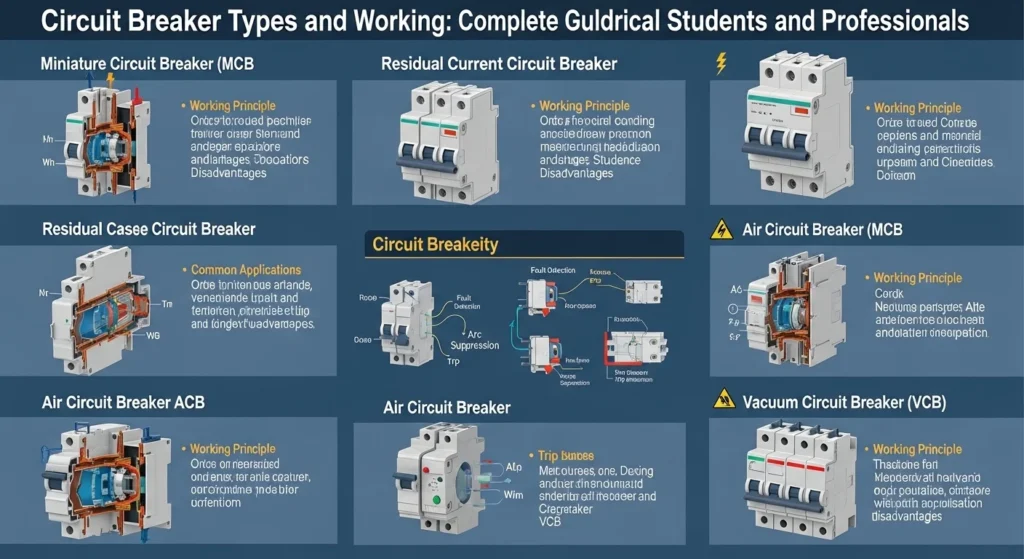
Circuit breakers are available in several types, including MCB (Miniature Circuit Breaker), MCCB (Molded Case Circuit Breaker), RCCB (Residual Current Circuit Breaker), RCBO (Residual Current Breaker with Overcurrent Protection), ACB (Air Circuit Breaker), VCB (Vacuum Circuit Breaker), OCB (Oil Circuit Breaker), and SF₆ Circuit Breaker. Each type is designed for specific voltage levels, current ratings, and applications in residential, commercial, industrial, and power distribution systems.
The working principle of a circuit breaker is simple. Under normal conditions, it allows electricity to flow continuously through the circuit. When the current exceeds the safe limit due to an overload or short circuit, the internal trip mechanism detects the fault, opens the electrical contacts, extinguishes the arc, and disconnects the power supply. This fast action prevents overheating, electrical fires, equipment damage, and electric shock.
Simple Explanation
Think of a circuit breaker as an intelligent automatic switch. It constantly monitors the flow of electricity and only interrupts the circuit when it detects an unsafe condition. After the problem is fixed, most circuit breakers can simply be reset instead of being replaced, making them more convenient and cost-effective than traditional fuses.
Practical Example
Imagine you are using an air conditioner, electric heater, microwave oven, and washing machine on the same household circuit. If the total current exceeds the circuit’s rated capacity, the breaker automatically trips within milliseconds, disconnecting the power before the wiring overheats. This protects your home’s electrical system, prevents equipment damage, and significantly reduces the risk of electrical fires.
Circuit Breaker Working Principle: Step-by-Step Operation Explained (2026)
The working principle of a circuit breaker is based on automatically detecting abnormal electrical current and interrupting the flow of electricity before it can damage electrical equipment, wiring, or connected devices. Under normal operating conditions, the breaker allows current to pass through its contacts without interruption. However, when an overload, short circuit, or ground fault occurs, the breaker reacts within milliseconds to isolate the faulty section of the circuit.
Modern circuit breakers use thermal, magnetic, or electronic trip mechanisms depending on their design and application. Once a fault is detected, the internal contacts separate, creating an electric arc. The breaker then uses an arc extinguishing system—such as air, oil, vacuum, or SF₆ gas—to safely extinguish the arc and completely stop the current flow. This automatic operation helps prevent electrical fires, equipment failure, and electric shock, making circuit breakers one of the most important safety devices in residential, commercial, and industrial electrical systems.
How Does a Circuit Breaker Work? (Step-by-Step)
1. Normal Operating Condition
During normal operation, the circuit breaker remains in the closed position, allowing electrical current to flow continuously from the power source to the connected load. Since the current stays within the rated limit, the breaker does not trip.
2. Fault or Overload Occurs
When an overload, short circuit, or ground fault develops, the current rises rapidly above the breaker’s rated capacity. This excessive current can overheat cables, damage electrical equipment, and create serious safety hazards.
3. Fault Detection
The breaker’s internal trip mechanism detects the abnormal current.
- Thermal trip responds to prolonged overload conditions using a bimetallic strip.
- Magnetic trip reacts almost instantly to high short-circuit currents using an electromagnetic coil.
- Electronic trip units in advanced breakers monitor current digitally for greater accuracy and protection.
4. Automatic Tripping
Once the fault is detected, the trip mechanism releases the latch, causing the breaker contacts to separate automatically. This immediately interrupts the flow of electricity to the faulty circuit.
5. Arc Formation
As the contacts separate, an electric arc forms because current continues to flow through the ionized air between the contacts. This arc can reach extremely high temperatures if not controlled.
6. Arc Extinction
The circuit breaker’s arc extinguishing chamber rapidly cools and extinguishes the arc using air, oil, vacuum, or SF₆ gas (depending on the breaker type). Once the arc is eliminated, current flow stops completely, isolating the fault and protecting the electrical system.
7. Reset and Restoration
After the fault has been identified and corrected, the circuit breaker can be reset manually or automatically (depending on its design) to restore power safely to the circuit.
In simple terms: A circuit breaker continuously monitors electrical current. If it detects an unsafe condition, it automatically opens its contacts, extinguishes the electrical arc, and disconnects the faulty circuit to protect people, wiring, and electrical equipment.
Easy Analogy
It works like a safety guard. If danger appears, it instantly shuts the door to protect everything inside.
Types of Circuit Breakers: Complete Classification and Applications (2026)
Circuit breakers are classified based on their operating voltage, arc extinguishing medium, installation location, and application. Each type is designed to provide reliable protection for specific electrical systems, from residential wiring to high-voltage power transmission networks.
1. Miniature Circuit Breaker (MCB)
The Miniature Circuit Breaker (MCB) is the most commonly used circuit breaker in residential buildings, apartments, and small commercial offices. It protects electrical circuits from overloads and short circuits by automatically disconnecting the power when the current exceeds the safe limit.
Key Features
- Suitable for low-current applications (typically up to 125 A)
- Provides protection against overloads and short circuits
- Compact size and easy installation
- Can be manually reset after tripping
- Commonly used in home distribution boards and lighting circuits
Applications
- Residential homes
- Small offices
- Shops
- Lighting and socket circuits
2. Molded Case Circuit Breaker (MCCB)
A Molded Case Circuit Breaker (MCCB) is designed for higher current ratings than an MCB and is widely used in commercial buildings, factories, and industrial power distribution systems. Many MCCBs offer adjustable trip settings for improved protection.
Key Features
- Suitable for medium- to high-current applications (up to several thousand amperes)
- Adjustable thermal and magnetic trip settings
- High interrupting capacity
- Durable molded insulated housing
- Provides overload and short-circuit protection
Applications
- Industrial plants
- Commercial buildings
- Motor protection
- Main power distribution panels
3. Air Circuit Breaker (ACB)
An Air Circuit Breaker (ACB) uses compressed air at atmospheric pressure to extinguish the electrical arc formed during contact separation. It is commonly installed in low-voltage industrial switchgear where high current protection is required.
Key Features
- Uses air as the arc extinguishing medium
- High breaking capacity
- Suitable for frequent switching operations
- Easy maintenance and inspection
- Reliable protection for large electrical systems
Applications
- Low-voltage switchgear
- Industrial power distribution
- Generator protection
- Large commercial facilities
4. Vacuum Circuit Breaker (VCB)
A Vacuum Circuit Breaker (VCB) interrupts the electrical arc inside a sealed vacuum chamber. Because there is almost no gas inside the chamber, the arc extinguishes very quickly, making VCBs highly efficient and low maintenance.
Key Features
- Vacuum provides excellent arc quenching
- Long service life
- Minimal maintenance requirements
- Environmentally friendly
- High operational reliability
Applications
- Medium-voltage substations
- Industrial power systems
- Renewable energy plants
- Distribution networks
5. SF₆ Circuit Breaker
An SF₆ (Sulfur Hexafluoride) Circuit Breaker uses sulfur hexafluoride gas to extinguish the electric arc. The gas has excellent insulating and arc-quenching properties, making it ideal for high-voltage transmission systems.
Key Features
- Excellent dielectric strength
- Fast and efficient arc interruption
- Suitable for extra-high-voltage applications
- Compact design
- High reliability and operational efficiency
Applications
- High-voltage substations
- Electrical transmission networks
- Power generation stations
- Utility grid protection
6. Oil Circuit Breaker (OCB)
An Oil Circuit Breaker (OCB) uses insulating oil as both the arc extinguishing medium and insulation between contacts. Although it was once widely used, it has largely been replaced by vacuum and SF₆ circuit breakers due to higher maintenance requirements and fire risks.
Key Features
- Uses mineral oil for insulation and arc quenching
- Good cooling performance
- Suitable for medium- and high-voltage systems
- Requires regular oil testing and maintenance
- Gradually being phased out in modern installations
Applications
- Older substations
- Legacy industrial power systems
- Existing high-voltage installations
Comparison of Common Circuit Breaker Types
| Circuit Breaker Type | Voltage Level | Arc Extinguishing Medium | Common Applications |
|---|---|---|---|
| MCB | Low Voltage | Air | Homes, offices, lighting circuits |
| MCCB | Low to Medium Voltage | Air | Commercial buildings, industries |
| ACB | Low Voltage | Air | Industrial switchgear, generators |
| VCB | Medium Voltage | Vacuum | Substations, industrial plants |
| SF₆ Circuit Breaker | High Voltage | SF₆ Gas | Transmission systems, power grids |
| Oil Circuit Breaker | Medium to High Voltage | Insulating Oil | Older substations and legacy systems |
This classification helps engineers and electricians select the most suitable circuit breaker based on the voltage level, current capacity, interruption capability, maintenance requirements, and intended application.
Main Components of a Circuit Breaker and Their Functions (2026)
A circuit breaker consists of several essential components that work together to detect electrical faults, interrupt the flow of current, extinguish the electric arc, and protect the electrical system from damage. Each component has a specific function that ensures the breaker operates safely, efficiently, and reliably.
1. Contacts
The contacts are the conducting parts of the circuit breaker that allow electrical current to flow under normal operating conditions. They consist of fixed contacts and moving contacts. When a fault occurs, the moving contacts separate from the fixed contacts, interrupting the electrical circuit and stopping the flow of current.
Functions
- Carry current during normal operation
- Disconnect the circuit during faults
- Withstand high temperatures and electrical stress
- Ensure reliable switching performance
2. Trip Unit
The trip unit is the sensing and control mechanism of the circuit breaker. It continuously monitors the electrical current and automatically trips the breaker when it detects an overload, short circuit, or ground fault. Depending on the breaker type, the trip unit may be thermal, magnetic, or electronic.
Functions
- Detects abnormal current conditions
- Activates the tripping mechanism
- Protects electrical equipment from damage
- Improves system safety and reliability
3. Arc Extinguishing System (Arc Chute)
When the breaker contacts separate, an electric arc forms between them. The arc extinguishing system safely cools and eliminates this arc to completely interrupt the current. Different circuit breakers use different arc-quenching media, such as air, vacuum, insulating oil, or SF₆ gas.
Functions
- Extinguishes the electrical arc quickly
- Prevents contact damage
- Improves breaking capacity
- Enhances operational safety
4. Operating Mechanism
The operating mechanism controls the opening and closing of the breaker contacts. It stores mechanical energy using springs or other mechanisms and releases it instantly when the trip unit detects a fault, ensuring rapid circuit interruption.
Functions
- Opens and closes the contacts
- Enables manual and automatic operation
- Provides fast fault isolation
- Ensures reliable switching performance
5. Insulation System
The insulation system electrically isolates live parts inside the breaker and prevents current leakage or flashovers. High-quality insulation is essential for maintaining safe operation, especially in medium- and high-voltage circuit breakers.
Functions
- Prevents electrical leakage
- Protects against short circuits
- Increases dielectric strength
- Ensures safe operation of the breaker
6. Frame or Housing
The frame (housing) is the protective outer enclosure that holds all internal components together. It provides mechanical strength, protects against dust, moisture, and accidental contact, and ensures the breaker can operate safely in different environments.
Functions
- Supports internal components
- Protects against environmental damage
- Provides electrical insulation
- Improves durability and safety
7. Terminal Connections
The terminal connections are the input and output points where electrical conductors are connected to the circuit breaker. They provide a secure electrical connection and ensure efficient current transfer.
Functions
- Connect incoming and outgoing cables
- Minimize electrical resistance
- Ensure secure wiring connections
- Maintain stable current flow
Summary
All of these components work together to ensure that a circuit breaker can detect electrical faults, interrupt excessive current, extinguish dangerous arcs, and protect electrical equipment and human life. The reliability and efficiency of a circuit breaker depend on the quality and proper functioning of each of these essential components.
Advantages of Circuit Breakers (2026)
Circuit breakers offer numerous advantages over traditional fuses, making them the preferred choice for protecting modern electrical systems. They provide fast fault detection, reliable circuit interruption, and can be reset after operation, reducing maintenance costs and improving system safety.
Key Advantages of Circuit Breakers
1. Protects Electrical Equipment
Circuit breakers automatically disconnect faulty circuits before excessive current can damage motors, transformers, cables, appliances, and other electrical equipment.
2. Prevents Electrical Fires
By interrupting overloads and short circuits within milliseconds, circuit breakers prevent overheating of electrical wiring, significantly reducing the risk of electrical fires.
3. Automatic Fault Detection
Circuit breakers continuously monitor electrical current and trip automatically whenever they detect an overload, short circuit, or other abnormal operating condition.
4. Reusable After Tripping
Unlike fuses, which must be replaced after they blow, most circuit breakers can simply be reset once the fault has been corrected, saving both time and replacement costs.
5. Fast and Reliable Operation
Modern circuit breakers respond extremely quickly to electrical faults, minimizing equipment damage and improving the overall reliability of electrical systems.
6. Long Service Life
Designed for repeated operation, high-quality circuit breakers have a long operational life and can perform thousands of switching cycles with proper maintenance.
7. Improved Electrical Safety
Circuit breakers help protect people from electrical hazards by safely isolating faulty circuits and reducing the risk of electric shock and equipment failure.
8. Suitable for All Voltage Levels
Different types of circuit breakers are available for residential, commercial, industrial, medium-voltage, and high-voltage power systems.
Overall, circuit breakers are essential safety devices that improve electrical protection, system reliability, and operational efficiency in modern power systems.
Disadvantages and Limitations of Circuit Breakers (2026)
Although circuit breakers provide excellent protection, they also have some limitations that should be considered when selecting electrical protection devices.
Key Disadvantages
1. Higher Initial Cost
Circuit breakers are generally more expensive than traditional fuses because of their advanced mechanical and electrical components.
2. Maintenance Requirements
Medium- and high-voltage circuit breakers require regular inspection, testing, lubrication, and maintenance to ensure reliable operation.
3. Complex Construction
Advanced circuit breakers such as VCBs, SF₆ breakers, and ACBs have more sophisticated internal mechanisms, making installation and maintenance more complex.
4. Incorrect Selection Can Reduce Protection
Choosing the wrong current rating or interrupting capacity may result in nuisance tripping or inadequate protection during electrical faults.
5. Larger Size for High-Power Systems
Industrial circuit breakers occupy more space than simple fuses, especially in large switchgear and power distribution panels.
6. Professional Installation May Be Required
High-capacity circuit breakers often require qualified electricians or engineers for proper installation, testing, and commissioning.
Despite these limitations, the safety, reliability, and long-term benefits of circuit breakers far outweigh their disadvantages, making them the standard protection device in modern electrical installations.
Applications of Circuit Breakers (2026)
Circuit breakers are used in almost every electrical system where reliable protection against overloads and short circuits is required. Their applications range from residential homes to large industrial plants and high-voltage transmission networks.
1. Residential Applications
Circuit breakers are installed in household distribution boards to protect electrical wiring and home appliances.
Common Uses
- Home distribution boards
- Lighting circuits
- Power outlets
- Air conditioners
- Water heaters
- Kitchen appliances
2. Commercial Applications
Commercial buildings use circuit breakers to ensure safe and reliable power distribution for offices, shopping malls, hospitals, hotels, and educational institutions.
Common Uses
- Office buildings
- Shopping centers
- Hospitals
- Schools and universities
- Commercial electrical panels
- HVAC systems
3. Industrial Applications
Industries rely on heavy-duty circuit breakers to protect motors, generators, transformers, and manufacturing equipment from electrical faults.
Common Uses
- Motor control centers (MCC)
- Power distribution panels
- Industrial machinery
- Manufacturing plants
- Generator protection
- Transformer protection
4. Utility and Power Distribution
Power utilities use medium- and high-voltage circuit breakers to maintain the stability and reliability of electrical transmission and distribution networks.
Common Uses
- Electrical substations
- Transmission lines
- Distribution feeders
- Switchyards
- Grid protection systems
5. Renewable Energy Systems
Modern renewable energy installations use circuit breakers to protect solar, wind, and battery storage systems from electrical faults.
Common Uses
- Solar photovoltaic (PV) systems
- Wind power plants
- Battery energy storage systems (BESS)
- Hybrid renewable energy projects
6. Modern Smart Infrastructure
With the growth of smart electrical systems, circuit breakers are becoming increasingly important in protecting advanced electrical networks.
Common Uses
- Smart grids
- Data centers
- Electric vehicle (EV) charging stations
- Industrial automation systems
- Building management systems
- Critical power backup systems
Summary
From homes and offices to factories, renewable energy plants, substations, and smart grids, circuit breakers play a critical role in ensuring electrical safety, equipment protection, and uninterrupted power distribution across virtually every modern electrical installation.
Circuit Breaker vs Fuse: Key Differences (2026)
Although both circuit breakers and fuses protect electrical circuits from overloads and short circuits, they operate differently and are suited to different applications. A fuse protects a circuit by melting its metal element when excessive current flows, whereas a circuit breaker automatically disconnects the circuit using a mechanical switching mechanism and can usually be reset after the fault is cleared.
Comparison Between Circuit Breaker and Fuse
| Feature | Circuit Breaker | Fuse |
|---|---|---|
| Operating Principle | Automatically trips using a mechanical trip mechanism | Metal fuse element melts to interrupt current |
| Reusability | Can be reset and reused after the fault is cleared | Must be replaced after every operation |
| Response Time | Very fast (thermal, magnetic, or electronic trip) | Extremely fast, especially for severe short circuits |
| Protection Type | Overload, short circuit, and in some models ground fault protection | Primarily overload and short-circuit protection |
| Maintenance | Low maintenance | Requires replacement after blowing |
| Cost | Higher initial cost | Lower initial cost |
| Convenience | Easy to reset without replacing parts | Replacement required after every fault |
| Applications | Residential, commercial, industrial, and power systems | Small appliances, electronics, and backup protection |
Which Is Better?
For most modern electrical installations, circuit breakers are preferred because they provide reusable protection, faster fault isolation, improved safety, and lower long-term maintenance costs. Fuses are still widely used in electronic equipment and certain specialized applications due to their simplicity and extremely fast response.
How to Choose the Right Circuit Breaker: Complete Selection Guide (2026)
Selecting the right circuit breaker is one of the most important steps in designing a safe and reliable electrical system. A properly selected circuit breaker protects electrical wiring, appliances, motors, transformers, and other equipment from overloads, short circuits, and electrical faults. Choosing the wrong breaker can lead to frequent nuisance tripping, equipment damage, overheating, electrical fires, or even complete system failure.
Whether you are installing a circuit breaker in a home, commercial building, industrial facility, or power distribution system, several technical factors must be considered before making your selection.
1. Select the Correct Voltage Rating
The voltage rating of a circuit breaker should always be equal to or higher than the operating voltage of the electrical system. Using a breaker with an incorrect voltage rating can reduce its ability to interrupt fault currents safely.
Consider the following:
- Residential systems (120V, 230V, or 240V)
- Commercial low-voltage systems
- Medium-voltage distribution networks
- High-voltage transmission systems
Tip: Never install a breaker with a lower voltage rating than the system voltage.
2. Choose the Proper Current (Ampere) Rating
The current rating determines the maximum continuous current that the breaker can safely carry without tripping. It should be selected according to the connected load and the current-carrying capacity of the electrical conductors.
Common Current Ratings
- 6A
- 10A
- 16A
- 20A
- 32A
- 63A
- 100A
- 250A
- Higher ratings for industrial systems
Selection Tip: Always calculate the total electrical load before choosing the breaker size.
3. Verify the Breaking Capacity (Interrupting Capacity)
The breaking capacity, also known as the interrupting capacity, is the maximum fault current a circuit breaker can safely interrupt without being damaged.
Typical values include:
- 6 kA
- 10 kA
- 25 kA
- 36 kA
- 50 kA
- Higher ratings for industrial substations
Installing a breaker with insufficient breaking capacity may cause severe equipment damage during a short circuit.
4. Choose the Correct Type of Circuit Breaker
Different electrical systems require different types of circuit breakers depending on voltage level, current capacity, and application.
| Circuit Breaker Type | Typical Applications |
|---|---|
| MCB (Miniature Circuit Breaker) | Homes, apartments, offices, lighting circuits |
| MCCB (Molded Case Circuit Breaker) | Commercial buildings, factories, motor protection |
| RCCB (Residual Current Circuit Breaker) | Protection against earth leakage and electric shock |
| RCBO | Combined overload, short-circuit, and earth leakage protection |
| ACB (Air Circuit Breaker) | Large industrial low-voltage switchgear |
| VCB (Vacuum Circuit Breaker) | Medium-voltage substations and industrial plants |
| SF₆ Circuit Breaker | High-voltage transmission and utility power systems |
Selecting the correct breaker type ensures reliable protection and efficient operation.
5. Consider the Installation Environment
Environmental conditions have a significant impact on circuit breaker performance and service life.
Consider:
- Ambient temperature
- Humidity levels
- Dust and dirt
- Corrosive environments
- Mechanical vibration
- Indoor or outdoor installation
- Water exposure
- Ventilation inside electrical panels
For harsh environments, choose breakers specifically designed for industrial or outdoor applications.
6. Verify Compliance with International Standards
Always purchase circuit breakers that comply with internationally recognized electrical standards.
Common standards include:
- IEC (International Electrotechnical Commission)
- UL (Underwriters Laboratories)
- ANSI (American National Standards Institute)
- IEEE Standards
Certified breakers provide better safety, reliability, and long-term performance.
7. Check the Trip Characteristics
Different electrical loads require different tripping characteristics.
The most common MCB trip curves are:
- Type B – Lighting and residential circuits
- Type C – General commercial and industrial loads
- Type D – Motors, transformers, and heavy starting currents
Selecting the correct trip curve helps prevent unnecessary breaker trips while maintaining proper protection.
8. Select a Reliable Manufacturer
Always purchase circuit breakers from trusted manufacturers known for producing high-quality electrical protection devices.
High-quality breakers offer:
- Better durability
- More accurate tripping performance
- Longer service life
- Improved electrical safety
- Easier availability of spare parts
Avoid low-quality or counterfeit products that may fail during electrical faults.
9. Plan for Future Electrical Expansion
When designing new electrical installations, consider future load growth. Choosing a breaker with reasonable expansion capacity can reduce future replacement costs if additional equipment is added later.
10. Consult a Qualified Electrician or Electrical Engineer
For medium- and high-voltage installations, always consult a qualified electrical professional to ensure proper breaker sizing, coordination, and compliance with local electrical codes.
Quick Circuit Breaker Selection Checklist
Before purchasing a circuit breaker, make sure you verify:
- ✔️ System voltage rating
- ✔️ Required current (ampere) rating
- ✔️ Breaking (interrupting) capacity
- ✔️ Correct circuit breaker type (MCB, MCCB, RCCB, RCBO, ACB, VCB, or SF₆)
- ✔️ Trip curve (B, C, or D)
- ✔️ Environmental conditions
- ✔️ Compliance with IEC, UL, or ANSI standards
- ✔️ Manufacturer quality and reliability
- ✔️ Future expansion requirements
- ✔️ Local electrical regulations and safety codes
Final Recommendation
Choosing the right circuit breaker is about more than matching the current rating. You should evaluate the system voltage, load requirements, breaking capacity, trip characteristics, installation environment, applicable standards, and future expansion needs. A correctly selected circuit breaker provides maximum electrical safety, reliable fault protection, longer equipment life, improved energy efficiency, and uninterrupted operation for residential, commercial, industrial, and utility power systems.
Common Circuit Breaker Problems and Troubleshooting Guide: Causes, Solutions, and Maintenance Tips (2026)
Even the highest-quality circuit breakers can develop problems over time due to overloads, short circuits, aging components, improper installation, loose electrical connections, environmental conditions, or lack of maintenance. Recognizing these issues early can prevent equipment damage, reduce downtime, improve electrical safety, and extend the lifespan of your electrical system.
Below are the most common circuit breaker problems, their possible causes, and practical troubleshooting solutions.
1. Circuit Breaker Trips Frequently
A circuit breaker that trips repeatedly is one of the most common electrical problems. Frequent tripping indicates that the breaker is detecting an unsafe condition and disconnecting the circuit to prevent damage or fire.
Possible Causes
- Circuit overload due to too many connected appliances
- Short circuit caused by damaged wiring
- Ground fault in the electrical system
- Faulty electrical equipment
- Loose electrical connections
- Incorrect breaker rating
Troubleshooting Solutions
- Disconnect unnecessary electrical devices to reduce the load.
- Check appliances for internal faults.
- Inspect cables and wiring for signs of damage.
- Tighten loose electrical connections.
- Replace damaged wiring or faulty equipment.
- Install a properly rated circuit breaker if the existing one is undersized.
Prevention Tip: Avoid connecting multiple high-power appliances to the same circuit.
2. Circuit Breaker Does Not Trip During a Fault
A breaker that fails to trip during an overload or short circuit is a serious safety hazard because it can allow excessive current to damage wiring and electrical equipment.
Possible Causes
- Defective thermal or magnetic trip mechanism
- Internal mechanical failure
- Incorrect breaker selection
- Aging breaker components
- Improper installation
Troubleshooting Solutions
- Perform breaker testing using approved equipment.
- Verify that the breaker rating matches the electrical load.
- Replace old or defective breakers immediately.
- Have the electrical system inspected by a qualified electrician.
- Install a certified breaker from a reputable manufacturer.
Safety Warning: Never continue using a breaker that fails to trip during a fault.
3. Circuit Breaker Overheating
An overheated circuit breaker is a warning sign that excessive heat is building inside the breaker or its connections. Ignoring this problem can lead to insulation failure or electrical fires.
Possible Causes
- Loose terminal connections
- Continuous overload
- Undersized breaker
- Poor ventilation inside the electrical panel
- Corroded terminals
- High ambient temperature
Troubleshooting Solutions
- Tighten all terminal screws securely.
- Reduce the electrical load on the circuit.
- Improve airflow around the electrical panel.
- Replace damaged or corroded terminals.
- Upgrade to the correct breaker size if required.
- Schedule regular electrical inspections.
Maintenance Tip: Periodically check for discoloration, burning smells, or excessive heat around circuit breakers.
4. Circuit Breaker Makes Buzzing Noise or Sparks
A buzzing sound or visible sparks usually indicate poor electrical contact or internal arcing, which should never be ignored.
Possible Causes
- Loose electrical connections
- Internal arcing
- Worn contacts
- Moisture inside the breaker
- Damaged insulation
- Excessive electrical load
Troubleshooting Solutions
- Switch off the power immediately.
- Inspect the breaker and panel for damage.
- Tighten loose wiring connections.
- Replace damaged breakers.
- Remove any moisture from the electrical enclosure.
- Contact a licensed electrician if arcing continues.
Safety Tip: Never operate a circuit breaker that produces sparks or burning smells.
5. Circuit Breaker Will Not Reset
Sometimes a breaker cannot be switched back ON after tripping. This usually means the original electrical fault still exists or the breaker itself has failed.
Possible Causes
- Persistent short circuit
- Ground fault
- Internal breaker damage
- Mechanical locking mechanism failure
- Overheated breaker
- Defective connected equipment
Troubleshooting Solutions
- Disconnect all connected electrical loads.
- Locate and repair the original fault.
- Allow the breaker to cool before resetting.
- Test connected appliances individually.
- Replace the breaker if it still refuses to reset.
Important: Never force the breaker handle into the ON position.
6. Circuit Breaker Keeps Tripping Without Any Visible Load
If the breaker trips even when very few appliances are connected, there may be hidden electrical problems inside the circuit.
Possible Causes
- Damaged insulation
- Hidden wiring faults
- Moisture inside walls
- Ground leakage
- Defective breaker
Solutions
- Perform insulation resistance testing.
- Inspect concealed wiring.
- Replace damaged cables.
- Install a new breaker if testing confirms internal failure.
7. Circuit Breaker Handle Feels Loose
A loose operating handle may indicate mechanical wear inside the breaker.
Possible Causes
- Mechanical wear
- Broken operating mechanism
- Manufacturing defect
- Excessive switching cycles
Solutions
- Replace the breaker.
- Avoid using damaged breakers.
- Schedule regular maintenance inspections.
8. Burning Smell Around the Circuit Breaker
A burning odor is one of the most dangerous warning signs and requires immediate attention.
Possible Causes
- Overheated wiring
- Loose terminals
- Internal arcing
- Melted insulation
- Overloaded circuit
Solutions
- Turn off the main power immediately.
- Do not reuse the breaker until inspected.
- Replace damaged wiring and components.
- Contact a qualified electrician.
Preventive Maintenance Tips for Circuit Breakers
Regular maintenance helps reduce unexpected failures and extends the service life of circuit breakers.
- Inspect breakers regularly for signs of wear or damage.
- Tighten electrical connections during scheduled maintenance.
- Keep electrical panels clean, dry, and free from dust.
- Avoid overloading electrical circuits.
- Test circuit breakers periodically according to manufacturer recommendations.
- Replace aging or damaged breakers promptly.
- Use only certified circuit breakers that meet IEC, UL, or ANSI standards.
Safety Reminder
A circuit breaker is a critical electrical safety device, and repeated tripping should never be ignored. Frequent trips, overheating, buzzing sounds, sparking, or a breaker that refuses to reset are clear indicators of an underlying electrical problem. Identifying the root cause and carrying out timely maintenance or replacement not only protects electrical equipment but also helps prevent electric shock, costly equipment damage, and electrical fires, ensuring a safe and reliable power distribution system.
Future Trends in Circuit Breaker Technology: Innovations Shaping the Future (2026 and Beyond)
The future of circuit breaker technology is being driven by rapid advancements in smart grids, renewable energy, industrial automation, artificial intelligence (AI), the Internet of Things (IoT), and digital power management systems. As electrical networks become more complex and interconnected, traditional circuit breakers are evolving into intelligent protection devices capable of monitoring electrical conditions, detecting faults, communicating with control systems, and optimizing power distribution in real time.
Modern industries, commercial buildings, and utility companies are increasingly adopting smart circuit breakers that not only interrupt fault currents but also provide valuable operational data. These next-generation devices improve electrical safety, reduce maintenance costs, minimize downtime, and increase the overall reliability of power systems. In the coming years, circuit breakers will become an essential component of digital substations, renewable energy plants, electric vehicle charging infrastructure, and intelligent buildings.
1. Smart Circuit Breakers with IoT Connectivity
One of the biggest developments is the rise of smart circuit breakers equipped with IoT (Internet of Things) technology. Unlike conventional breakers, smart breakers continuously monitor electrical parameters such as current, voltage, frequency, power consumption, temperature, and energy usage.
Using built-in communication modules, these breakers transmit real-time data to cloud platforms, control centers, or mobile applications. Facility managers and engineers can monitor electrical systems remotely, receive instant fault notifications, and analyze power quality without being physically present.
Benefits
- Real-time electrical monitoring
- Remote fault notifications
- Energy usage analysis
- Improved preventive maintenance
- Better operational efficiency
2. Remote Monitoring and Intelligent Control
Future circuit breakers will be fully integrated into Building Management Systems (BMS) and Supervisory Control and Data Acquisition (SCADA) systems. Engineers will be able to remotely switch breakers ON or OFF, monitor load conditions, review historical operating data, and diagnose electrical problems from anywhere using secure internet connections.
Remote operation is particularly valuable for:
- Electrical substations
- Manufacturing plants
- Data centers
- Hospitals
- Renewable energy farms
- Large commercial buildings
This technology reduces maintenance time, improves worker safety, and allows faster restoration of power after faults.
3. Artificial Intelligence (AI) and Predictive Maintenance
Artificial Intelligence is transforming electrical protection systems. Instead of waiting for equipment to fail, AI-powered circuit breakers analyze operating patterns, temperature changes, switching frequency, and fault history to predict potential failures before they occur.
Predictive maintenance helps organizations:
- Reduce unexpected outages
- Increase equipment lifespan
- Lower maintenance costs
- Improve system reliability
- Prevent costly production downtime
AI algorithms will continue becoming more accurate as they learn from historical electrical data collected across thousands of installations.
4. Digital Circuit Breakers
Traditional mechanical trip mechanisms are gradually being enhanced by digital electronic trip units capable of extremely accurate fault detection and protection.
Digital circuit breakers offer:
- Programmable protection settings
- Event recording
- Fault diagnostics
- Power quality monitoring
- Communication with automation systems
- Firmware updates for improved performance
These advanced capabilities make them ideal for modern industrial automation and smart manufacturing facilities.
5. Environmentally Friendly Circuit Breakers
Environmental concerns are encouraging manufacturers to replace SF₆ (Sulfur Hexafluoride) gas because of its high global warming potential. Researchers are developing new insulating gases and vacuum-based technologies that provide similar electrical performance while significantly reducing environmental impact.
Future eco-friendly circuit breakers will feature:
- Low greenhouse gas emissions
- Sustainable insulating materials
- Improved energy efficiency
- Reduced maintenance requirements
- Compliance with stricter environmental regulations
Vacuum circuit breakers are expected to become even more popular because they require no harmful gases and have long service lives.
6. Renewable Energy Integration
The global expansion of renewable energy is creating new challenges for electrical protection systems. Solar farms, wind power plants, hydroelectric stations, and battery energy storage systems require specialized circuit breakers capable of handling fluctuating power generation and bidirectional current flow.
Future circuit breakers will support:
- Solar photovoltaic (PV) systems
- Wind turbines
- Battery Energy Storage Systems (BESS)
- Microgrids
- Hybrid renewable energy plants
- Distributed energy resources (DERs)
These advanced breakers will improve the stability and efficiency of renewable energy networks.
7. Electric Vehicle (EV) Charging Infrastructure
The rapid adoption of electric vehicles is increasing demand for reliable electrical protection. High-power EV charging stations require circuit breakers that can safely interrupt high currents while supporting continuous operation.
Future circuit breakers for EV infrastructure will provide:
- Fast fault detection
- DC fault protection
- Overload protection
- Ground fault monitoring
- Remote diagnostics
- Smart energy management
These features will ensure safe and reliable charging for millions of electric vehicles worldwide.
8. Integration with Smart Grids
Smart grids use advanced communication technologies to balance electricity generation, transmission, and consumption more efficiently. Circuit breakers will play a critical role by automatically responding to faults, isolating damaged sections, and restoring power with minimal interruption.
Smart grid integration enables:
- Automatic fault isolation
- Self-healing electrical networks
- Improved grid stability
- Better load balancing
- Reduced power outages
- Faster service restoration
This technology is expected to become standard in future utility power systems.
9. Enhanced Cybersecurity
As circuit breakers become connected to digital networks, protecting them from cyber threats becomes increasingly important. Manufacturers are developing advanced cybersecurity features such as encrypted communication, secure firmware updates, user authentication, and network access controls.
Future smart breakers will include:
- Secure communication protocols
- Encrypted operational data
- Multi-level user authentication
- Cyberattack detection
- Remote security updates
These measures will help protect critical electrical infrastructure from digital threats.
10. Higher Reliability and Faster Protection
Continuous improvements in electronic sensors, semiconductor technology, and intelligent trip units will allow future circuit breakers to detect and interrupt electrical faults more quickly than ever before.
Engineers can expect:
- Faster tripping speeds
- Higher interrupting capacities
- Improved arc extinguishing systems
- Better coordination between protection devices
- Reduced equipment damage
- Increased electrical system reliability
These advancements will be especially important for mission-critical facilities such as hospitals, airports, data centers, and industrial manufacturing plants.
The Future of Circuit Breakers
The next generation of circuit breakers will be far more than simple protective switches. They will function as intelligent electrical management devices capable of monitoring, analyzing, communicating, and automatically optimizing electrical systems in real time. Powered by AI, IoT, digital communication, cloud computing, and smart automation, these advanced breakers will significantly improve electrical safety, energy efficiency, predictive maintenance, renewable energy integration, and power system reliability.
As industries continue moving toward Industry 4.0, smart cities, renewable energy, and fully digital power networks, intelligent circuit breakers will become one of the most important technologies for ensuring safe, efficient, and uninterrupted electricity distribution in the years beyond 2026.
Conclusion
Understanding circuit breaker types and working is essential for anyone involved in electrical systems. Circuit breakers act as a safety shield, protecting equipment and human life from electrical faults. From simple MCBs used in homes to advanced SF6 breakers in power systems, each type serves a specific purpose.
We discussed their working principle, types, components, advantages, disadvantages, and applications. We also compared them with fuses and provided a selection guide for beginners.
As technology advances, circuit breakers are becoming smarter and more reliable. Learning this topic not only improves your technical knowledge but also helps you design safer electrical systems.