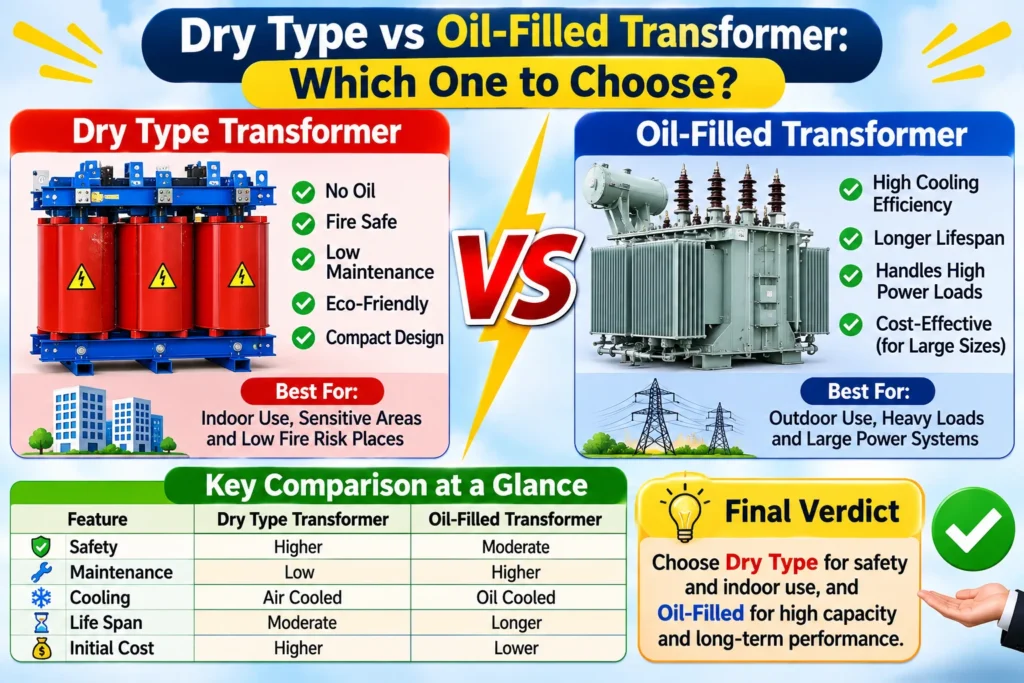

When a building, a factory, or a utility needs a transformer, one of the first decisions is also one of the most consequential: should it be a dry type or an oil-filled unit? Both step voltage up or down through a magnetic core and two sets of windings — but they do it in very different ways. A dry type transformer cools its windings with air and insulates them with solid resin. An oil-filled transformer immerses the whole core and winding assembly in insulating liquid that both cools and insulates. That single difference ripples through fire safety, size, cost, maintenance, and noise.
This guide compares the dry type vs oil-filled transformer on cooling, fire safety, efficiency, cost, maintenance, and applications, with a worked total-cost example. If you are still deciding what kind of transformer you need at all, our overview of the different types of transformers is a good place to start.
What Is a Dry Type Transformer?
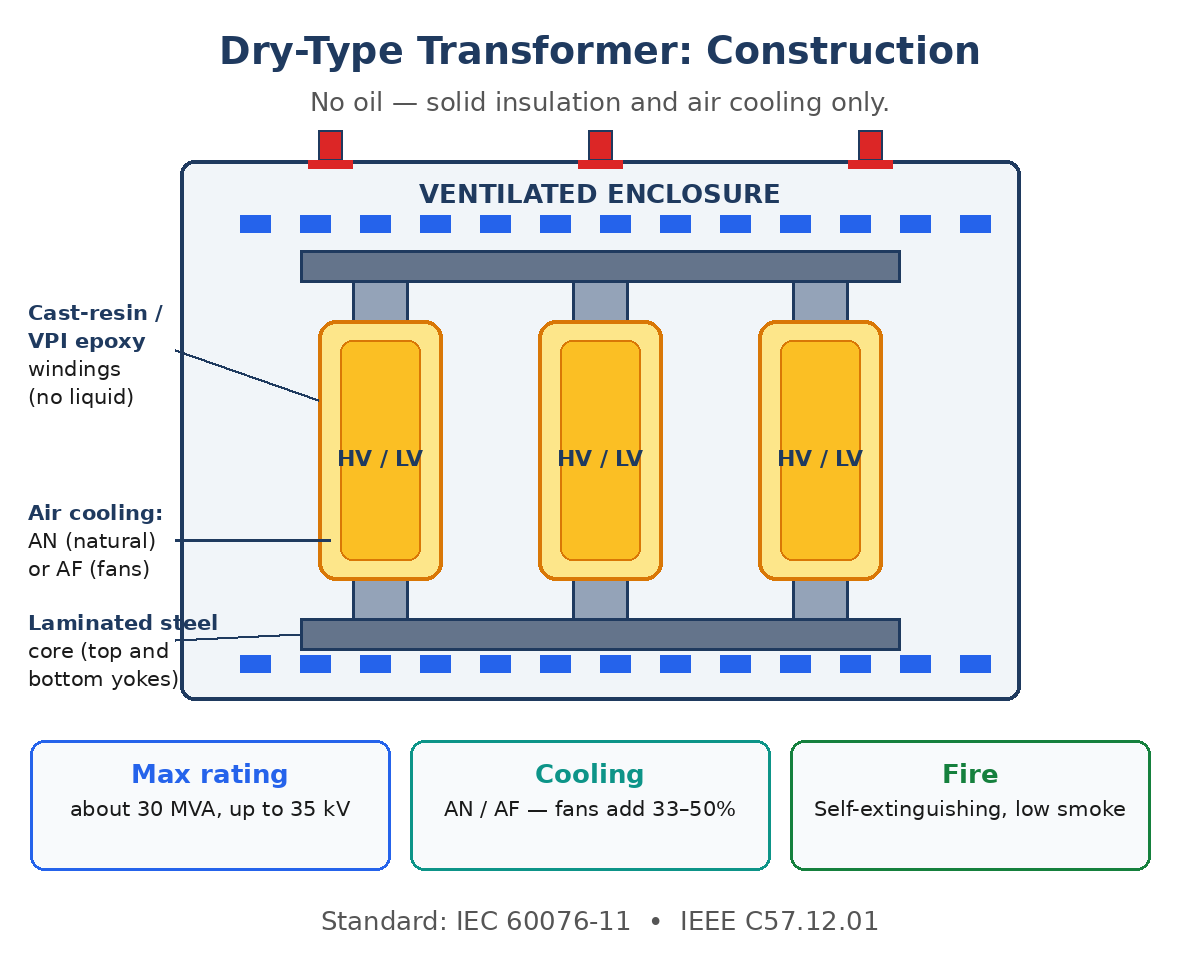
A dry type transformer contains no insulating liquid at all. Its windings are insulated with solid materials — most commonly cast resin, in which the windings are encapsulated in epoxy, or vacuum pressure impregnated (VPI) epoxy — and the whole assembly is cooled by air moving through a ventilated enclosure. There is nothing to leak, nothing to spill, and nothing to catch fire as a pool of burning liquid. That is the dry type’s defining advantage, and why you find these units inside buildings where people live and work.
Dry types are cooled in two ways, described by the cooling codes in IEC 60076-11. AN (air natural) cooling relies on natural air circulation, while AF (air forced) cooling adds fans that blow air over the windings. Switching the fans on typically adds about 33–50% capacity over the AN rating, giving useful headroom on a hot day or during a peak load. The trade-off is fan power, noise, and maintenance of their own.
Because air is a much poorer coolant and insulator than oil, dry type units are built smaller: a typical dry type tops out at about 30 MVA and voltages up to 35–36 kV, which covers most building work but rules it out for large utility substations. The windings also run hotter — Class F insulation allows a 155 °C maximum with a 100 K temperature rise, and Class H allows 180 °C with a 125 K rise — far above the 65 K winding rise of an oil-filled Class A design. The relevant standards are IEC 60076-11 and IEEE C57.12.01.
What Is an Oil-Filled Transformer?
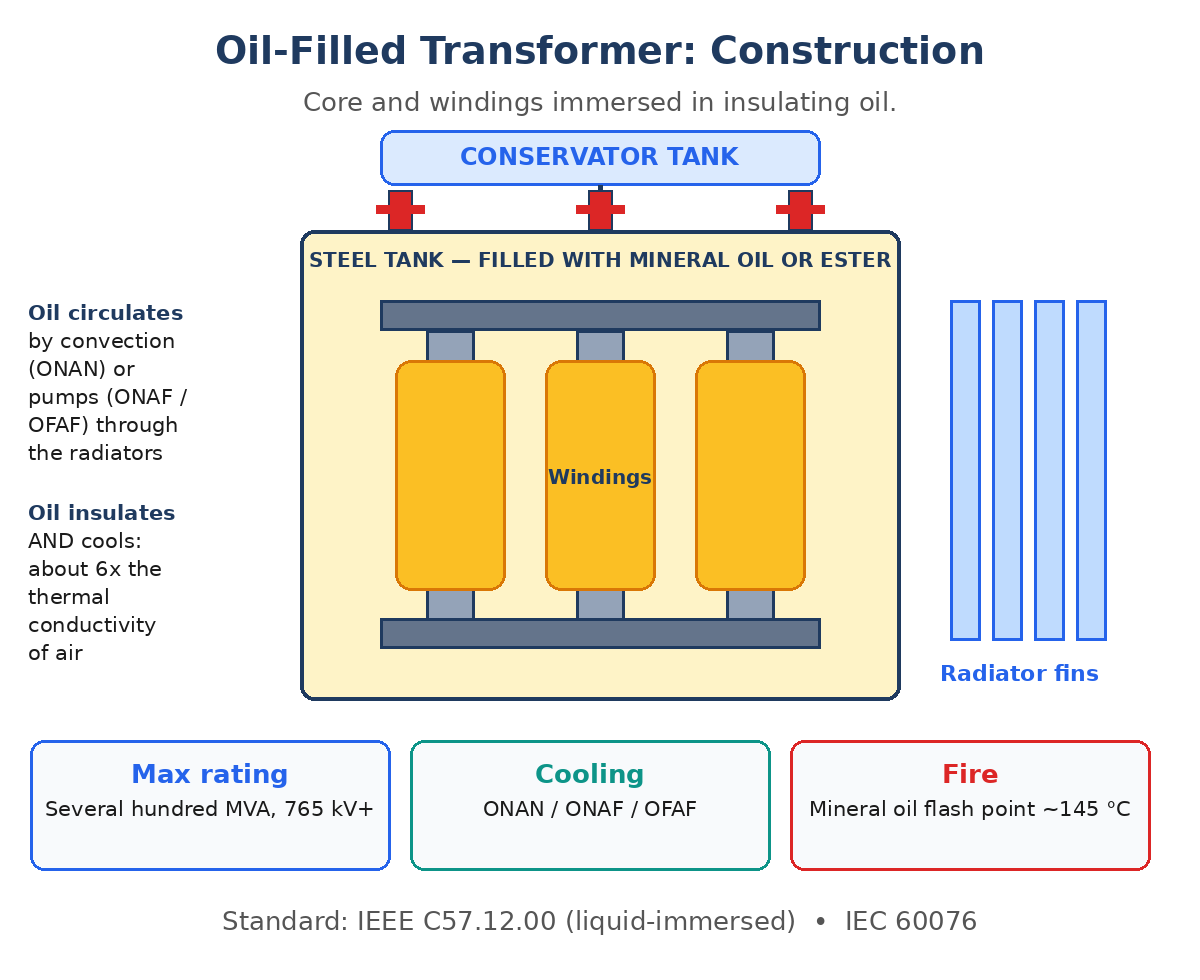
An oil-filled transformer — also called a liquid-immersed transformer — places the core and windings inside a sealed steel tank filled with mineral oil or, increasingly, a natural or synthetic ester fluid. The liquid does two jobs at once: it insulates the windings and carries heat away to the tank walls and radiators. Oil’s thermal conductivity is about 0.15 W/m·K, roughly six times that of air, which is why an oil-filled unit of the same rating is smaller, quieter, and cooler-running than its dry type equivalent.
In the simplest design, coded ONAN (oil natural, air natural), the oil circulates by natural convection: hot oil rises, cools in the radiators, and sinks again. Larger units add fans on the radiators (ONAF) or pumps that force the oil through the radiators (OFAF). A conservator tank on top gives the oil room to expand, and bushings carry the high-voltage connections through the tank lid. These are the workhorses of the power system: a power transformer in a transmission substation is almost always oil-filled, and oil-filled units range from small pole-mounted units up to several hundred MVA at 765 kV and beyond.
The price of that performance is the liquid itself. Mineral oil is flammable, with a flash point around 145 °C and a fire point around 160–170 °C, and a tank can hold thousands of liters of it. Ester fluids are much safer, with a fire point above 300 °C, which is why they are increasingly specified for indoor and environmentally sensitive sites. Either way, an oil-filled unit needs leak monitoring, oil testing, and indoor fire containment — none of which the dry type needs.
Dry Type vs Oil-Filled: Key Differences
| Feature | Dry Type | Oil-Filled |
|---|---|---|
| Insulation | Solid: cast resin or VPI epoxy | Liquid: mineral oil or ester fluid |
| Cooling | Air — AN (natural) or AF (forced fans) | Oil — ONAN, ONAF, or OFAF |
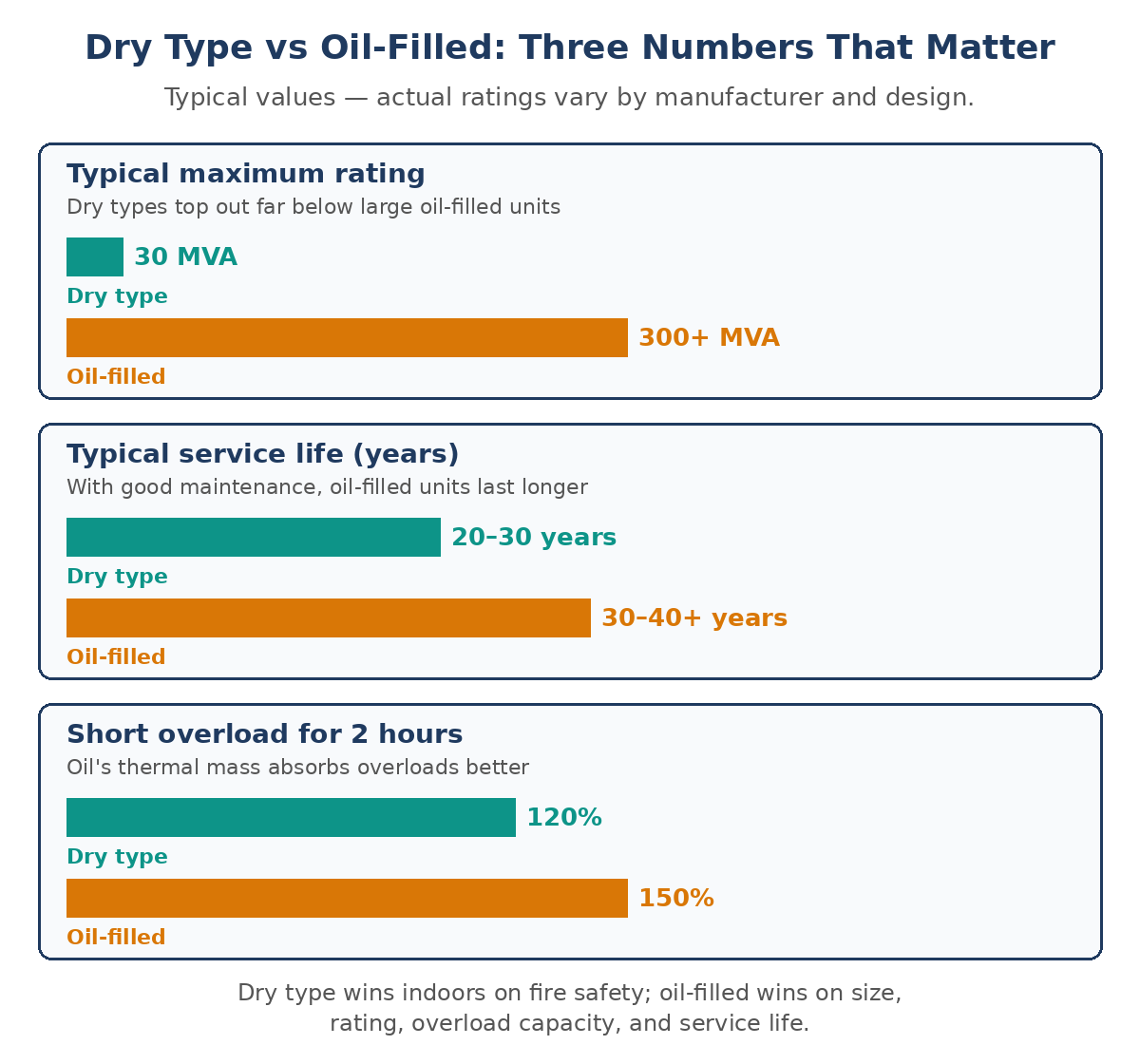
| Typical maximum rating | About 30 MVA, up to 35–36 kV | Several hundred MVA, up to 765 kV+ |
| Fire risk | Self-extinguishing, low smoke, no pool fire | Mineral oil flammable (flash point ~145 °C); ester above 300 °C |
| Efficiency | Over 98% at typical loads | Over 98%; usually slightly lower losses at the same rating |
| Overload (2 hours) | About 120% | Up to about 150% |
| Typical service life | 20–30 years | 30–40+ years with good maintenance |
| Noise | 45–65 dB | 35–50 dB (oil dampens vibration) |
| Temperature rise | Class F 100 K / Class H 125 K | Class A 65 K winding rise |
| Maintenance | Inspection, dust cleaning, fan checks | Oil sampling, BDV/DGA tests, leak and bushing checks |
Cooling and Temperature Rise
Cooling is where the two designs diverge most in daily operation. In a dry type unit, air is the only coolant. Natural circulation (AN) is silent and has nothing to fail, but it limits the rating; adding fans (AF) buys 33–50% more capacity, at the cost of fan noise, fan power, and another component that can fail on the hottest day of the year. Dust is the dry type’s quiet enemy: a layer of dust on the windings blocks airflow and raises the winding temperature, so regular cleaning is part of the routine.
Fire Safety and NEC Rules
Fire safety is the strongest argument for a dry type transformer, and often the deciding one. Cast resin is self-extinguishing: remove the flame and it stops burning, it produces little smoke, and there is no pool of burning liquid to spread a fire through a building. That is why dry types are the default for hospitals, schools, shopping malls, data centers, and high-rise buildings.
Mineral oil, by contrast, is flammable: its flash point is about 145 °C and its fire point is around 160–170 °C, so a serious fault can ignite the thousands of liters in the tank. Ester fluids are far safer, with a fire point above 300 °C, and they are biodegradable. In the United States, the National Electrical Code (NEC) Article 450 governs indoor oil-filled installations — in practice that usually means a fire-rated vault, oil containment, and sometimes a suppression system. Outdoors, the same unit sits over a bunded pit in a fenced yard — so the rule of thumb is simple: the more people near the transformer, the stronger the case for dry type.
Efficiency and Losses
Both types are efficient machines. At typical loads, either one can exceed 98% efficiency, and both must meet the same US Department of Energy efficiency rules. The difference is small but real: at the same rating, an oil-filled transformer usually has slightly lower total losses than a dry type, because oil cools the windings more effectively. Over a 25- or 30-year life, even a 1–2 kW difference adds up to a noticeable amount of energy — as the worked example below shows.
Worked example — 1,500 kVA at 50% load, running all year. Take a 1,500 kVA unit loaded to 50% (750 kVA), running 8,760 hours a year. Suppose, as an illustrative assumption (not a measured figure), that the dry type loses 12 kW at that load and the oil-filled unit loses 10 kW. Step by step:
- Dry type annual energy lost: 12 kW × 8,760 hours = 105,120 kWh per year.
- Oil-filled annual energy lost: 10 kW × 8,760 hours = 87,600 kWh per year.
- Extra energy lost by the dry type: 105,120 − 87,600 = 17,520 kWh per year.
- Extra cost at $0.12 per kWh: 17,520 × $0.12 = $2,102 per year.
- Over 25 years: $2,102 × 25 = $52,550 of extra energy cost for the dry type in this example.
The loss figures here are illustrative assumptions — real figures come from the manufacturer’s test report for the specific units being compared. The lesson is that losses are a running cost, paid every year for decades, while the purchase price is paid once. A 2 kW difference looks trivial on a datasheet and costs more than $50,000 over the life of the unit.
Cost and Total Cost of Ownership
On purchase price alone, the oil-filled transformer usually wins. At the same kVA rating, a dry type costs more to buy, because its windings need more copper and pricier solid insulation. But indoors the balance often tips the other way. An oil-filled unit installed inside needs a fire-rated vault, oil containment, and possibly fire suppression — civil work that can cost far more than the transformer itself. A dry type needs none of that: it can sit in an electrical room with normal ventilation, so its total installed cost indoors is often lower despite the higher sticker price.
Return to the worked example to see how total cost of ownership plays out. Suppose the dry type costs $8,000 more to buy than the oil-filled unit, but saves $15,000 on vault and containment work indoors. On day one, the dry type is $7,000 ahead ($15,000 saved minus $8,000 extra). But it also loses an extra $2,102 a year in energy, so that $7,000 advantage is eaten in about 3.3 years ($7,000 ÷ $2,102 ≈ 3.3). After that, the oil-filled unit pulls ahead, saving roughly $45,000 net over 25 years in this example. The conclusion flips with the loading: at light loading, the loss difference shrinks and the dry type’s installation saving dominates; at high loading, the oil-filled unit’s lower losses dominate. That is the practical rule — oil wins at high loading, dry wins at low loading — and it is why the loading profile, not the catalog price, should drive the decision.
Maintenance Compared
Maintenance is where the dry type earns its reputation for simplicity. With no liquid to test, leak, or replace, the routine is short: visual inspection, cleaning dust off the windings and vents, checking the fans (on AF units) and their controls, and measuring insulation resistance. Most of it can be done without a long outage, and there is no hazardous waste to dispose of.
- Dry type routine: visual inspection, dust cleaning, fan and temperature-monitor checks, insulation resistance measurement.
- Oil-filled routine: oil sampling for breakdown voltage (BDV) and dissolved gas analysis (DGA), leak checks on gaskets and valves, bushing and radiator inspection, conservator and breather checks, and periodic oil filtering or replacement.
Where Each Type Is Used
The application usually decides the type before the price does. Dry types go where people are: hospitals, schools, shopping malls, office towers, data centers, high-rise buildings, and indoor substations — anywhere a fire or an oil spill would be unacceptable, and anywhere a vault and containment would be impractical. They are also the natural choice for a distribution transformer feeding a building from inside it, and for fire-sensitive sites such as chemical plants.
Oil-filled transformers go where the power is: outdoor substations, utility networks, solar and wind farms, large industrial plants, and pole-mounted distribution. A substation transformer is almost always oil-filled, because the ratings are large, the load is high and continuous, and the lower losses and longer life pay for themselves many times over. If the transformer will live outside, serve a heavy continuous load, or exceed about 30 MVA, oil-filled is usually the only practical option.
Frequently Asked Questions
Which is better, dry type or oil-filled transformer?
Neither is better in general — it depends on the location and the load. Dry type is better indoors and where fire safety matters most: hospitals, schools, malls, and high-rise buildings. Oil-filled is better outdoors, at large ratings, and under heavy continuous loading, where lower losses and longer life win.
Can a dry type transformer be used outdoors?
Yes, but only in a weatherproof enclosure with proper ingress protection — dry types are built for indoor use as standard, and they still need ventilation for cooling. In practice, an outdoor installation usually ends up oil-filled anyway, because the oil-filled unit is cheaper, quieter, and better sealed against the weather.
Why are oil-filled transformers cheaper than dry type?
Because oil is a far better coolant and insulator than air — about six times the thermal conductivity — so an oil-filled unit needs less copper, less insulation material, and a smaller core for the same rating. That saving is on the purchase price only: indoors, the vault and containment an oil-filled unit requires can wipe it out, which is why total installed cost is the fair comparison.
How long does a dry type transformer last?
A typical dry type transformer lasts 20–30 years, with some sources quoting 15–25 years depending on loading and environment. Heat and dust are the main life-limiting factors. An oil-filled transformer typically lasts 30–40+ years with good maintenance, because the oil keeps the windings cooler and oil testing catches problems early.
Do dry type transformers need oil testing?
No — there is no oil to test. That is one of the dry type’s main advantages: no oil sampling, no breakdown voltage tests, no dissolved gas analysis, and no oil leaks to chase. Maintenance is limited to inspection, dust cleaning, fan checks, and insulation resistance measurement — but you lose the early-warning diagnostics that oil analysis gives an oil-filled unit.
Conclusion
The dry type vs oil-filled transformer choice comes down to one question: where will it live, and how hard will it work? Dry type wins indoors and around people — no flammable liquid, self-extinguishing insulation, and minimal maintenance. Oil-filled wins outdoors and at scale — higher ratings up to 765 kV and beyond, lower losses, 150% short overload capacity, and a 30–40+ year life. The worked example shows why loading matters: at 50% load around the clock, a 2 kW loss difference costs about $2,102 a year, erasing a $7,000 installation saving in just over three years. So compare the total cost of ownership using the manufacturer’s loss figures and your real load profile, and the right type will usually pick itself. For a manufacturer’s side-by-side comparison with more technical detail, see the Dry Type Transformer vs Oil Filled guide on ZTeleC Group.