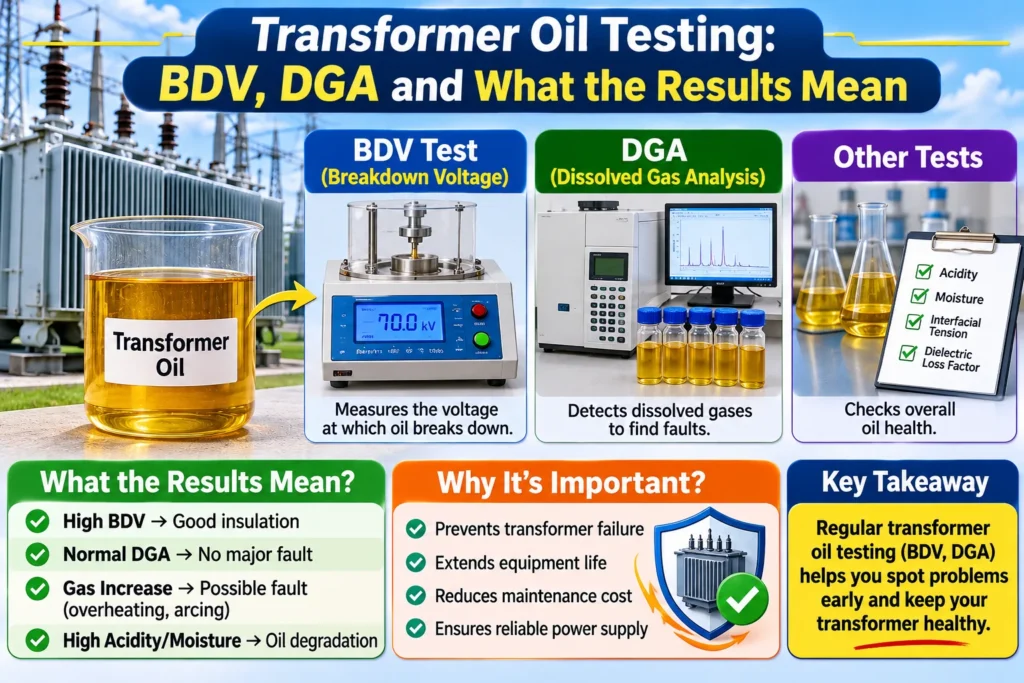

A transformer is a tank of oil with a very expensive core inside. The oil insulates the windings, carries away heat, and — usefully for the engineer — collects the evidence when something starts to go wrong. Testing that oil is how you know whether a transformer is healthy, needs treatment, or is about to fail. A full test costs a few hundred pounds; an unplanned failure costs a great deal more.
Three tests do most of the work: BDV, dissolved gas analysis (DGA), and moisture. This guide explains each one, what the limits mean, and how to read a real report — including a worked example on a 132 kV unit. If you are new to the machine itself, start with how a transformer works and our guide to the power transformer.
Why Test Transformer Oil?
Transformer oil does two jobs at once: it insulates the windings from each other and from the tank, and it carries heat from the core and windings to the radiators. It is both an insulator and a coolant, so its condition tells you about both. When it degrades, it loses insulating strength, makes acids that attack paper and copper, and stops carrying heat.
Testing the oil is cheaper than opening the tank, and it gives earlier warning. Oil samples reveal overheating, arcing, moisture ingress, and paper aging long before the protection trips or the transformer fails — which is why most utilities test annually, and more often for critical or aging units.
The Main Oil Tests at a Glance
| Test | What It Measures | Key Limit | What a Failure Means |
|---|---|---|---|
| BDV | Dielectric strength (kV) | 30 kV minimum in service | Wet or contaminated oil — treat or replace |
| DGA | Dissolved gases (ppm) | Acetylene 0 ppm; H₂ under 100 ppm | Arcing, overheating, or partial discharge |
| Moisture | Water content (ppm) | Under 20 ppm for 132 kV | Weak insulation; dry out or filter |
| Acidity | Neutralisation number (mg KOH/g) | Under 0.2 mg KOH/g | Oxidation and sludge forming |
| Interfacial tension | Oil surface tension (mN/m) | Above 25 mN/m | Contamination building up |
| Furan (2-FAL) | Paper breakdown marker (ppb) | Under 100 ppb | Solid insulation aging |
BDV: Breakdown Voltage Test
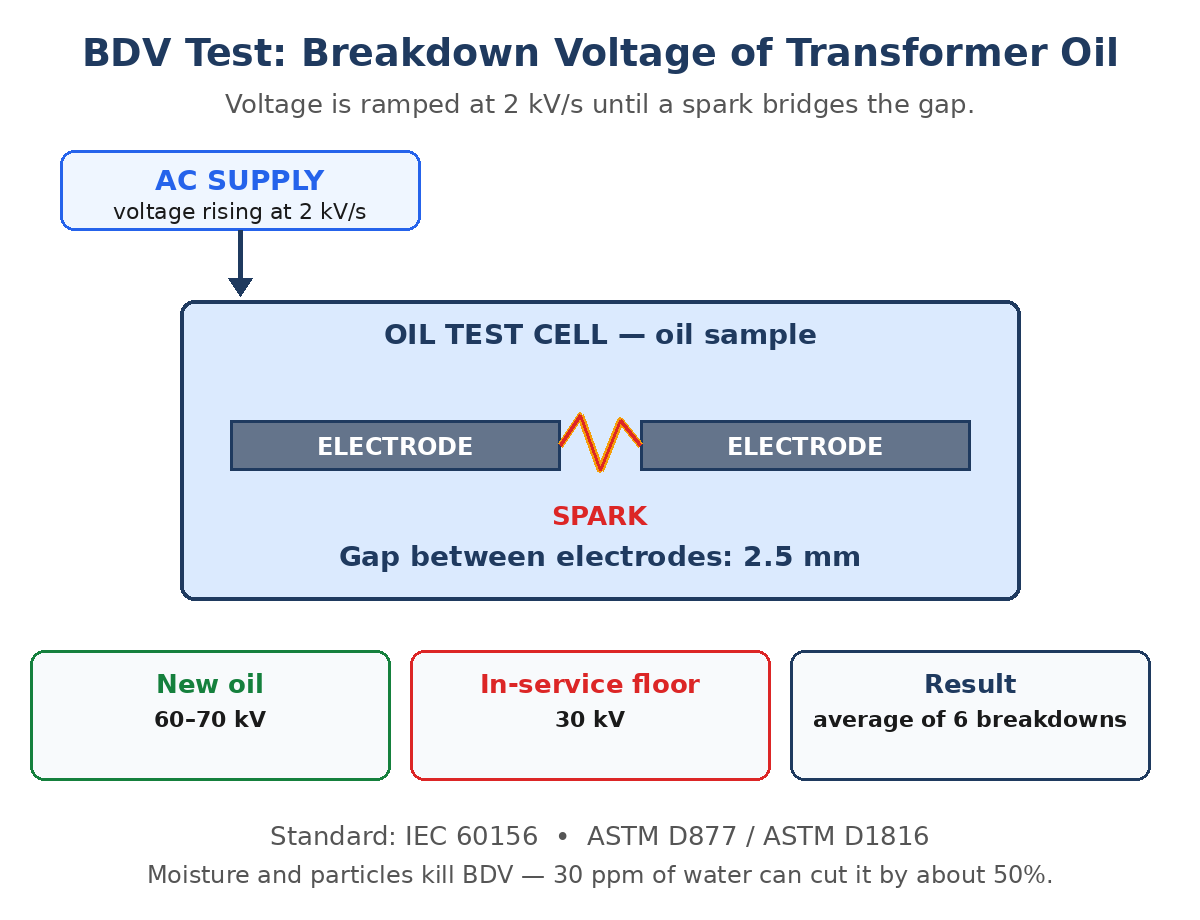
The BDV test measures the oil’s dielectric strength: the voltage at which it stops insulating and breaks down. A sample is put in a test cell between two electrodes 2.5 mm apart, and the voltage is ramped at 2 kV/s until a spark bridges the gap. The result is the average of six breakdowns.
| Oil Class | New Oil | In-Service Minimum | What the Value Means |
|---|---|---|---|
| 11 kV | 50 kV | 25 kV | Basic distribution unit |
| 33 kV | 60 kV | 30 kV | Standard in-service floor |
| 132 kV | 70 kV | 40 kV | Higher floor for EHV units |
| Any class (in service) | — | Below 30 kV | Below the in-service floor — act |
BDV falls for two reasons: moisture and solid contamination. Water dissolves in the oil and lowers its insulating strength, while particles — fibres, carbon, metal dust — bridge the gap between electrodes. Both are fixable: the oil can be filtered and dried, and the test repeated. If you are tracking the losses that heat the oil, see our guide to transformer losses.
DGA: Dissolved Gas Analysis
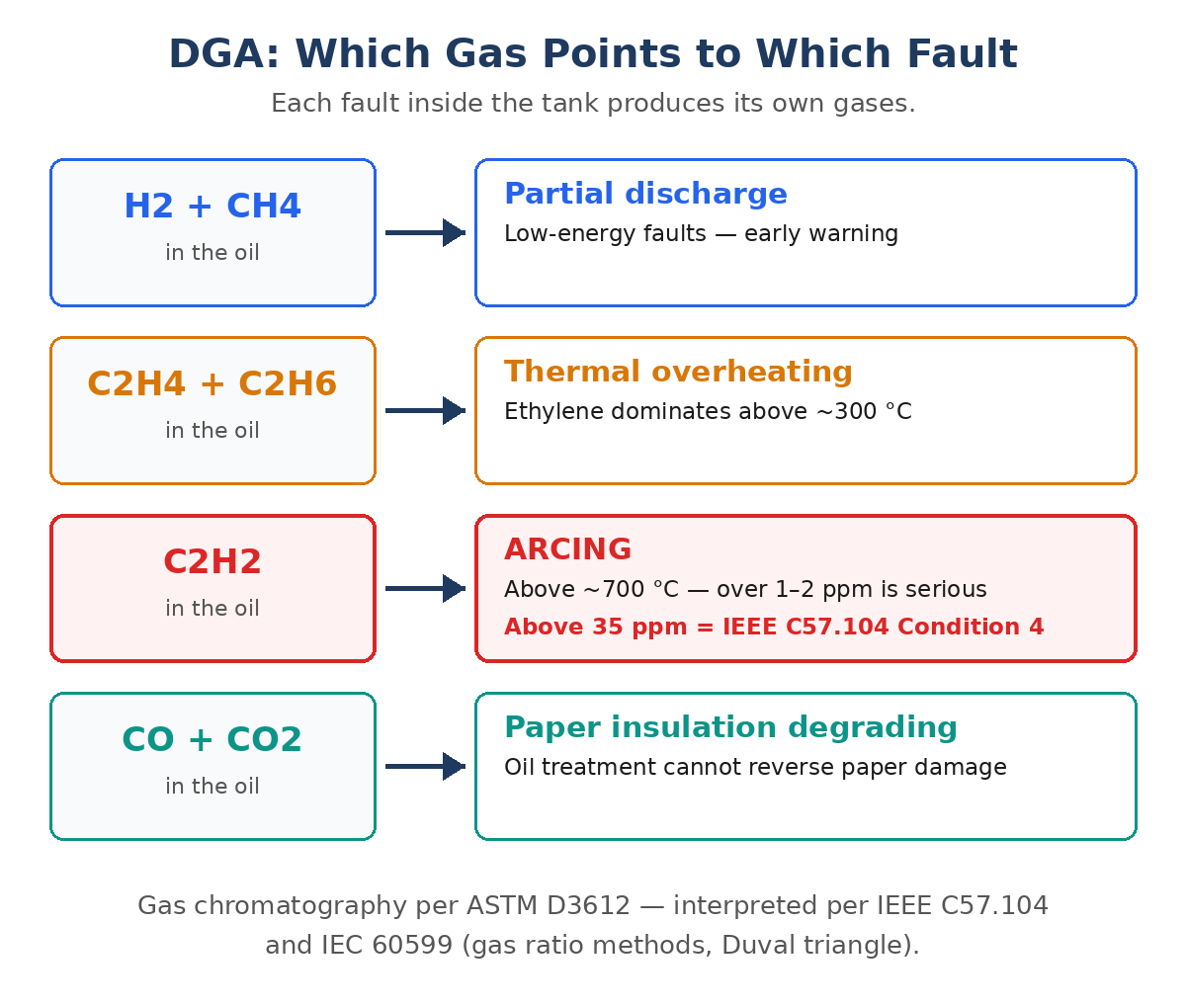
Dissolved gas analysis (DGA) is the most powerful test of all. Faults inside the transformer break the oil and paper apart into gases that dissolve in the oil. A sample is drawn, the gases are extracted and measured in parts per million, and the pattern tells you what kind of fault is happening, and how severe it is.
| Gas | What It Indicates | Typical Healthy Level |
|---|---|---|
| Hydrogen (H₂) | Partial discharge / corona | Under 100 ppm |
| Methane (CH₄) | Partial discharge / corona | Under 120 ppm |
| Ethylene (C₂H₄) | Overheating of oil | Under 50 ppm |
| Ethane (C₂H₆) | Overheating of oil | Under 65 ppm |
| Acetylene (C₂H₂) | Arcing — the serious one | 0 ppm (any presence is serious) |
| Carbon monoxide (CO) | Paper aging | Under 350 ppm |
| Carbon dioxide (CO₂) | Paper aging | Under 2,500 ppm |
Acetylene is the gas to watch. Healthy oil has none, and it only appears when something is arcing. Any acetylene above 1–2 ppm is serious — the transformer needs an urgent internal inspection. Carbon monoxide and dioxide are the paper gases: rising values mean the solid insulation is aging. For the bigger picture, see our guide to the types of transformers.
Moisture, Acidity and Other Tests
Moisture is measured by Karl Fischer titration and reported in parts per million. The limit depends on voltage class: under 35 ppm for 11 kV units, under 25 ppm for 33 kV, and under 20 ppm for 132 kV and above. Water in oil is dangerous for two reasons: it lowers the BDV, and it degrades the paper insulation faster.
Acidity — the neutralisation number — measures the acids formed as oil oxidises. Fresh oil is under 0.03 mg KOH/g, and 0.2 mg KOH/g is the action limit. High acidity attacks copper and paper, so an acidic oil needs reclaiming or replacing. Interfacial tension and furan testing complete the picture: interfacial tension below 25 mN/m means polar contaminants are building up, and furan (2-FAL) above 100 ppb shows the paper insulation is aging.
How Oil Samples Are Taken
The result is only as good as the sample. Take the sample from the bottom drain valve while the transformer is in service, flush the valve first to clear stagnant oil, and use a clean, dry syringe or bottle. Keep the sample out of sunlight and air, and send it to the lab the same day.
Never sample a transformer that has just been switched off or just been topped up: the oil is not mixed and the result will mislead. And always label the sample with the transformer, the date, and the load at the time — trends over time matter more than any single reading.
Worked Example: Reading a Real Test Report
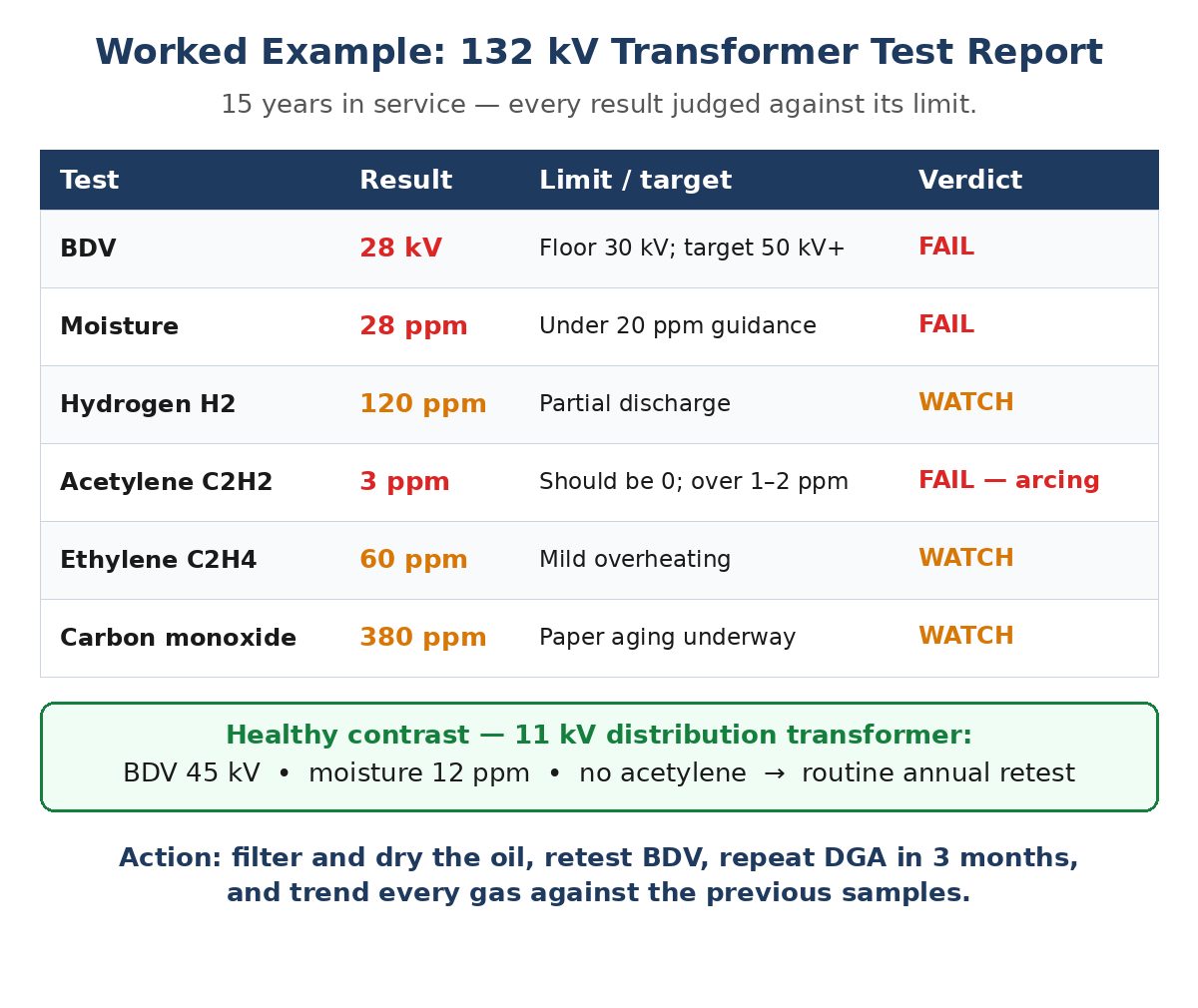
A 132 kV transformer, 15 years in service, is sampled annually. The 2026 result is a mixed picture, and the verdict is: the unit fails the test.
BDV is 28 kV. The floor for a 132 kV unit is 40 kV, so 28 kV is well below it — the oil’s insulating strength is compromised, most likely by moisture.
Moisture is 28 ppm. The guidance for 132 kV is under 20 ppm, so the oil is wetter than it should be. The moisture explains the low BDV — wet oil breaks down at lower voltage — and it is also aging the paper faster.
Hydrogen is 120 ppm, just above the 100 ppm guide, which suggests partial discharge. Acetylene is 3 ppm, and that is the serious result: acetylene should be zero in healthy oil, and 3 ppm is proof of arcing. The carbon monoxide reading of 380 ppm is just above the 350 ppm guide, so the paper is aging.
The same test on a healthy 11 kV unit passes on every measure: BDV 55 kV, moisture 15 ppm, hydrogen 40 ppm, acetylene 0 ppm, and carbon monoxide 200 ppm. The lesson is that one bad number rarely tells the story — it is the pattern that matters, and here the pattern is moisture plus arcing. The unit needs filtering and drying, an internal inspection for the arcing source, and a repeat DGA in one month rather than one year.
What to Do When a Result Fails
A single bad result is rarely a reason to switch a transformer off. It is a reason to investigate — starting with a repeat sample to rule out a bad sample or a lab error.
- BDV low: filter and dry the oil, then re-test. If the BDV stays low, check for a leak letting water in.
- Moisture high: dry out the oil by hot-oil circulation, and check the breathers and gaskets for the source.
- Acidity high: reclaim the oil or replace it; check the paper for damage.
- Acetylene present: take the unit out of service and inspect internally — arcing is the one fault you do not wait on.
- Hydrogen rising: monitor with monthly DGA and look for partial discharge.
- Furan high: plan for a paper replacement or a replacement transformer — the solid insulation is near the end of its life.
How Often to Test
Most utilities test distribution transformers every one to two years, and transmission units every year. Critical or aging transformers get tested every six months, and any unit that has shown a fault gets monthly DGA until the trend is clear. After any major work — a repair, a refill, or a fault — test again within a month to confirm the fix.
Frequently Asked Questions
What is transformer oil testing?
Transformer oil testing is the laboratory analysis of the insulating oil inside a transformer. It checks the oil’s dielectric strength (BDV), dissolved gases (DGA), moisture, acidity, and other properties to judge the condition of the transformer and its insulation.
What is a good BDV value for transformer oil?
New oil should be above 60 kV, and in-service oil should stay above 30 kV. Below 30 kV the oil needs filtering and drying, or replacing.
What does DGA tell you about a transformer?
DGA tells you what kind of fault is happening inside a transformer. Hydrogen and methane point to partial discharge, ethylene and ethane to overheating, acetylene to arcing, and carbon monoxide and dioxide to paper aging.
How often should transformer oil be tested?
Distribution transformers are usually tested every one to two years, and transmission units every year. Critical or aging transformers get tested every six months, and any unit showing a fault gets monthly DGA until the trend is clear.
What causes low BDV in transformer oil?
Low BDV is usually caused by moisture or solid contamination in the oil. Water lowers the oil’s insulating strength, and particles bridge the gap between electrodes. Both are fixable by filtering and drying the oil.
Conclusion
Transformer oil testing turns a sealed tank into a readable story. BDV tells you whether the oil still insulates, DGA tells you what kind of fault is happening inside, and moisture, acidity, and furan fill in the rest. The numbers matter most as a trend: a rising gas, a falling BDV, or a creeping moisture level is the warning. Test on schedule, act on the pattern, and the oil will tell you what the transformer needs before it fails. For more detail on the tests and limits, see Transformer Oil Testing: BDV, DGA, Moisture ppm & More on Infinita Lab.