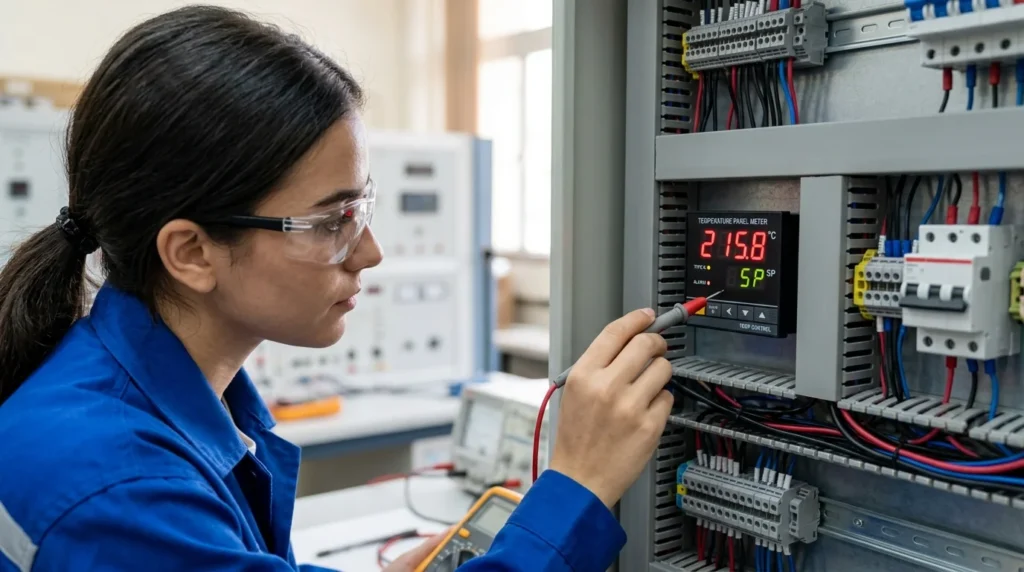

Imagine you are working in a factory where machines operate continuously at high temperatures. One small rise in temperature can damage equipment, reduce efficiency, or even cause accidents. In such situations, monitoring temperature accurately becomes very important. This is where a Temperature Panel Meter plays a key role.
A temperature panel meter is commonly used in electrical panels, industrial machines, and control systems to display real-time temperature readings. It helps engineers and technicians monitor conditions and take action before problems occur.
Understanding this device is essential for anyone working in electrical or industrial fields. In this article, you will learn what a temperature panel meter is, how it works, its types, components, advantages, limitations, applications, and how to select the right one. By the end, you will have a clear and practical understanding of this important instrument.
What is Temperature Panel Meter?
A Temperature Panel Meter is an electronic or digital device used to measure and display temperature in electrical panels and industrial systems.
Simple Explanation
It is a display instrument that shows temperature values received from sensors like thermocouples or RTDs.
Practical Example
In an electrical control panel, a temperature panel meter shows the heat level inside the panel. If the temperature rises beyond a safe limit, operators can take action like turning on cooling systems.
Temperature Panel Meter Working Principle
The temperature panel meter working principle is based on sensing temperature and converting it into a readable signal.
Step-by-Step Working
- A temperature sensor (RTD or thermocouple) detects heat
- The sensor converts temperature into an electrical signal
- The panel meter receives this signal
- The internal circuit processes and calibrates the signal
- The temperature value is displayed on the screen
Easy Analogy
Think of it like a thermometer connected to a digital screen. The sensor feels the temperature, and the meter shows it clearly.
Types / Classification of Temperature Panel Meter
Analog Temperature Panel Meter
These meters use a needle and scale.
- Simple design
- No digital display
- Lower cost
- Less accurate compared to digital
Digital Temperature Panel Meter
These are the most commonly used meters.
- LED or LCD display
- High accuracy
- Easy to read
- Advanced features
Programmable Temperature Panel Meter
- Allows setting alarms
- Can control relays
- Used in automation systems
Multi-Input Temperature Panel Meter
- Accepts different sensor types
- Flexible usage
- Ideal for complex systems
Main Components of Temperature Panel Meter
Temperature Sensor
- RTD or thermocouple
- Detects temperature
Signal Conditioning Circuit
- Converts sensor signal into usable form
- Improves accuracy
Display Unit
- LED or LCD screen
- Shows temperature reading
Power Supply
- Provides energy to operate the device
Control Buttons
- Used for settings and calibration
Advantages of Temperature Panel Meter
The temperature panel meter advantages and disadvantages should be clearly understood.
Advantages
- Accurate temperature measurement
- Easy to install and use
- Real-time monitoring
- Improves safety in systems
- Supports automation and control
- Long service life
Disadvantages / Limitations
- Requires proper calibration
- Dependent on sensor accuracy
- Digital meters may be costly
- Sensitive to electrical noise
- Needs maintenance in harsh environments
Temperature Panel Meter Applications
The temperature panel meter applications are wide in different fields.
Industrial Applications
- Manufacturing plants
- Boilers and furnaces
- Chemical processing
Electrical Applications
- Control panels
- Transformers
- Switchgear systems
Home and Commercial Use
- HVAC systems
- Refrigeration
- Smart home devices
Modern Technology
- Automation systems
- IoT-based monitoring
- Data logging systems
Comparison Section
Difference Between Analog and Digital Temperature Panel Meter
| Feature | Analog Meter | Digital Meter |
|---|---|---|
| Display | Needle | Numeric display |
| Accuracy | Medium | High |
| Cost | Low | Medium to High |
| Ease of Reading | Difficult | Easy |
| Features | Basic | Advanced |
Selection Guide
Choosing the right temperature panel meter is important.
Key Factors
- Type of sensor (RTD or thermocouple)
- Measurement range
- Accuracy requirements
- Display type
- Environment conditions
Tips for Beginners
- Always check compatibility with sensors
- Choose digital for better accuracy
- Consider future expansion needs
- Select trusted brands
Common Problems & Solutions
1. Incorrect Temperature Reading
Cause: Faulty sensor
Solution: Replace or recalibrate sensor
2. Display Not Working
Cause: Power issue
Solution: Check wiring and supply
3. Fluctuating Readings
Cause: Electrical noise
Solution: Use proper shielding
4. Slow Response
Cause: Sensor delay
Solution: Use faster sensor type
Future Trends
Smart Temperature Panel Meters
- IoT-enabled devices
- Remote monitoring
Wireless Technology
- No complex wiring
- Easy installation
Integration with Automation
- Works with PLC and SCADA systems
Improved Accuracy
- Advanced sensors
- Better signal processing
Conclusion
A Temperature Panel Meter is an essential device for monitoring temperature in electrical and industrial systems. It ensures safety, improves efficiency, and helps prevent equipment damage. From simple analog meters to advanced digital and programmable models, these devices are widely used across various industries.
In this guide, you learned about the working principle, types, components, applications, and selection of temperature panel meters. Understanding these concepts will help you choose and use the right meter effectively.
As technology advances, temperature panel meters are becoming smarter and more integrated with automation systems. For students and professionals, mastering this topic is an important step toward building strong technical knowledge in electrical engineering.