
Imagine you are fixing a loose nut on an electrical panel, but you don’t have the exact size spanner. Instead of searching through multiple tools, you simply pick up one tool, adjust its jaw, and get the job done quickly. That tool is an adjustable wrench—a must-have in every electrician’s and technician’s toolkit.
In electrical work, maintenance, and daily repair tasks, having the right tools saves time, improves safety, and increases efficiency. The adjustable wrench is especially important because it can handle different sizes of nuts and bolts without needing multiple tools. This makes it ideal for beginners who may not yet have a full tool set.
In this article, you will learn everything about the adjustable wrench, including its definition, adjustable wrench working principle, types, components, adjustable wrench applications, and adjustable wrench advantages and disadvantages. By the end, you will clearly understand how to use it correctly and choose the best one for your needs.
2. What is Adjustable Wrench?
An adjustable wrench is a hand tool used to tighten or loosen nuts and bolts of different sizes. It has a movable jaw that can be adjusted to fit various fasteners.
Simple Explanation
In simple words, an adjustable wrench is a tool that changes its size. Instead of using many spanners, you can use one adjustable wrench for multiple sizes.
Practical Example
For example, when working on electrical installations like tightening cable gland nuts or fixing panel bolts, you may face different nut sizes. Instead of switching tools repeatedly, you adjust the wrench and continue working smoothly.
3. Adjustable Wrench Working Principle
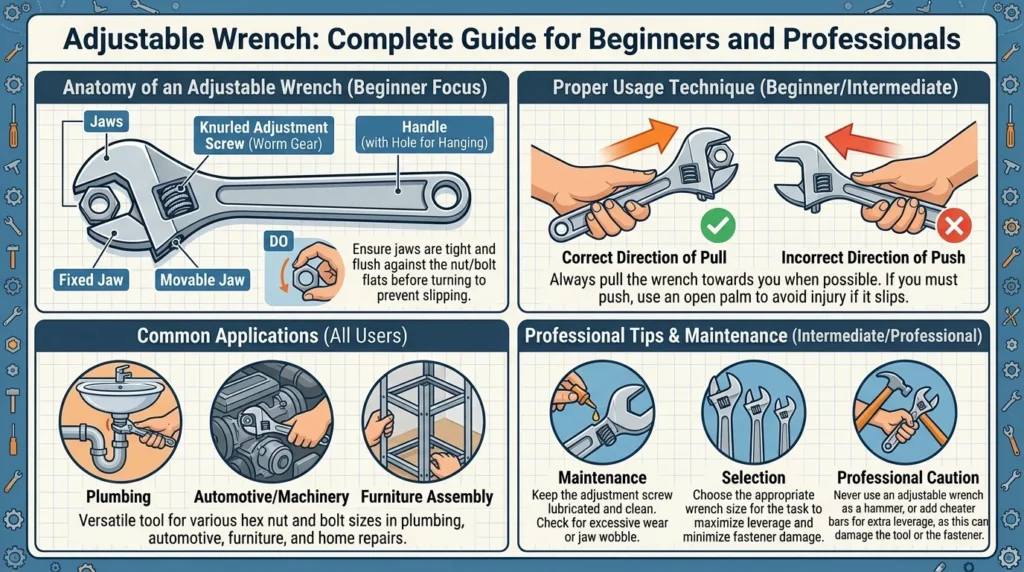
The adjustable wrench working principle is simple and based on mechanical adjustment using a screw mechanism.
Step-by-Step Working
- The wrench has two jaws: one fixed and one movable
- A screw (worm gear) controls the movement of the adjustable jaw
- When you rotate the screw:
- The jaw moves closer or farther
- This changes the opening size
- Once fitted on the nut, force is applied through the handle
- The torque (turning force) helps tighten or loosen the fastener
Easy Analogy
Think of it like adjusting a door lock latch. You turn a knob, and the latch moves in or out. Similarly, the adjustable wrench changes its jaw size.
4. Types / Classification
4.1 Standard Adjustable Wrench
This is the most common type used in homes and workshops. It has a straight handle and adjustable jaw.
4.2 Wide Jaw Adjustable Wrench
This type has a wider opening range. It is useful for large nuts and bolts, especially in industrial work.
4.3 Insulated Adjustable Wrench
Designed for electrical work, it has an insulated handle to protect against electric shock.
4.4 Adjustable Pipe Wrench
Used for pipes and round objects. It has serrated jaws for better grip.
4.5 Mini Adjustable Wrench
Small and compact, ideal for tight spaces and light-duty work.
5. Main Components
An adjustable wrench has simple but important parts:
5.1 Fixed Jaw
This jaw does not move and provides stability while gripping the nut.
5.2 Movable Jaw
This part slides to adjust the opening size.
5.3 Worm Screw (Adjustment Screw)
This screw controls the movement of the movable jaw.
5.4 Handle
The handle is used to apply force. A longer handle provides more torque.
5.5 Scale (Optional)
Some wrenches have measurement markings to estimate jaw opening size.
6. Advantages
The adjustable wrench advantages and disadvantages should be clearly understood.
Advantages
- Versatility: One tool fits multiple sizes
- Cost-effective: Reduces the need for many spanners
- Easy to use: Simple adjustment mechanism
- Portable: Compact and easy to carry
- Time-saving: No need to switch tools frequently
- Useful for beginners: Ideal for those learning basic repairs
7. Disadvantages / Limitations
Disadvantages
- Less grip than fixed spanner: May slip if not properly adjusted
- Can damage nuts: Loose fit can round off edges
- Not ideal for heavy-duty work: Limited strength compared to fixed tools
- Requires careful handling: Improper use can cause injury
- Slower in repetitive tasks: Adjusting each time takes effort
8. Applications
Adjustable wrench applications are wide and useful in many fields.
Home Use
- Fixing furniture
- Repairing plumbing fittings
- Tightening bolts in appliances
Electrical Work
- Installing cable glands
- Working on distribution boards
- Tightening panel connections
Industrial Use
- Machine maintenance
- Assembly and disassembly of parts
Automotive Use
- Repairing vehicles
- Adjusting battery terminals
9. Comparison Section
Difference Between Adjustable Wrench and Spanner
| Feature | Adjustable Wrench | Fixed Spanner |
|---|---|---|
| Size | Adjustable | Fixed size |
| Versatility | High | Low |
| Grip | Moderate | Strong |
| Speed | Slower | Faster |
| Usage | Multi-purpose | Specific tasks |
This shows the difference between adjustable wrench and spanner clearly. Each tool has its own use.
10. Selection Guide
Choosing the right adjustable wrench is important.
Tips for Beginners
- Select the correct size (6″, 8″, or 10″)
- Choose a strong material like chrome vanadium steel
- Ensure smooth jaw movement
- Prefer non-slip handles
- For electrical work, use insulated types
- Avoid very cheap tools with poor quality
11. Common Problems & Solutions
Q1: Why does my adjustable wrench slip?
Answer: The jaw may not be tightened properly. Always adjust it firmly before use.
Q2: Can an adjustable wrench damage nuts?
Answer: Yes, if used loosely. Always ensure a tight grip.
Q3: What if the screw becomes hard to rotate?
Answer: Clean and lubricate the worm screw regularly.
Q4: Is it safe for electrical work?
Answer: Only insulated adjustable wrenches should be used near electricity.
12. Future Trends
The adjustable wrench is evolving with technology.
New Developments
- Ergonomic designs for better comfort
- Lightweight materials for easy handling
- Digital measurement scales
- Improved grip technology
- Smart tools with torque control
These innovations are making tools safer and more efficient for modern technicians.
13. Conclusion
The adjustable wrench is one of the most important tools for electrical students, technicians, and beginners. Its ability to adjust to different sizes makes it highly versatile and practical for everyday use. Understanding the adjustable wrench working principle helps users apply it correctly and safely.
We discussed its types, components, adjustable wrench applications, and adjustable wrench advantages and disadvantages in detail. While it may not replace all tools, it is a valuable addition to any toolkit.
For best results, always use the correct technique, maintain the tool properly, and choose a high-quality wrench. Learning how to use tools correctly is the first step toward becoming a skilled technician or engineer.