
Starting a 100 HP motor with a DOL starter is like flooring a car’s accelerator from a standstill — the jolt stresses everything in the drivetrain. A soft starter is the gentler alternative: an electronic device that eases a motor up to speed with a smooth, controlled voltage ramp instead of slamming it with full voltage.
Soft starters sit in the sweet spot between cheap electromechanical starters and expensive variable frequency drives. They cost more than a star-delta starter but far less than a VFD, and for applications that need smooth starting without speed control, they are often the perfect answer. Here is how they work, how they are wired, and when to choose one over a VFD.
Soft Starter Basics: The Core Idea
A soft starter is an electronic motor controller that reduces the voltage applied to a motor during starting — and optionally during stopping — then applies full voltage once the motor reaches running speed. It is used almost exclusively with AC three-phase induction motors, the workhorses of industry.
Unlike a star-delta starter, which switches abruptly between two fixed voltages, a soft starter increases voltage gradually and steplessly, so torque builds up smoothly and current never spikes violently. Once the motor is at full speed, an internal bypass contactor typically shorts out the electronics, so the soft starter runs cool and efficiently during normal operation.
Think of it as a dimmer switch for your motor — except instead of controlling brightness, it controls the violence of the start.
How a Soft Starter Works
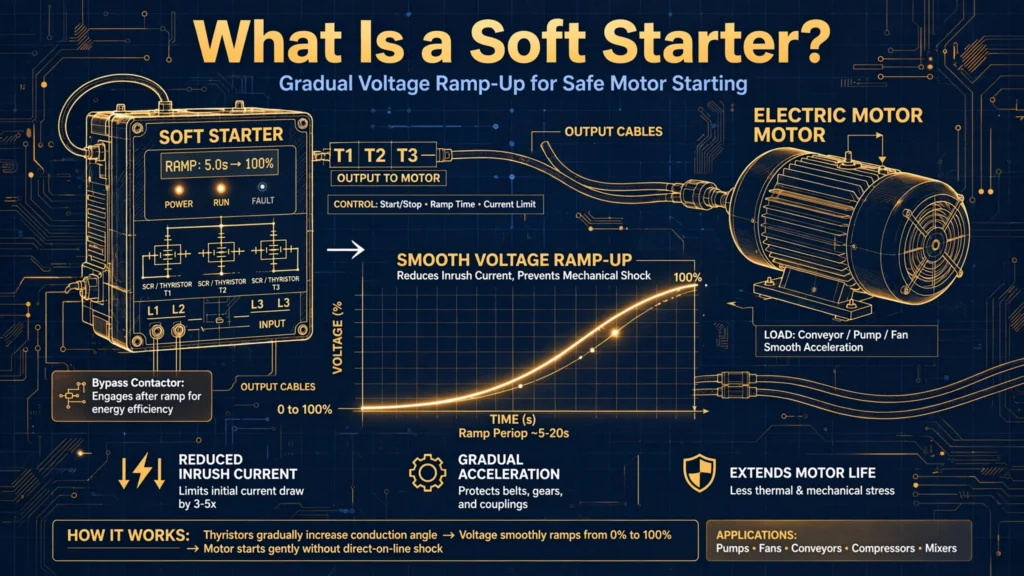
The heart of a soft starter is a set of back-to-back thyristors (SCRs) — one pair in each of the three phases. A thyristor is a semiconductor switch that can be triggered to conduct partway through each AC half-cycle. By delaying the trigger point (a technique called phase-angle control), the soft starter chops the sine wave and delivers only a fraction of the full voltage to the motor.
Here is the starting sequence:
- Start command received. The soft starter begins with a low initial voltage (often 30–50% of line voltage, adjustable).
- Voltage ramp. Over an adjustable ramp time (typically 5–30 seconds), the thyristors fire earlier in each half-cycle, and the motor voltage climbs smoothly toward 100%.
- Current stays controlled. Because voltage rises gradually, the starting current is limited — usually to 2–4 times full-load current instead of 6–8×, and the current limit is adjustable on most units.
- Bypass at full speed. When the motor reaches rated speed, the bypass contactor closes, connecting the motor directly to the supply. The thyristors stop conducting, eliminating their heat losses during continuous running.
- Stop command (optional soft stop). Instead of cutting power instantly, the soft starter can ramp voltage down gradually — invaluable for pumps, where an abrupt stop causes water hammer.
The key insight: motor torque is proportional to the square of voltage, so even a modest voltage reduction dramatically softens the starting kick. That is why a soft starter can tame inrush while still developing enough torque to accelerate the load.
Soft Starter Wiring Diagram Explained
A typical soft starter wiring arrangement has two parts — power wiring and control wiring:
Power circuit (main current path):
- The three-phase supply (L1, L2, L3) connects to the soft starter’s line terminals.
- The soft starter’s motor terminals (T1, T2, T3) connect to the motor.
- An incoming MCCB or isolator sits upstream for short-circuit protection (the soft starter does not replace this).
- The bypass contactor is wired in parallel with the thyristor section — it is usually built into the unit and closes automatically at full speed.
- An overload relay or electronic overload function protects against sustained overload; many soft starters include this internally.
Control circuit:
- Start/stop pushbuttons (or PLC contacts) wire to the soft starter’s control inputs.
- A run/fault relay output from the soft starter can signal a PLC or lamp.
- Emergency stop should drop out the upstream contactor directly — never rely on electronics alone for safety isolation.
One critical wiring rule: never connect power factor correction capacitors between the soft starter and the motor unless the manufacturer explicitly allows it — the chopped waveform can destroy them. Capacitors belong upstream of the soft starter.
Key Features of Modern Soft Starters
Adjustable ramp time — set how many seconds the voltage takes to reach full value, matching the load’s inertia.
Current limit — caps the starting current at a set multiple of full-load current (e.g. 3×), protecting weak supplies.
Kick start — a brief pulse of higher voltage at the very beginning to break away high-friction loads like loaded conveyors, before the gentle ramp takes over.
Soft stop — ramps voltage down on stopping; the classic fix for water hammer in pumping systems and for preventing product pile-up on conveyors.
Motor protection built in — electronic overload, phase loss, phase imbalance, thyristor over-temperature and stall protection come standard on most units, reducing the need for separate relays.
Communication — Modbus and other fieldbus options let the soft starter report current, status and faults to a PLC or SCADA system.
Soft Starter vs VFD: Which One Do You Need?
This is the most common selection dilemma, so here is the head-to-head comparison:
| Feature | Soft Starter | VFD |
|---|---|---|
| Starting current | 2–4 × FLC (limited) | 1–1.5 × FLC |
| Speed control | No — full speed after starting | Yes — continuous 0–100%+ |
| Soft stop | Yes | Yes (controlled deceleration) |
| Energy saving | No | Yes, on variable-torque loads |
| Harmonics | Minimal | Significant (may need filters) |
| Cost | Medium | High (2–4× a soft starter) |
| Complexity | Simple to set up | Needs commissioning and tuning |
| Motor heating during start | Moderate | Lowest |
Choose a soft starter when: you need smooth starting and stopping but the motor always runs at full speed — conveyors, crushers, compressors, constant-speed pumps and fans. It delivers 80% of the starting benefit at a fraction of VFD cost.
Choose a variable frequency drive when: you need speed control, frequent starts/stops, precise process control, or energy savings on variable loads. If the motor’s speed ever needs to vary, only a VFD will do — a soft starter fundamentally cannot change running speed.
Applications of Soft Starters
- Pumps — soft stop eliminates water hammer that bursts pipes and damages valves.
- Conveyors — gentle acceleration prevents belt slap, product spillage and stretched belts; kick start breaks away loaded belts.
- Fans and blowers — high-inertia loads accelerate smoothly without belt squeal or duct pressure spikes.
- Compressors — reduced starting current avoids nuisance tripping on limited supplies.
- Crushers and mixers — controlled torque build-up protects gearboxes and couplings from shock loads.
Frequently Asked Questions
Does a soft starter save energy?
Not during normal running — once the bypass contactor closes, the motor runs at full voltage and full speed exactly as with a DOL starter. Energy savings come only from reduced mechanical wear and fewer demand peaks, not from lower running consumption. For real energy savings through speed control, you need a VFD.
Can a soft starter be used with a single-phase motor?
Soft starters are designed for three-phase induction motors. Single-phase motors have completely different starting mechanisms (capacitor start, shaded pole), and standard soft starters are not compatible with them. Special single-phase soft starters exist but are uncommon.
What is the difference between a soft starter and a star-delta starter?
A star-delta starter switches abruptly between two fixed voltages (58% then 100%) using contactors and a timer — cheap but jerky, with a current transient at changeover. A soft starter ramps voltage smoothly with electronics, gives adjustable current limiting and soft stop, and costs more. Both provide no speed control.
Do I still need overload protection with a soft starter?
Most modern soft starters include electronic overload protection, but you must verify it is enabled and set to the motor’s full-load current. Upstream short-circuit protection (MCCB or fuses) is always still required — a soft starter cannot interrupt short-circuit current.
Why is my motor overheating with a soft starter?
The usual suspect is a ramp time set too long — the motor spends excessive time at reduced voltage drawing high slip current. Shorten the ramp, check the current limit setting, and confirm the bypass contactor is actually closing at full speed (if it stays open, the thyristors overheat and so does the motor).
Can I bypass a soft starter if it fails?
Yes — most installations include a DOL bypass arrangement (or the internal bypass contactor can be forced) so the plant keeps running while the soft starter is repaired. Design this emergency path into the panel from day one; retrofitting it during a breakdown is painful.
Final Thoughts
A soft starter is the elegant middle ground of motor starting: smoother than star-delta, far cheaper than a VFD, and simple enough for any electrician to commission. If your motors need gentle starts and stops but run at constant speed, it is very likely the most cost-effective choice on the panel. Just remember its limits — no speed control, no energy savings at running speed — and size the upstream protection correctly. For a broader comparison of every starting method, see our guide to DOL starter fundamentals.