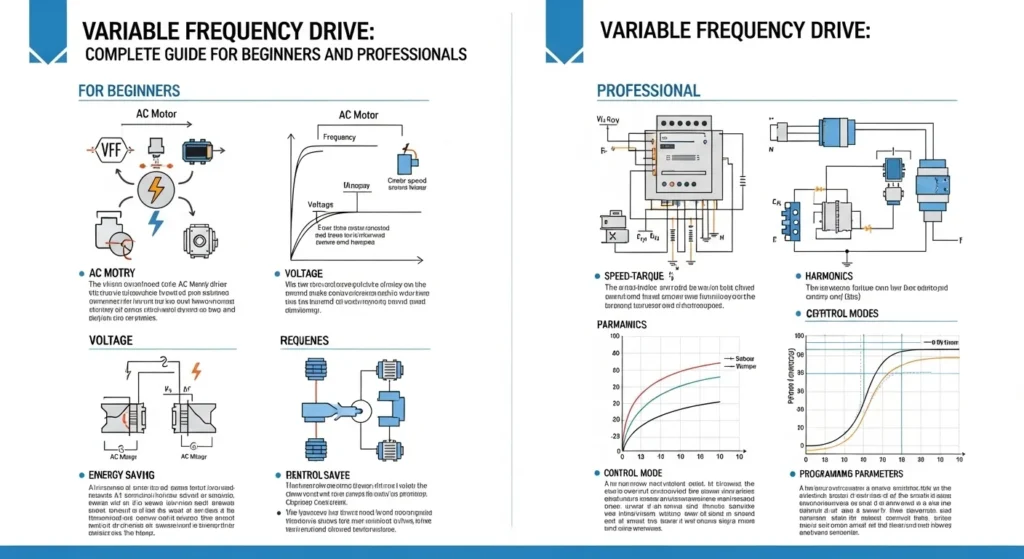

Picture this: A large pump in a water treatment plant runs at full speed all day, even when demand is low. Electricity bills are high, the motor wears out faster, and pressure fluctuates. Now imagine the same pump slowing down automatically to match exact needs—saving 30-50% energy, running quieter, and lasting longer. This is possible thanks to a Variable Frequency Drive (VFD).
As a senior electrical engineer with over 25 years of experience designing and troubleshooting motor control systems, I have installed and maintained hundreds of VFDs in factories, buildings, and water plants. In this guide, you will learn everything you need to know in simple, clear language. We cover what a Variable Frequency Drive is, its working principle, types, main components, Variable Frequency Drive advantages and disadvantages, real-world Variable Frequency Drive applications, selection tips, common problems, and future trends. Whether you are an electrical student, technician, engineer, or just starting out, this article will help you understand and use VFDs confidently.
What is a Variable Frequency Drive?
A Variable Frequency Drive, often called a VFD or AC drive, is an electronic device that controls the speed and torque of an AC electric motor by changing the frequency and voltage of the power supplied to it.
Most AC motors run at a nearly fixed speed when connected directly to mains power (50 or 60 Hz). A VFD converts the fixed-frequency supply into a variable frequency and variable voltage output. This allows the motor to run at any speed from very slow to full speed or even faster in some cases.
Practical example: In an HVAC system, a fan connected to a VFD can run slowly at night when cooling demand is low and speed up during the day. Without a VFD, the fan would always run at full speed, wasting energy and creating noise.
Variable Frequency Drive Working Principle
The Variable Frequency Drive working principle is based on a simple idea: the speed of an AC induction motor depends mainly on the frequency of the supply power. Higher frequency means higher speed.
Here is a step-by-step explanation using an easy analogy:
Think of a VFD as a smart power converter with three main stages, like a water tap that can change both the flow rate and pressure.
- Rectifier stage: Incoming AC power (fixed voltage and frequency) is converted to DC, similar to turning alternating current into a steady stream.
- DC bus / filter stage: The DC is smoothed and stored in capacitors, providing a clean, stable “reservoir” of power.
- Inverter stage: The DC is turned back into AC, but with adjustable frequency and voltage. This is done using fast electronic switches (usually IGBTs) that create a simulated sine wave through pulse width modulation (PWM).
The control unit (microprocessor) decides the exact frequency and voltage needed based on the required motor speed. It constantly monitors and adjusts the output.
In short: Fixed AC → DC → Adjustable AC. This process gives precise control over motor speed without wasting much energy.
Types of Variable Frequency Drives
VFDs are classified in different ways. The most common classification is based on the method of power conversion and control.
Voltage Source Inverter (VSI) Type
This is the most widely used type today. It uses a DC voltage source and creates variable frequency AC output. VSI drives are reliable, cost-effective, and suitable for most general applications like pumps and fans.
Current Source Inverter (CSI) Type
CSI drives use a DC current source. They are less common now but still used in very high-power applications (above 500 HP) where smooth control and regeneration are needed.
Direct Torque Control (DTC) or Sensorless Vector Drives
These advanced types offer excellent torque and speed control without needing a speed sensor on the motor. They are ideal for applications requiring high precision, such as cranes or extruders.
Most modern VFDs you will encounter in the field are VSI-based with vector or sensorless vector control.
Main Components of a Variable Frequency Drive
A typical VFD has several key parts that work together:
- Rectifier: Converts AC to DC using diodes or thyristors.
- DC Bus / Capacitors: Stores and smooths the DC power; acts like a battery bank.
- Inverter: Uses IGBTs (Insulated Gate Bipolar Transistors) to create variable frequency AC output.
- Control Circuit / Microprocessor: The “brain” that runs the software, processes commands, and protects the system.
- Cooling System: Fans or heat sinks to remove heat generated by the electronics.
- User Interface: Display, keypad, or communication ports for setting parameters and monitoring.
- Protection Features: Built-in sensors for overcurrent, overvoltage, overheating, etc.
Understanding these components helps you diagnose issues quickly.
Variable Frequency Drive Advantages and Disadvantages
Advantages
- Saves significant energy by running motors only at the speed needed (often 20-50% savings on pumps and fans).
- Provides smooth soft starting, reducing mechanical stress and extending motor and equipment life.
- Allows precise speed and torque control for better process quality.
- Reduces starting current, which lowers stress on the electrical supply.
- Enables features like ramp-up/ramp-down times, braking, and multi-speed operation.
- Improves power factor and reduces overall electricity demand charges.
Disadvantages and Limitations
- Higher initial cost compared to simple starters like DOL or soft starters.
- Generates electrical harmonics that can affect other equipment (mitigated with filters).
- Requires proper installation, shielding, and sometimes additional reactors or filters.
- Can produce audible noise from the motor due to PWM switching (can be reduced with filters).
- Sensitive to harsh environments like dust, heat, or moisture unless properly enclosed.
- Needs trained personnel for programming and troubleshooting.
When used correctly, the long-term energy savings and reliability usually outweigh the initial drawbacks.
Variable Frequency Drive Applications
Variable Frequency Drive applications are everywhere motors are used.
In homes and commercial buildings: HVAC fans, pumps in water systems, elevators, and escalators.
In industry: Conveyor belts, compressors, mixers, extruders, machine tools, and cranes. Variable torque loads like centrifugal pumps and fans benefit the most from energy savings.
In modern tech: Renewable energy (wind turbines, solar pumps), electric vehicles (similar technology), robotics, and automated manufacturing lines.
From small 0.5 HP drives in workshops to multi-megawatt drives in mines or power plants, VFDs improve efficiency and control across sectors.
Difference Between VFD and Soft Starter
Many people ask about the difference between VFD and soft starter (or VFD vs DOL starter).
Here is a clear comparison table:
| Feature | Variable Frequency Drive (VFD) | Soft Starter | DOL Starter |
|---|---|---|---|
| Speed Control | Full variable speed control throughout operation | Only during startup; fixed speed after | No speed control; full speed only |
| Starting Current | Very low and controlled | Reduced compared to DOL | Very high (6-8 times full load) |
| Energy Savings | Excellent (matches speed to load) | Moderate (mainly during start) | None |
| Torque Control | Precise at all speeds | Limited | None |
| Cost | Higher | Medium | Lowest |
| Best For | Pumps, fans, conveyors needing speed variation | Applications needing smooth start only | Small motors with light load |
In summary, choose a VFD when you need ongoing speed control and energy efficiency. Use a soft starter for smooth starting without speed variation.
Selection Guide for Variable Frequency Drives
Choosing the right VFD is straightforward if you follow these steps:
- Determine the motor’s full load amps (FLA) from the nameplate—size the VFD to match or exceed this current.
- Check voltage rating (e.g., 230V or 480V) and phase (single or three-phase).
- Identify the load type: Variable torque (pumps/fans) or constant torque (conveyors/cranes). Variable torque drives can often be smaller.
- Consider environment: Choose NEMA 1 for clean indoors or NEMA 4X for dusty/wet areas.
- Plan for future needs: Oversize slightly (10-20%) if the motor may be upgraded.
- Look for features like built-in filters, communication (Modbus, Ethernet), and braking options.
- For beginners: Start with a reputable brand, read the manual carefully, and have an experienced technician do the first installation and programming.
Always match the VFD to the motor and application rather than just horsepower.
Common Problems and Solutions
Here are answers to frequent questions I hear from juniors and technicians:
Q: Why does my VFD keep tripping on overcurrent?
A: Check for motor overload, shorted cables, or incorrect acceleration time. Increase ramp time or check motor insulation.
Q: The motor makes a whining noise—how to fix?
A: This is often from PWM carrier frequency. Increase the switching frequency in parameters if the drive allows.
Q: Why is the VFD overheating?
A: Poor ventilation, high ambient temperature, or blocked cooling fans. Clean filters and ensure proper spacing.
Q: Analog signal loss or erratic speed?
A: Check wiring, grounding, and shielding. Use twisted-pair shielded cable for control signals.
Q: What about harmonics or interference with other equipment?
A: Install line reactors or harmonic filters on the input side.
Regular maintenance—cleaning, checking connections, and monitoring temperatures—prevents most issues.
Future Trends in Variable Frequency Drives
The VFD market continues to grow rapidly due to the global focus on energy efficiency. Future trends include:
- Integration with IoT and smart factories for remote monitoring and predictive maintenance.
- Use of wide-bandgap semiconductors (like SiC) for higher efficiency and smaller size.
- Built-in AI for automatic optimization and fault prediction.
- Greater adoption in renewable energy systems and EV charging infrastructure.
- Enhanced harmonic mitigation and regenerative capabilities for energy recovery.
As industries move toward sustainability and automation, VFDs will become even smarter and more essential.
Conclusion
A Variable Frequency Drive is a powerful tool that gives you precise control over AC motors while saving energy and reducing wear. We have covered its clear definition, the Variable Frequency Drive working principle, different types, components, Variable Frequency Drive advantages and disadvantages, wide Variable Frequency Drive applications, comparison with soft starters, selection tips, troubleshooting, and exciting future trends.
Start small—understand your motor and load first. With proper selection and installation, a VFD will pay for itself quickly through energy savings and longer equipment life. Keep learning, practice safe installation, and always follow local electrical codes. Mastering VFDs will make you a more valuable technician or engineer in today’s energy-conscious world.