
Imagine you are installing a three-phase motor in a workshop. You open the motor terminal box and see six terminals with metal links. The nameplate shows: “Star/Delta – 400/690V.” If you connect it incorrectly, the motor may draw excessive current or fail to start properly.
This is where understanding Star and Delta Connection becomes essential.
In three-phase electrical systems, the way we connect windings determines voltage, current, and performance. Star and Delta are the two most common connection methods used in motors, generators, and transformers. Choosing the correct connection directly affects safety, efficiency, and equipment life.
In this article, you will learn the Star and Delta Connection working principle, types, components, applications, advantages and disadvantages, the difference between star and delta connection, selection tips, and troubleshooting guidance. I will explain everything in simple language, just like a senior engineer guiding a junior technician in the field.
What is Star and Delta Connection?
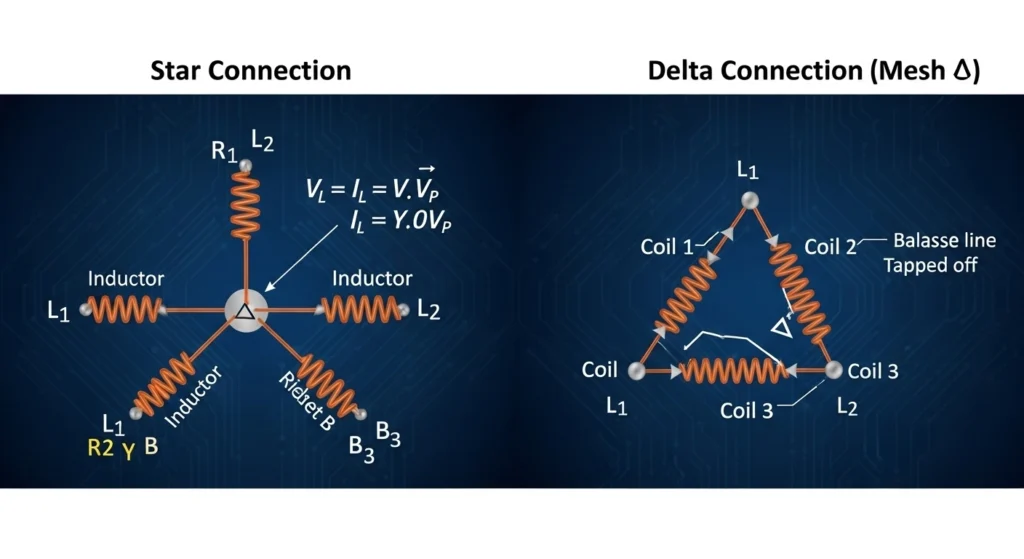
Star and Delta Connection are the two most common methods used to connect the windings of a three-phase electrical system. These connection methods determine how voltage and current are distributed throughout the circuit and directly affect the performance, efficiency, and application of electrical equipment such as transformers, generators, and three-phase induction motors.
Although both connections use the same three-phase supply, they differ in the way the windings are interconnected. This difference influences the phase voltage, line voltage, phase current, line current, starting current, power output, and overall operating characteristics of the system. Choosing the correct connection is essential for ensuring safe, efficient, and reliable operation of electrical equipment.
Star and Delta connections are widely used in residential, commercial, and industrial power systems. Electrical engineers and technicians must understand these configurations because they are fundamental concepts in electrical engineering and are frequently encountered in power generation, transmission, distribution, and motor control applications.
Simple Definition of Star Connection (Y Connection)
A Star Connection, also called a Y Connection, is a three-phase winding configuration in which one end of each of the three windings is connected together to form a common point called the neutral point, while the remaining three ends are connected to the three-phase power supply.
The neutral point allows the system to provide both three-phase and single-phase power. Because the voltage across each winding is lower than the line voltage, the star connection reduces insulation requirements and improves safety. For this reason, it is widely used in electrical transmission and distribution networks, large transformers, generators, and motor starting applications.
In a star-connected system:
- Three windings share one common neutral point.
- The system can have three or four wires depending on whether the neutral is used.
- Phase voltage is lower than line voltage.
- It is suitable for high-voltage applications.
- Starting current is comparatively lower.
- It provides better protection and stability for electrical equipment.
Simple Definition of Delta Connection (Δ Connection)
A Delta Connection, represented by the Greek letter Δ (Delta), is a three-phase winding configuration in which the end of each winding is connected to the beginning of the next winding, forming a closed triangular loop. There is no neutral point in this configuration.
Since each winding is directly connected across the line voltage, the equipment receives full voltage, enabling it to deliver maximum power and torque. Delta connections are commonly used in industrial motors, heavy machinery, manufacturing plants, compressors, pumps, and other high-power applications.
In a delta-connected system:
- The three windings form a closed loop.
- There is no neutral connection.
- Each winding receives the full line voltage.
- Higher starting current is drawn.
- It delivers greater output power and torque.
- It is widely used for heavy industrial loads.
Simple Explanation
To understand Star and Delta connections, imagine a three-phase electrical system containing three separate coils or windings. The performance of the system depends on how these three windings are connected.
In a Star Connection, one end of each winding is joined together at a common neutral point. The other ends are connected to the three-phase supply lines. Because the voltage is divided between the windings, each winding operates at a lower voltage, resulting in reduced current during startup. This makes the star connection ideal for safely starting large motors and for supplying electricity over long distances.
In a Delta Connection, the windings are connected end-to-end, creating a continuous closed loop shaped like a triangle. Since every winding is connected directly across the supply voltage, each winding receives the full line voltage. This allows the motor or transformer to produce its maximum rated power, making delta connection suitable for normal running conditions and heavy-load applications.
The main difference is that Star Connection focuses on reducing voltage and starting current, while Delta Connection provides full voltage and maximum power output.
Practical Example
A common real-world application of Star and Delta connections is the Star-Delta Starter, which is widely used to start large three-phase induction motors.
When a large motor starts directly on a three-phase supply, it can draw six to eight times its normal operating current. This high inrush current may cause voltage drops, overheating, and stress on electrical equipment.
To overcome this problem, the motor is initially connected in Star Connection.
During this stage:
- Each winding receives lower voltage.
- Starting current is significantly reduced.
- Starting torque is lower.
- Mechanical and electrical stress is minimized.
- The motor accelerates smoothly.
After the motor reaches approximately 80–90% of its rated speed, the starter automatically changes the winding connection from Star to Delta.
Once switched to Delta:
- Each winding receives the full line voltage.
- The motor develops full torque.
- Full rated power becomes available.
- The motor operates efficiently under normal load conditions.
This automatic switching process is called a Star-Delta Starter, and it is commonly used in:
- Water pumps
- Air compressors
- Industrial fans
- Conveyor systems
- Crushers
- HVAC equipment
- Manufacturing machines
The Star-Delta starter is one of the most economical and widely used motor starting methods because it reduces starting current while allowing the motor to operate at full power after startup.
Why Understanding Star and Delta Connection is Important
Star and Delta connections are among the most fundamental concepts in three-phase electrical engineering. They affect voltage levels, current flow, power output, efficiency, motor starting performance, and system safety. Understanding these two connection methods helps electrical students, engineers, and technicians correctly select, install, operate, and troubleshoot three-phase motors, transformers, generators, and power distribution systems in residential, commercial, and industrial applications.
3. Star and Delta Connection Working Principle
The Star and Delta Connection working principle depends on how voltage and current are distributed across windings.
Let us understand step-by-step.
Star Connection (Y-Connection): Construction, Working Principle, Characteristics, Advantages, Disadvantages, and Applications
A Star Connection, also known as a Y-Connection, is one of the most widely used methods of connecting the windings of a three-phase electrical system. In this configuration, one end of each of the three windings is connected together to form a common point called the neutral point (N), while the remaining three ends are connected to the three-phase supply lines (R, Y, and B).
The star connection is extensively used in power generation, transmission, distribution systems, transformers, generators, and three-phase induction motors because it provides a neutral point, supports both single-phase and three-phase loads, and offers better voltage regulation. Due to its lower phase voltage, it also reduces insulation requirements, making it economical and safer for high-voltage applications.
One of the major advantages of a star-connected system is that it provides two different voltage levels. The voltage measured between any phase and the neutral point is called the phase voltage, while the voltage measured between any two phase lines is called the line voltage. In a balanced three-phase system, the line voltage is √3 (1.732) times greater than the phase voltage, whereas the line current is equal to the phase current.
Because of these characteristics, star connection is commonly used in electrical distribution networks where different voltage levels are required for industrial, commercial, and residential consumers.
What Is Star Connection?
A star connection (Y-connection) is a three-phase electrical connection in which one end of each of the three windings is connected to a common point called the neutral point. The other ends of the windings are connected to the three-phase supply lines.
In a star connection, the voltage across each individual winding is lower than the line voltage. This makes the connection useful when a system needs reduced starting current and lower phase voltage. Star connections are commonly used in three-phase motors, transformers, generators, and electrical distribution systems.
For a balanced three-phase star connection:
- Line Voltage = √3 × Phase Voltage
- Line Current = Phase Current
For example, if the line voltage is 400 V, the voltage across each phase winding is approximately 230 V.
Star connection is also commonly used during motor starting because it can reduce the voltage applied to the motor windings and therefore reduce starting current.
Construction of Star Connection
The construction of a star connection is simple and consists of three identical windings or loads connected in a specific arrangement.
In this configuration:
- Three separate windings are used.
- One end of each winding is connected together to form a common neutral point (N).
- The remaining three ends are connected to the three-phase supply lines (R, Y, and B).
- The system may operate with three wires (without neutral) or four wires (with neutral), depending on the application.
- The neutral point can be grounded to improve system safety and fault protection.
This arrangement forms a shape similar to the English letter “Y”, which is why it is called a Y-Connection.
Working Principle of Star Connection
The working principle of a star connection is based on the flow of three-phase alternating current through three separate windings connected to a common neutral point.
When a balanced three-phase AC supply is applied:
- Each phase voltage appears across its respective winding.
- Current flows from each phase conductor through the connected load.
- After passing through the load, the current returns through the neutral point in balanced or unbalanced conditions.
- Since the three phase currents are displaced by 120 electrical degrees, their vector sum becomes zero under balanced load conditions, resulting in no current flowing through the neutral conductor.
- If the loads become unequal, the neutral wire carries the unbalanced current, maintaining stable voltages across all phases.
The neutral connection is one of the biggest advantages of the star configuration because it helps stabilize the system and allows both single-phase and three-phase loads to operate simultaneously.
Electrical Characteristics of Star Connection
A star-connected system has several important electrical characteristics that distinguish it from a delta-connected system.
Voltage Relationship
- Phase Voltage (Vph): Voltage between any phase and the neutral.
- Line Voltage (VL): Voltage between any two phase conductors.
The relationship is:
Line Voltage = √3 × Phase Voltage
or
VL = √3 × Vph
For example, if the phase voltage is 230 V, the line voltage will be approximately 400 V.
Current Relationship
In a star connection:
Line Current = Phase Current
or
IL = Iph
This means the current flowing through each supply line is exactly the same as the current flowing through each winding.
Key Features of Star Connection
- One end of all three windings is connected to a common neutral point.
- Provides both phase voltage and line voltage.
- Line voltage is √3 times greater than phase voltage.
- Line current is equal to phase current.
- Supports both single-phase and three-phase power supply.
- Neutral point can be grounded for improved electrical safety.
- Lower insulation requirements due to reduced phase voltage.
- Suitable for high-voltage transmission and distribution systems.
- Can operate with balanced and unbalanced loads.
- Offers better voltage regulation and system stability.
Advantages of Star Connection
The Star Connection (Y-Connection) offers several electrical, operational, and safety advantages, making it one of the most widely used three-phase connection methods in power systems. Its ability to provide a neutral point, operate at different voltage levels, and support both single-phase and three-phase loads makes it ideal for power generation, transmission, distribution, and industrial applications.
1. Provides a Neutral Point
One of the biggest advantages of a star connection is the presence of a neutral point, which can be grounded for improved electrical safety. The neutral conductor provides a return path for current during unbalanced load conditions and helps stabilize system voltage. It also protects electrical equipment and personnel from dangerous fault currents.
2. Supports Both Single-Phase and Three-Phase Loads
A star-connected system can supply both single-phase and three-phase electrical loads from the same power source. Single-phase consumers receive power between any phase and the neutral, while three-phase equipment operates using all three phases. This flexibility makes star connection suitable for residential, commercial, and industrial power distribution.
3. Lower Insulation Requirement
In a star connection, each winding is subjected only to the phase voltage, which is lower than the line voltage. Since the voltage across each winding is reduced, less insulation is required, resulting in lower manufacturing costs and improved equipment reliability.
4. Suitable for High-Voltage Applications
Because the phase voltage is lower than the line voltage, star connection is highly suitable for high-voltage transmission and distribution systems. It reduces electrical stress on the windings and insulation, making it safer and more economical for long-distance power transmission.
5. Better Voltage Stability
The neutral conductor helps maintain balanced voltages even when the connected loads are unequal. This improves voltage regulation, reduces voltage fluctuations, and ensures a more stable power supply throughout the electrical network.
6. Improved Electrical Safety
Grounding the neutral point minimizes the risk of electric shock and protects electrical equipment from insulation failure, overvoltage, and earth faults. This makes star-connected systems safer for both operators and connected devices.
7. Easier Fault Detection and Protection
The presence of a neutral conductor makes it easier to detect ground faults, earth leakage, and other system abnormalities. Protective devices such as circuit breakers, relays, and earth fault protection systems operate more effectively in star-connected networks.
8. Reduced Starting Current in Motors
When a three-phase induction motor is connected in star during startup, each winding receives lower voltage. As a result, the motor draws significantly less starting current, reducing voltage drops and minimizing stress on the electrical supply system.
9. Ideal for Long-Distance Power Distribution
Star connection is widely used in electrical distribution networks because it efficiently supplies electricity over long distances while maintaining voltage stability and reducing insulation requirements.
Disadvantages of Star Connection
Although the star connection provides many advantages, it also has certain limitations that should be considered when selecting a three-phase connection method.
1. Requires an Additional Neutral Conductor
A four-wire star system requires an extra neutral wire, increasing the amount of conductor material, installation complexity, and overall wiring cost.
2. Lower Starting Torque
Since each motor winding receives only the phase voltage during star connection, the starting torque is lower than that of a delta-connected motor. This makes star connection unsuitable for applications requiring high starting torque.
3. Sensitive to Load Imbalance
If the loads connected to each phase are not evenly distributed, the neutral conductor carries the unbalanced current. Excessive load imbalance may cause voltage fluctuations and reduce overall system performance.
4. Lower Power Output
Each winding operates at phase voltage rather than full line voltage, resulting in lower power output compared to a delta-connected system operating under the same supply conditions.
5. Not Suitable for Heavy Starting Loads
Machines such as crushers, compressors, and heavy conveyors often require high starting torque. A star connection alone may not provide sufficient torque for these applications, which is why many motors switch from star to delta after startup.
6. Neutral Conductor May Carry Current
Under unbalanced load conditions, the neutral wire carries current, which can lead to additional power losses if the imbalance becomes significant.
Applications of Star Connection
Because of its flexibility, safety, and ability to provide multiple voltage levels, the star connection is widely used in electrical power systems across residential, commercial, and industrial sectors.
Power Generation Stations
Three-phase alternators in power plants are commonly connected in star configuration to provide a neutral point and facilitate efficient power transmission.
Power Transmission and Distribution Networks
Star connection is extensively used in transmission and distribution systems because it supports high-voltage operation, reduces insulation requirements, and provides stable voltage regulation.
Electrical Substations
Power transformers installed in substations often use star connection on the high-voltage side to improve grounding, reduce insulation costs, and enhance system protection.
Residential and Commercial Electrical Supply
Four-wire star systems provide both 230 V single-phase and 400 V three-phase supplies, making them ideal for homes, offices, schools, hospitals, and commercial buildings.
Three-Phase Transformers
Star-connected transformers provide a neutral point and are widely used in electrical substations and distribution networks.
Three-Phase Generators
Most synchronous generators use star connection because it allows grounding of the neutral and provides multiple output voltage options.
Three-Phase Induction Motors
Large induction motors are initially connected in star configuration during startup to reduce inrush current before switching to delta for normal operation using a Star-Delta Starter.
Industrial Power Systems
Manufacturing plants, factories, processing industries, and large commercial facilities use star-connected systems for safe, reliable, and efficient power distribution.
Renewable Energy Systems
Wind turbines, solar power plants, and other renewable energy installations often use star-connected transformers and generators to integrate electricity into the power grid.
Why Star Connection is Widely Used
Star connection has become one of the most important and widely adopted three-phase electrical configurations because it offers an excellent combination of safety, efficiency, flexibility, and reliability. The presence of a neutral point allows effective grounding, improves fault protection, and enables the system to supply both single-phase and three-phase loads simultaneously. Its lower phase voltage reduces insulation requirements, making it economical for high-voltage applications while extending the life of electrical equipment.
Another major advantage is its ability to maintain stable voltage under varying load conditions, which is essential for modern power systems. Star connection is extensively used in power plants, transmission lines, substations, transformers, generators, distribution networks, and motor starting applications because it ensures smooth operation, better voltage regulation, and enhanced system protection.
For these reasons, understanding the construction, working principle, characteristics, advantages, disadvantages, and applications of Star Connection is essential for electrical engineering students, technicians, electricians, and professionals involved in designing, operating, and maintaining three-phase electrical systems.
Delta Connection (Δ Connection): Construction, Working Principle, Characteristics, Advantages, Disadvantages, and Applications
A Delta Connection (Δ Connection), also known as a Mesh Connection, is one of the two standard methods used to connect the windings of a three-phase electrical system. In this configuration, the end of each phase winding is connected to the beginning of the next winding, forming a closed loop that resembles the Greek letter Delta (Δ) or a triangle.
Unlike a star connection, a delta connection does not have a neutral point. The three windings are connected directly between the three supply lines (R, Y, and B), allowing each winding to receive the full line voltage. Because of this, delta-connected systems can deliver higher power output and produce greater starting torque, making them ideal for heavy-duty industrial applications.
Delta connection is widely used in three-phase induction motors, transformers, generators, industrial machinery, compressors, pumps, conveyors, and manufacturing plants where high efficiency, reliable performance, and maximum power are required. Its ability to continue operating even if one winding becomes faulty (known as open-delta operation in transformers) also improves system reliability in certain applications.
What Is Delta Connection?
A delta connection (Δ-connection) is a three-phase electrical connection in which the three windings are connected end-to-end to form a closed loop that looks like a triangle. Each corner of the triangle is connected to one of the three-phase supply lines.
Unlike a star connection, a delta connection does not normally have a neutral point. Each winding is directly connected across the line voltage, making delta connections suitable for applications that require higher torque and full phase voltage.
For a balanced three-phase delta connection:
- Line Voltage = Phase Voltage
- Line Current = √3 × Phase Current
Delta connections are commonly used in three-phase motors, transformers, generators, and industrial electrical systems. They are especially useful in motor applications where higher starting torque and full voltage operation are required.
Construction of Delta Connection
The construction of a delta connection is straightforward and consists of three identical windings connected in a continuous closed loop.
In this configuration:
- Three phase windings are used.
- The end of the first winding is connected to the beginning of the second winding.
- The end of the second winding is connected to the beginning of the third winding.
- The end of the third winding is connected to the beginning of the first winding.
- The three junction points are connected to the three-phase supply lines (R, Y, and B).
- No neutral point or neutral conductor is provided.
The arrangement forms a triangular (Δ-shaped) circuit, which gives the connection its name.
Working Principle of Delta Connection
The working principle of a delta connection is based on supplying full line voltage directly across each winding.
When a balanced three-phase AC supply is connected:
- Each winding is connected between two supply lines.
- Every winding receives the full line voltage.
- Current flows through each winding and circulates around the closed triangular loop.
- Since the three phase currents are displaced by 120 electrical degrees, the resulting line current becomes greater than the current flowing through each individual winding.
- The motor or transformer receives maximum electrical power, allowing it to deliver higher torque and improved performance under heavy loads.
Because each winding receives the complete line voltage, delta-connected equipment produces greater output power and higher efficiency than star-connected equipment operating under the same supply conditions.
Electrical Characteristics of Delta Connection
A delta-connected system has unique voltage and current relationships.
Voltage Relationship
In a delta connection:
- Phase Voltage (Vph) is equal to the Line Voltage (VL).
Therefore,
Line Voltage = Phase Voltage
or
VL = Vph
This means each winding receives the full supply voltage.
Current Relationship
The current flowing through each line is greater than the current flowing through each winding.
The relationship is:
Line Current = √3 × Phase Current
or
IL = √3 × Iph
Because of the higher line current, delta-connected systems can deliver greater power and are suitable for heavy industrial applications.
Key Features of Delta Connection
- Windings are connected in a closed triangular (Δ) loop.
- No neutral point is available.
- Operates with only three phase conductors.
- Each winding receives the full line voltage.
- Line voltage is equal to phase voltage.
- Line current is √3 times the phase current.
- Produces high starting torque.
- Delivers greater output power than a star connection.
- Performs well under heavy electrical loads.
- Widely used in industrial power systems and motor applications.
Advantages of Delta Connection
Delta connection offers several important advantages, especially in applications requiring high power and reliable performance.
1. High Starting Torque
Since each winding receives the full line voltage, delta-connected motors produce significantly higher starting torque. This makes them suitable for heavy-duty machines that require strong starting performance.
2. Higher Power Output
Delta-connected equipment delivers maximum rated power because every winding operates at the full supply voltage.
3. Suitable for Heavy Industrial Loads
Delta connection is ideal for factories, manufacturing plants, mining operations, and other industries where motors operate under heavy mechanical loads.
4. No Neutral Wire Required
The absence of a neutral conductor simplifies the wiring system and reduces installation costs for many industrial applications.
5. Better Performance Under Unbalanced Loads
Delta-connected systems can continue operating more effectively under moderate load imbalance compared to some star-connected systems.
6. Improved Motor Efficiency
Three-phase induction motors connected in delta operate more efficiently during normal running conditions and provide stable power output.
7. Can Continue Operating with Open Delta
In transformer applications, a delta-connected bank can continue supplying three-phase power even if one transformer is removed or becomes faulty by operating in an Open Delta (V-V) configuration, although at reduced capacity.
Disadvantages of Delta Connection
Despite its advantages, delta connection also has some limitations.
1. No Neutral Point
Since there is no neutral connection, delta systems cannot directly supply single-phase loads that require a neutral conductor.
2. Not Suitable for Residential Distribution
Because of the absence of a neutral wire, delta connection is generally unsuitable for domestic and commercial power distribution where both single-phase and three-phase supplies are needed.
3. Higher Insulation Requirement
Each winding receives the full line voltage, requiring stronger insulation compared to a star-connected winding.
4. Higher Starting Current
Delta-connected motors draw higher inrush current during startup, which may cause voltage drops in the electrical network if started directly.
5. More Difficult Fault Detection
Ground faults and insulation failures can be more difficult to identify because there is no neutral reference point.
6. Greater Thermal Stress
Higher operating currents and full voltage across each winding increase heating, requiring effective cooling and proper motor protection.
Applications of Delta Connection
Delta connection is widely used wherever high power, high efficiency, and strong motor performance are required.
Three-Phase Induction Motors
Most industrial induction motors operate in delta connection during normal running because it provides maximum power and torque.
Industrial Manufacturing Plants
Factories use delta-connected motors to drive conveyors, crushers, mixers, rolling mills, and production machinery.
Pumping Stations
Large water pumps and irrigation systems use delta-connected motors to provide the high torque needed for continuous operation.
Air Compressors
Industrial compressors require high starting torque, making delta connection an ideal choice.
HVAC Systems
Large chillers, ventilation fans, and refrigeration compressors often operate using delta-connected motors.
Heavy Machinery
Construction equipment, mining machinery, and processing plants commonly use delta-connected motors because of their high power capability.
Three-Phase Transformers
Delta connection is frequently used on transformer windings to improve reliability, reduce harmonic currents, and support heavy industrial loads.
Power Transmission and Distribution
Delta-connected transformers are widely used in medium-voltage and industrial power systems where a neutral connection is not required.
Why Delta Connection is Widely Used
Delta connection is one of the most important configurations in three-phase electrical engineering because it provides maximum power output, high starting torque, excellent efficiency, and reliable operation under heavy-load conditions. Since each winding receives the full line voltage, delta-connected motors and transformers can deliver superior performance in demanding industrial environments.
Its simple three-wire configuration, ability to handle high currents, and suitability for heavy machinery make it the preferred choice for industries such as manufacturing, mining, oil and gas, water treatment, HVAC, and large-scale processing plants. For these reasons, understanding the construction, working principle, electrical characteristics, advantages, disadvantages, and applications of Delta Connection is essential for electrical engineering students, technicians, electricians, and professionals working with three-phase electrical systems.
Difference Between Star and Delta Connection
| Feature | Star Connection | Delta Connection |
|---|---|---|
| Neutral Point | Present | Not available |
| Wiring | 4 wires (3 phase + neutral) | 3 wires only |
| Voltage | Line voltage = √3 × phase voltage | Line voltage = phase voltage |
| Current | Line current = phase current | Line current = √3 × phase current |
| Use | Distribution systems | Power and industrial loads |
Delta connection is a powerful and efficient three-phase system used mainly in industrial applications. It provides high performance, strong torque, and reliable operation for heavy electrical loads. While it does not offer a neutral point like star connection, its strength and efficiency make it ideal for motors and power systems.
Understanding both star and delta connections is essential for electrical students, engineers, and technicians working with three-phase systems.
- Three windings are connected end-to-end.
- They form a closed triangle (loop).
- Three supply lines are connected at each junction.
- Line voltage equals phase voltage.
- Line current is √3 times the phase current.
Easy Analogy
Think of three water pumps:
- In Star, all pumps share a common return pipe.
- In Delta, each pump connects to the next in a circular loop.
The arrangement changes how pressure (voltage) and flow (current) behave.
4. Types / Classification
4.1 Star (Y) Connection
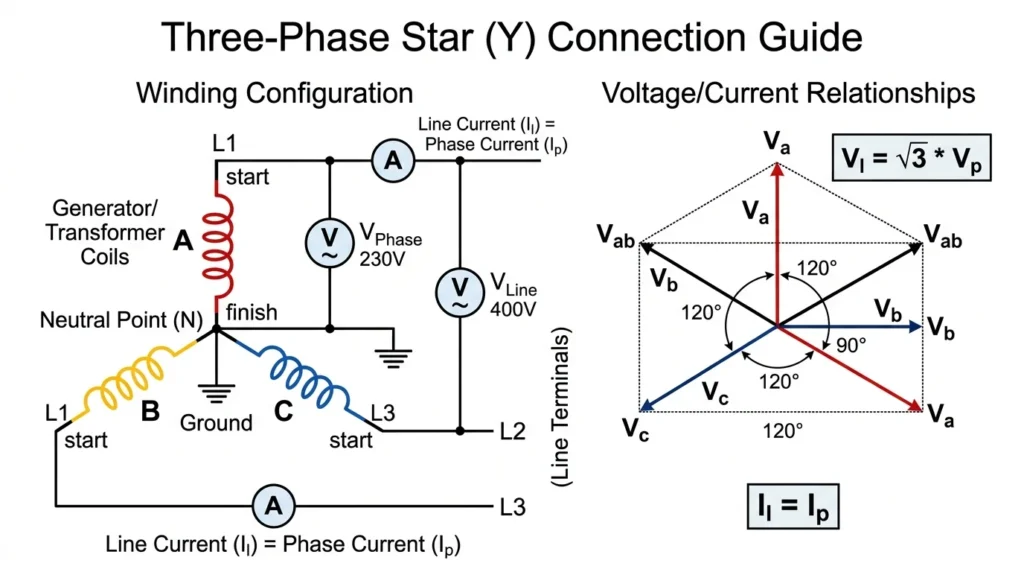
A star connection, also called a Y connection, is a method of connecting three-phase electrical systems in which one end of each phase winding is joined together to form a common neutral point. The other ends of the three windings are connected to the three-phase supply lines. This type of connection is widely used in power generation, transmission, and distribution systems because it provides both line voltage and phase voltage. In a star connection, the voltage between any two lines is called line voltage, while the voltage between a line and the neutral point is called phase voltage. The line voltage is greater than the phase voltage by a factor of √3. One major advantage of the star connection is the availability of a neutral wire, which allows both three-phase and single-phase loads to operate from the same system. It also requires less insulation because the phase voltage is lower than the line voltage. Star connections are commonly used in transformers, alternators, motors, and residential power distribution systems. In electrical motors, star connection helps reduce starting current, making it useful for starting large induction motors safely. However, the torque produced during starting is lower compared to delta connection. Proper balancing of loads is important in star-connected systems to maintain stable operation and prevent voltage imbalance. Maintenance and correct wiring are also essential for safe and efficient performance. Overall, the star (Y) connection is an important three-phase electrical configuration that offers flexibility, safety, and efficient power distribution in industrial, commercial, and domestic applications.
In Star connection:
- Neutral point is available.
- Suitable for high-voltage, low-current applications.
- Common in power distribution systems.
Used where neutral grounding is required.
4.2 Delta (Δ) Connection
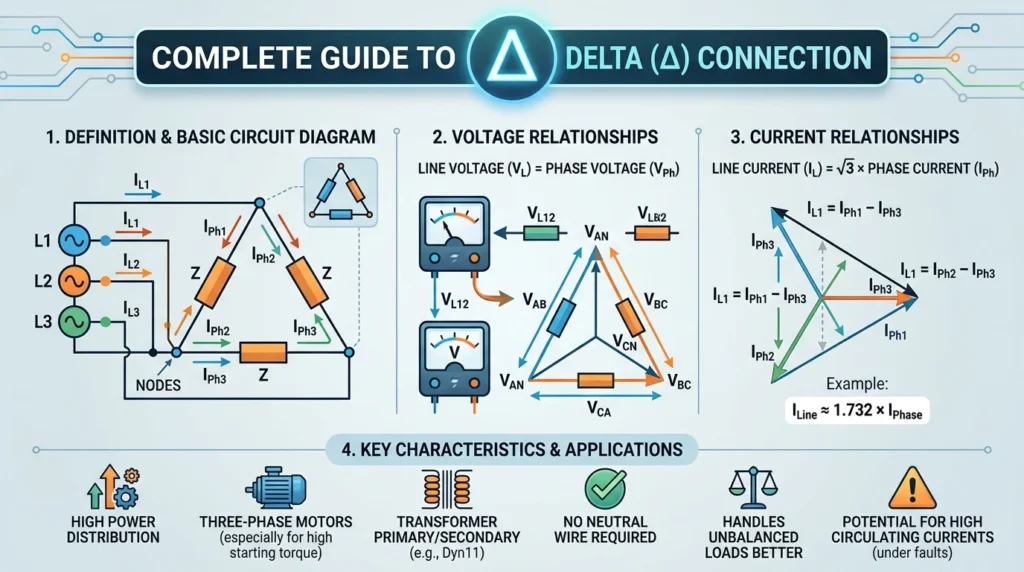
A delta (Δ) connection is a method of connecting three-phase electrical windings in which the end of each winding is connected to the start of the next winding, forming a closed loop or triangular shape. This connection is widely used in three-phase power systems, especially in industrial motors, transformers, and heavy electrical equipment. In a delta connection, the three phases are connected directly across the supply lines, and there is no neutral point. The voltage across each winding is equal to the line voltage, while the line current is greater than the phase current by a factor of √3. Delta connection is commonly preferred where high starting torque and strong motor performance are required. One of the major advantages of a delta connection is that it can deliver more power and operate efficiently under heavy loads. It also provides better performance in industrial machines such as compressors, pumps, conveyors, and large induction motors. Another benefit is that if one winding becomes faulty, the system can sometimes continue operating in an open delta arrangement with reduced capacity. However, delta systems do not provide a neutral wire, so they are less suitable for single-phase loads. The starting current in delta-connected motors is also higher compared to star-connected motors, which may cause voltage drops if not controlled properly. Proper insulation, balancing of loads, and regular maintenance are important for safe operation. Overall, the delta (Δ) connection is an efficient and reliable three-phase electrical configuration that is widely used in industrial and commercial power systems requiring high power, strong torque, and stable operation.
In Delta connection:
- No neutral point.
- Suitable for low-voltage, high-current applications.
- Common in motors and industrial loads.
Provides better torque in motors.
4.3 Star-Delta Starter
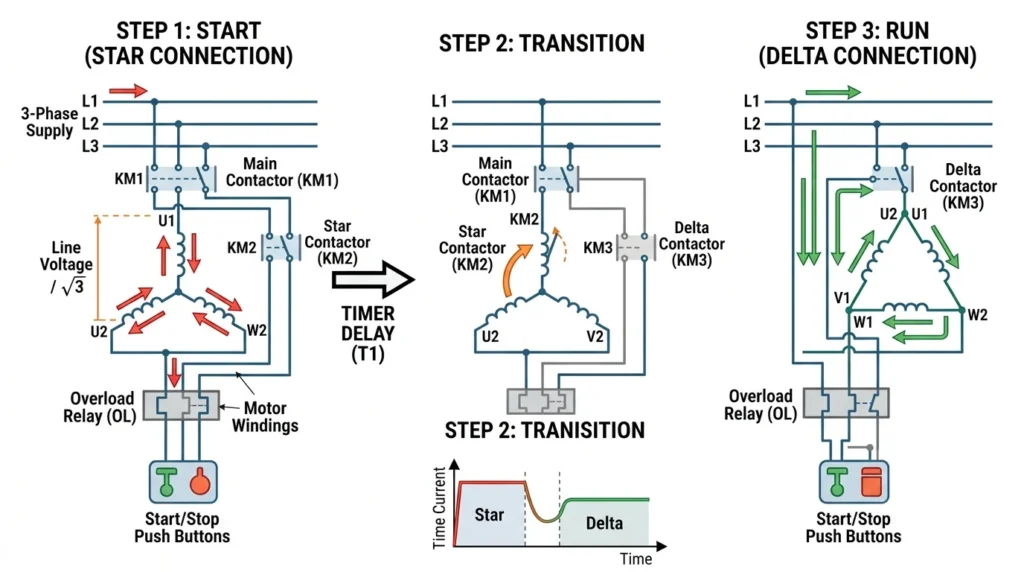
A star-delta starter is a type of motor starter used to reduce the starting current of three-phase induction motors. It is one of the most common and economical methods used for starting large motors safely in industrial applications. In this method, the motor initially starts in star (Y) connection and then automatically changes to delta (Δ) connection after reaching a certain speed. This reduces the high inrush current that normally occurs during motor starting. When the motor starts in star connection, each motor winding receives lower voltage, which decreases the starting current and protects the electrical system from sudden overload. After the motor gains sufficient speed, the starter switches the winding connection to delta mode, allowing the motor to operate at full voltage and full power. A star-delta starter mainly consists of three contactors, a timer, overload protection, and push buttons for control. It is widely used in pumps, compressors, conveyors, fans, blowers, and industrial machinery where large motors are required. One of the major advantages of a star-delta starter is that it reduces starting current, minimizes voltage drops, and increases motor life by providing smoother starting. It is also simple, reliable, and cost-effective compared to some advanced motor starting methods. However, the starting torque produced in star connection is lower, which makes it less suitable for heavy-load starting applications. Proper wiring, maintenance, and timer adjustment are important for safe and efficient operation. Overall, the star-delta starter is an important motor control device that improves the safe operation and performance of three-phase induction motors in industrial and commercial electrical systems.
A combination method used in motors.
- Motor starts in Star (reduced current).
- Then switches to Delta (full power).
This reduces starting current and mechanical stress.
5. Main Components
To understand Star and Delta systems, you must know their key elements.
5.1 Three-Phase Windings: Working Principle, Types, and Importance in Electrical Systems
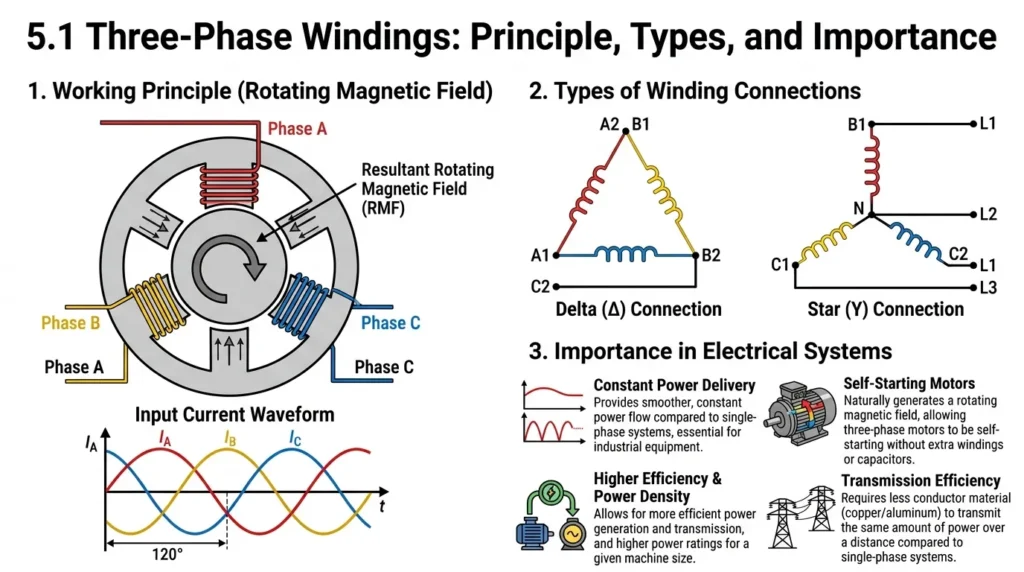
- Three separate coils
- 120° electrical phase difference
- Create rotating magnetic field in motors
- Three-Phase Windings
- Three-phase windings are an important part of electrical machines such as motors and generators. They consist of three separate windings placed inside the stator, arranged 120° apart from each other. These windings are designed to carry three alternating currents of equal magnitude but with a phase difference of 120°.
- When a three-phase supply is applied, each winding produces a magnetic field. These magnetic fields combine to create a rotating magnetic field, which is essential for the smooth and continuous operation of electrical machines like induction motors.
- Three-phase windings are commonly used in industrial power systems because they provide higher efficiency, constant power output, and better performance compared to single-phase systems. They also help reduce vibration and ensure smoother torque in rotating machines.
- In short, three-phase windings play a key role in converting electrical energy into mechanical energy efficiently and reliably in modern electrical systems.
5.2 Neutral Point in Star Connection (Y-Connection): Function and Electrical Significance
- Common junction point
- Allows grounding
- Provides phase-to-neutral voltage
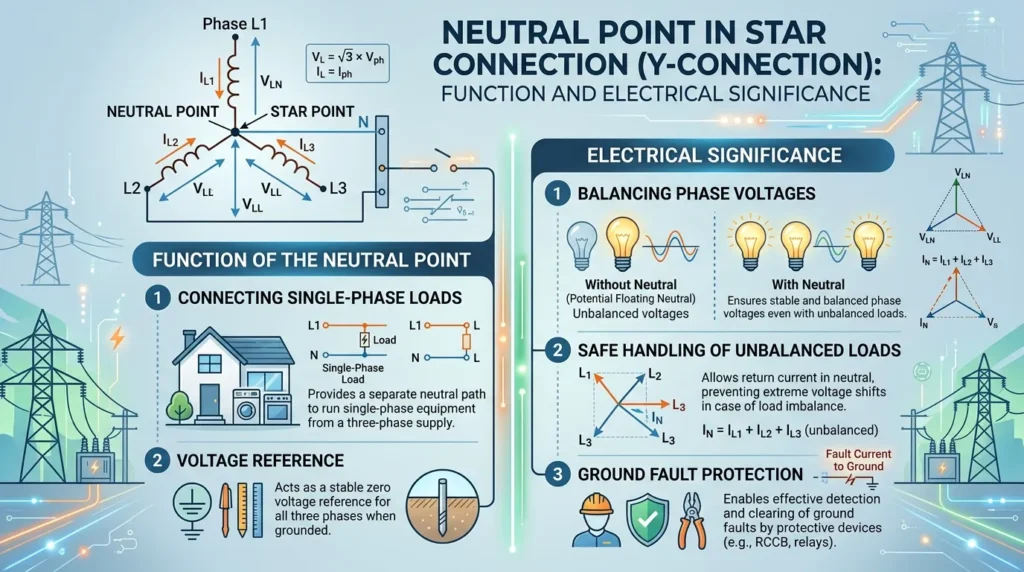
In a star (Y) connection, the neutral point is the common point where one end of all three phase windings is joined together. This point is called the neutral because it acts as a reference point for the system and is usually connected to the ground for safety and stability.
The main purpose of the neutral point is to provide a return path for unbalanced currents in a three-phase system. When the load on all three phases is not equal, the neutral wire carries the imbalance current, helping to maintain system balance and smooth operation.
In a perfectly balanced system, no current flows through the neutral point because the three-phase currents cancel each other out. However, in real-world applications, loads are often unbalanced, so the neutral point becomes very important for safe and efficient power distribution.
Overall, the neutral point plays a key role in improving system reliability, protecting equipment, and ensuring stable voltage in star-connected electrical systems.
5.3 Line Conductors: Function, Types, and Role in Three-Phase Electrical Systems
- Three supply wires (R, Y, B)
- Carry current from source
Line conductors are the three electrical wires in a three-phase power system that carry current from the source (generator or transformer) to the load. These conductors are directly connected to the external terminals of a three-phase system and are responsible for delivering electrical power to the equipment.
In both star (Y) and delta (Δ) connections, line conductors play a very important role. In a star connection, line conductors are connected to the ends of each phase winding, while in a delta connection, they are connected at the junctions of the windings.
The voltage between any two line conductors is called line voltage, and the current flowing through them is known as line current. These values are very important in power system calculations and machine performance.
Line conductors are designed to carry high current safely and efficiently, so they are usually made of highly conductive materials like copper or aluminum. They ensure smooth and continuous power distribution in electrical systems.
5.4 Terminal Links in Motor Applications: Construction, Working, and Industrial Uses
- Metal connectors
- Used to configure Star or Delta
- Located inside motor terminal box
Each component plays an important role in system performance.
Terminal links in motor applications are the connection points inside an electric motor where the stator windings are joined and connected to the external power supply. These links are usually arranged in a terminal box, which is mounted on the motor body for safe and easy access. The construction typically includes brass or copper terminals, insulating plates, and connecting straps or links that allow different wiring configurations such as star (Y) or delta (Δ).
The working of terminal links is based on establishing proper electrical connections between motor windings and the supply system. By changing the position of these links, the motor can be configured to operate in different connection modes. For example, in star connection, the links are arranged to join one end of each winding together, while in delta connection, they are connected end-to-end to form a closed loop. This flexibility helps control starting current, torque, and performance of the motor.
In industrial applications, terminal links are widely used in three-phase induction motors, pumps, compressors, conveyor systems, and heavy machinery. They allow safe switching between star and delta configurations, which helps in reducing starting current and improving efficiency. Overall, terminal links play a crucial role in motor control, protection, and reliable operation in electrical systems.
Star and Delta Connection: Complete Comparison Table
| Feature | Star Connection (Y) | Delta Connection (Δ) |
|---|---|---|
| Voltage Level | Lower phase voltage | Full line voltage applied |
| Neutral Point | Available (used for grounding & unbalanced loads) | Not available |
| Starting Current | Low starting current | High starting current |
| Starting Torque | Low torque in motors | High starting torque |
| Insulation Requirement | Less insulation stress | High insulation stress |
| Load Handling | Suitable for light to medium loads | Suitable for heavy loads |
| Power Output | Lower power output | Higher power output |
| System Performance | Best for balanced systems | Can run in open delta (reduced capacity) |
| Applications | Transmission, distribution, light motor loads | Industrial motors, heavy machinery |
| Disadvantages | Low torque, not suitable for heavy loads, limited power output | High starting current, more heating, no neutral point, higher stress |
Star and Delta Connection Applications in Electrical Systems
The applications of Star and Delta connections are widely used in modern electrical power systems, industries, and machines. Each connection type is selected based on voltage level, load requirement, and system performance.
8.1 Power Distribution Systems
- Star connection is commonly used in substations
- It provides a neutral point for domestic and commercial supply
- Ensures safe and balanced voltage distribution
8.2 Three-Phase Motors
- Star connection is used during motor starting to reduce current
- Delta connection is used during normal running condition
- Helps improve efficiency and control starting torque
8.3 Transformers
- Star-Delta configurations are widely used in transformers
- Used for step-up and step-down voltage conversion
- Helps in efficient power transmission over long distances
8.4 Generators
- Star connection is preferred for grounding purposes
- Improves system stability and safety
- Ensures balanced output voltage
8.5 Industrial Machinery
- Widely used in heavy-duty applications such as:
- Pumps
- Compressors
- Conveyor systems
- Ensures smooth operation and better load handling
Star and Delta connections are essential in electrical engineering as they provide flexibility, efficiency, and safety in different power system applications.
9. Comparison Section
Star vs Delta Connection
Star and delta connections are two common methods of connecting three-phase electrical systems. The main difference is how the three windings are connected and how voltage and current are distributed across them.
| Feature | Star Connection | Delta Connection |
|---|---|---|
| Connection shape | Y-shaped | Triangle-shaped |
| Neutral point | Available | Normally not available |
| Phase voltage | Line voltage ÷ √3 | Equal to line voltage |
| Line current | Equal to phase current | √3 × phase current |
| Starting current | Lower | Higher |
| Starting torque | Lower | Higher |
| Insulation requirement | Lower | Higher |
| Common use | Motor starting, distribution systems | Motor running, industrial loads |
In a star connection, each winding receives a lower voltage than the line voltage. This reduces the starting current, which is why star connections are commonly used when starting three-phase motors.
In a delta connection, each winding receives the full line voltage. This allows the motor or electrical load to produce higher torque and operate at full power.
For three-phase motors, star-delta starters use the star connection during starting and then switch to delta connection during normal operation. This helps reduce the starting current while allowing the motor to operate normally after acceleration.
Selection Guide: How to Choose Between Star and Delta Connection
Selecting the correct connection method is essential for achieving safe operation, maximum efficiency, and reliable performance in a three-phase electrical system. The choice between Star (Y) Connection and Delta (Δ) Connection depends on several factors, including the operating voltage, motor starting requirements, type of load, available power supply, and application.
While both configurations are widely used, each has its own advantages and is suitable for specific situations. Understanding these selection criteria helps electrical engineers, technicians, and students choose the most appropriate connection for motors, transformers, generators, and power distribution systems.
1. Choose Based on Voltage Level
The operating voltage is one of the most important factors when selecting a connection method.
- Star Connection is generally preferred for high-voltage systems because each winding receives only the phase voltage, reducing electrical stress and insulation requirements.
- Delta Connection is preferred for low- and medium-voltage systems where each winding can safely receive the full line voltage and deliver maximum power.
Recommended Choice
- High-voltage transmission and distribution → Star Connection
- Low-voltage industrial systems → Delta Connection
2. Choose According to Load Type
The nature of the connected load greatly influences the selection.
Star Connection is suitable for:
- Light electrical loads
- Motor starting
- Power distribution networks
- Residential and commercial installations
Delta Connection is suitable for:
- Heavy industrial loads
- Compressors
- Pumps
- Crushers
- Conveyors
- Large manufacturing machines
Heavy-duty equipment requires higher starting torque, which is provided by the delta configuration.
3. Check Whether a Neutral Point Is Required
If the electrical system must supply both single-phase and three-phase loads, a neutral conductor is necessary.
Choose Star Connection when:
- A neutral wire is required.
- Grounding is necessary.
- Residential or commercial loads are connected.
- Single-phase appliances operate from the same supply.
Choose Delta Connection when:
- Only three-phase loads are supplied.
- No neutral conductor is needed.
4. Consider Motor Starting Current
Large induction motors draw a very high current during startup, which can cause voltage drops and stress on the power system.
If reducing starting current is important:
- Start the motor in Star Connection.
- After reaching approximately 80–90% of rated speed, automatically switch to Delta Connection using a Star-Delta Starter.
This method significantly reduces starting current while allowing the motor to operate at full power during normal operation.
5. Consider Insulation Requirements
The voltage applied to each winding determines the insulation requirement.
- In Star Connection, each winding receives only phase voltage, so insulation requirements are lower.
- In Delta Connection, each winding receives full line voltage, requiring stronger insulation.
For high-voltage equipment, star connection is generally more economical because it reduces insulation costs.
6. Consider Motor Torque Requirements
Motor torque requirements also affect the connection choice.
Star Connection
- Lower starting torque
- Lower starting current
- Smooth motor acceleration
Delta Connection
- Higher starting torque
- Higher power output
- Suitable for heavy mechanical loads
Machines such as crushers, compressors, and large pumps normally require delta operation.
7. Consider System Efficiency
For continuous heavy-load operation, Delta Connection usually provides higher efficiency because each winding operates at the full supply voltage.
For distribution systems and mixed loads, Star Connection offers better flexibility and voltage regulation.
8. Consider the Type of Application
Different electrical applications require different connection methods.
| Application | Recommended Connection |
|---|---|
| Power transmission | Star |
| Power distribution | Star |
| Residential supply | Star |
| Commercial buildings | Star |
| Large induction motor starting | Star-Delta |
| Heavy industrial motors | Delta |
| Compressors | Delta |
| Pumps | Delta |
| Manufacturing plants | Delta |
| Transformers (HV side) | Star |
| Transformers (Industrial LV side) | Delta |
Quick Selection Summary
| Selection Factor | Star Connection | Delta Connection |
|---|---|---|
| Voltage Level | High Voltage | Low/Medium Voltage |
| Neutral Available | Yes | No |
| Starting Current | Low | High |
| Starting Torque | Low | High |
| Insulation Requirement | Lower | Higher |
| Power Output | Moderate | High |
| Industrial Heavy Loads | No | Yes |
| Residential Supply | Yes | No |
| Motor Starting | Excellent | Normal Running |
Beginner’s Tip
Before connecting any three-phase motor, always check the motor nameplate carefully. The nameplate specifies the rated voltage, current, frequency, and the correct Star (Y) or Delta (Δ) connection. Incorrect wiring can cause excessive current, overheating, reduced performance, insulation failure, or permanent motor damage.
Common Problems and Solutions in Star and Delta Systems
Although Star and Delta connections are highly reliable, improper installation, incorrect wiring, overload conditions, and electrical faults can lead to operational problems. Understanding these common issues and their solutions helps ensure safe operation, reduce downtime, and extend the life of electrical equipment.
Problem 1: Motor Does Not Start in Delta Connection
Possible Causes
- Incorrect terminal link arrangement
- Wrong wiring configuration
- Loose terminal connections
- Faulty contactor
- Insufficient supply voltage
- Open motor winding
Solution
- Verify the terminal connections according to the manufacturer’s wiring diagram.
- Tighten all electrical terminals.
- Check the contactor operation.
- Measure the supply voltage.
- Test motor windings for continuity.
Problem 2: Excessive Starting Current
Possible Causes
- Direct-On-Line (DOL) starting of a large motor
- Motor overload
- Incorrect motor sizing
- Supply voltage fluctuations
Solution
- Install a Star-Delta Starter.
- Reduce the mechanical load during startup.
- Ensure the motor rating matches the application.
- Check supply voltage stability.
Using a Star-Delta starter can reduce starting current by approximately 60–70% compared to direct delta starting.
Problem 3: Voltage Unbalance in Star Connection
Possible Causes
- Loose neutral connection
- Poor grounding
- Unequal phase loading
- Damaged cables
- Faulty transformer winding
Solution
- Inspect and tighten the neutral conductor.
- Improve grounding connections.
- Balance the loads equally across all phases.
- Replace damaged cables if necessary.
- Test transformer condition.
Maintaining balanced loads improves voltage stability and increases equipment life.
Problem 4: Motor Overheating
Possible Causes
- Incorrect Star or Delta connection
- Overloading
- Low supply voltage
- Phase loss
- Poor ventilation
- Bearing failure
Solution
- Verify the correct connection according to the motor nameplate.
- Reduce the connected load.
- Check all three supply phases.
- Improve motor cooling.
- Lubricate or replace damaged bearings.
- Inspect overload protection settings.
Ignoring motor overheating may result in insulation failure and permanent motor damage.
Problem 5: Fuses or Circuit Breakers Trip Repeatedly
Possible Causes
- Short circuit
- Ground fault
- Insulation breakdown
- Overloaded motor
- Incorrect cable size
Solution
- Perform an Insulation Resistance (IR) Test using a megger.
- Check motor windings for short circuits.
- Replace damaged insulation.
- Verify cable sizing.
- Inspect overload relay settings.
Problem 6: Motor Runs with Low Torque
Possible Causes
- Motor remains connected in Star instead of switching to Delta
- Low supply voltage
- Mechanical overload
Solution
- Check the Star-Delta timer.
- Verify automatic switching.
- Measure supply voltage.
- Reduce excessive load.
Problem 7: Excessive Vibration and Noise
Possible Causes
- Loose foundation
- Bearing wear
- Rotor imbalance
- Misalignment
Solution
- Tighten mounting bolts.
- Replace worn bearings.
- Balance the rotor.
- Correct shaft alignment.
General Troubleshooting Tips
- Always verify the motor nameplate before making connections.
- Inspect wiring according to the circuit diagram.
- Measure line voltage and current regularly.
- Perform insulation resistance testing during maintenance.
- Keep terminals clean and tightly secured.
- Ensure protective devices are correctly rated.
- Follow electrical safety procedures before working on live equipment.
Proper preventive maintenance significantly reduces unexpected failures and improves the reliability of Star and Delta connected systems.
Future Trends in Star and Delta Systems
As industries move toward Industry 4.0, smart manufacturing, and intelligent power systems, Star and Delta connection technology is also evolving. Modern electrical systems now incorporate automation, digital monitoring, energy-efficient equipment, and predictive maintenance to improve reliability, reduce energy consumption, and minimize downtime.
Smart Motor Starters
Traditional electromechanical starters are increasingly being replaced by smart digital motor starters.
Modern smart starters can:
- Monitor voltage and current in real time.
- Measure motor temperature.
- Detect overload conditions.
- Record operating history.
- Send alarms before failures occur.
- Improve motor protection and efficiency.
These systems reduce maintenance costs while extending equipment life.
PLC-Based Automatic Star-Delta Control
Modern industries increasingly use Programmable Logic Controllers (PLCs) for automatic motor control.
PLC-controlled Star-Delta starters provide:
- Automatic switching between Star and Delta.
- Accurate timing control.
- Reduced human error.
- Improved process automation.
- Easy fault diagnosis.
- Integration with industrial control systems.
PLC-based control is now standard in many automated factories.
Variable Frequency Drives (VFDs)
Although Star-Delta starters remain popular, Variable Frequency Drives (VFDs) are becoming a preferred alternative for many applications.
VFDs offer:
- Smooth motor starting.
- Adjustable motor speed.
- Lower starting current.
- Higher energy efficiency.
- Better process control.
- Reduced mechanical stress.
Many modern industries now combine VFD technology with advanced motor protection systems.
Energy-Efficient Motor Designs
Manufacturers are developing high-efficiency motors with:
- Improved winding materials.
- Lower copper losses.
- Better magnetic cores.
- Reduced heat generation.
- Higher power factor.
These innovations reduce electricity consumption while improving overall system performance.
Smart Grid Integration
Future electrical grids will increasingly integrate intelligent monitoring systems capable of:
- Automatic load balancing.
- Remote fault detection.
- Real-time power management.
- Predictive maintenance.
- Renewable energy integration.
- Improved grid reliability.
Star and Delta connected equipment will play an important role in these smart electrical networks.
IoT-Based Condition Monitoring
Industrial motors are increasingly equipped with Internet of Things (IoT) sensors that continuously monitor:
- Current
- Voltage
- Temperature
- Vibration
- Bearing condition
- Power consumption
The collected data allows maintenance teams to identify problems before equipment fails.
Artificial Intelligence in Motor Protection
Artificial Intelligence (AI) and machine learning are beginning to improve motor protection systems by:
- Predicting equipment failures.
- Optimizing maintenance schedules.
- Detecting abnormal operating conditions.
- Improving energy efficiency.
- Reducing unexpected downtime.
These technologies are expected to become common in future industrial power systems.
Sustainable and Green Electrical Systems
Future electrical installations will focus on:
- Lower energy consumption.
- High-efficiency motors.
- Renewable energy integration.
- Reduced carbon emissions.
- Intelligent energy management.
Star and Delta systems will continue to evolve to meet global energy-efficiency standards while supporting reliable and sustainable electrical power distribution.
Future Outlook
The future of Star and Delta systems lies in automation, digital control, intelligent monitoring, and energy-efficient technologies. With the growing adoption of PLCs, smart motor starters, VFDs, IoT-based monitoring, and AI-driven diagnostics, these traditional three-phase connection methods are becoming more reliable, efficient, and adaptable than ever before. Understanding these advancements will help electrical students, engineers, and technicians prepare for the next generation of modern power systems.
13. Conclusion
Star and Delta Connection are fundamental concepts in three-phase electrical systems. They determine how voltage and current behave in motors, transformers, and power distribution networks.
Understanding the Star and Delta Connection working principle, applications, and the difference between star and delta connection is essential for every electrical professional.
Each method has its own advantages and disadvantages. Star offers lower starting current and neutral availability, while Delta provides higher torque and power output. Selecting the correct configuration ensures safety, efficiency, and long equipment life.
As an electrical engineer, mastering these basics will strengthen your foundation and improve your practical skills in real-world installations.