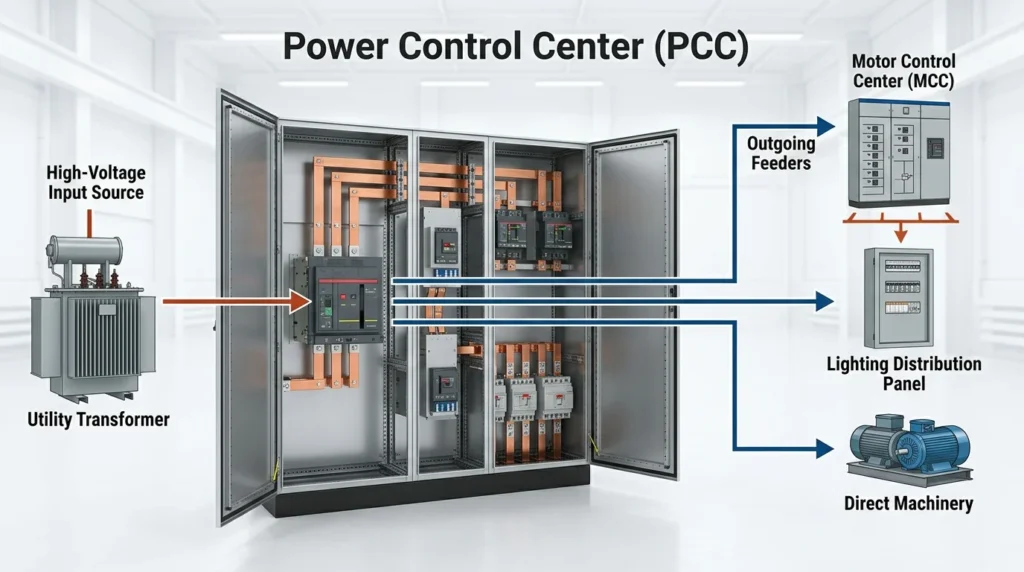

Imagine a large factory receiving electrical power from a transformer. That power must be distributed safely to many areas, machines, lighting systems, and other electrical panels. If there were no central point to control and protect this power, the system would be difficult to manage and unsafe to maintain.
This is where a PCC panel becomes important.
PCC stands for Power Control Center. A PCC panel is a major electrical panel used to receive electrical power from a transformer, generator, or other source and distribute it to different outgoing feeders. It also provides switching, isolation, measurement, and protection.
PCC panels are common in factories, commercial buildings, power plants, water treatment facilities, and other large electrical installations. For electrical students and technicians, understanding a PCC is important because it is often one of the main points in an industrial power distribution system.
In this guide, you will learn what is PCC panel, its working principle, types, components, advantages and disadvantages, applications, selection methods, common problems, troubleshooting steps, and future trends.
What Is PCC Panel?
A PCC panel (Power Control Center panel) is a low-voltage electrical switchboard used to receive, control, protect, and distribute electrical power to multiple outgoing circuits.
In simple words, a PCC panel works like a main power distribution station for a building or industrial facility.
Electrical power enters through an incoming feeder. The PCC then distributes that power through busbars to different outgoing feeders.
A simple power flow looks like this:
Transformer/Generator → PCC Panel → Outgoing Feeders → MCC/DB/Loads
For example, a factory may receive power from a transformer and send it to a PCC panel. The PCC can then supply:
- Motor Control Centers
- Distribution boards
- Lighting panels
- HVAC systems
- Production equipment
- Pumps
- Compressors
- Other electrical loads
Simple Practical Example
Suppose a factory has a 1,000 kVA transformer.
The transformer supplies power to the main PCC panel. The PCC may have separate outgoing feeders for:
- Production area
- Office building
- MCC-1
- MCC-2
- HVAC system
- Lighting system
Each feeder can have its own circuit breaker and protection.
This arrangement makes the electrical system easier to control and maintain.
PCC Panel Working Principle
The PCC panel working principle is based on receiving electrical power, controlling it, protecting the incoming and outgoing circuits, and distributing it to different loads.
Think of the PCC as a main road junction.
The incoming power is like traffic entering the junction. Busbars are like major roads, and outgoing feeders are roads carrying power to different destinations.
Step 1: Power Enters the PCC
Electrical power enters the PCC through an incoming cable or busduct.
The supply may come from:
- Transformer
- Generator
- Utility supply
- Another main switchboard
Step 2: Incoming Breaker Controls the Supply
The incoming circuit breaker provides switching and protection.
It allows authorized personnel to connect or disconnect the incoming supply and helps protect the system from serious electrical faults.
Step 3: Power Reaches the Busbars
After entering the panel, power reaches the main busbars.
Busbars are heavy conductors designed to carry and distribute high electrical current.
Step 4: Power Is Distributed to Outgoing Feeders
The busbars supply several outgoing circuit breakers.
Each outgoing feeder sends power to a particular load or downstream panel.
For example:
Main Busbar → MCC
Main Busbar → Distribution Board
Main Busbar → HVAC Panel
Main Busbar → Production Equipment
Step 5: Protection Operates During Faults
If a short circuit or other serious fault occurs, the appropriate protective device can disconnect the affected circuit.
This helps prevent damage to cables, equipment, and other parts of the electrical system.
Step 6: Measurement and Monitoring
Meters and monitoring devices can display electrical values such as:
- Voltage
- Current
- Frequency
- Power
- Power factor
- Energy consumption
Modern PCC panels may also send this information to an automation or monitoring system.
Types of PCC Panels
PCC panels can be classified in different ways based on construction, voltage, application, and installation requirements.
1. Standard PCC Panel
A standard PCC is designed for general low-voltage power distribution.
It commonly contains:
- Incoming breaker
- Busbars
- Outgoing breakers
- Metering
- Protection devices
These panels are widely used in industrial and commercial installations.
2. Main PCC Panel
A main PCC receives power directly from the main transformer or generator.
It is normally one of the most important distribution points in the facility.
It may supply several downstream panels and large loads.
3. Automatic PCC Panel
An automatic PCC can include control equipment that allows automatic switching or system coordination.
It may work with:
- Automatic transfer systems
- Generators
- PLCs
- Monitoring systems
- Remote control equipment
4. PCC With Bus Coupler
Some larger systems use multiple bus sections connected through a bus coupler.
A bus coupler can allow operators to connect or separate bus sections according to the system design.
This arrangement can improve flexibility and supply continuity when properly engineered.
5. APFC-Integrated PCC
A PCC can be designed with or connected to an Automatic Power Factor Correction (APFC) system.
Capacitor banks can be switched automatically to improve power factor when required.
6. Intelligent PCC
Modern PCC panels can include digital meters, communication devices, protection relays, and monitoring systems.
These panels can provide information about the electrical system in real time.
Main Components of a PCC Panel
Understanding the components is important for electrical technicians and engineers.
Incoming Circuit Breaker
The incoming breaker controls the main power supply entering the PCC.
Depending on the system design, this may be an ACB or another suitable circuit breaker.
It provides switching, isolation, and protection.
Outgoing Circuit Breakers
Outgoing breakers protect and control individual feeders.
Different feeders may have different breaker ratings depending on the connected load.
Busbars
Busbars distribute electrical power inside the PCC.
They are commonly made from copper or aluminum.
Busbar size depends on factors such as:
- Rated current
- Temperature rise
- Short-circuit withstand requirements
- Installation conditions
Neutral Busbar
The neutral busbar provides a common connection point for neutral conductors where the system requires one.
Its design must follow the electrical system and applicable standards.
Earth Busbar
The earth busbar connects protective earthing conductors to the panel’s grounding system.
Proper earthing is essential for electrical safety.
Current Transformer
A Current Transformer (CT) reduces high current to a suitable value for meters and protection equipment.
CTs allow the system to measure current without directly connecting sensitive instruments to the high-current circuit.
Protection Relays
Protection relays monitor electrical conditions and can initiate breaker operation when abnormal conditions occur.
Multifunction Meter
A digital multifunction meter can display values such as:
- Voltage
- Current
- Power
- Power factor
- Frequency
- Energy
Indicating Lamps
Indicating lamps provide visual information about the panel.
They may show:
- Supply available
- Breaker ON
- Breaker OFF
- Trip condition
Control Circuit
The control circuit operates devices such as breakers, relays, contactors, indication systems, and other control equipment.
Enclosure
The enclosure protects internal components from accidental contact and environmental conditions.
The enclosure type depends on the installation location and required protection level.
Cable Chamber
Cable chambers provide space for incoming and outgoing cable connections.
Good cable arrangement makes installation and maintenance easier.
PCC Panel Advantages and Disadvantages
Understanding PCC panel advantages and disadvantages helps engineers decide whether a PCC arrangement is suitable for an installation.
Advantages
- Centralized power distribution: Large amounts of electrical power can be controlled from one location.
- Better protection: Circuit breakers and protection systems help protect feeders and equipment.
- Easy monitoring: Digital meters can provide important electrical information.
- Organized wiring: Incoming and outgoing feeders are arranged in a structured system.
- Easy isolation: Individual feeders can be disconnected for maintenance.
- Supports automation: Modern PCCs can communicate with PLC and monitoring systems.
- Improved system management: Operators can monitor multiple feeders from one location.
- Expandable design: Additional feeders may be accommodated when future expansion is considered during design.
Disadvantages and Limitations
- High initial cost: A large PCC requires significant equipment and engineering.
- Large physical size: High-current PCCs can require considerable installation space.
- Heat generation: High current can create heat inside the enclosure.
- Maintenance requirements: Breakers, busbars, connections, meters, and other components require inspection.
- Complex installation: Proper cable termination and protection coordination are important.
- Single-point impact: A serious fault in a main PCC section can affect several downstream loads.
- Requires skilled personnel: Installation, testing, and maintenance should be performed by qualified electrical personnel.
PCC Panel Applications
PCC panel applications are mainly found in systems where large electrical loads need centralized distribution and protection.
Industrial Applications
PCC panels are commonly used in:
- Manufacturing plants
- Cement factories
- Steel plants
- Textile factories
- Chemical facilities
- Food processing plants
- Mining operations
- Automotive factories
A PCC can supply multiple MCCs and other distribution systems.
Commercial Buildings
Large commercial facilities may use PCCs for:
- HVAC systems
- Lighting
- Elevators
- Pumps
- Office areas
- Fire protection systems
- Mechanical equipment
Water Treatment Plants
Water and wastewater facilities have many electrical loads, including:
- Water pumps
- Sewage pumps
- Blowers
- Mixers
- Treatment equipment
A PCC can distribute power to these systems.
Power Plants
PCCs can distribute power to auxiliary equipment such as:
- Pumps
- Fans
- Compressors
- Cooling systems
- Control systems
Data Centers
Large data centers require reliable electrical distribution.
PCCs can be part of the electrical distribution system supplying downstream equipment and panels.
Renewable Energy Systems
Large solar and other renewable-energy installations may use suitable power distribution switchboards as part of their electrical infrastructure.
Difference Between PCC Panel and MCC Panel
The difference between PCC panel and MCC panel is mainly their purpose.
A PCC is primarily used for power distribution, while an MCC is primarily used for motor control and protection.
| Feature | PCC Panel | MCC Panel |
|---|---|---|
| Full form | Power Control Center | Motor Control Center |
| Main purpose | Power distribution | Motor control |
| Main loads | Panels, MCCs, large electrical loads | Electric motors |
| Main equipment | ACBs, MCCBs, busbars, meters | Starters, contactors, overloads, VFDs |
| Motor starters | Not normally the main function | Common |
| VFDs | Possible but not the main purpose | Common |
| Busbars | Yes | Yes |
| Outgoing feeders | Major feature | Motor feeders |
| PLC integration | Possible | Common in modern systems |
| Typical location | Main distribution level | Downstream motor distribution |
Simple Way to Remember
Think of the system as:
Transformer → PCC → MCC → Motor
The PCC distributes power.
The MCC controls motors.
This is a simplified arrangement; actual industrial systems vary according to the electrical design.
PCC Panel Selection Guide
Choosing a PCC panel requires careful electrical planning.
1. Determine the Total Load
Calculate the connected and expected operating load.
Consider:
- Motor loads
- Lighting
- HVAC
- Production equipment
- General power
- Future loads
2. Select the Correct Voltage
The PCC must be suitable for the system voltage.
Common industrial low-voltage systems may use three-phase AC supplies, but the exact voltage depends on the project.
3. Determine Current Rating
The main busbar and incoming breaker must be selected according to the expected current and applicable design requirements.
Do not select equipment based only on the normal load. Future loading and operating conditions must also be considered.
4. Check Short-Circuit Rating
The PCC must withstand the available fault current at its installation point.
Short-circuit calculations are important when selecting breakers, busbars, and the overall panel construction.
5. Select the Incoming Breaker
An incoming ACB or suitable circuit breaker should be selected based on:
- Rated current
- System voltage
- Short-circuit level
- Protection requirements
- Coordination requirements
6. Plan Outgoing Feeders
List every downstream load and determine its required feeder rating.
Leave suitable spare capacity when future expansion is expected.
7. Consider Metering
For larger facilities, multifunction meters and energy monitoring can provide useful operating information.
8. Consider Environmental Conditions
Check whether the PCC will be installed:
- Indoors
- Outdoors
- In a dusty area
- In a humid location
- In a high-temperature environment
- In a corrosive environment
The panel enclosure and ventilation should suit the site.
9. Follow Applicable Standards
PCC construction and testing should follow the applicable electrical standards, project specifications, and local regulations.
Always use approved drawings and manufacturer documentation.
Common PCC Panel Problems and Solutions
Why Does the Main Breaker Trip?
Possible causes include:
- Short circuit
- Overload
- Incorrect protection settings
- Downstream equipment fault
- Cable problem
Solution: Do not repeatedly reset the breaker. Isolate the system according to the approved safety procedure and investigate the fault.
Why Does an Outgoing Breaker Trip?
The connected load may be drawing excessive current, or a downstream short circuit may exist.
Check:
- Load current
- Cable condition
- Downstream breaker
- Equipment condition
- Protection settings
Why Is the PCC Busbar Hot?
Possible causes include:
- Excessive current
- Loose connection
- Poor termination
- Uneven loading
- Inadequate ventilation
Thermal inspection can help identify abnormal hot spots.
Loose electrical connections should be corrected only by qualified personnel under proper isolation procedures.
Why Is the Meter Showing Incorrect Current?
Possible causes include:
- CT ratio problem
- Incorrect meter settings
- CT wiring issue
- Faulty CT
- Meter fault
Check the CT ratio and wiring against the approved drawings and equipment specifications.
Why Is the Power Factor Low?
A low power factor may be caused by inductive loads such as motors and transformers.
Possible solutions may include a properly designed APFC system or other power-factor correction methods.
Why Is the PCC Making Noise?
Unusual noise may come from:
- Loose components
- Mechanical vibration
- Breaker mechanisms
- Electrical arcing
- Transformer-related sources nearby
Unusual sounds should never be ignored. The system should be safely inspected by qualified personnel.
Important Safety Note
A PCC can contain high fault energy and dangerous voltage levels. Never open, test, or repair an energized PCC unless the work is specifically designed and authorized for energized conditions.
Use appropriate isolation, lockout/tagout, testing, grounding, and personal protective equipment according to the site’s electrical safety procedures.
Future Trends in PCC Panels
PCC technology is moving toward smarter monitoring, better protection, and greater integration with automation.
Smart Energy Monitoring
Modern digital meters can provide detailed electrical information.
Operators can track:
- Energy consumption
- Voltage
- Current
- Power
- Power factor
- Frequency
This data can help identify inefficient equipment and abnormal conditions.
Remote Monitoring
Modern PCCs can communicate with control systems.
Operators may be able to monitor breaker status, electrical values, and alarms from a central control room.
Predictive Maintenance
Condition monitoring can help maintenance teams identify problems before major failures occur.
For example, abnormal temperature or current patterns may indicate a developing problem.
Digital Protection
Modern electronic protection devices provide more precise monitoring and adjustable protection functions than many older electromechanical systems.
Energy Management
Factories are increasingly focused on reducing energy costs.
Smart PCC monitoring can help identify where electricity is being consumed and support energy-management programs.
Integration With Industrial Automation
PCCs can increasingly connect with:
- PLC systems
- SCADA
- Industrial communication networks
- Building management systems
- Energy management systems
This allows electrical distribution to become part of the wider automation system.
FAQs About PCC Panels
What is a PCC panel?
A PCC panel is a Power Control Center used to receive, control, protect, measure, and distribute electrical power to multiple outgoing feeders.
What does PCC stand for?
PCC stands for Power Control Center.
What is the main function of a PCC?
The main function of a PCC is to distribute electrical power safely from a main source to several downstream circuits and loads.
What are the main components of a PCC?
Common components include incoming and outgoing circuit breakers, busbars, CTs, protection devices, meters, control circuits, indication lamps, neutral and earth bars, and an enclosure.
What is the difference between PCC and MCC?
A PCC is mainly used for power distribution, while an MCC is mainly used for controlling and protecting electric motors.
Can a PCC contain an ACB?
Yes. An ACB, or Air Circuit Breaker, is commonly used as an incoming or high-current outgoing breaker in suitable low-voltage PCC designs.
Where are PCC panels used?
PCC panels are widely used in factories, commercial buildings, water treatment plants, power plants, data centers, and other large electrical installations.
Conclusion
A PCC panel, or Power Control Center, is an important part of a large electrical distribution system. It receives power from a transformer, generator, or other source and distributes it safely to multiple outgoing feeders.
Understanding what is PCC panel becomes much easier when you remember its main job: receive, protect, control, measure, and distribute electrical power. The main components include circuit breakers, busbars, CTs, meters, protection devices, control circuits, and earthing systems.
PCC panels are widely used in industrial plants, commercial buildings, water facilities, power plants, and modern automated systems. Newer PCC designs also support smart monitoring, remote communication, energy management, and predictive maintenance.
For beginners, start by learning the power path from the transformer to the PCC and then follow each outgoing feeder. Understanding breakers, busbars, protection, metering, and earthing will give you a strong foundation for industrial electrical work.