
Imagine entering a large electrical distribution panel in a factory or commercial building. Inside the panel, you may notice thick metal bars connecting multiple circuit breakers and electrical components. These bars are responsible for carrying large amounts of electrical current safely and distributing it to different circuits. These important components are known as Busbars.
In modern electrical power systems, efficient power distribution is essential. Instead of using many individual cables, engineers often use busbars because they can carry high current and distribute power in a compact and organized way. Busbars are widely used in substations, switchgear panels, distribution boards, and industrial power systems.
For electrical students, technicians, and engineers, understanding the Busbar working principle is very important. Busbars play a key role in safe electrical distribution and equipment protection. They help reduce wiring complexity, improve reliability, and support high-power systems.
In this article, you will learn what a busbar is, how it works, its different types, and Busbar applications in electrical systems. We will also explain Busbar advantages and disadvantages, selection guidelines, troubleshooting tips, and future developments in busbar technology.
What is a Busbar?
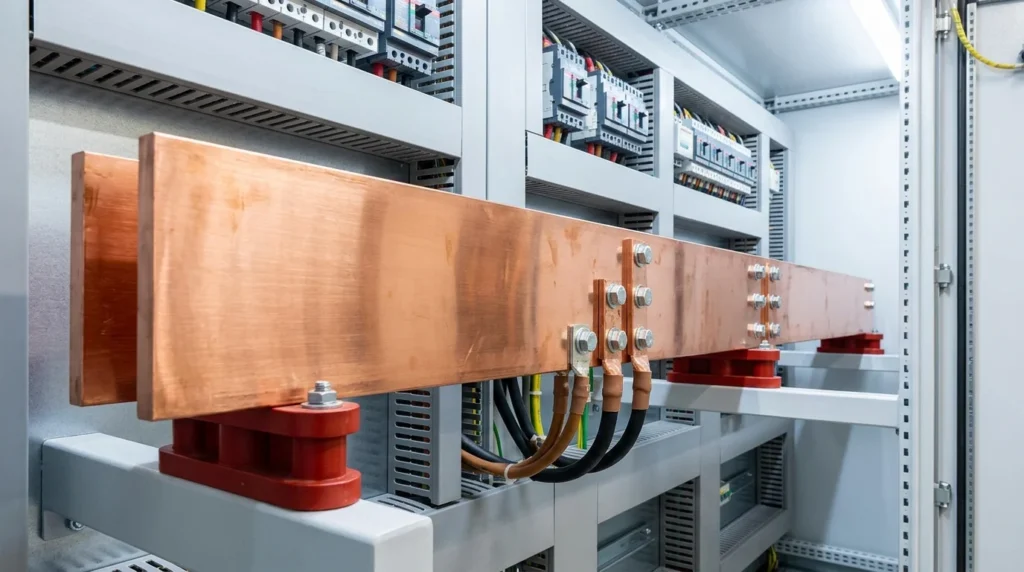
A Busbar is a metallic conductor used in electrical power distribution systems to collect and distribute electrical power to multiple circuits.
Clear Definition
A busbar is a thick metal bar or strip made of copper or aluminum that carries large electrical current and distributes it to different electrical circuits.
Simple Explanation
Instead of connecting many wires together, engineers use a busbar as a central point where electricity enters and then spreads to different outgoing circuits.
Practical Example
For example, inside a distribution board, the incoming power from the main supply is connected to a busbar. From this busbar, electricity is distributed to multiple circuit breakers that supply power to different rooms or machines.
Busbar Working Principle
The Busbar working principle is based on electrical conduction. The busbar acts as a low-resistance path that carries electrical current from one point to several circuits.
Because busbars have a large cross-sectional area, they can safely carry high current without excessive heating.
Step-by-Step Working Process
- Power Input
- Electrical power enters the system through the main supply.
- Connection to Busbar
- The incoming supply is connected directly to the busbar.
- Current Distribution
- The busbar distributes electrical current to multiple outgoing circuits.
- Load Supply
- Circuit breakers connected to the busbar supply electricity to different loads.
- Efficient Power Flow
- Electricity flows smoothly through the low-resistance metal conductor.
Simple Analogy
Think of a busbar like a water distribution pipe in a building. A large main pipe carries water and distributes it to smaller pipes that supply different rooms. Similarly, a busbar distributes electrical power to different circuits.
Types of Busbar
Busbars are classified based on their design, material, and installation method.
Copper Busbar
Copper is the most commonly used busbar material.A copper busbar is a solid conductor made from high-quality copper, used in electrical systems to distribute power efficiently. It is commonly used in electrical panels, switchgear, substations, and industrial installations where high current needs to be carried safely. Copper is preferred because of its excellent electrical conductivity, which allows it to transmit electricity with very low resistance. This means less energy is lost as heat, making copper busbars highly efficient and reliable for power distribution.
One of the biggest advantages of a copper busbar is its high conductivity. Copper can carry more current compared to other materials like aluminum, which makes it suitable for heavy electrical loads. This helps in maintaining stable voltage levels and improves the overall performance of the system. Another important benefit is its strong mechanical strength. Copper busbars are durable and can withstand high temperatures and mechanical stress without bending or breaking easily. This makes them ideal for long-term use in demanding environments.
Copper busbars also offer better heat dissipation. When electrical current flows, some heat is generated, but copper can quickly dissipate this heat, reducing the risk of overheating. This increases safety and extends the life of electrical components. In addition, copper has excellent corrosion resistance, which means it does not easily rust or degrade over time. This ensures consistent performance even in slightly harsh environmental conditions.
Another advantage is easy installation and maintenance. Copper busbars can be shaped, drilled, and connected easily, allowing engineers to design flexible and organized electrical systems. They also provide a neat and compact arrangement compared to traditional wiring, reducing clutter inside panels.
However, copper busbars are relatively more expensive than aluminum busbars, which can increase the initial cost of installation. Despite this, their long lifespan, high efficiency, and low maintenance requirements often make them a cost-effective choice in the long run.
In conclusion, copper busbars are an essential component in modern electrical systems due to their high conductivity, durability, safety, and efficiency. They are widely used in industries and commercial setups where reliable and efficient power distribution is required.
Features:
- Excellent electrical conductivity
- High strength and durability
- Suitable for high current systems
Copper busbars are widely used in industrial power systems.
Aluminum Busbar
Aluminum busbars are lighter and cheaper than copper.An aluminum busbar is a type of electrical conductor made from aluminum, widely used in power distribution systems such as electrical panels, switchgear, and substations. It serves the same purpose as a copper busbar—carrying and distributing electrical current—but is often chosen because of its lightweight and cost-effective nature. Aluminum is much lighter than copper, which makes installation easier, especially in large electrical systems or overhead setups where weight is a major concern.
One of the main advantages of an aluminum busbar is its lower cost. Aluminum is significantly cheaper than copper, making it a budget-friendly option for large-scale projects. This is why many industries and commercial buildings prefer aluminum busbars when cost savings are important. Another benefit is its good electrical conductivity. Although aluminum has lower conductivity than copper, it can still carry a large amount of current when properly sized. Engineers usually increase the cross-sectional area of aluminum busbars to achieve the required performance.
Aluminum busbars also offer excellent corrosion resistance. When exposed to air, aluminum forms a thin oxide layer on its surface, which protects it from further corrosion. This makes it suitable for outdoor installations or environments where moisture is present. Additionally, aluminum is easier to handle and transport due to its lighter weight, which reduces labor effort during installation.
However, aluminum busbars also have some limitations. They have lower mechanical strength compared to copper, meaning they can bend or deform more easily under stress. Aluminum also has higher resistance, which can lead to slightly more heat generation. Proper connections are very important because aluminum expands more with temperature changes, which can loosen joints over time if not installed correctly.
In conclusion, aluminum busbars are a practical and economical choice for electrical power distribution. Their lightweight design, affordability, and corrosion resistance make them suitable for many applications, especially where cost and weight are key factors.
Features:
- Lower cost
- Lightweight design
- Good electrical conductivity
They are often used in large power distribution systems.
Laminated Busbar
A laminated busbar consists of multiple layers of conductive material separated by insulation.A laminated busbar is a specialized type of electrical conductor made by stacking multiple thin layers of conductive materials, usually copper or aluminum, separated by insulating layers. These layers are bonded together to form a compact and efficient power distribution system. Laminated busbars are commonly used in modern electrical equipment such as inverters, power supplies, electric vehicles, and industrial control panels where performance and space optimization are important.
One of the main advantages of a laminated busbar is its low inductance. Inductance is a property that can cause energy loss and voltage spikes in electrical systems. The layered design of laminated busbars reduces this effect, making them highly efficient for high-frequency and sensitive electronic applications. This results in improved performance and reduced electrical noise, which is especially important in advanced electronic systems.
Another key benefit is compact design and space saving. Because multiple conductors are combined into a single unit, laminated busbars reduce the need for bulky wiring. This helps in creating a neat, organized, and space-efficient layout inside electrical panels. It also improves airflow and cooling, which enhances the overall reliability of the system.
Laminated busbars also offer better thermal performance. The layered structure allows heat to spread evenly, reducing the chances of overheating. This increases the lifespan of electrical components and ensures stable operation. Additionally, they provide high reliability and safety, as the insulation between layers minimizes the risk of short circuits and electrical faults.
Another advantage is easy installation and reduced assembly time. Since laminated busbars are pre-designed and manufactured according to specific requirements, they can be installed quickly without complex wiring, reducing labor costs and errors.
However, laminated busbars can be more expensive than traditional busbars and require precise design and manufacturing. Despite this, their efficiency, compactness, and reliability make them an excellent choice for modern electrical and electronic systems.
Features:
- Reduced electrical losses
- Better heat dissipation
- Improved electromagnetic performance
These busbars are commonly used in power electronics.
Flexible Busbar
Flexible busbars are made from thin conductive layers.A flexible busbar is a type of electrical conductor designed to provide power distribution while allowing movement, bending, and easy installation. It is usually made of multiple thin layers or braided strands of copper or aluminum, covered with insulation for safety. Flexible busbars are widely used in electrical panels, switchgear, battery connections, transformers, and industrial equipment where vibration or movement is present.
One of the main advantages of a flexible busbar is its high flexibility. Unlike rigid busbars, it can bend easily without breaking, which makes it ideal for tight spaces or complex layouts. This flexibility reduces mechanical stress on connections and helps prevent damage caused by vibration or thermal expansion. It is especially useful in applications like electric vehicles, renewable energy systems, and machinery where parts may move or expand during operation.
Another important benefit is easy installation. Flexible busbars can be installed quickly without the need for precise alignment, saving time and labor costs. They can also be adjusted or repositioned easily, which makes them suitable for systems that may require modifications in the future. This flexibility also helps in reducing installation errors.
Flexible busbars also provide good electrical conductivity, especially when made from copper. They can carry high current efficiently while maintaining stable performance. In addition, they offer better resistance to vibration and mechanical stress, which increases the lifespan of the electrical system and reduces maintenance requirements.
Safety is another key advantage. Flexible busbars are usually well insulated, which minimizes the risk of short circuits and accidental contact. They also help in absorbing shocks and movements, protecting connected equipment.
However, flexible busbars may have slightly higher resistance compared to solid busbars and can be more expensive depending on the design and materials used. Despite these limitations, their flexibility, durability, and ease of use make them a valuable solution in modern electrical systems.
Features:
- Can bend easily
- Suitable for compact electrical systems
- Reduces vibration issues
They are used in modern electronic equipment.
Insulated Busbar
Insulated busbars have protective insulation coating.An insulated busbar is an electrical conductor that is covered with a protective insulating material to enhance safety and performance in power distribution systems. It is commonly made from copper or aluminum and coated with materials such as PVC, epoxy, or heat-shrink insulation. Insulated busbars are widely used in electrical panels, switchgear, substations, and industrial installations where protection against electrical faults and accidental contact is important.
One of the main advantages of an insulated busbar is improved safety. The insulation layer prevents direct contact with the conductor, reducing the risk of electric shock and short circuits. This makes it especially useful in environments where multiple components are installed close together. The insulation also protects against dust, moisture, and other environmental factors that can affect performance.
Another important benefit is reduced risk of short circuits. Since the busbar is covered with insulation, the chances of accidental contact between conductors are minimized. This increases the reliability of the electrical system and helps prevent equipment damage. Insulated busbars are also more compact, as they allow closer spacing between conductors without compromising safety. This helps save space inside electrical panels and improves overall system design.
Insulated busbars also offer better durability and long life. The protective coating shields the conductor from corrosion, oxidation, and physical damage. This ensures consistent performance over time with less maintenance. In addition, insulation can improve thermal performance by controlling heat distribution and reducing hotspots.
Another advantage is easy identification and installation. Insulated busbars are often color-coded, making it easier for technicians to identify different phases and connections. This reduces installation errors and simplifies maintenance work.
However, insulated busbars may have a slightly higher cost compared to bare busbars due to the additional insulation material. Despite this, their safety, reliability, and compact design make them a preferred choice in modern electrical systems where protection and efficiency are critical.
Features:
- Improved safety
- Reduced risk of short circuits
- Better environmental protection
They are often used in enclosed switchgear systems.
Main Components of a Busbar System
A busbar system contains several important parts that ensure proper electrical distribution.
Conductive Busbar
The main metal bar that carries electrical current.
Function:
- Distributes electrical power to multiple circuits.
Insulators
Insulators support the busbar while preventing electrical contact with the panel structure.
Function:
- Maintain electrical isolation.
Busbar Supports
Mechanical supports hold the busbars in place.
Function:
- Provide stability and proper spacing.
Circuit Breaker Connections
Circuit breakers are connected to the busbar.
Function:
- Control and protect electrical circuits.
Protective Enclosure
Many busbars are installed inside metal or insulated enclosures.
Function:
- Protect users from electrical hazards.
Busbar Advantages
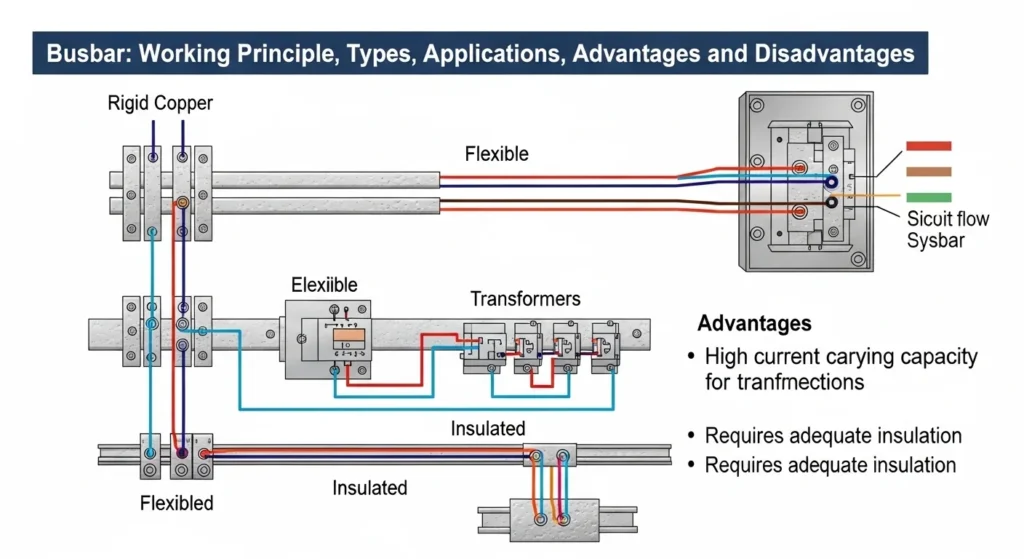
Understanding Busbar advantages and disadvantages helps engineers design better electrical systems.A busbar is a metallic conductor, usually made of copper or aluminum, used in electrical systems to distribute power efficiently. It is commonly found in electrical panels, substations, and industrial installations. One of the main advantages of a busbar is its high current carrying capacity. Unlike traditional wiring systems, busbars can handle large amounts of current without excessive heating, making them ideal for heavy electrical loads in industries and commercial buildings.
Another important advantage is better efficiency and reduced power loss. Busbars have a low resistance compared to cables, which means less energy is lost in the form of heat. This improves the overall efficiency of the electrical system and ensures stable power distribution. Additionally, busbars provide compact and organized installation. Instead of using multiple wires, a single busbar system can distribute power neatly, reducing clutter inside panels and making the system easier to manage.
Busbars also offer easy maintenance and flexibility. Since they are clearly arranged and accessible, it is easier to identify faults, perform maintenance, or make modifications in the system. Engineers can easily add or remove connections without disturbing the entire setup. This saves time and reduces downtime in industrial operations.
Another key benefit is improved safety. Busbars are designed with proper insulation and protection, which reduces the risk of short circuits and electrical accidents. They also provide strong mechanical support, making them more reliable than loose wiring systems. Moreover, busbars are durable and long-lasting, as they can withstand high temperatures and harsh environmental conditions.
In conclusion, busbars are an efficient, safe, and reliable solution for power distribution. Their high current capacity, low energy loss, organized design, and ease of maintenance make them a preferred choice in modern electrical systems.
Advantages
- Can carry very high electrical current
- Reduces complex wiring
- Improves electrical efficiency
- Easy installation and maintenance
- Better heat dissipation
- Compact design for switchgear panels
Real-World Benefits
Because of these advantages, busbars are widely used in modern electrical power distribution systems.
Busbar Disadvantages / Limitations
Although busbars are highly useful, they have some limitations.A busbar system, although efficient and widely used in electrical distribution, also has several disadvantages that should be considered before installation. One of the main drawbacks is its high initial cost. Busbars, especially those made from high-quality copper or aluminum, can be expensive compared to traditional wiring systems. In addition to material cost, proper installation requires skilled labor, which further increases the overall expense. This makes busbars less suitable for small-scale or low-budget projects.
Another disadvantage is the difficulty in modification once installed. While busbars offer organized distribution, making major changes in the system after installation can be challenging. If the load requirements change significantly, the entire busbar setup may need redesigning or replacement, which can be time-consuming and costly. This lack of flexibility can be a limitation in environments where frequent changes are expected.
Busbars also require proper insulation and protection. If not installed correctly, they can pose serious safety risks such as short circuits, electric shocks, or fire hazards. Since busbars carry high current, any fault or loose connection can lead to overheating and damage. Therefore, regular inspection and proper maintenance are necessary to ensure safe operation.
Another issue is space requirement in certain designs. While busbars are generally compact, high-capacity systems may require sufficient space for installation, especially in industrial setups. This can be a problem in areas with limited installation space.
Additionally, busbars may face environmental limitations. Exposure to moisture, dust, or corrosive environments can affect their performance if proper protective measures are not used. Over time, corrosion can reduce efficiency and lead to failures.
In conclusion, while busbars provide efficient power distribution, they come with disadvantages such as high initial cost, limited flexibility, safety concerns if poorly installed, space requirements, and environmental sensitivity. Proper planning and maintenance are essential to overcome these challenges and ensure reliable performance.
Limitations
- Higher initial installation cost
- Requires proper insulation and protection
- Risk of short circuit if poorly installed
- Requires accurate design for current capacity
Proper engineering design helps reduce these limitations.
Busbar Applications
There are many Busbar applications in electrical power systems.
Electrical Substations
Busbars distribute power from transformers to multiple feeders.
Switchgear Panels
Busbars connect circuit breakers inside switchgear systems.
Industrial Power Systems
Factories use busbars for high-current power distribution.
Data Centers
Modern data centers use busbars for efficient power distribution.
Renewable Energy Systems
Busbars connect solar inverters, batteries, and distribution equipment.
Comparison: Busbar vs Cable
Understanding the difference between busbar and cable helps in selecting the right power distribution method.
| Feature | Busbar | Cable |
|---|---|---|
| Current Capacity | Very high | Limited |
| Installation | Fixed inside panels | Flexible routing |
| Cooling | Better heat dissipation | Less efficient cooling |
| Maintenance | Easier inspection | More complex |
| Cost | Higher initial cost | Lower initial cost |
Key Difference
The main difference between busbar and cable is that busbars are rigid conductors used for high-current distribution, while cables are flexible wires used for general electrical connections.
Selection Guide
Choosing the correct busbar depends on several factors.
Important Factors
Material Selection
Copper busbars offer better conductivity, while aluminum busbars reduce cost.
Current Rating
The busbar must be designed to carry the expected electrical load.
Installation Environment
Busbars used in outdoor environments require additional protection.
Safety Standards
Ensure the busbar system meets electrical safety regulations.
Tips for Beginners
- Always calculate current capacity before selecting a busbar.
- Ensure proper insulation and spacing.
- Use high-quality connectors and supports.
Common Problems & Solutions
Why does the busbar overheat?
Possible reasons:
- Excessive current
- Poor ventilation
- Loose connections
Solution: Check load capacity and tighten connections.
Why does corrosion occur on busbars?
Corrosion may occur due to humidity or environmental exposure.
Solution: Use protective coatings or insulated busbars.
Why do busbars produce vibration noise?
High electrical current can create electromagnetic forces.
Solution: Install proper busbar supports.
Why does the system trip frequently?
Possible causes include overload or short circuits.
Solution: Inspect circuit breakers and busbar connections.
Future Trends in Busbar Technology
Electrical power systems are evolving with new busbar technologies.
Smart Busbar Systems
Modern systems include monitoring sensors for current and temperature.
High-Efficiency Materials
New alloys improve conductivity and durability.
Compact Busbar Designs
Manufacturers are developing space-saving busbar systems.
Integration with Renewable Energy
Busbars are increasingly used in solar and battery energy storage systems.
Conclusion
A Busbar is an essential component in electrical power distribution systems. It provides a reliable and efficient method for carrying and distributing large electrical currents in substations, switchgear, and industrial installations.
Understanding the Busbar working principle, types, and Busbar applications helps electrical students and technicians design safer and more efficient power systems. Busbars reduce wiring complexity, improve system organization, and support high-power electrical networks.
Although busbars require careful design and installation, their advantages in high-current handling and efficient power distribution make them a preferred solution in modern electrical engineering.
As technology continues to advance, busbar systems will become even more efficient, compact, and integrated with smart monitoring systems.