
Imagine a robotic arm in a car factory placing hundreds of parts with perfect accuracy every minute. Or think about a drone that stays stable in the air while responding instantly to your commands. These machines perform such precise movements because they use servo motors.
A servo motor is one of the most important electric motors used in modern automation, robotics, CNC machines, industrial equipment, and electronic devices. Unlike ordinary motors that simply rotate when power is applied, a servo motor can move to an exact position, maintain that position, and change its speed or direction with remarkable accuracy. This makes it ideal for applications where precision and reliability are essential.
Whether you are an electrical engineering student, technician, hobbyist, or industry professional, understanding how servo motors work is an important step in learning modern motion control systems.
In this guide, you will learn what a servo motor is, its working principle, types, main components, advantages, disadvantages, applications, selection tips, troubleshooting methods, and future trends. By the end of this article, you will have a clear understanding of why servo motors are widely used in today’s advanced electrical and automation industries.
2. What Is a Servo Motor?
Definition
A servo motor is a high-precision electric motor designed to control position, speed, and torque with exceptional accuracy. It operates as part of a closed-loop control system, meaning it continuously receives feedback about its position or speed and automatically adjusts its movement to match the desired output.
Unlike a standard electric motor that rotates continuously when power is supplied, a servo motor moves only as much as required and can stop, hold, or change its position accurately. This precise control makes servo motors essential in automation, robotics, and industrial machinery.
Simple Explanation
In simple words, a servo motor is a smart electric motor that knows exactly where it is and where it needs to go.
When the controller sends a command, the servo motor moves to the required position. A built-in feedback device checks the actual position and compares it with the commanded position. If there is any difference, the controller automatically corrects the motor until the desired position is reached.
Because of this continuous feedback, servo motors provide extremely accurate and smooth movement.
Key Features of a Servo Motor
Some important features of a servo motor include:
- High positioning accuracy
- Closed-loop feedback control
- Excellent speed control
- High starting torque
- Smooth and quiet operation
- Fast response to control signals
- High efficiency
- Reliable long-term performance
These features make servo motors suitable for applications requiring accurate motion control.
How Is a Servo Motor Different from a Normal Motor?
A normal electric motor rotates continuously when electrical power is applied. It cannot automatically stop at a specific position without additional control systems.
A servo motor, however, constantly monitors its movement using a feedback device. This allows it to rotate to an exact angle, maintain that position, and adjust its speed whenever necessary.
For example:
- A ceiling fan motor keeps spinning while power is supplied.
- A servo motor can rotate exactly 90°, 180°, or any other required angle and stop precisely.
This precise control is the main reason servo motors are widely used in automation.
Practical Example
Imagine an industrial robotic arm assembling electronic components.
Each component must be placed within fractions of a millimeter. If the motor moves too far or too little, the product may be damaged.
A servo motor solves this problem by moving the robotic arm to the exact required position every time. The built-in feedback system continuously checks the movement and corrects any errors instantly.
Similarly, in a CNC milling machine, servo motors accurately control the movement of the cutting tool along different axes. This ensures smooth cutting, high precision, and consistent product quality.
Where Are Servo Motors Commonly Used?
Servo motors are widely used in industries that require precise movement and accurate positioning.
Common applications include:
- Industrial robots
- CNC machines
- 3D printers
- Conveyor automation systems
- Camera stabilization systems
- Medical equipment
- Packaging machines
- Textile machinery
- Printing presses
- Aerospace control systems
- Automated manufacturing equipment
- Computer numerical control (CNC) machines
In all these applications, precision is more important than continuous rotation, making servo motors the preferred choice.
Why Are Servo Motors Important?
Modern industries rely heavily on automation and precision manufacturing. Machines must operate quickly while maintaining extremely high accuracy.
Servo motors provide several important benefits:
- Precise motion control
- Faster production
- Improved product quality
- Reduced human error
- Better energy efficiency
- Reliable operation
- Increased machine productivity
Because of these advantages, servo motors have become one of the most important components in modern automation systems.
3. Servo Motor Working Principle
The servo motor working principle is based on a closed-loop feedback control system. Unlike conventional motors, a servo motor continuously monitors its position, speed, and sometimes torque using a feedback device such as an encoder or resolver.
The controller compares the desired position (command signal) with the actual position (feedback signal). If there is any difference between the two, the controller automatically adjusts the motor until the error is eliminated.
This continuous process allows the servo motor to achieve extremely accurate positioning and smooth motion.
Simple Analogy
Think about driving a car to a parking space.
You don’t simply press the accelerator and hope to stop in the correct place. Instead, you continuously watch where the car is, compare it with where you want to stop, and make small steering or braking adjustments until you park perfectly.
A servo motor works in the same way. It constantly checks its position and automatically makes corrections to reach the exact target.
Step-by-Step Working Process
Step 1: Command Signal
A controller, PLC, CNC controller, or microcontroller sends a command telling the servo motor where to move, how fast to rotate, or how much torque to produce.
Step 2: Servo Driver Receives the Command
The servo drive converts the control signal into the appropriate electrical power required by the motor.
It regulates voltage, current, and frequency according to the desired movement.
Step 3: Motor Starts Rotating
The electrical power energizes the motor windings, creating a rotating magnetic field.
The rotor begins to rotate toward the commanded position.
Step 4: Feedback Device Monitors Movement
A feedback device, usually an encoder or resolver, continuously measures:
- Shaft position
- Rotation speed
- Direction of rotation
This information is sent back to the controller in real time.
Step 5: Error Detection
The controller compares:
- Desired position
- Actual position
If there is any error, the controller instantly calculates the correction required.
Step 6: Automatic Correction
The servo drive adjusts the motor output by increasing or decreasing the supplied current.
The motor continues moving until the actual position exactly matches the commanded position.
Step 7: Position Holding
Once the required position is reached, the servo motor maintains that position by continuously making tiny corrections whenever external forces attempt to move the shaft.
This ability to hold position accurately is one of the biggest advantages of servo motors.
Key Points of Servo Motor Operation
- Operates using a closed-loop feedback system.
- Uses an encoder or resolver for continuous monitoring.
- Automatically corrects positioning errors.
- Provides accurate speed and torque control.
- Delivers smooth and precise motion.
- Responds quickly to changing commands.
Why Closed-Loop Control Is Important
The closed-loop system makes servo motors much more accurate than conventional motors.
Even if the load changes suddenly or an external force tries to move the shaft, the feedback system detects the error and immediately corrects it.
This results in:
- Higher positioning accuracy
- Better speed regulation
- Improved efficiency
- Greater reliability
- Consistent performance under varying loads
4. Types of Servo Motors
Servo motors are classified based on their power supply, construction, and operating principle. Although all servo motors are designed to provide accurate position, speed, and torque control, each type has its own advantages and applications.
The main types of servo motors are:
- AC Servo Motor
- DC Servo Motor
- Brushless Servo Motor
- Brushed Servo Motor
- Rotary Servo Motor
- Linear Servo Motor
Selecting the right type depends on factors such as speed, torque, precision, maintenance requirements, and operating environment.
4.1 AC Servo Motor
What Is an AC Servo Motor?
An AC servo motor is a servo motor powered by alternating current (AC). It is widely used in modern industrial automation because it offers high efficiency, excellent speed control, and precise positioning.
Most CNC machines, industrial robots, packaging machines, and automated production lines use AC servo motors due to their outstanding performance and reliability.
Construction of an AC Servo Motor
An AC servo motor mainly consists of:
- Stator with three-phase windings
- Rotor
- Shaft
- Bearings
- Encoder or resolver
- Servo drive
The encoder continuously monitors the motor’s position and sends feedback to the controller.
Working Principle
The operation of an AC servo motor follows these steps:
Step 1: Command Signal
The controller sends a motion command to the servo drive.
Step 2: Power Supply
The servo drive supplies controlled AC power to the motor windings.
Step 3: Rotating Magnetic Field
The energized stator produces a rotating magnetic field.
Step 4: Rotor Rotation
The rotor follows the rotating magnetic field and begins turning.
Step 5: Continuous Feedback
The encoder measures the shaft position and speed.
Step 6: Automatic Correction
If any error occurs, the servo drive immediately adjusts the motor output until the required position is reached.
Features
- High efficiency
- Excellent positioning accuracy
- High-speed operation
- Low maintenance
- Smooth rotation
- High reliability
Advantages
- Excellent speed control
- High torque
- Long service life
- Suitable for heavy industrial applications
- Quiet operation
Applications
AC servo motors are commonly used in:
- CNC machines
- Industrial robots
- Printing machines
- Textile machinery
- Conveyor systems
- Packaging equipment
- Semiconductor manufacturing
4.2 DC Servo Motor
What Is a DC Servo Motor?
A DC servo motor is powered by direct current (DC) and is commonly used in low- and medium-power motion control systems.
Although many industries now prefer AC servo motors, DC servo motors are still used in educational projects, laboratory equipment, and certain portable devices because they are simple to control.
Construction
A DC servo motor typically includes:
- Armature winding
- Permanent magnets or field windings
- Commutator
- Carbon brushes (in brushed versions)
- Shaft
- Encoder
- Bearings
Working Principle
The controller sends DC power to the motor through the servo driver.
The motor rotates, while the encoder continuously monitors its position and speed. The controller compares the actual movement with the desired position and makes automatic corrections whenever necessary.
Features
- Easy speed control
- Good starting torque
- Fast response
- Compact design
Advantages
- Simple control system
- Quick acceleration
- Good low-speed performance
- Suitable for smaller applications
Limitations
- Brushes wear over time
- Requires periodic maintenance
- Lower efficiency than modern AC servo motors
Applications
DC servo motors are used in:
- Educational equipment
- Small robots
- Camera systems
- Medical instruments
- Portable automation devices
4.3 Brushless Servo Motor
What Is a Brushless Servo Motor?
A brushless servo motor is a modern servo motor that operates without carbon brushes or a mechanical commutator.
Instead of mechanical switching, electronic circuits control the current supplied to the motor windings.
Because there are no brushes to wear out, brushless servo motors offer higher efficiency, lower maintenance, and longer service life.
How It Works
The servo drive energizes the stator windings electronically.
The rotor, which contains permanent magnets, follows the rotating magnetic field.
An encoder continuously provides position feedback, allowing the controller to maintain precise motion.
Features
- Brushless construction
- High efficiency
- Low maintenance
- Long operational life
- High-speed capability
- Smooth operation
Advantages
- No brush replacement
- Reduced maintenance
- Less electrical noise
- Better efficiency
- Higher reliability
- Longer lifespan
Applications
Brushless servo motors are widely used in:
- Industrial robots
- CNC machining centers
- Aerospace equipment
- Electric vehicles
- Medical devices
- Precision automation systems
4.4 Brushed Servo Motor
What Is a Brushed Servo Motor?
A brushed servo motor uses carbon brushes and a commutator to transfer electrical current to the rotating armature.
This is one of the older servo motor designs.
Although brushed servo motors are simple and inexpensive, they require regular maintenance because the brushes wear with use.
Features
- Simple construction
- Easy control
- Lower initial cost
- Good starting torque
Advantages
- Cost-effective
- Easy to repair
- Suitable for light-duty applications
Limitations
- Brush wear
- Higher maintenance
- More electrical noise
- Shorter service life
Applications
Brushed servo motors are commonly found in:
- Educational training equipment
- Hobby robots
- Small automation projects
- Laboratory machines
4.5 Rotary Servo Motor
What Is a Rotary Servo Motor?
A rotary servo motor converts electrical energy into rotational motion.
It is the most common type of servo motor and is widely used in industrial automation.
The output shaft rotates by a precise angle or continuously under controlled conditions.
Features
- Rotational movement
- High accuracy
- Excellent speed control
- Compact design
Applications
Rotary servo motors are used in:
- CNC machines
- Industrial robots
- Conveyor systems
- Packaging equipment
- Automated production lines
4.6 Linear Servo Motor
What Is a Linear Servo Motor?
A linear servo motor produces straight-line motion instead of rotational motion.
Unlike rotary motors that require gears or lead screws to create linear movement, linear servo motors generate linear motion directly.
Features
- Direct linear movement
- Extremely high positioning accuracy
- No mechanical transmission
- High speed
- Smooth operation
Applications
Linear servo motors are widely used in:
- Semiconductor manufacturing
- Precision assembly machines
- High-speed packaging
- Medical equipment
- Precision measuring systems
Comparison of Different Types of Servo Motors
| Feature | AC Servo Motor | DC Servo Motor | Brushless Servo Motor | Brushed Servo Motor |
|---|---|---|---|---|
| Power Supply | AC | DC | AC/DC | DC |
| Efficiency | High | Moderate | Very High | Moderate |
| Maintenance | Low | Moderate | Very Low | High |
| Speed | High | Medium | High | Medium |
| Accuracy | Excellent | Good | Excellent | Good |
| Service Life | Long | Moderate | Very Long | Shorter |
| Industrial Use | Very Common | Limited | Very Common | Limited |
Which Servo Motor Is Best?
The best servo motor depends on the application.
- AC servo motors are ideal for industrial automation and heavy-duty machinery.
- DC servo motors are suitable for smaller systems and educational projects.
- Brushless servo motors provide the highest efficiency, longest lifespan, and lowest maintenance.
- Brushed servo motors are economical for simple applications.
- Rotary servo motors are best for controlled rotational motion.
- Linear servo motors are preferred where direct linear movement is required.
Today, brushless AC servo motors are the most widely used because they combine high efficiency, excellent precision, long service life, and reliable performance.
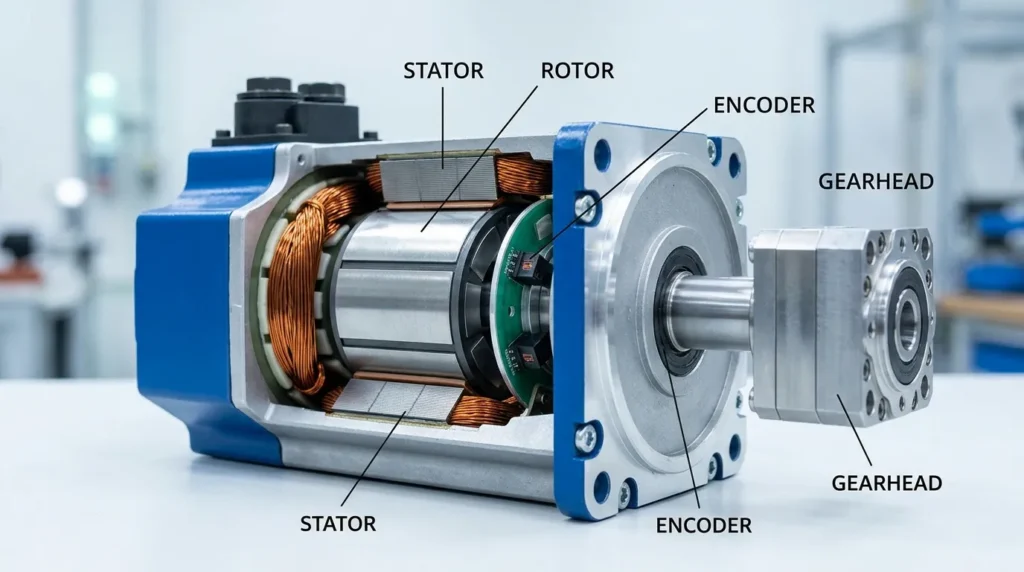
5. Main Components of a Servo Motor
A servo motor is made up of several mechanical and electronic components that work together to provide accurate position, speed, and torque control. Each component performs a specific function, and the overall performance of the servo motor depends on how efficiently these parts operate together.
The major components of a servo motor include:
- Stator
- Rotor
- Shaft
- Bearings
- Encoder (Feedback Device)
- Servo Drive
- Controller
- Housing (Frame)
Understanding these components helps engineers troubleshoot, maintain, and select the right servo motor for different applications.
5.1 Stator
What Is the Stator?
The stator is the stationary part of the servo motor. It contains electrical windings that generate a rotating magnetic field when energized.
The stator is built using laminated steel cores to reduce magnetic losses and improve efficiency.
Functions of the Stator
The stator performs several important tasks:
- Produces the rotating magnetic field.
- Holds the motor windings.
- Converts electrical energy into magnetic energy.
- Controls rotor movement.
- Determines motor performance.
Without the stator, the motor cannot produce rotational motion.
5.2 Rotor
What Is the Rotor?
The rotor is the rotating part inside the servo motor. It follows the magnetic field created by the stator and converts electromagnetic energy into mechanical rotation.
Depending on the motor design, the rotor may contain permanent magnets or conductive windings.
Functions of the Rotor
The rotor performs the following functions:
- Rotates according to the magnetic field.
- Produces mechanical torque.
- Drives the output shaft.
- Provides smooth and precise movement.
The rotor is responsible for delivering the controlled motion required in servo applications.
5.3 Shaft
What Is the Shaft?
The shaft is connected directly to the rotor and transfers the motor’s rotational motion to external mechanical systems.
It is manufactured from high-strength steel to withstand continuous operation and mechanical loads.
Functions of the Shaft
- Transfers rotational motion.
- Delivers mechanical power.
- Connects the motor to gears, pulleys, or couplings.
- Maintains accurate positioning.
5.4 Bearings
What Are Bearings?
Bearings support the shaft and allow it to rotate smoothly with minimal friction.
High-quality bearings improve motor efficiency, reduce vibration, and increase service life.
Functions of Bearings
- Support the shaft.
- Reduce friction.
- Maintain shaft alignment.
- Minimize vibration.
- Extend motor lifespan.
5.5 Encoder (Feedback Device)
What Is an Encoder?
The encoder is one of the most important components of a servo motor.
It continuously measures:
- Shaft position
- Speed
- Direction of rotation
The encoder sends this information back to the controller, allowing the servo system to operate as a closed-loop control system.
Functions of the Encoder
- Provides real-time feedback.
- Improves positioning accuracy.
- Detects movement errors.
- Enables automatic correction.
- Supports precise speed control.
Without an encoder, the servo motor cannot achieve its high level of accuracy.
5.6 Servo Drive
What Is a Servo Drive?
The servo drive is an electronic device that receives motion commands from the controller and supplies the correct electrical power to the servo motor.
It continuously adjusts voltage, current, and frequency according to the encoder feedback.
Functions of the Servo Drive
- Controls motor speed.
- Controls position.
- Controls torque.
- Processes encoder feedback.
- Protects against overloads.
- Ensures smooth motor operation.
5.7 Controller
What Is the Controller?
The controller is the brain of the servo system.
It sends motion commands to the servo drive based on the application’s requirements.
Controllers may include:
- PLCs
- CNC controllers
- Motion controllers
- Microcontrollers
- Industrial computers
Functions of the Controller
- Sends motion commands.
- Calculates positioning errors.
- Coordinates machine movement.
- Controls acceleration and deceleration.
- Synchronizes multiple servo motors.
5.8 Housing (Frame)
What Is the Housing?
The housing is the outer protective enclosure of the servo motor.
It provides mechanical strength, protects internal components, and helps dissipate heat during operation.
Functions of the Housing
- Protects internal parts.
- Supports mounting.
- Dissipates heat.
- Improves durability.
- Reduces mechanical damage.
Summary of Servo Motor Components
| Component | Main Function |
|---|---|
| Stator | Produces rotating magnetic field |
| Rotor | Converts magnetic energy into rotation |
| Shaft | Transfers mechanical motion |
| Bearings | Support shaft and reduce friction |
| Encoder | Provides position and speed feedback |
| Servo Drive | Controls motor power and movement |
| Controller | Sends motion commands |
| Housing | Protects internal components |
6. Advantages of a Servo Motor
Servo motors are widely used in modern automation because they provide high precision, fast response, and reliable performance. Unlike conventional motors, they continuously monitor their position and automatically correct any movement errors. This makes them the preferred choice for applications where accuracy and repeatability are critical.
Below are the major servo motor advantages that make them popular in industrial, commercial, and advanced technological applications.
6.1 High Positioning Accuracy
One of the biggest advantages of a servo motor is its exceptional positioning accuracy.
The built-in feedback device continuously monitors the shaft position and ensures the motor reaches the exact commanded position.
This makes servo motors ideal for:
- CNC machines
- Industrial robots
- Medical equipment
- Precision manufacturing
6.2 Excellent Speed Control
Servo motors can operate over a wide speed range while maintaining smooth and stable performance.
The controller can instantly increase or decrease the motor speed according to the application’s requirements.
Benefits include:
- Smooth acceleration
- Stable rotation
- Accurate speed regulation
- Better production quality
6.3 High Torque at Low Speed
Unlike many conventional motors, servo motors can produce high torque even at very low speeds.
This allows them to move heavy loads accurately without losing performance.
Applications requiring this feature include:
- Robotic arms
- Packaging machines
- Conveyor positioning
- Automated assembly systems
6.4 Closed-Loop Feedback Control
Servo motors continuously receive feedback from an encoder or resolver.
This allows the controller to:
- Detect movement errors
- Correct position automatically
- Maintain precise speed
- Improve overall system accuracy
This closed-loop operation is one of the biggest differences between servo motors and many standard motors.
6.5 Fast Response Time
Servo motors respond almost instantly to control signals.
Quick response improves machine performance in applications requiring rapid movement and frequent position changes.
Examples include:
- Pick-and-place robots
- High-speed packaging
- Semiconductor manufacturing
6.6 High Efficiency
Modern servo motors convert electrical energy into mechanical energy very efficiently.
Advantages include:
- Lower energy consumption
- Reduced heat generation
- Improved operating efficiency
- Lower running costs
6.7 Smooth and Quiet Operation
Servo motors provide smooth rotation with very little vibration.
This improves:
- Product quality
- Machine life
- Operator comfort
- System stability
6.8 Reliable Operation
Servo motors are designed for continuous industrial use.
They offer:
- Long service life
- Low maintenance
- Consistent performance
- High reliability
6.9 Compact Design
Servo motors provide high power in a relatively small size.
Their compact construction allows installation in machines where space is limited.
6.10 Easy Automation Integration
Servo motors work easily with:
- PLC systems
- CNC controllers
- Motion controllers
- Industrial robots
- Computer-controlled machines
This makes them an essential part of Industry 4.0 automation systems.
Summary of Servo Motor Advantages
- High positioning accuracy
- Excellent speed control
- High torque at low speeds
- Closed-loop feedback control
- Fast response time
- High efficiency
- Smooth operation
- Low vibration
- Reliable performance
- Long service life
- Easy integration with automation systems
7. Disadvantages and Limitations of a Servo Motor
Although servo motors provide excellent performance, they also have some disadvantages. Understanding these limitations helps engineers select the right motor for each application.
7.1 Higher Initial Cost
Servo motors are generally more expensive than standard induction motors or stepper motors.
The higher cost is due to:
- Encoder
- Servo drive
- Advanced controller
- Precision manufacturing
However, the improved accuracy and productivity often justify the investment.
7.2 Complex Control System
A servo motor cannot operate directly from a simple power supply.
It requires:
- Servo drive
- Feedback device
- Controller
- Proper programming
This increases system complexity compared to ordinary motors.
7.3 Requires Proper Tuning
Servo systems must be correctly tuned for optimum performance.
Improper tuning may cause:
- Oscillation
- Vibration
- Poor accuracy
- Reduced efficiency
7.4 Higher Maintenance Cost
Although modern brushless servo motors require little maintenance, other parts such as encoders, cables, and drives may occasionally need servicing or replacement.
7.5 Sensitive to Electrical Noise
Servo systems use electronic feedback devices that can be affected by electrical interference.
Proper shielding and grounding are important for reliable operation.
7.6 More Expensive Repairs
Servo motors contain advanced electronic components.
Repairs generally require skilled technicians and specialized diagnostic equipment.
7.7 Requires Stable Power Supply
Voltage fluctuations may reduce servo performance or cause unexpected shutdowns.
Using a stable power supply improves reliability.
Summary of Servo Motor Disadvantages
- Higher purchase cost
- Requires servo drive and controller
- More complex installation
- Needs proper tuning
- Higher repair costs
- Sensitive to electrical noise
- Requires stable power quality
8. Servo Motor Applications
Servo motors are used wherever precise position, speed, and torque control are required. Their ability to operate accurately and reliably makes them one of the most important motors in modern engineering.
8.1 Industrial Applications
Industrial automation is the largest application area for servo motors.
Common industrial uses include:
- CNC milling machines
- CNC lathes
- Industrial robots
- Conveyor systems
- Packaging machines
- Printing presses
- Textile machinery
- Assembly lines
- Material handling systems
- Semiconductor manufacturing
Servo motors improve productivity while maintaining high manufacturing accuracy.
8.2 Robotics Applications
Robotics requires smooth, accurate, and repeatable movement.
Servo motors are widely used in:
- Robotic arms
- Collaborative robots (Cobots)
- Welding robots
- Pick-and-place robots
- Inspection robots
- Educational robots
The precise motion control of servo motors allows robots to perform complex tasks accurately.
8.3 Home and Consumer Applications
Servo motors are also found in many household and consumer products.
Examples include:
- Automatic doors
- Smart home devices
- Camera pan-and-tilt systems
- RC cars
- RC airplanes
- Hobby robotics
8.4 Medical Applications
Medical equipment often requires extremely accurate movement.
Servo motors are used in:
- Surgical robots
- MRI systems
- CT scanners
- Infusion pumps
- Laboratory automation
- Diagnostic equipment
Their precision improves patient safety and equipment performance.
8.5 Aerospace Applications
Servo motors play an important role in aerospace systems.
Applications include:
- Aircraft control systems
- Satellite positioning
- Radar systems
- Flight simulators
- Navigation equipment
8.6 Automotive Applications
Modern vehicles use servo motors in several advanced systems.
Examples include:
- Electric power steering
- Automated manufacturing robots
- Headlight positioning
- Electronic throttle control
- Vehicle testing equipment
8.7 Modern Technology Applications
Servo motors are widely used in advanced technologies such as:
- 3D printers
- Laser cutting machines
- Camera stabilization systems
- Automated warehouses
- Smart manufacturing
- Drone gimbals
- Precision measuring equipment
Why Servo Motors Are So Popular
Servo motors have become the preferred choice for modern motion control because they combine:
- High accuracy
- Fast response
- Excellent reliability
- High efficiency
- Smooth operation
- Easy automation integration
As industries continue adopting automation and robotics, servo motor applications continue to grow worldwide.
9. Difference Between Servo Motor and Stepper Motor
Servo motors and stepper motors are both used for motion control, but they operate differently and are suitable for different applications. Choosing between them depends on factors such as accuracy, speed, torque, load requirements, and budget.
Servo Motor vs Stepper Motor Comparison
| Feature | Servo Motor | Stepper Motor |
|---|---|---|
| Control System | Closed-loop | Usually open-loop |
| Feedback Device | Encoder or resolver | Usually not required |
| Position Accuracy | Very high | High |
| Speed | High | Best at low to medium speeds |
| Torque at High Speed | Excellent | Decreases as speed increases |
| Holding Torque | Requires active control | Naturally good when energized |
| Efficiency | High | Moderate |
| Response Time | Very fast | Moderate |
| Smoothness | Very smooth | May produce vibration |
| Risk of Losing Position | Very low (self-correcting) | Can lose steps under heavy load |
| Maintenance | Low (brushless models) | Very low |
| Cost | Higher | Lower |
| Control Complexity | More complex | Simpler |
| Best Applications | Robotics, CNC, automation | 3D printers, CNC hobby machines, positioning systems |
When Should You Choose a Servo Motor?
A servo motor is the better choice when your application requires:
- High precision
- High speed
- Heavy loads
- Continuous operation
- Automatic error correction
- Industrial automation
Examples include:
- Industrial robots
- CNC machining centers
- Packaging systems
- Aerospace equipment
- Medical machines
When Should You Choose a Stepper Motor?
A stepper motor is a good option when:
- The load is relatively light.
- Moderate accuracy is sufficient.
- Budget is limited.
- Simple control is preferred.
- Low-speed positioning is required.
Typical applications include:
- 3D printers
- Small CNC machines
- Camera sliders
- Educational robotics
- Laboratory equipment
Which Motor Is Better?
Neither motor is universally better—the right choice depends on the application.
- Choose a servo motor for demanding applications requiring high speed, high torque, and exceptional precision.
- Choose a stepper motor for simpler, lower-cost systems where accurate low-speed positioning is the main requirement.
Both motors are widely used in modern automation, and understanding the difference between a servo motor and a stepper motor helps engineers select the most suitable solution for their projects.
10. Servo Motor Selection Guide
Selecting the right servo motor is essential for achieving reliable performance, high efficiency, and long service life. A servo motor that is too small may struggle to move the load, while an oversized motor increases the system cost and consumes unnecessary power.
Before purchasing a servo motor, engineers should carefully evaluate the application’s motion requirements, operating conditions, and control system. Choosing the correct motor improves positioning accuracy, reduces maintenance, and ensures smooth machine operation.
A properly selected servo motor offers:
- Accurate motion control
- Better energy efficiency
- Higher productivity
- Longer equipment life
- Lower maintenance costs
- Improved system reliability
10.1 Determine the Required Torque
Torque is the rotational force that allows the motor to move a load.
When selecting a servo motor, calculate the total torque required by considering:
- Load weight
- Friction
- Acceleration and deceleration
- Gear ratio
- External forces
For reliable operation, choose a servo motor with 20–30% higher torque than the calculated requirement. This safety margin prevents overload and ensures stable performance.
10.2 Check the Required Speed
Different applications require different operating speeds.
For example:
- Conveyor systems require moderate speed.
- CNC machines require variable speeds.
- Industrial robots often require high-speed movement.
Select a servo motor that can maintain sufficient torque at the desired operating speed.
10.3 Consider Positioning Accuracy
Applications such as CNC machining, robotics, and medical equipment demand extremely accurate positioning.
To achieve high precision:
- Select a motor with a high-resolution encoder.
- Choose a quality servo drive.
- Ensure proper controller compatibility.
Higher encoder resolution results in better positioning accuracy.
10.4 Choose the Correct Power Supply
Servo motors operate using either AC or DC power.
Before selection, verify:
- Rated voltage
- Rated current
- Available power supply
- Frequency (for AC servo motors)
Using the correct power supply improves efficiency and protects the motor from damage.
10.5 Select a Compatible Servo Drive
A servo motor cannot operate without a suitable servo drive.
The drive should match the motor’s:
- Voltage rating
- Current rating
- Power rating
- Encoder type
- Communication protocol
Modern servo drives also provide:
- Overload protection
- Automatic tuning
- Position control
- Speed control
- Torque control
10.6 Evaluate the Operating Environment
Environmental conditions have a significant impact on motor performance.
Consider:
- Ambient temperature
- Dust levels
- Moisture
- Vibration
- Chemical exposure
For harsh environments, choose a servo motor with an appropriate protection rating (IP rating).
10.7 Consider Motor Size and Mounting
Servo motors are available in various frame sizes.
Select a motor that:
- Fits the available installation space.
- Meets the torque requirement.
- Allows easy maintenance.
- Supports the required mounting method.
10.8 Think About Future Expansion
If the machine may be upgraded in the future, selecting a slightly higher-capacity servo motor can reduce future replacement costs.
Tips for Beginners
If you are selecting a servo motor for the first time, follow these practical tips:
- Calculate the required torque before purchasing.
- Choose a motor with a small safety margin.
- Use a compatible servo drive and controller.
- Avoid overloading the motor.
- Select a high-resolution encoder for precision applications.
- Ensure proper ventilation and cooling.
- Follow the manufacturer’s installation guidelines.
- Test the system before full operation.
Quick Servo Motor Selection Checklist
Before buying a servo motor, confirm the following:
✔ Required torque calculated
✔ Speed requirements identified
✔ Position accuracy determined
✔ Power supply verified
✔ Servo drive compatibility checked
✔ Encoder resolution selected
✔ Environmental conditions evaluated
✔ Installation space measured
✔ Cooling requirements considered
✔ Future expansion planned
11. Common Servo Motor Problems and Solutions
Even though servo motors are highly reliable, they may occasionally experience problems due to incorrect installation, improper tuning, electrical faults, or mechanical issues. Understanding these common problems and their solutions helps improve system reliability and reduce downtime.
Q1: Why Is My Servo Motor Vibrating?
Servo motor vibration is usually caused by improper tuning or mechanical resonance.
Possible Causes
- Incorrect servo gain settings
- Loose motor mounting
- Mechanical resonance
- Worn bearings
- Unbalanced load
Solutions
- Perform automatic servo tuning.
- Reduce gain settings if necessary.
- Tighten all mounting bolts.
- Inspect bearings for wear.
- Balance the mechanical load.
Q2: Why Does the Servo Motor Overheat?
Servo motors naturally become warm during operation, but excessive heat indicates a problem.
Possible Causes
- Motor overload
- Poor ventilation
- High ambient temperature
- Incorrect current settings
- Continuous heavy-duty operation
Solutions
- Reduce the mechanical load.
- Improve airflow around the motor.
- Check the servo drive current settings.
- Install cooling fans if required.
- Ensure the motor is correctly sized for the application.
Q3: Why Is the Servo Motor Not Rotating?
If the motor does not move, the issue is often electrical or related to the control system.
Possible Causes
- No power supply
- Faulty servo drive
- Incorrect wiring
- Controller not sending commands
- Emergency stop activated
Solutions
- Verify the power supply.
- Check all wiring connections.
- Inspect the servo drive for fault codes.
- Confirm controller output signals.
- Reset any emergency stop conditions.
Q4: Why Does the Servo Motor Produce Alarm Messages?
Servo drives include built-in protection systems that display alarms when abnormal conditions occur.
Common Alarm Causes
- Overload
- Overvoltage
- Undervoltage
- Encoder fault
- Overtemperature
Solutions
- Read the alarm code in the drive manual.
- Correct the identified fault.
- Reset the servo drive.
- Replace damaged components if necessary.
Q5: Why Is the Servo Motor Losing Accuracy?
Poor positioning accuracy may result from mechanical wear or incorrect control settings.
Possible Causes
- Loose couplings
- Encoder problems
- Incorrect tuning
- Mechanical backlash
- Excessive load
Solutions
- Tighten all mechanical connections.
- Inspect the encoder.
- Re-tune the servo system.
- Reduce backlash in the mechanical system.
- Verify load calculations.
Q6: Why Does the Servo Motor Make Noise?
Some noise is normal, but excessive noise usually indicates a mechanical or electrical issue.
Possible Causes
- Bearing wear
- Loose mounting
- Incorrect tuning
- Misalignment
Solutions
- Replace worn bearings.
- Tighten mounting hardware.
- Check shaft alignment.
- Optimize servo parameters.
Troubleshooting Summary
| Problem | Possible Cause | Recommended Solution |
|---|---|---|
| Motor vibrates | Poor tuning, resonance | Auto-tune, adjust gain, secure mounting |
| Motor overheats | Overload, poor cooling | Reduce load, improve ventilation |
| Motor not rotating | Wiring or drive fault | Check power, wiring, and controller |
| Alarm messages | Drive protection activated | Identify and clear alarm code |
| Poor accuracy | Encoder or mechanical issue | Inspect encoder and re-tune system |
| Excessive noise | Bearings or alignment | Replace bearings and align the motor |
12. Future Trends in Servo Motor Technology
Servo motor technology continues to evolve as industries adopt automation, robotics, artificial intelligence (AI), and Industry 4.0. Modern servo systems are becoming smarter, more energy-efficient, and more connected, enabling higher productivity and better machine performance.
12.1 Smart Servo Drives
Modern servo drives now include intelligent features such as:
- Automatic tuning
- Self-diagnostics
- Predictive maintenance
- Real-time monitoring
- Advanced communication protocols
These features reduce setup time and improve system reliability.
12.2 Integration with Robotics
As industrial and collaborative robots become more common, the demand for high-performance servo motors continues to grow.
Future servo motors will offer:
- Faster response
- Greater accuracy
- Higher torque density
- Improved energy efficiency
This will enhance the capabilities of robotic arms, automated warehouses, and manufacturing systems.
12.3 Energy-Efficient Designs
Manufacturers are developing servo motors with improved magnetic materials and optimized winding designs to reduce energy consumption.
Future improvements include:
- Lower power losses
- Reduced heat generation
- Higher efficiency
- Smaller carbon footprint
These innovations help lower operating costs while supporting sustainable industrial practices.
12.4 Compact and High-Power Servo Motors
Advances in materials and manufacturing are enabling servo motors to deliver more power from smaller sizes.
Compact servo motors are increasingly used in:
- Medical equipment
- Drones
- Portable automation devices
- Semiconductor manufacturing
- Consumer electronics
12.5 Industry 4.0 and Smart Factories
Servo motors are becoming an essential part of connected manufacturing systems.
Future servo systems will support:
- Industrial IoT (IIoT)
- Cloud monitoring
- Remote diagnostics
- Predictive maintenance
- Real-time performance analysis
These technologies improve efficiency and reduce unexpected machine downtime.
12.6 Artificial Intelligence in Motion Control
Artificial Intelligence is transforming motion control by enabling servo systems to:
- Optimize motion automatically
- Predict maintenance needs
- Detect faults early
- Improve positioning accuracy
- Reduce energy consumption
AI-powered servo systems will become increasingly common in advanced manufacturing.
Future Outlook
The future of servo motor technology is focused on greater precision, higher efficiency, intelligent control, and seamless integration with modern automation systems. As robotics, smart factories, and advanced manufacturing continue to expand, servo motors will remain one of the most important technologies for achieving accurate, reliable, and efficient motion control.
13. Conclusion
Servo motors are among the most advanced electric motors used in modern engineering and automation. Their ability to provide precise control of position, speed, and torque makes them an essential component in robotics, CNC machines, medical equipment, packaging systems, and countless industrial applications.
In this guide, you learned what a servo motor is, the servo motor working principle, types, main components, applications, advantages and disadvantages, selection tips, troubleshooting methods, and future trends. Understanding these concepts helps students, technicians, and engineers select the right motor for different applications and maintain reliable system performance.
As automation and smart manufacturing continue to evolve, servo motors will play an even greater role in improving productivity, accuracy, and energy efficiency. Building a strong understanding of servo motor technology is an excellent foundation for anyone pursuing a career in electrical engineering, industrial automation, or motion control.