
Imagine you switch on a fan at home, and it starts rotating smoothly. The hidden force behind this simple action is voltage. Without voltage, electrical devices cannot operate. Whether it’s a mobile charger, industrial machine, or power grid, voltage plays a key role in every electrical system.
Understanding the Voltage Formula is essential for electrical students, engineers, technicians, and beginners. It helps you calculate electrical values, design circuits, and troubleshoot problems effectively. If you don’t understand voltage properly, working with electricity becomes confusing and unsafe.
In this article, you will learn:
- What voltage is and how it works
- The voltage formula working principle
- Different types of voltage formulas
- Practical applications and real-world examples
- Advantages and disadvantages
- Common problems and solutions
This guide is written in simple, easy English so anyone can understand it clearly.
Voltage Formula
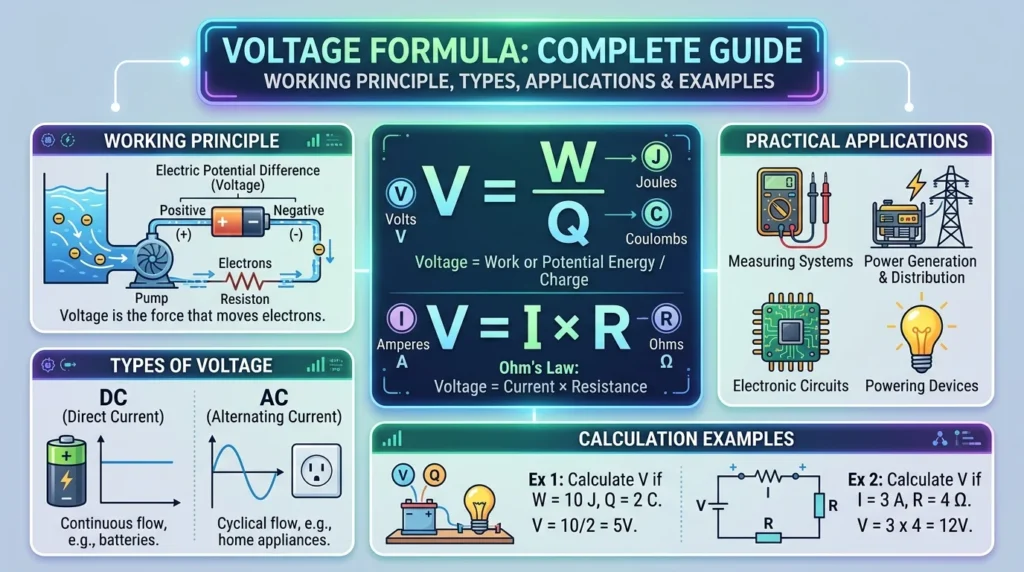
The Voltage Formula is one of the most important equations in electrical engineering and electronics. It is used to calculate the voltage (electrical potential difference) in an electrical circuit based on the relationship between current and resistance. This formula is derived from Ohm’s Law, one of the fundamental laws of electricity developed by the German physicist Georg Simon Ohm.
Understanding the voltage formula is essential for electrical students, electricians, engineers, and technicians because it helps analyze, design, troubleshoot, and maintain electrical systems. Whether you are calculating the voltage across a resistor, testing a battery, or designing an electrical circuit, this formula is used every day in practical electrical work.
The voltage formula explains how electrical pressure is created when electric current flows through a resistance. By knowing any two values—current and resistance—you can easily calculate the third value, voltage.
Basic Voltage Formula (Ohm’s Law)
The most commonly used voltage formula is derived from Ohm’s Law.
Formula:
V = I × R
Where:
- V = Voltage
- I = Current
- R = Resistance
This equation states that voltage is equal to the current flowing through a conductor multiplied by its resistance.
Understanding Each Part of the Formula
To use the voltage formula correctly, it is important to understand what each symbol represents.
V = Voltage
Voltage is the electrical force or pressure that pushes electrons through a conductor.
It is often called electrical potential difference because it represents the difference in electrical energy between two points in a circuit.
Unit: Volt (V)
Examples of Voltage Sources
- AA Battery = 1.5 V
- Car Battery = 12 V
- Household Supply = 120 V or 230 V (depending on the country)
Without voltage, electrical current cannot flow through a circuit.
I = Current
Current is the movement or flow of electric charge through a conductor.
The greater the flow of electrons, the higher the current.
Unit: Ampere (A)
One ampere means one coulomb of electric charge passes through a conductor every second.
Examples of electrical current include:
- Mobile phone charger
- Electric fan
- Water pump
- LED lighting
- Industrial motors
R = Resistance
Resistance is the property of a material that opposes the flow of electric current.
Every conductor has some resistance, although good conductors like copper have very low resistance.
Unit: Ohm (Ω)
Higher resistance makes it harder for electricity to flow.
Examples of resistance include:
- Heating elements
- Electric irons
- Water heaters
- Resistors in electronic circuits
How the Voltage Formula Works
The voltage formula shows the relationship between voltage, current, and resistance.
When Current Increases
If resistance remains constant and current increases, voltage also increases.
Example
- Current = 2 A
- Resistance = 5 Ω
Voltage:
V = 2 × 5 = 10 V
If current increases to 4 A:
V = 4 × 5 = 20 V
Higher current produces higher voltage across the same resistance.
When Resistance Increases
If current stays constant but resistance increases, voltage also increases.
Example
Current = 3 A
Resistance = 2 Ω
Voltage:
V = 3 × 2 = 6 V
If resistance increases to 5 Ω:
V = 3 × 5 = 15 V
This shows that increasing resistance increases the required voltage.
Simple Explanation of the Voltage Formula
The voltage formula can be understood in very simple words.
Imagine electricity flowing through a pipe.
- Voltage is like the water pressure.
- Current is like the amount of water flowing.
- Resistance is like a narrow section of the pipe that restricts water flow.
If the pipe becomes narrower (higher resistance), more pressure (voltage) is required to push the same amount of water through it.
Similarly, electrical circuits require higher voltage when resistance increases.
Step-by-Step Method to Calculate Voltage
Follow these simple steps whenever you need to calculate voltage.
Step 1: Identify the Current
Measure or determine the electrical current flowing through the circuit.
Example:
Current = 2 A
Step 2: Determine the Resistance
Find the resistance of the circuit or component.
Example:
Resistance = 5 Ω
Step 3: Apply Ohm’s Law
Use the formula:
V = I × R
Substitute the values:
V = 2 × 5
Step 4: Calculate the Answer
Multiply the values.
V = 10 V
Final Answer
Voltage = 10 Volts
Solved Examples
Example 1
Given:
Current = 2 A
Resistance = 5 Ω
Solution
V = I × R
V = 2 × 5
Voltage = 10 V
Example 2
Given:
Current = 6 A
Resistance = 4 Ω
Solution
V = 6 × 4
Voltage = 24 V
Example 3
Given:
Current = 10 A
Resistance = 3 Ω
Solution
V = 10 × 3
Voltage = 30 V
Practical Applications of the Voltage Formula
The voltage formula is used in many areas of electrical engineering and everyday life.
Common applications include:
- Designing electrical circuits
- Household wiring calculations
- Power distribution systems
- Motor control circuits
- Battery testing
- Solar power systems
- Electrical maintenance
- Industrial automation
- Electronic circuit design
- Troubleshooting electrical faults
Electricians and engineers use this formula daily to calculate the correct operating voltage for electrical equipment.
Important Points to Remember
- Voltage is measured in Volts (V).
- Current is measured in Amperes (A).
- Resistance is measured in Ohms (Ω).
- The voltage formula comes directly from Ohm’s Law.
- If current increases, voltage increases (when resistance remains constant).
- If resistance increases, voltage also increases (when current remains constant).
- The formula applies to both simple electrical circuits and many practical engineering calculations.
By understanding and applying the Voltage Formula (V = I × R), students and professionals can easily analyze electrical circuits, solve practical problems, and ensure the safe and efficient operation of electrical systems.
Other Forms of the Voltage Formula
The basic Voltage Formula (V = I × R) is the most commonly used equation in electrical engineering. However, depending on the information available, voltage can also be calculated using several other formulas derived from Ohm’s Law and the Electrical Power Formula.
These alternative formulas make it easier to solve different types of electrical problems without measuring every electrical quantity directly. Electrical engineers, technicians, and students use these equations regularly in circuit analysis, equipment design, troubleshooting, and power calculations.
Current Formula
When the voltage and resistance are known, the electrical current can be calculated using the following equation.
Formula:
I = V ÷ R
Where
- I = Current (Ampere, A)
- V = Voltage (Volt, V)
- R = Resistance (Ohm, Ω)
Explanation
This formula tells us how much electrical current flows through a circuit when a certain voltage is applied across a known resistance.
If voltage increases while resistance remains the same, current also increases.
If resistance increases while voltage remains constant, current decreases.
Example
Given
- Voltage = 24 V
- Resistance = 6 Ω
Solution
I = 24 ÷ 6
Current = 4 A
Resistance Formula
When the voltage and current are known, resistance can be calculated using Ohm’s Law.
Formula:
R = V ÷ I
Where
- R = Resistance (Ohm, Ω)
- V = Voltage (Volt, V)
- I = Current (Ampere, A)
Explanation
This equation determines how much resistance is present in an electrical circuit.
Higher resistance restricts the flow of electrical current, while lower resistance allows current to flow more easily.
Example
Given
- Voltage = 12 V
- Current = 3 A
Solution
R = 12 ÷ 3
Resistance = 4 Ω
Voltage Formula Using Power and Current
Sometimes the current and electrical power are known, but the voltage is unknown.
In this situation, the voltage can be calculated using the electrical power equation.
Formula:
V = P ÷ I
Where
- V = Voltage (Volt, V)
- P = Power (Watt, W)
- I = Current (Ampere, A)
Explanation
This formula is commonly used in electrical appliances, generators, batteries, and power supply systems.
It helps determine the operating voltage when the power consumption and current are already known.
Example
Given
- Power = 200 W
- Current = 10 A
Solution
V = 200 ÷ 10
Voltage = 20 V
Voltage Formula Using Power and Resistance
When electrical power and resistance are known, voltage can be calculated using the following equation.
Formula:
V = √(P × R)
Where
- V = Voltage (Volt, V)
- P = Power (Watt, W)
- R = Resistance (Ohm, Ω)
Explanation
This formula is derived by combining Ohm’s Law with the electrical power equation.
It is particularly useful when current is unknown but power and resistance are available.
Example
Given
- Power = 100 W
- Resistance = 25 Ω
Solution
V = √(100 × 25)
V = √2500
Voltage = 50 V
Summary of Common Voltage-Related Formulas
| Formula | Used to Calculate | When to Use |
|---|---|---|
| V = I × R | Voltage | Current and resistance are known |
| I = V ÷ R | Current | Voltage and resistance are known |
| R = V ÷ I | Resistance | Voltage and current are known |
| V = P ÷ I | Voltage | Power and current are known |
| V = √(P × R) | Voltage | Power and resistance are known |
Practical Uses of the Voltage Formula
The voltage formula is one of the most frequently used equations in electrical engineering because it applies to a wide variety of electrical systems and equipment.
1. Home Electrical Wiring
Electricians use the voltage formula when installing and troubleshooting:
- Lighting circuits
- Wall outlets
- Switchboards
- Household appliances
- Extension circuits
It helps ensure that electrical equipment receives the correct operating voltage.
2. Electrical Circuit Design
Electrical engineers use voltage calculations while designing:
- Series circuits
- Parallel circuits
- Control circuits
- Protection systems
- Distribution panels
Proper voltage calculations improve circuit performance and safety.
3. Battery Systems
The voltage formula is essential for:
- Battery charging systems
- UPS systems
- Electric vehicles
- Backup power supplies
- Portable electronic devices
It helps determine the correct operating voltage for connected equipment.
4. Solar Power Systems
Solar engineers use voltage calculations to design:
- Solar panels
- Charge controllers
- Battery banks
- Solar inverters
- Off-grid power systems
Correct voltage ensures maximum system efficiency and safe operation.
5. Industrial Electrical Machines
Voltage calculations are used extensively in industrial applications such as:
- Electric motors
- Motor control panels
- Transformers
- Industrial generators
- Manufacturing equipment
Maintaining the correct voltage helps improve equipment performance and reduce failures.
6. Electronics Repair
Technicians use voltage formulas while repairing:
- Televisions
- Computers
- Mobile phone chargers
- Power supplies
- Electronic control boards
Voltage measurements help locate faulty components quickly.
7. Motor Calculations
Motor designers and maintenance engineers use voltage formulas for:
- Motor performance analysis
- Motor efficiency calculations
- Starting circuit design
- Motor troubleshooting
- Preventive maintenance
Accurate voltage calculations help ensure reliable motor operation.
Important Points to Remember
Keep these important facts in mind whenever using the voltage formula.
- Voltage is measured in Volts (V).
- Current is measured in Amperes (A).
- Resistance is measured in Ohms (Ω).
- Power is measured in Watts (W).
- Always use the correct formula based on the values available.
- Higher voltage generally produces higher current if resistance remains constant.
- Excessive voltage can overheat or permanently damage electrical equipment.
- Low voltage may cause poor performance, overheating, or improper operation of electrical devices.
- Always verify calculations before applying power to a circuit.
- Follow proper electrical safety procedures and use calibrated measuring instruments, such as a voltmeter or digital multimeter, when checking voltage in real-world applications.
Understanding these different forms of the Voltage Formula allows students, electricians, and engineers to solve a wide range of electrical problems accurately and safely. Whether working on household wiring, industrial machinery, renewable energy systems, or electronic circuits, these formulas provide the foundation for effective electrical analysis and design.
2. What is Voltage Formula?
Voltage is the electrical pressure that pushes electric current through a circuit. It is measured in volts (V).
The most common Voltage Formula comes from Ohm’s Law:
genui{“math_block_widget_always_prefetch_v2”:{“content”:”V = I R”}}
Where:
- V = Voltage (Volts)
- I = Current (Amperes)
- R = Resistance (Ohms)
Simple Explanation
Voltage is like water pressure in a pipe:
- Higher pressure → more water flow
- Higher voltage → more current flow
Practical Example
If a circuit has:
- Current = 2 Amps
- Resistance = 5 Ohms
Then:
Voltage = 2 × 5 = 10 Volts
3. Working Principle of Voltage Formula
The voltage formula working principle is based on the relationship between voltage, current, and resistance.
Step-by-Step Explanation
- Voltage creates pressure in the circuit
- Current flows because of this pressure
- Resistance opposes the flow
- The balance of these three gives the voltage value
Easy Analogy
Think of:
- Voltage = water pressure
- Current = water flow
- Resistance = pipe blockage
Key Points
- Increasing voltage increases current
- Increasing resistance decreases current
- Voltage depends on both current and resistance
Types and Classification of Voltage Formula
The Voltage Formula can be expressed in different forms depending on the electrical quantities available. While Ohm’s Law is the most common method for calculating voltage, engineers and electricians also use formulas based on power and Kirchhoff’s Voltage Law (KVL) for more advanced electrical analysis.
Each voltage formula has a specific purpose and is used in different types of electrical circuits, from simple household wiring to complex industrial power systems. Understanding these formulas helps students and professionals solve electrical problems more efficiently.
1. Ohm’s Law Voltage Formula
This is the most fundamental and widely used voltage formula in electrical engineering.
genui{“circuits_magnetism_induction_learning_block_staging”:{“type_id”:”OHMS_LAW”}}
Formula
V = I × R
Where
- V = Voltage (Volt, V)
- I = Current (Ampere, A)
- R = Resistance (Ohm, Ω)
Explanation
Ohm’s Law states that the voltage across a conductor is equal to the current flowing through it multiplied by its resistance.
This formula is used to calculate voltage in simple DC and AC resistive circuits and forms the foundation of most electrical calculations.
Applications
- Household electrical wiring
- Electronic circuits
- Battery-powered devices
- Educational laboratories
- Basic electrical troubleshooting
Example
Current = 4 A
Resistance = 5 Ω
V = 4 × 5 = 20 V
Answer: Voltage = 20 Volts
2. Voltage Formula Using Power and Current
When electrical power and current are known, voltage can be calculated using the power equation.
Formula
V = P ÷ I
Where
- V = Voltage (Volt, V)
- P = Power (Watt, W)
- I = Current (Ampere, A)
Explanation
This formula is derived from the electrical power equation:
P = V × I
By rearranging the equation, voltage can be calculated whenever power consumption and current are known.
Applications
This formula is commonly used in:
- Electric motors
- Power supplies
- Household appliances
- Solar power systems
- Battery charging systems
- Industrial electrical equipment
Example
Power = 240 W
Current = 12 A
V = 240 ÷ 12 = 20 V
Answer: Voltage = 20 Volts
3. Voltage Formula Using Power and Resistance
When the power and resistance of a circuit are known, voltage can be calculated without measuring current.
Formula
V = √(P × R)
Where
- V = Voltage (Volt, V)
- P = Power (Watt, W)
- R = Resistance (Ohm, Ω)
Explanation
This equation combines Ohm’s Law with the electrical power equation.
It is especially useful when the current flowing through the circuit is unknown but the power rating and resistance are available.
Applications
Engineers use this formula for:
- Heater calculations
- Resistor circuit design
- Electrical appliance design
- Power distribution analysis
- Industrial electrical calculations
Example
Power = 100 W
Resistance = 25 Ω
V = √(100 × 25)
V = √2500
Voltage = 50 V
4. Kirchhoff’s Voltage Law (KVL)
Kirchhoff’s Voltage Law (KVL) is one of the fundamental laws used in electrical circuit analysis.
Principle
The algebraic sum of all voltages around any closed electrical loop is equal to zero.
Mathematical Expression
ΣV = 0
Explanation
According to Kirchhoff’s Voltage Law, the total voltage supplied by a power source is exactly equal to the total voltage drops across all components in a closed circuit.
In other words:
Total Supply Voltage = Total Voltage Drop
This law is based on the principle of energy conservation, meaning electrical energy is neither created nor destroyed as current flows around a closed loop.
Applications
KVL is widely used in:
- Series circuit analysis
- Complex electrical networks
- Industrial control systems
- Power distribution circuits
- Electronic circuit design
- Electrical engineering calculations
Example
Suppose a circuit contains:
- Supply Voltage = 24 V
- Resistor 1 Voltage Drop = 10 V
- Resistor 2 Voltage Drop = 8 V
- Resistor 3 Voltage Drop = 6 V
Applying Kirchhoff’s Voltage Law:
24 − 10 − 8 − 6 = 0
Since the sum of all voltages equals zero, the circuit satisfies Kirchhoff’s Voltage Law.
Comparison of Voltage Formula Types
| Voltage Formula | Formula | Known Values | Common Applications |
|---|---|---|---|
| Ohm’s Law Voltage Formula | V = I × R | Current and Resistance | Basic electrical circuits, wiring, troubleshooting |
| Power and Current Formula | V = P ÷ I | Power and Current | Electrical appliances, motors, power supplies |
| Power and Resistance Formula | V = √(P × R) | Power and Resistance | Heater design, resistor calculations, industrial systems |
| Kirchhoff’s Voltage Law (KVL) | ΣV = 0 | All circuit voltages | Complex circuit analysis, network design, electrical engineering |
Which Voltage Formula Should You Use?
The correct voltage formula depends on the information available.
- Use Ohm’s Law (V = I × R) when current and resistance are known.
- Use V = P ÷ I when power and current are available.
- Use V = √(P × R) when power and resistance are known but current is unknown.
- Use Kirchhoff’s Voltage Law (ΣV = 0) when analyzing closed-loop or multi-component electrical circuits.
By understanding these different types of voltage formulas, students, electricians, and engineers can solve a wide range of electrical problems accurately and confidently, from simple household circuits to complex industrial electrical systems.
Main Components Involved in the Voltage Formula
To understand how the Voltage Formula works, it is important to know the basic electrical components found in a circuit. Each component plays a specific role in generating, controlling, and using electrical energy. Together, these components create a complete path that allows current to flow and makes voltage calculations possible.
Whether you are studying basic electrical engineering or working on real electrical systems, understanding these components will help you apply the voltage formula correctly.
1. Voltage Source
The voltage source is the component that supplies electrical energy to the circuit. It creates the electrical potential difference (voltage) that pushes electrons through the conductor.
Without a voltage source, no current can flow, and the circuit will not operate.
Common Voltage Sources
- Batteries
- Power supplies
- Electrical generators
- Solar panels
- Inverters
- Utility power (AC mains)
Function
- Supplies electrical energy to the circuit
- Creates the potential difference (voltage)
- Drives current through the electrical load
- Powers electrical and electronic devices
Example: A 12 V car battery provides the voltage needed to operate the vehicle’s electrical system.
2. Conductor
A conductor is the path through which electric current flows. It connects all the components in the circuit and carries electrical energy from the source to the load.
Copper and aluminum are the most commonly used conductor materials because they have very low electrical resistance.
Common Conductors
- Copper wires
- Aluminum cables
- Busbars
- Printed circuit board (PCB) tracks
Function
- Carries electrical current
- Connects all circuit components
- Provides a complete path for electricity to flow
- Minimizes power loss due to low resistance
Example: The copper wires in household wiring carry electricity from the distribution board to lights, fans, and electrical outlets.
3. Resistance
Resistance is the property of a material that opposes the flow of electric current. Every electrical circuit contains some resistance, whether it comes from a resistor, a heating element, or even the connecting wires.
Resistance directly affects both the current and voltage in a circuit, making it a key part of Ohm’s Law.
Unit
- Ohm (Ω)
Function
- Limits the flow of electrical current
- Controls the voltage drop across components
- Protects electrical devices from excessive current
- Converts electrical energy into heat when required
Example: The heating element inside an electric iron has high resistance, which produces heat when current flows through it.
4. Load
A load is any electrical device or equipment that consumes electrical energy to perform useful work. The load converts electrical energy into another form of energy, such as light, heat, motion, or sound.
Every electrical circuit is designed to supply power to one or more loads.
Common Electrical Loads
- Light bulbs
- Ceiling fans
- Electric motors
- Water pumps
- Televisions
- Air conditioners
- Refrigerators
- Mobile phone chargers
Function
- Uses electrical energy
- Converts electricity into useful work
- Determines the amount of current drawn from the source
- Completes the purpose of the electrical circuit
Example: A ceiling fan uses electrical energy to rotate its blades and produce airflow.
5. Electric Current
Although current is part of the voltage formula rather than a physical component, it is an essential element for understanding how the formula works.
Current is the flow of electrons through the conductor from the voltage source to the load.
Unit
- Ampere (A)
Function
- Transfers electrical energy through the circuit
- Powers electrical devices
- Works together with voltage and resistance according to Ohm’s Law
Example: A small LED lamp may draw only 0.2 A, while an electric heater may draw 10 A or more.
How These Components Work Together
The operation of a basic electrical circuit can be understood in the following steps:
Step 1: The Voltage Source Supplies Power
A battery, generator, or power supply provides the electrical voltage needed to operate the circuit.
Step 2: Current Flows Through the Conductor
The voltage pushes electric current through the connecting wires toward the load.
Step 3: Resistance Controls Current Flow
The resistance in the circuit limits the amount of current that can flow, helping protect the electrical components.
Step 4: The Load Uses Electrical Energy
The electrical load converts electrical energy into useful output, such as light, heat, or mechanical motion.
Step 5: The Voltage Formula Describes the Relationship
The relationship between these components is explained by Ohm’s Law:
V = I × R
This formula shows that:
- Voltage drives current through the circuit.
- Resistance opposes the current flow.
- Current depends on both the applied voltage and the circuit resistance.
Component Summary Table
| Component | Description | Primary Function |
|---|---|---|
| Voltage Source | Battery, generator, or power supply | Provides electrical energy and creates voltage |
| Conductor | Copper wire or cable | Carries electrical current throughout the circuit |
| Resistance | Resistor or electrical opposition | Limits current flow and creates voltage drop |
| Load | Fan, bulb, motor, heater, or appliance | Uses electrical energy to perform useful work |
| Current | Flow of electric charge | Transfers electrical energy from the source to the load |
Understanding these main components of the voltage formula provides a strong foundation for learning electrical engineering. Once you know how the voltage source, conductor, resistance, load, and current interact, applying the voltage formula to real-world electrical circuits becomes much easier and more accurate.
6. Advantages
Voltage Formula Advantages and Disadvantages (Advantages)
- Helps in accurate circuit calculations
- Easy to use and understand
- Useful in troubleshooting
- Essential for electrical design
- Saves time during analysis
- Works in both simple and complex circuits
7. Disadvantages / Limitations
- Works best in ideal conditions
- Not always accurate in complex AC systems
- Requires correct measurement of current and resistance
- Cannot directly apply to nonlinear devices
- Needs proper understanding to avoid mistakes
Applications of the Voltage Formula
The Voltage Formula is one of the most widely used equations in electrical engineering. It helps electricians, engineers, technicians, and students calculate the correct voltage required for electrical circuits and equipment. From small household appliances to large industrial power systems, voltage calculations are essential for designing safe and efficient electrical installations.
Understanding the applications of the voltage formula makes it easier to see how this simple equation is used in everyday life and modern technology.
1. Home Electrical Applications
The voltage formula is commonly used in residential electrical systems to ensure appliances and electrical circuits receive the correct operating voltage.
Typical applications include:
- Calculating voltage for household appliances
- Designing home electrical wiring
- Installing lighting circuits
- Checking wall sockets and switches
- Troubleshooting wiring faults
- Testing batteries and power supplies
- Verifying extension cord voltage
- Maintaining home electrical systems
Proper voltage calculations help prevent electrical equipment from overheating or becoming damaged.
2. Industrial Applications
Industrial electrical systems require accurate voltage calculations for safe and reliable operation.
Engineers and technicians use the voltage formula for:
- Designing industrial power systems
- Operating electric motors
- Machine control circuits
- Distribution panels
- Control panels
- Manufacturing equipment
- Generator systems
- Transformer calculations
- Preventive maintenance
Correct voltage ensures industrial machinery operates efficiently while minimizing energy losses and equipment failures.
3. Electronics and Communication Systems
Electronic devices rely on precise voltage levels for proper operation.
The voltage formula is used in:
- Electronic circuit design
- Printed circuit boards (PCBs)
- Computer power supplies
- Mobile phone chargers
- Audio and video equipment
- Communication systems
- Consumer electronics
- Embedded systems
Small voltage variations can significantly affect the performance of electronic circuits, making accurate calculations essential.
4. Renewable Energy Systems
Renewable energy installations require careful voltage calculations to maximize efficiency and ensure safe operation.
Applications include:
- Solar photovoltaic (PV) systems
- Wind power generation
- Battery energy storage systems
- Solar charge controllers
- Hybrid power systems
- Off-grid electrical systems
- Inverters
- Electric vehicle charging systems
Voltage calculations help match system components and reduce power losses.
5. Electrical Maintenance and Troubleshooting
Maintenance engineers use the voltage formula every day to diagnose electrical problems.
Common maintenance applications include:
- Finding voltage drops
- Identifying faulty wiring
- Testing electrical equipment
- Inspecting motors and transformers
- Troubleshooting control circuits
- Verifying power supply performance
- Preventive maintenance inspections
Accurate voltage calculations help reduce downtime and improve equipment reliability.
Comparison: Voltage vs Current
Although voltage and current are closely related, they are different electrical quantities. Understanding their differences helps beginners better understand Ohm’s Law and electrical circuit operation.
| Feature | Voltage | Current |
|---|---|---|
| Definition | Electrical pressure or potential difference that pushes electrons | Flow of electric charge through a conductor |
| Symbol | V | I |
| SI Unit | Volt (V) | Ampere (A) |
| Function | Pushes current through the circuit | Carries electrical energy through the circuit |
| Measurement Instrument | Voltmeter | Ammeter |
| Measured Across or Through | Across a component | Through a conductor or load |
| Analogy | Water pressure in a pipe | Water flowing through the pipe |
| Relationship | Drives current | Depends on voltage and resistance |
Key Difference
Think of a water pipe:
- Voltage is like the water pressure.
- Current is like the amount of water flowing.
- Resistance is like the size of the pipe that restricts the flow.
Higher pressure generally produces greater flow if the pipe size remains the same.
Selection Guide: How to Use the Voltage Formula Correctly
Selecting the correct voltage formula is important for obtaining accurate electrical calculations. Different situations require different formulas depending on the information available.
Step 1: Identify the Known Values
Before solving any problem, determine which electrical values are already known.
For example:
- Voltage
- Current
- Resistance
- Power
Knowing the available values helps you choose the correct equation.
Step 2: Choose the Correct Formula
Use the appropriate formula based on the information you have.
Examples include:
- V = I × R → When current and resistance are known.
- V = P ÷ I → When power and current are known.
- V = √(P × R) → When power and resistance are known.
Using the correct equation ensures accurate results.
Step 3: Use Standard Electrical Units
Always use standard SI units when performing calculations.
- Voltage = Volt (V)
- Current = Ampere (A)
- Resistance = Ohm (Ω)
- Power = Watt (W)
Incorrect units may produce incorrect answers.
Step 4: Perform the Calculation Carefully
Substitute the known values into the selected formula and solve the equation step by step.
Using a calculator helps improve accuracy.
Step 5: Verify the Answer
Always review your calculation.
Check that:
- Units are correct.
- Mathematical operations are accurate.
- The result is reasonable for the electrical circuit.
Verifying calculations helps prevent design errors and equipment damage.
Tips for Beginners
If you are learning electrical calculations for the first time, these tips will help you understand the voltage formula more easily.
- Start by learning Ohm’s Law (V = I × R).
- Understand the relationship between voltage, current, and resistance.
- Practice solving simple numerical problems every day.
- Draw circuit diagrams before performing calculations.
- Always write the correct units beside every value.
- Use a scientific calculator for accuracy.
- Check your answers by solving the problem again.
- Practice with real electrical examples such as batteries, lamps, and resistors.
Regular practice builds confidence and improves problem-solving skills.
Common Problems and Solutions
Students and technicians often encounter practical questions while applying the voltage formula. The following troubleshooting guide answers some of the most common issues.
Q1: Why Is the Calculated Voltage Incorrect?
Possible Causes
- Incorrect current value
- Incorrect resistance value
- Wrong formula selection
- Calculation error
- Incorrect unit conversion
Solution
- Verify the current and resistance values.
- Make sure you are using the correct voltage formula.
- Check all calculations carefully.
- Confirm that all values are in standard SI units.
Q2: Why Is Current Not Flowing in the Circuit?
Possible Causes
- No voltage supply
- Open circuit
- Blown fuse
- Broken conductor
- Loose electrical connection
Solution
- Check the voltage source.
- Inspect wiring connections.
- Test the fuse or circuit breaker.
- Repair damaged conductors.
Q3: Why Is There a Voltage Drop?
Possible Causes
- Long cable length
- High resistance
- Loose terminals
- Undersized conductors
- Excessive electrical load
Solution
- Tighten electrical connections.
- Replace damaged wiring.
- Use larger conductor sizes if necessary.
- Reduce excessive circuit loading.
Q4: How Can Voltage Be Measured?
Solution
Use a voltmeter or digital multimeter.
Connect the meter across the two points where the voltage needs to be measured.
Always select the correct AC or DC voltage range before testing and follow proper electrical safety procedures.
Q5: Why Is My Electrical Device Not Operating Properly?
Possible Causes
- Low supply voltage
- Excessive voltage
- Faulty power source
- Damaged wiring
- Internal equipment failure
Solution
Measure the supply voltage and compare it with the equipment’s rated voltage.
Repair faulty wiring or replace defective electrical components if necessary.
Future Trends in Voltage Calculations
As electrical engineering continues to evolve, voltage calculations are becoming faster, smarter, and more accurate through the use of digital technology and automation. However, the basic principles of the voltage formula remain the foundation of all electrical system design and analysis.
Smart Electrical Systems
Modern electrical systems increasingly use intelligent controllers that automatically monitor and adjust voltage levels to improve efficiency, reliability, and energy savings.
AI-Based Circuit Analysis
Artificial intelligence (AI) is being integrated into electrical design software to analyze complex circuits, detect faults, and recommend optimal voltage settings with minimal human intervention.
Renewable Energy Integration
The rapid growth of solar, wind, and battery energy storage systems has increased the need for accurate voltage calculations to ensure efficient power generation, storage, and distribution.
Advanced Simulation Software
Electrical engineers now use sophisticated simulation tools to model voltage behavior before building actual circuits.
These programs help:
- Predict circuit performance
- Reduce design errors
- Improve system efficiency
- Lower development costs
Smart Measuring Instruments
Modern digital multimeters, smart voltmeters, and wireless testing devices provide highly accurate voltage measurements and can store, analyze, and transmit data for predictive maintenance and remote monitoring.
The Future of Voltage Calculations
Although modern software and intelligent instruments can automate many electrical calculations, a solid understanding of the Voltage Formula and Ohm’s Law will always remain essential. Students, electricians, engineers, and technicians who master these fundamental principles will continue to have the knowledge needed to design, troubleshoot, and maintain safe and reliable electrical systems in the future.
13. Conclusion
The Voltage Formula is one of the most important concepts in electrical engineering. It helps you understand how electricity works and allows you to design, analyze, and troubleshoot circuits effectively.
From simple home wiring to complex industrial systems, voltage plays a critical role everywhere. By learning the voltage formula working principle, types, and applications, you build a strong foundation in electrical knowledge.
Keep practicing calculations and applying these concepts in real-life situations. With time, you will become confident in handling electrical systems safely and efficiently.