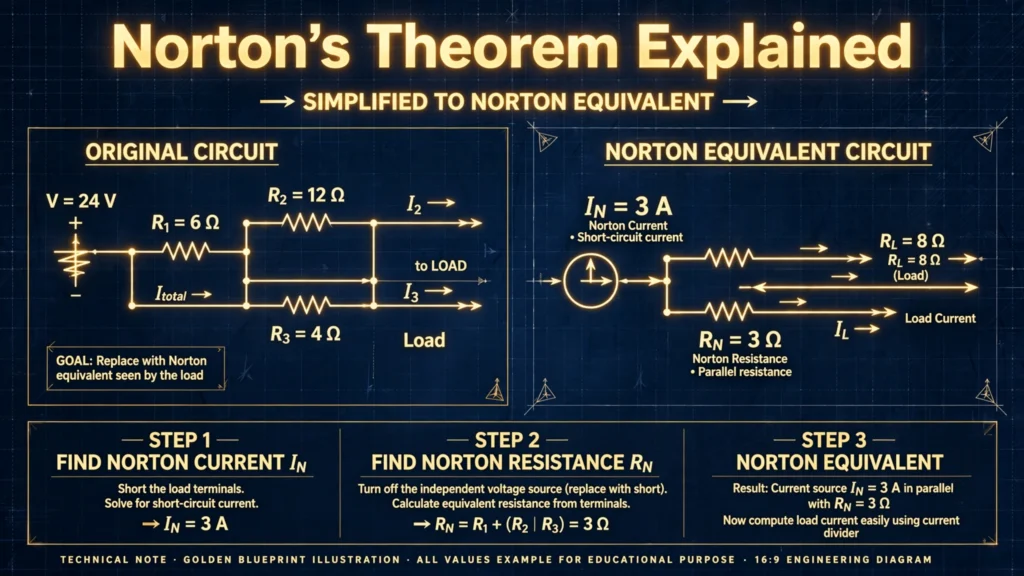

If you have met Thevenin’s theorem, Norton’s theorem will feel like meeting its twin. Where Thevenin replaces a complex network with a voltage source in series with a resistor, Norton replaces it with a current source in parallel with a resistor. The two are mathematically equivalent — two faces of the same idea — but Norton form is often more convenient when you are working with parallel branches or current-driven analysis.
This guide explains the theorem, walks through two fully solved examples, and shows exactly how Norton and Thevenin convert into each other.
What the Theorem States
Norton’s theorem says: any linear two-terminal network of sources and resistors can be replaced by an equivalent circuit consisting of a single current source (IN) in parallel with a single resistor (RN).
The terminals are the same two points where the load connects. Everything behind those terminals collapses into the Norton equivalent, and the load cannot tell the difference — it sees the same current and voltage as before.
Like its twin, the theorem rests on linearity, so it applies to circuits built from resistors and independent sources. If you are comfortable with Ohm’s law and Kirchhoff’s current law, the method below will feel straightforward. (New to the twin theorem? Read our guide to Thevenin’s theorem first — the ideas mirror each other.)
The Norton Equivalent Circuit
The equivalent has just three elements:
- IN (Norton current) — the short-circuit current flowing between the two terminals when they are connected together (load removed, terminals shorted).
- RN (Norton resistance) — the equivalent resistance seen from the terminals with all independent sources turned off. This is exactly the same resistance as Thevenin’s Rth.
- The load (RL) — reconnected across the terminals, in parallel with the current source and RN.
With the equivalent drawn, the load current follows the current-divider rule: IL = IN × RN / (RN + RL).
Step-by-Step Method to Find IN and RN
Step 1 — Remove the load and short the terminals. Unlike Thevenin (open circuit), Norton needs the short-circuit current, so place a wire across A–B.
Step 2 — Find IN. Calculate the current flowing through that short. All the network’s drive capability funnels into this one number.
Step 3 — Find RN. Turn off all independent sources (voltage sources become shorts, current sources become opens) and reduce the network to a single equivalent resistance between A–B. RN always equals Rth for the same terminals.
Step 4 — Draw the equivalent. Sketch the current source IN in parallel with RN, reconnect RL across the terminals, and use the current divider to find the load current.
Solved Example 1: Finding the Load Current
Problem: A 24 V source connects in series with R1 = 6 Ω. Across the output terminals A–B sits R2 = 12 Ω, and the load RL = 12 Ω also connects across A–B. Find the load current using Norton’s theorem.
Step 1 — Remove RL and short A–B. The short across A–B puts R2 in parallel with a wire, so R2 carries no current — it is bypassed entirely.
Step 2 — Find IN. With A–B shorted, the only path is the source through R1 into the short:
IN = Vs / R1 = 24 / 6 = 4 A
Step 3 — Find RN. Deactivate the source (short it). From A–B, R1 and R2 are in parallel:
RN = (6 × 12) / (6 + 12) = 72 / 18 = 4 Ω
Step 4 — Current divider with RL reconnected:
IL = IN × RN / (RN + RL) = 4 × 4 / (4 + 12) = 16 / 16 = 1 A
The load current is 1 A — identical to what Thevenin’s method would give, as it must be.
Solved Example 2: Norton Equivalent and Load Voltage
Problem: A 20 V source feeds R1 = 4 Ω in series, with R2 = 8 Ω across terminals A–B. Load RL = 8 Ω. Find the Norton equivalent and the voltage across the load.
Step 1 — Short A–B (RL removed). R2 is bypassed by the short.
Step 2 — IN:
IN = 20 / 4 = 5 A
Step 3 — RN (source shorted, R1 || R2):
RN = (4 × 8) / (4 + 8) = 32 / 12 = 2.67 Ω
Step 4 — Load current and voltage:
IL = 5 × 2.67 / (2.67 + 8) = 13.33 / 10.67 = 1.25 A
VL = IL × RL = 1.25 × 8 = 10 V
Converting Between Norton and Thevenin
Because RN = Rth, conversion takes one line. This is called source transformation:
- Norton → Thevenin: Vth = IN × RN (voltage source in series with the same resistor)
- Thevenin → Norton: IN = Vth / Rth (current source in parallel with the same resistor)
Check with Example 1: Vth = 4 A × 4 Ω = 16 V in series with 4 Ω. Load current = 16 / (4 + 12) = 1 A. Same answer — the two forms are interchangeable, so learn whichever feels natural and convert freely.
Thevenin vs Norton: Which Should You Use?
| Situation | Better choice | Why |
|---|---|---|
| Load in series with the network | Thevenin | Voltage divider is one step |
| Load in parallel branches | Norton | Current divider is one step |
| You need open-circuit voltage | Thevenin | Vth is found directly |
| You need short-circuit current | Norton | IN is found directly |
| Converting sources in a chain | Either | Source transformation links them |
In exams, pick the form that matches what the question asks for. In practice, engineers often compute the Thevenin equivalent first (open-circuit voltage is easy to measure) and convert to Norton only if the analysis that follows is current-based.
Frequently Asked Questions
What is Norton’s theorem in simple words?
Any linear circuit, viewed from two terminals, behaves exactly like a single current source (IN) in parallel with a single resistor (RN). It is the current-source twin of Thevenin’s voltage-source equivalent.
Is Norton resistance the same as Thevenin resistance?
Yes. RN and Rth are the same value — the equivalent resistance seen from the terminals with all independent sources turned off. Only the source type differs.
Why short the terminals instead of leaving them open?
The Norton current is defined as the short-circuit current. Shorting A–B forces the maximum current the network can deliver through those terminals, which is exactly the value the equivalent current source must provide.
Can Norton handle circuits with dependent sources?
Yes, with the same test-source technique used for Thevenin: deactivate independent sources, apply a test voltage at the terminals, measure the current, and compute RN = Vtest / Itest. Then find IN from the actual short-circuit condition.
When is Norton easier than Thevenin?
When the circuit has parallel-heavy topology or the question asks for short-circuit current, Norton usually needs fewer steps. For series-heavy circuits or open-circuit voltage questions, Thevenin is typically faster.
Does Norton’s theorem work for AC circuits?
Yes. Use phasor currents and complex impedances instead of DC values. The steps — short-circuit current, deactivated-source impedance — are unchanged.
Final Thoughts
Norton’s theorem gives you a second lens for the same circuits: where Thevenin sees a voltage pushing through a series resistor, Norton sees a current splitting through a parallel resistor. Master source transformation and you effectively know both theorems at once — a genuine two-for-one in circuit analysis. For the formal treatment, see Norton’s theorem on Wikipedia.