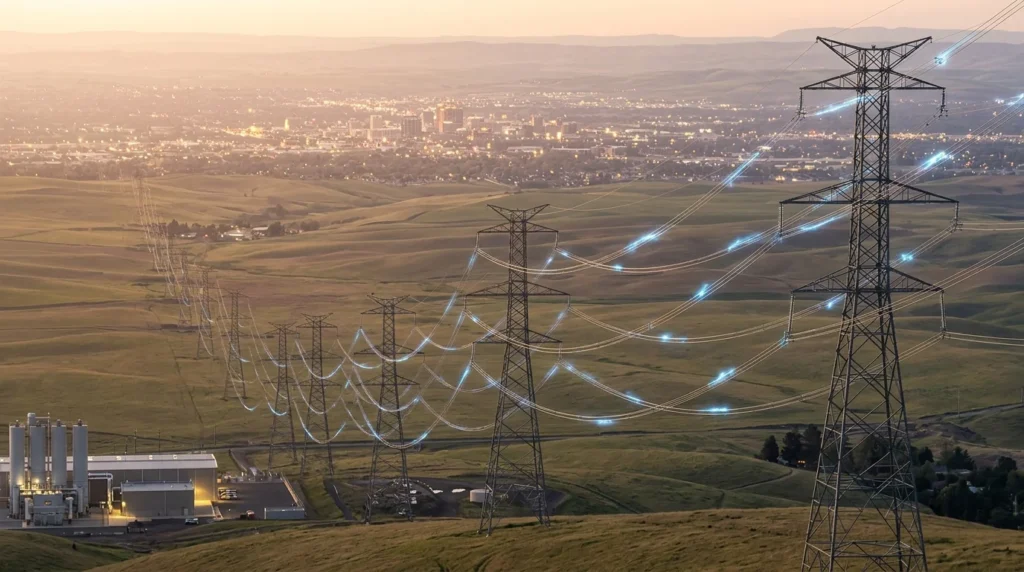

Imagine electricity generated at a power station hundreds of kilometers away lighting up your home instantly. This is made possible by transmission lines, which carry electrical energy over long distances safely and efficiently. Without them, modern life—industries, hospitals, communication systems—would simply stop.
Understanding the Transmission Line is essential for electrical students, engineers, and technicians. It helps you design power systems, reduce losses, and ensure reliable electricity supply. Whether you are working on a small project or a large grid system, this concept is fundamental.
In this article, you will learn:
- Transmission line working principle
- Types and classifications
- Key components and design factors
- Transmission line applications
- Transmission line advantages and disadvantages
- Common problems and practical solutions
This guide is written in simple and clear English, just like a senior engineer explaining concepts to a junior.
2. What is Transmission Line?
A Transmission Line is a system used to transfer electrical power from one place to another, usually from a power plant to substations.
Simple Explanation
It is like a highway for electricity:
- Power plants = source
- Transmission lines = roads
- Homes/industries = destination
Practical Example
Electricity generated at a thermal power plant travels through high-voltage transmission lines to cities and industries before reaching consumers.
3. Working Principle
The transmission line working principle is based on efficient power transfer using high voltage and low current.
Step-by-Step Explanation
- Electricity is generated at power plants
- Voltage is increased using transformers
- Power flows through transmission lines
- Voltage is reduced near consumption areas
- Electricity is distributed to users
Easy Analogy
Think of water supply:
- High pressure (voltage) → efficient flow
- Long pipes (lines) → transport
- Low leakage → minimal loss
Key Points
- High voltage reduces power loss
- Current flow causes heat loss
- Proper insulation ensures safety
4. Types / Classification
Short Transmission Line
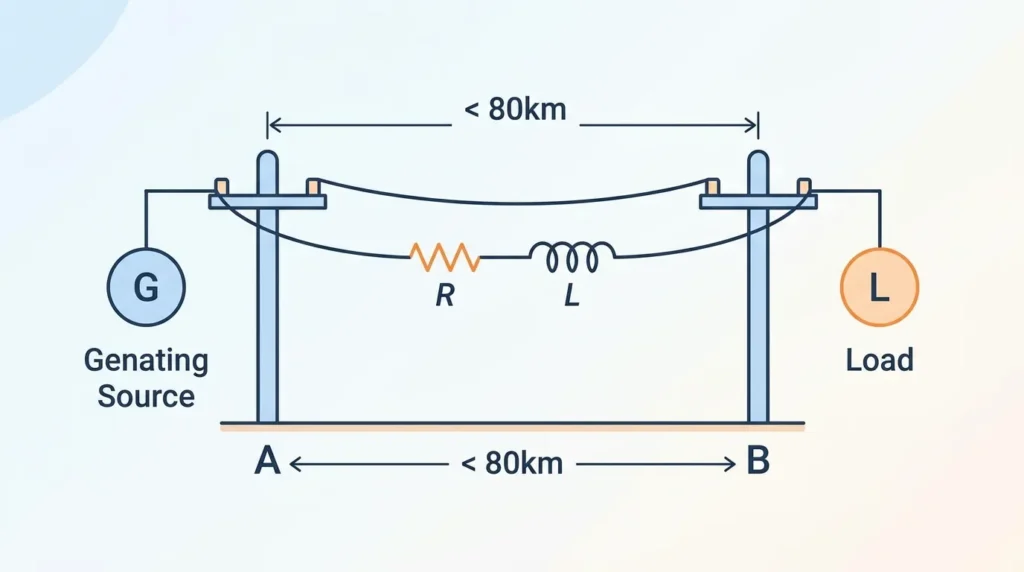
- Length less than 80 km
- Voltage below 20 kV
- Simple calculations used
A short transmission line is a type of electrical power transmission line in which the length of the line is relatively small, usually up to 80 kilometers. Because of its short length, the effects of line capacitance are very small and can often be neglected in calculations. In a short transmission line, only the resistance and inductance of the line are considered important for analysis. This makes the study and calculation of voltage drop and power loss simpler compared to medium and long transmission lines. Short transmission lines are commonly used in local power distribution systems where electricity is transmitted from substations to nearby towns, industrial areas, or residential zones. The voltage level in short transmission lines is generally low to medium, typically below 20 kV or sometimes up to 33 kV depending on the system design. The main purpose of a short transmission line is to deliver electrical power efficiently over a small distance with minimal losses. Since the distance is short, the voltage regulation is usually good, but engineers still calculate voltage drop to ensure proper supply at the receiving end. The basic formula used in analysis considers resistance (R) and inductive reactance (X), while capacitive effects are ignored. Power loss in a short transmission line mainly occurs due to the resistance of the conductor, which converts electrical energy into heat. To reduce losses, conductors with low resistance and high conductivity such as copper or aluminum are used. Proper line design and maintenance are important for efficient operation.
For example, a 11 kV distribution line supplying electricity from a local substation to a nearby village or industrial area within 20 to 50 kilometers is a typical example of a short transmission line. Another example is the power supply line used to connect a city substation to surrounding residential neighborhoods. In both cases, the distance is short, so engineers do not consider capacitance effects, making the system easier to design and analyze. Overall, short transmission lines play a very important role in delivering electricity safely and efficiently over small distances in power distribution networks.
Medium Transmission Line
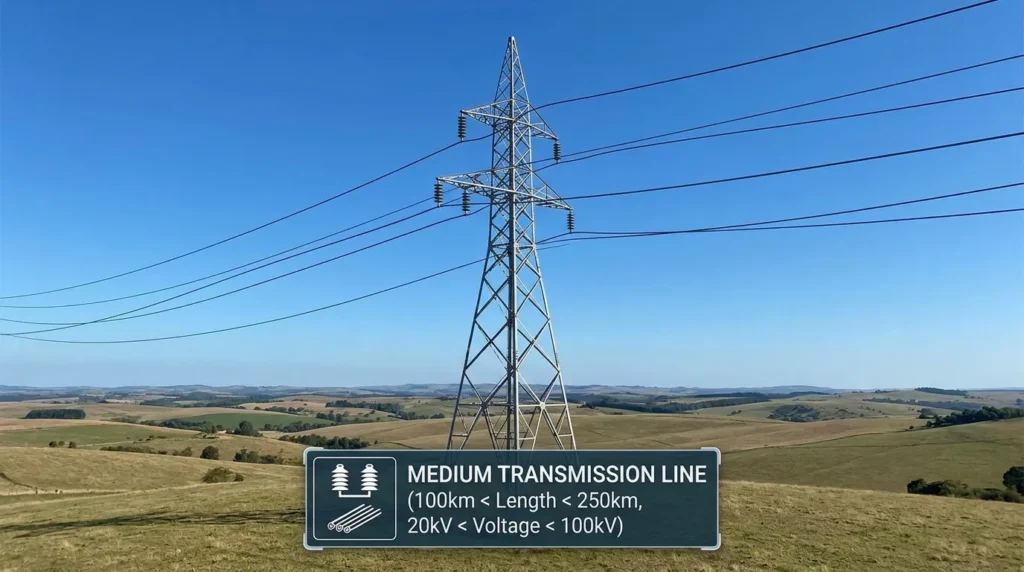
- Length between 80–250 km
- Voltage between 20 kV–100 kV
- Includes capacitance effects
A medium transmission line is a type of electrical power transmission line in which the length of the line is generally between 80 km and 250 km. In this type of line, the effect of line capacitance becomes significant and cannot be ignored in calculations. Therefore, unlike a short transmission line, both resistance, inductance, and capacitance are considered for accurate analysis of performance, voltage regulation, and power loss. Medium transmission lines are commonly used in regional power transmission systems where electricity is transferred from generating stations or major substations to distant substations or large cities. The voltage level in medium transmission lines is usually in the range of 33 kV to 132 kV, depending on the power system design and load requirements.
To analyze a medium transmission line, engineers use different models such as the nominal π (pi) model and nominal T model. These models help in calculating voltage drop, current distribution, and efficiency more accurately by including the effect of capacitance distributed along the line. Due to increased distance, power losses in medium transmission lines are higher compared to short transmission lines, mainly because of resistance in the conductors and reactive power effects caused by inductance and capacitance. Proper design, conductor selection, and voltage regulation techniques are used to minimize these losses and maintain system stability.
For example, a 132 kV transmission line that carries electricity from a hydroelectric power station to a major city located about 150 km away is a typical example of a medium transmission line. Another example is the power transmission system connecting two large substations in different districts within a state. In both cases, the line length is sufficient to make capacitance effects important, so engineers must include them in system calculations.
Overall, medium transmission lines play a very important role in regional power distribution networks. They act as a bridge between short transmission lines and long transmission lines, ensuring efficient and reliable delivery of electrical power over moderate distances.
Long Transmission Line
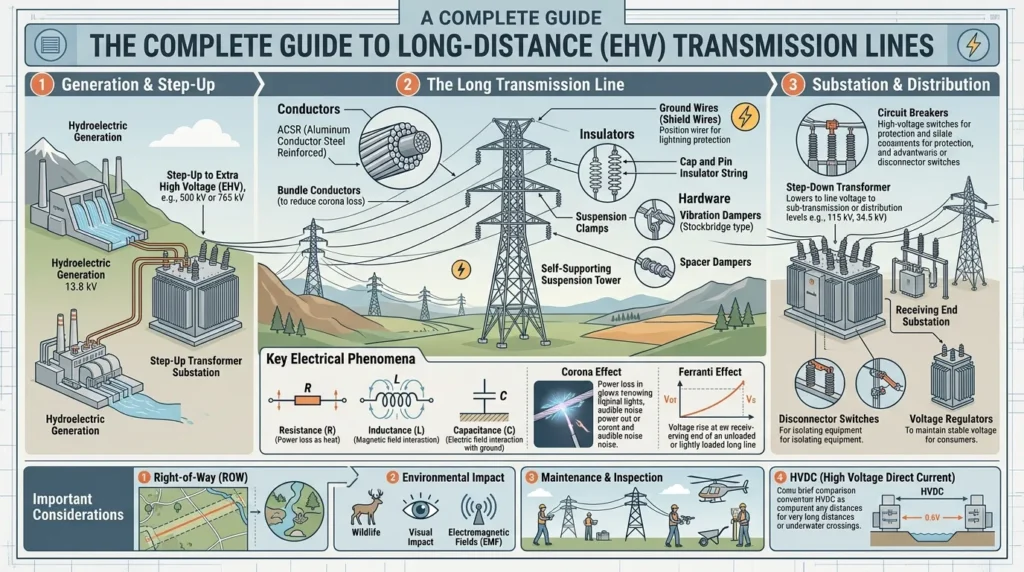
- Length above 250 km
- Voltage above 100 kV
- Complex analysis required
A long transmission line is an electrical power transmission line in which the length is generally more than 250 km. In long transmission lines, all three parameters—resistance, inductance, and capacitance—are fully significant and must be considered for accurate analysis. Unlike short and medium transmission lines, the electrical properties are not uniform along the entire length, so the line is treated as a distributed parameter system. This makes the study of long transmission lines more complex in power system engineering.
Long transmission lines are mainly used to transmit large amounts of electrical power over very long distances, such as from power generation stations (hydro, thermal, or nuclear plants) to distant load centers or national grids. The voltage levels in long transmission lines are very high, usually above 132 kV and can go up to 765 kV or even higher in extra-high voltage (EHV) systems. High voltage is used to reduce current flow, which helps minimize power losses due to resistance and improves transmission efficiency.
For analysis of long transmission lines, advanced mathematical models such as the distributed parameter model are used. Engineers also use ABCD parameters to study voltage regulation, power flow, and stability. The effects of capacitance are very important because they cause charging currents, especially during light load conditions, which can affect system performance. To control these effects, special devices like shunt reactors are used.
For example, a 400 kV transmission line that carries electricity from a large thermal power plant in one region to a major city located 300 km away is a typical example of a long transmission line. Another example is inter-state transmission lines that connect different power grids across countries or large geographical areas.
Overall, long transmission lines are a vital part of modern power systems. They ensure bulk power transfer over long distances with high efficiency and reliability, making large-scale electricity distribution possible for industries, cities, and national grids.
Overhead Transmission Line
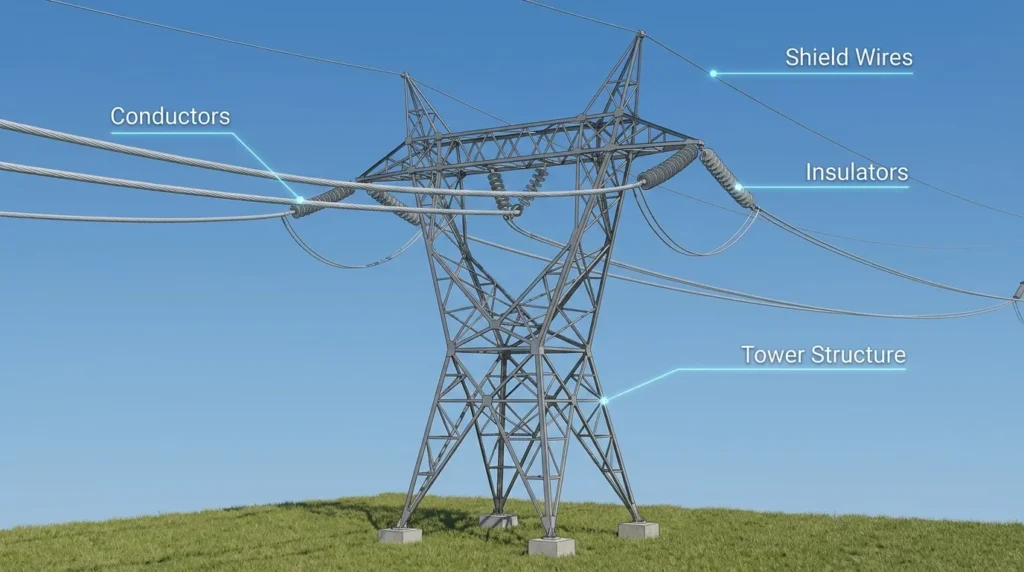
- Installed on towers
- Low cost
- Easy maintenance
An overhead transmission line is a type of electrical power transmission system in which electrical energy is carried through conductors that are supported by tall towers or poles and placed in open air above the ground. It is the most commonly used method for transmitting high-voltage electricity over long distances because it is more economical and easier to maintain compared to underground cables. The main components of an overhead transmission line include conductors, insulators, supporting towers or poles, cross arms, and grounding systems. The conductors, usually made of aluminum or copper, carry the electrical current, while insulators prevent the current from flowing into the supporting structures.
Overhead transmission lines operate at different voltage levels depending on the distance and load requirements, ranging from low voltage distribution lines to extra-high voltage (EHV) transmission lines above 132 kV. These lines are designed to reduce power losses by transmitting electricity at high voltage and low current. This helps improve efficiency and reduces heating losses in the conductors.
One of the major advantages of overhead transmission lines is their low installation cost and easy fault detection and repair. They are also suitable for carrying large amounts of power over long distances. However, they are exposed to environmental conditions such as wind, rain, lightning, and temperature changes, which can sometimes cause faults or interruptions in power supply. Proper design, insulation, and maintenance are essential to ensure reliable operation.
For example, a 220 kV overhead transmission line connecting a hydroelectric power station in a mountainous region to a city 200 km away is a typical application. Another example is the high-voltage lines visible along highways that distribute electricity from power plants to substations across regions.
Overall, overhead transmission lines play a crucial role in modern power systems by providing an efficient, cost-effective, and reliable method of transmitting electrical energy over large distances.
Underground Transmission Line
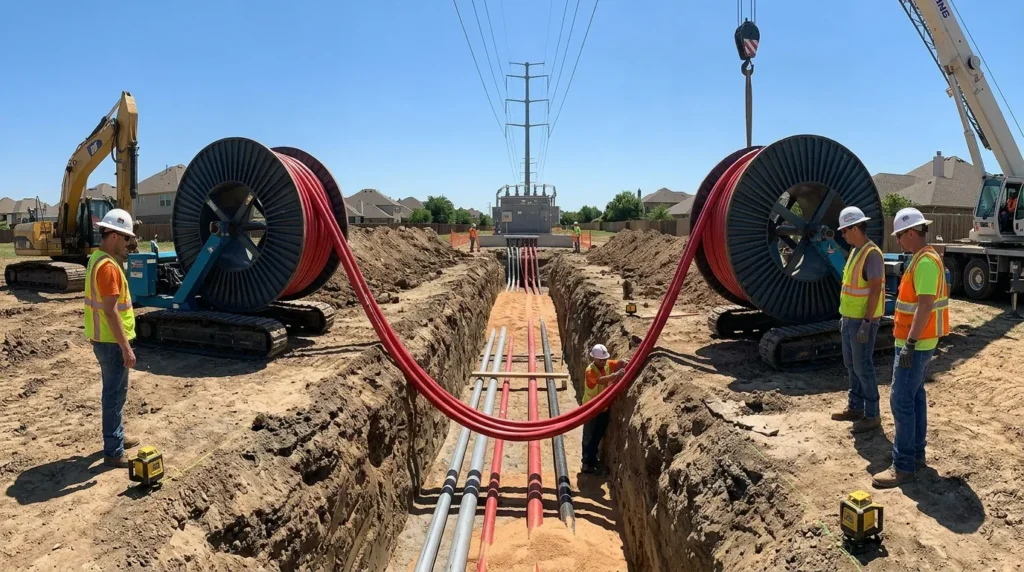
- Installed below ground
- High cost
- Used in cities
An underground transmission line is a type of electrical power transmission system in which electrical energy is carried through cables that are laid below the surface of the ground instead of being supported by overhead towers. These cables are insulated and protected with special materials such as PVC, XLPE (Cross-Linked Polyethylene), and metal sheathing to ensure safety and reliability. Underground transmission lines are mainly used in urban areas, crowded cities, airports, industrial zones, and places where overhead lines are not practical due to space limitations or safety concerns.
The main components of an underground transmission system include insulated power cables, joints and splices, cable ducts or trenches, and termination points. Since the cables are buried, they are protected from weather conditions such as wind, storms, lightning, and falling trees. This makes underground systems more reliable in terms of external disturbances. However, heat dissipation is a major challenge because underground cables cannot easily release heat into the surrounding environment, so proper thermal design is required.
Underground transmission lines usually operate at low, medium, and high voltage levels, including 11 kV, 33 kV, 66 kV, and even extra-high voltage in modern systems. They are designed to handle power efficiently while maintaining safety and stability. One of the key advantages of underground transmission lines is their aesthetic appearance, as they do not require visible towers or poles. They also reduce the risk of electrical accidents and are less affected by environmental damage.
However, underground transmission systems are very expensive to install and repair. Fault detection is also more difficult compared to overhead lines because the cables are not visible, and locating faults requires special equipment. Repair work can take more time and cost more money.
For example, electricity distribution systems in large cities like business districts, metro rail systems, and airport zones often use underground transmission lines to ensure safety and reliability. Another example is high-voltage underground cables used in densely populated urban areas where overhead lines are not allowed.
Overall, underground transmission lines are an important part of modern power systems, offering high safety, reliability, and better urban planning, although at a higher cost compared to overhead transmission systems.
5. Main Components
A transmission line consists of several important components that work together to transfer electrical energy safely and efficiently from generating stations to consumers. Each component has a specific role in maintaining reliability, reducing losses, and ensuring the continuous flow of electricity. Understanding these components helps students and professionals understand how modern power transmission systems operate.
Conductors
Conductors are the primary parts of a transmission line because they carry electrical current from one location to another. They are usually made from highly conductive materials such as aluminum or copper. Aluminum conductors are widely used because they are lightweight, cost-effective, and offer good conductivity, while copper conductors provide excellent electrical performance and durability. The size and type of conductor are selected according to the amount of power being transmitted. Proper conductor selection helps reduce power losses and improves transmission efficiency.
Functions
- Carry electrical current over long distances.
- Connect generating stations to substations.
- Minimize transmission losses.
- Handle high electrical loads.
- Ensure reliable power delivery.
Insulators
Insulators are devices used to support the conductors while preventing the leakage of electrical current to the transmission towers or the ground. They are commonly made from porcelain, glass, or composite materials with excellent insulating properties. Insulators must withstand high voltages, changing weather conditions, and mechanical stress. Their proper functioning ensures the safety and efficiency of the transmission system. Damaged insulators can cause flashovers and interruptions in the power supply.
Functions
- Prevent current leakage.
- Support transmission conductors.
- Isolate live conductors from towers.
- Improve system safety.
- Withstand environmental conditions.
Transmission Towers
Transmission towers are large steel structures designed to hold conductors at a safe height above the ground. They maintain proper spacing between conductors and provide mechanical support throughout the transmission route. The design and height of towers depend on factors such as voltage level, terrain, and environmental conditions. These towers ensure that electricity can be transmitted safely over long distances while minimizing the risk of accidental contact.
Functions
- Support conductors securely.
- Maintain safe ground clearance.
- Keep conductors properly spaced.
- Withstand wind and weather forces.
- Ensure safe operation of transmission lines.
Transformers
Transformers play a vital role in power transmission systems by changing voltage levels according to system requirements. At generating stations, transformers increase voltage to reduce current and minimize transmission losses. Near consumers, other transformers reduce the voltage to safe levels suitable for residential, commercial, and industrial use. Without transformers, efficient long-distance transmission would not be possible.
Functions
- Increase voltage for transmission.
- Decrease voltage for distribution.
- Improve transmission efficiency.
- Reduce power losses.
- Support safe power utilization.
Ground Wire
The ground wire, also known as the shield wire, is installed above the conductors to protect the transmission line from lightning strikes. It safely directs fault currents and lightning energy into the earth before they can damage the conductors or electrical equipment. This protective feature improves system reliability and reduces the chances of outages caused by storms.
Functions
- Protect against lightning strikes.
- Divert fault currents to the ground.
- Improve transmission reliability.
- Protect valuable equipment.
- Reduce weather-related damage.
6. Advantages
Transmission lines play a crucial role in modern electrical power systems. They allow electricity generated at power plants to reach cities, industries, and rural communities efficiently. Understanding the Transmission Line Advantages and Disadvantages helps explain why these systems are essential for national development and economic growth.
Efficient Long-Distance Power Transfer
Transmission lines enable electricity to be transported over hundreds of kilometers with acceptable efficiency. This allows power generated in one region to serve consumers in another area. Long-distance transmission supports the sharing of electrical resources across large geographical locations.
Reduces Energy Losses Using High Voltage
Electricity is transmitted at very high voltages to reduce current flow and minimize I²R losses. Lower current means less heat generation and improved efficiency. This technique significantly reduces energy wastage during transmission.
Supports Large Power Systems
Transmission networks connect multiple power plants and substations into a single integrated system. This interconnected arrangement improves reliability and ensures that electricity can be redirected when required. It also helps balance supply and demand.
Reliable and Continuous Supply
A well-designed transmission network provides consumers with a stable and continuous electricity supply. Alternative routes and interconnected systems help maintain service even if one section experiences a fault.
Easy to Expand Network
As electricity demand increases, transmission systems can be expanded by adding new lines, substations, and equipment. This flexibility allows the network to grow alongside population and industrial development.
Essential for National Grid Systems
Transmission lines form the backbone of national power grids. They connect generation facilities with distribution networks and ensure that electricity reaches all parts of a country efficiently and reliably.
7. Disadvantages / Limitations
Although transmission lines offer many benefits, they also have certain disadvantages and limitations. These factors must be considered during planning, construction, and operation to ensure cost-effective and environmentally responsible power delivery.
High Installation Cost
Building transmission lines requires a significant financial investment. Costs include conductors, towers, insulators, substations, land acquisition, and labor. High-voltage projects can require substantial capital expenditure.
Power Losses Due to Resistance
Even with efficient designs, some electrical energy is lost as heat because of conductor resistance. These losses cannot be eliminated completely and become more significant over very long distances.
Environmental Impact
Transmission lines can affect natural landscapes and ecosystems. Clearing land for towers and transmission corridors may disturb vegetation and wildlife habitats. Visual impacts are also a concern in some communities.
Requires Regular Maintenance
Routine inspections and maintenance are necessary to ensure safe and reliable operation. Components such as insulators, conductors, and towers must be checked regularly to identify wear and potential faults.
Weather-Related Faults
Storms, strong winds, lightning strikes, ice accumulation, and falling trees can damage transmission lines. Severe weather conditions may lead to interruptions in the power supply.
Land Requirement for Towers
Transmission lines require wide corridors and suitable locations for towers. Acquiring land can be expensive and sometimes challenging, particularly in densely populated areas.
8. Applications
Transmission lines have numerous applications in modern society. They play a vital role in delivering electricity to homes, industries, and advanced technological systems. Their importance continues to grow as energy demands increase worldwide.
Home Use
Although households are not directly connected to transmission lines, they rely on them for their electricity supply. Power generated at stations is transmitted through these networks before being distributed to residential areas. Without transmission lines, homes would not have access to reliable electrical energy.
Industrial Use
Industries depend heavily on transmission systems to operate machinery, manufacturing equipment, and production facilities. Large factories require substantial amounts of electricity, and transmission lines provide the power needed for continuous industrial operations.
Modern Technology Applications
Transmission lines support many emerging technologies and advanced energy systems. They are essential for integrating renewable energy sources such as solar farms and wind power plants into the national grid. Modern smart grids also rely on transmission infrastructure to improve efficiency, monitoring, and power management.
Examples of Modern Applications
- Renewable energy transmission.
- Smart grid systems.
- Urban infrastructure development.
- Electric transportation networks.
- Large-scale data centers.
- Future energy management systems.
Transmission lines remain one of the most important elements of electrical power systems, ensuring that electricity generated at power plants can safely and efficiently reach consumers across cities, industries, and rural communities.
9. Comparison Section
Difference Between Overhead and Underground Transmission Line
| Feature | Overhead Line | Underground Line |
|---|---|---|
| Cost | Low | High |
| Maintenance | Easy | Difficult |
| Installation | Simple | Complex |
| Safety | Less safe | More safe |
| Losses | Moderate | Low |
10. Selection Guide
How to Choose the Right Transmission Line
- Consider distance of power transfer
- Check voltage level requirements
- Analyze environmental conditions
- Evaluate cost and maintenance
Tips for Beginners
- Start with basic line calculations
- Understand voltage levels
- Study real system examples
11. Common Problems & Solutions
Q1: Why are power losses high?
Solution: Increase voltage and reduce resistance.
Q2: Why does voltage drop occur?
Solution: Use proper conductor size.
Q3: What causes line faults?
Solution: Weather, insulation failure, or overload.
Q4: How to reduce transmission losses?
Solution: Use high voltage and good conductors.
12. Future Trends
- Smart transmission systems
- HVDC technology
- Renewable energy integration
- AI-based monitoring
- Wireless power transmission
Transmission systems are becoming more efficient and intelligent.
13. Conclusion
The Transmission Line is a backbone of modern electrical systems, enabling efficient delivery of power from generation to consumption points. Understanding its working principle, types, and components is essential for anyone in the electrical field.
By learning transmission line applications and design basics, you can improve system efficiency and reduce energy losses. While there are some limitations, the benefits far outweigh them, making transmission lines indispensable in today’s world.
Continue learning and practicing these concepts to build strong technical knowledge and become a skilled electrical professional.