
Every year, workers are killed or seriously injured by equipment that was supposed to be “off.” A motor starts while someone’s hands are inside it. A breaker gets flipped back on while a technician is replacing a contactor. These tragedies share one root cause: stored or unexpected energy was never properly controlled.
Lockout Tagout — universally known as LOTO — is the formal safety procedure that prevents exactly this. Before anyone services, maintains, or repairs electrical equipment, every energy source is isolated, locked in the off position, and tagged with a warning. Only the person who applied the lock can remove it. It is simple, it is mandatory under regulations like OSHA’s Control of Hazardous Energy standard, and it saves lives.
This guide explains what LOTO is, the complete step-by-step procedure, the devices involved, and the mistakes that still get people hurt.
What Is Lockout Tagout?
Lockout Tagout is a two-part safety system:
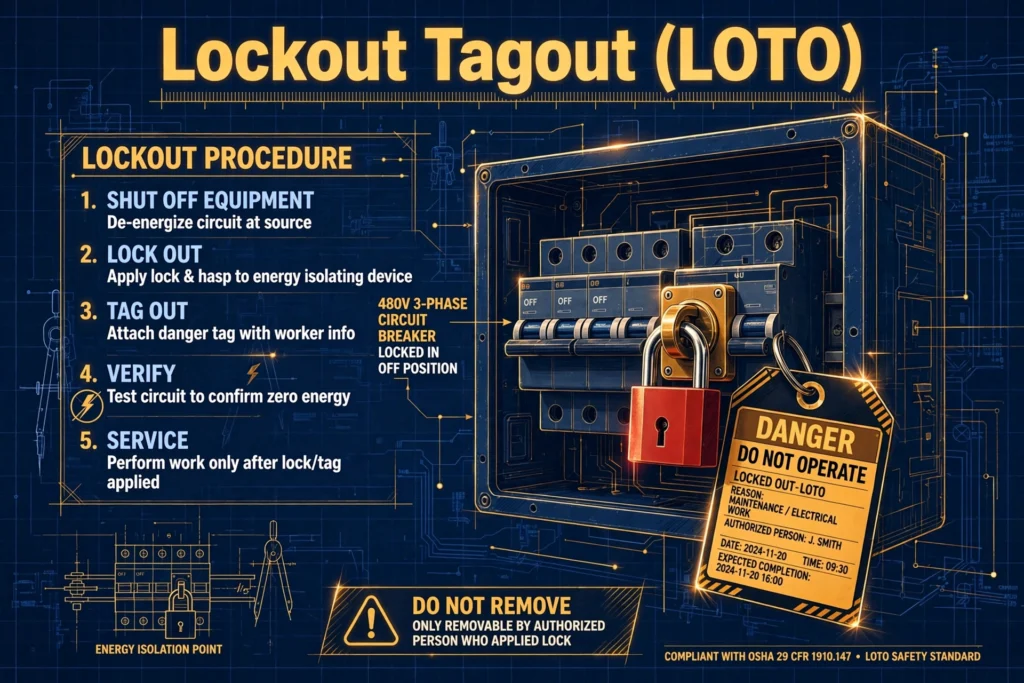
- Lockout means placing a physical lock on an energy-isolating device (a breaker, disconnect switch, or valve) so it cannot be operated. Each worker applies their own personal padlock — nobody else has the key.
- Tagout means attaching a highly visible tag to the locked device warning “DANGER — Do Not Operate.” The tag states who applied it, why, and when.
Together, they ensure that de-energized equipment stays de-energized until every worker is clear. Lockout–tagout applies not just to electricity but to all hazardous energy: mechanical (springs, rotating parts), pneumatic, hydraulic, thermal, and even gravity (a raised load that could fall).
A critical point beginners miss: switching something “off” is not lockout. A breaker in the OFF position can be flipped back on by anyone walking past. Until a lock physically prevents re-energization, the equipment is not safe to touch.
Why LOTO Matters: The Stakes
Electrical maintenance sits at the intersection of two deadly hazards: unexpected startup and stored energy. Even after you open the main disconnect, danger can remain:
- Capacitors hold charge long after power is removed — large DC bus capacitors in drives can stay lethal for minutes.
- Springs and pneumatics in breaker mechanisms store mechanical energy.
- Backfeed from a second source (a generator, UPS, or even another panel) can re-energize a “dead” circuit.
- Human error — someone else, unaware of the maintenance work, restores power.
This is why LOTO is not just “good practice” but a legal requirement in industrial workplaces, and why it complements the basic electrical safety rules every electrician should already follow.
The 8-Step LOTO Procedure
OSHA defines a standard sequence. Memorize it — the order matters, because each step verifies the one before it.
Step 1 — Identify all energy sources. Walk the equipment and list every source: electrical feeds (including control circuits and UPS), plus mechanical, pneumatic, hydraulic, and thermal energy. Check drawings and nameplates.
Step 2 — Notify affected employees. Tell operators, supervisors, and nearby workers what equipment is being locked out, why, and for how long.
Step 3 — Shut down the equipment. Stop it using its normal operating controls — not the emergency stop, which may bypass normal sequencing.
Step 4 — Isolate every energy source. Open disconnect switches, circuit breakers, and valves. Pull fuses where applicable. Every source identified in Step 1 must be physically separated.
Step 5 — Apply locks and tags. Each worker attaches their personal lock and a “DANGER — Do Not Operate” tag to every isolation point. If a device cannot take multiple locks, use a hasp (see devices below).
Step 6 — Release stored energy. Discharge capacitors, bleed pneumatic/hydraulic pressure to zero, release springs, block raised parts, let hot surfaces cool. Verify with gauges where possible.
Step 7 — Verify isolation (try-start). This is the step people skip — and the step that catches mistakes. Attempt to start the equipment with its normal controls. Nothing should happen. Then return the controls to OFF/neutral.
Step 8 — Begin work. Only now is it safe to touch the equipment. Keep your lock on for the entire job.
Restoring energy reverses the discipline: clear tools and people, remove guards’ bypasses, notify everyone, then each worker removes only their own lock and tag.
LOTO Devices Explained
- Safety padlocks: dedicated LOTO padlocks, one key per lock, never used for anything else. Standardized colors help identify departments.
- Tags: durable, non-reusable tags reading “DANGER — Do Not Operate,” with fields for name, date, and reason. Tags alone (tagout without lockout) are weaker and allowed only where lockout is physically impossible.
- Hasps: metal plates with multiple lock slots that fit through one breaker or switch — so six workers can each lock the same isolation point.
- Breaker lockouts: clamp-on devices that hold miniature or molded-case breakers in the OFF position.
- Plug lockouts: boxes that enclose an electrical plug so it cannot be reconnected.
- Valve lockouts: clamps for gate, ball, and butterfly valves on pneumatic/hydraulic lines.
- Switch and pushbutton covers: lockable covers for control-panel switches.
Group Lockout and Shift Changes
When a crew works on one machine, every person applies their own lock — the equipment cannot be re-energized until the last lock comes off. For large jobs, a primary authorized worker may use a lockbox: all isolation-point keys go inside, and each worker locks the box with a personal lock.
Shift changes are a classic failure point. The rule is strict: the outgoing worker’s lock comes off only after the incoming worker’s lock goes on. There must never be a moment when the equipment sits locked by nobody.
Contractors add another layer: the host employer and the contractor must inform each other of their LOTO procedures, and both sets of workers lock out together.
Common LOTO Mistakes That Cause Accidents
- Skipping the try-start verification — the single most skipped and most valuable step.
- Forgetting secondary sources — control circuits, UPS feeds, and backfeed from generators.
- Ignoring stored energy — capacitors, compressed air, raised loads.
- One lock for the whole crew — defeats the entire purpose; every worker needs a personal lock.
- Removing someone else’s lock — only the person who applied it (or a formal, documented supervisor procedure in a genuine emergency) may remove it.
- Using tagout where lockout is possible — tags warn but do not physically prevent operation.
Frequently Asked Questions
What does LOTO stand for?
LOTO stands for Lockout Tagout — the safety procedure of locking energy-isolating devices in the safe position and tagging them with warnings before servicing equipment.
Is lockout tagout required by law?
In the United States, OSHA’s standard 29 CFR 1910.147 requires it for general industry. Similar duties exist under electrical safety regulations worldwide (e.g., the UK’s Electricity at Work Regulations). Even where not explicitly codified, it is recognized industry best practice.
What is the difference between lockout and tagout?
Lockout physically prevents operation with a lock; tagout only warns with a tag. Lockout is stronger and preferred — tagout alone is permitted only when a device cannot accept a lock.
Can I remove another worker’s LOTO lock?
No — only the person who applied the lock may remove it. The sole exception is a formal employer procedure for genuine unavailability (e.g., the worker left site), with documented verification and notification.
Does LOTO apply to plug-in equipment?
Cord-and-plug equipment is typically exempt if the plug is under the exclusive control of the worker servicing it. If the plug could be reconnected by someone else, use a plug lockout device.
How long do capacitors hold charge after lockout?
It depends on size and discharge resistors — from seconds to many minutes. Always verify zero energy with a rated meter (test-before-touch) rather than assuming.
Final Thoughts
Lockout Tagout is beautifully simple: isolate everything, lock it yourself, tag it clearly, verify it is dead, and never trust anyone else’s lock with your life. The procedure takes minutes; skipping it has cost workers their lives. Whether you maintain a single contactor panel or an entire plant, make the 8-step LOTO sequence a non-negotiable habit — and make sure everyone working beside you does the same.