
Imagine an electrical technician working inside a control panel. Suddenly, a small metal chip flies while tightening a screw. In a split second, it hits the eye area—but thanks to safety goggles, the eye remains fully protected. This simple real-life situation shows how important eye protection is in electrical work and industrial environments.
Electrical students, engineers, and technicians often work with tools, wires, grinding machines, chemicals, and high-voltage systems. In all these environments, the eyes are highly vulnerable. Even a small dust particle, spark, or chemical splash can cause serious injury or permanent damage.
This article explains everything about safety goggles, including their working principle, types, components, advantages, disadvantages, and real-world applications. You will also learn how to choose the right goggles and common problems faced during use.
By the end, you will clearly understand why safety goggles are essential in electrical and industrial safety systems and how they protect workers in everyday operations.
2. What is Safety Goggles?
Definition
Safety goggles are protective eyewear designed to shield the eyes from dust, debris, chemicals, sparks, and harmful radiation during work.
Simple Explanation
They are tightly fitted glasses made from strong impact-resistant material that completely cover the eyes and prevent foreign particles from entering from the sides.
Practical Example
In electrical maintenance work, when cutting wires or drilling metal panels, tiny particles may fly into the air. Safety goggles protect the eyes from these hazards.
3. Working Principle of Safety Goggles
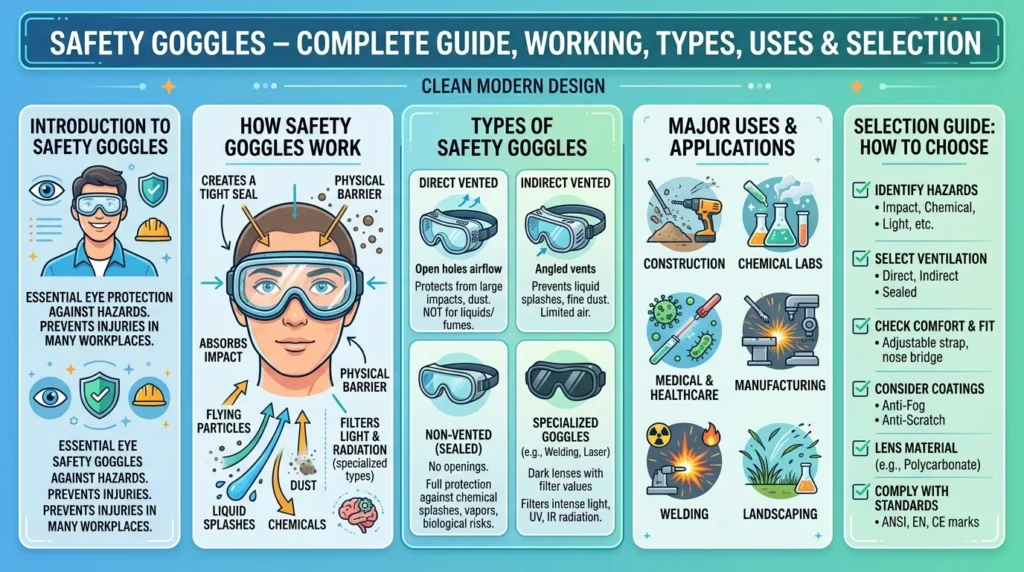
The safety goggles working principle is based on physical protection and impact resistance rather than electronics or mechanical movement.
Step-by-Step Working:
- Goggles are worn tightly over the eyes.
- A sealed frame prevents dust, air, and liquid entry.
- Strong polycarbonate lenses absorb impact energy.
- Side shields block particles coming from angles.
- Anti-fog coating ensures clear vision during work.
Simple Analogy:
Think of safety goggles as a “transparent shield” that stands between your eyes and dangerous particles, just like a helmet protects your head.
4. Types / Classification of Safety Goggles
4.1 Direct Ventilated Goggles
- Small openings for air circulation
- Prevent fogging
- Used in low-risk environments
4.2 Indirect Ventilated Goggles
- Air enters through covered vents
- Protects against dust and liquids
- Used in chemical and electrical work
4.3 Non-Ventilated (Sealed) Goggles
- Fully sealed design
- Maximum protection
- Used in chemical labs and high-risk environments
4.4 Chemical Splash Goggles
- Designed for liquid chemical protection
- Tight sealing around eyes
- Common in laboratories
4.5 Welding Safety Goggles
- Protect against intense light and sparks
- Dark tinted lenses
- Used in welding and cutting operations
5. Main Components of Safety Goggles
5.1 Lens
- Made of polycarbonate or acrylic
- High impact resistance
- Protects against particles and UV rays
5.2 Frame
- Holds the lens securely
- Made of flexible plastic or rubber
- Ensures comfortable fitting
5.3 Strap
- Adjustable elastic band
- Keeps goggles tightly in place
- Suitable for long working hours
5.4 Ventilation System
- Allows airflow
- Prevents fogging
- Maintains visibility
5.5 Anti-Fog Coating
- Prevents lens fogging during temperature changes
- Improves clear vision
6. Advantages of Safety Goggles
- Protect eyes from dust, sparks, and chemicals
- Reduce risk of permanent eye injury
- Improve safety in industrial and electrical work
- Comfortable for long-term use
- Lightweight and easy to wear
- Available in different designs for different jobs
- Increase confidence while working in hazardous environments
7. Disadvantages / Limitations
- Can become foggy in humid conditions
- May cause discomfort during long use
- Limited peripheral vision in some models
- Requires proper maintenance and cleaning
- Low-quality goggles may scratch easily
- Not suitable for fashion or casual use
8. Applications of Safety Goggles
8.1 Electrical Industry
- Panel wiring work
- Circuit maintenance
- High-voltage testing
8.2 Construction Sites
- Cutting, drilling, and grinding
- Protection from dust and debris
8.3 Laboratories
- Chemical experiments
- Acid and liquid handling
8.4 Manufacturing Industry
- Machine operation
- Welding and fabrication work
8.5 Home Use
- DIY repairs
- Painting and cleaning tasks
9. Comparison Section
Safety Goggles vs Safety Glasses
| Feature | Safety Goggles | Safety Glasses |
|---|---|---|
| Eye Coverage | Full sealed protection | Partial protection |
| Protection Level | High | Medium |
| Air Tight Seal | Yes | No |
| Best For | Chemicals, dust, sparks | Light mechanical work |
| Comfort | Moderate | High |
Key Difference:
The difference between safety goggles and safety glasses is that goggles provide full sealing protection, while glasses only protect the front of the eyes.
10. Selection Guide (How to Choose Safety Goggles)
Important Tips:
- Choose impact-resistant polycarbonate lenses
- Select anti-fog and scratch-resistant coating
- Ensure proper sealing around eyes
- Check comfort and adjustable strap
- Match goggles with your work type
- For electrical work, prefer indirect ventilated goggles
- For chemicals, choose sealed goggles
Beginner Advice:
Never compromise on quality. Cheap goggles may fail during critical situations.
11. Common Problems & Solutions
Problem 1: Fogging Inside Goggles
Solution: Use anti-fog coated lenses or indirect ventilation models.
Problem 2: Discomfort During Long Use
Solution: Choose lightweight and soft rubber-frame goggles.
Problem 3: Scratched Lenses
Solution: Store in protective case and clean with soft cloth.
Problem 4: Loose Fit
Solution: Adjust elastic strap properly or replace worn-out strap.
Problem 5: Poor Visibility
Solution: Replace old or low-quality lenses immediately.
12. Future Trends in Safety Goggles
The future of safety goggles is becoming more advanced with technology:
- Smart goggles with digital display
- Built-in sensors for gas and chemical detection
- Anti-fog nano-coating technology
- Augmented reality (AR) safety goggles for engineers
- Lightweight carbon-based materials
- Improved UV and infrared protection
Industries are moving towards smart PPE (Personal Protective Equipment) for better safety and productivity.
13. Conclusion
Safety goggles are one of the most important protective tools in electrical, industrial, and laboratory environments. They provide essential protection against dust, sparks, chemicals, and mechanical hazards that can cause serious eye injuries. Understanding the safety goggles working principle, types, and applications helps workers choose the right protection for their tasks.
Whether you are an electrical student, technician, or engineer, using proper eye protection should always be a priority. Safety goggles not only protect your vision but also improve confidence and efficiency during work. Although they have some limitations like fogging or discomfort, modern designs have significantly improved their performance and usability.
In short, safety goggles are a small investment for lifelong eye protection and workplace safety.