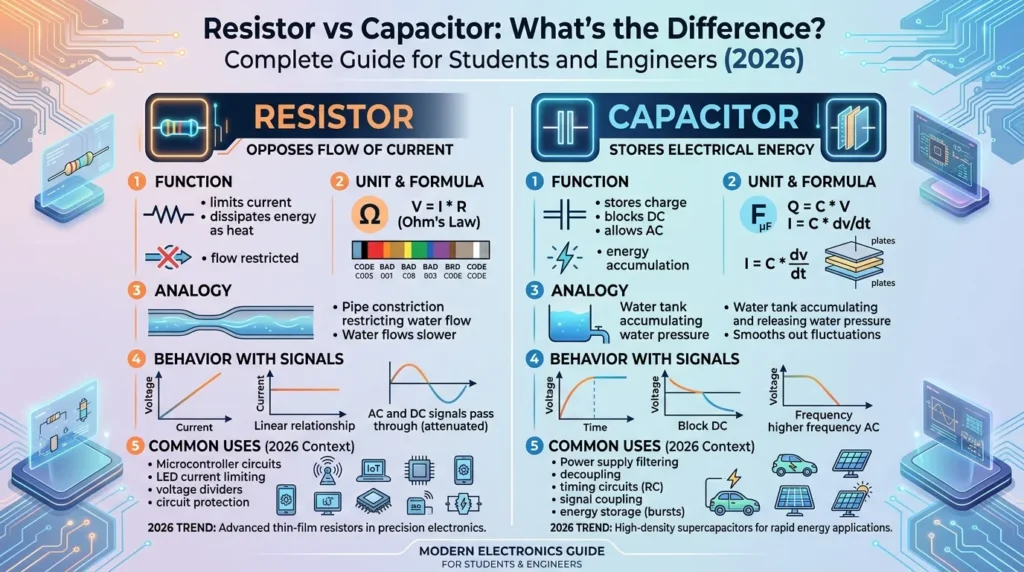

Imagine you switch on an LED light in your home. Behind the scenes, several electronic components work together to make the circuit operate safely and efficiently. Two of the most important components are the resistor and the capacitor. Although they are often placed on the same circuit board, they perform completely different jobs. A resistor controls the flow of electric current, while a capacitor stores and releases electrical energy when needed.
Understanding resistor vs capacitor is one of the first steps in learning electronics and electrical engineering. Whether you are an electrical student, technician, hobbyist, or professional engineer, knowing the difference between these two components will help you design, troubleshoot, and maintain electrical circuits with confidence.
In this guide, you’ll learn the difference between resistor and capacitor, their working principles, types, internal construction, and practical uses. Everything is explained in simple English with real-life examples, making it easy for beginners while still providing valuable knowledge for experienced readers.
What Is Resistor vs Capacitor?
The resistor vs capacitor comparison explains the difference between two essential electronic components that perform different functions in a circuit.
A resistor limits or controls the flow of electric current. It converts excess electrical energy into heat and protects sensitive components from receiving too much current.
A capacitor stores electrical energy in an electric field and releases it when needed. Instead of continuously blocking current, it temporarily stores electrical charge.
Simple Example
Think of a water pipe.
- A resistor is like a narrow section of the pipe that slows down water flow.
- A capacitor is like a small storage tank connected to the pipe that fills with water and releases it later.
Both components are important, but they solve different electrical problems.
Practical Example
In a mobile phone charger:
- The resistor controls the current flowing through different parts of the circuit.
- The capacitor smooths voltage fluctuations, reducing electrical noise and providing stable power.
Resistor vs Capacitor Working Principle
Understanding the resistor vs capacitor working principle becomes much easier when you study each component separately.
How a Resistor Works
A resistor opposes the flow of electric current.
Whenever electricity passes through a resistor, some electrical energy changes into heat.
Its operation follows Ohm’s Law:
Voltage (V) = Current (I) × Resistance (R)
Step-by-Step Working
- Electrical voltage is applied.
- Current begins flowing.
- The resistor creates opposition.
- Current decreases according to resistance.
- Excess electrical energy becomes heat.
Easy Analogy
Imagine cyclists riding on a road.
A smooth road allows them to move quickly.
A rough road slows them down.
The rough road behaves like a resistor.
How a Capacitor Works
A capacitor stores electrical energy between two conductive plates separated by an insulating material called a dielectric.
Unlike a resistor, it does not continuously consume energy.
Instead, it stores charge and releases it when required.
Step-by-Step Working
- Voltage is applied.
- Electrons collect on one plate.
- Opposite charge develops on the second plate.
- Electrical energy becomes stored.
- The capacitor releases stored energy whenever the circuit requires it.
Easy Analogy
Imagine filling a water tank.
Water enters the tank until it becomes full.
Later, when water is needed, the tank supplies it.
A capacitor behaves similarly by storing electrical energy.
Difference Between Resistor and Capacitor Working Principle
| Resistor | Capacitor |
|---|---|
| Controls current | Stores electrical energy |
| Dissipates energy as heat | Stores energy in an electric field |
| Works continuously | Charges and discharges |
| Does not store electricity | Temporarily stores charge |
Types of Resistors and Capacitors
Both resistors and capacitors come in different types for different electrical applications.
Types of Resistors
Carbon Film Resistor
Carbon film resistors are inexpensive and commonly used in consumer electronics.
They provide stable resistance for low-power circuits.
Applications
- Radios
- LED circuits
- Electronic kits
- Small appliances
Metal Film Resistor
Metal film resistors offer higher accuracy and lower electrical noise.
They are widely used in precision electronic equipment.
Applications
- Medical equipment
- Measuring instruments
- Audio systems
- Industrial electronics
Wire-Wound Resistor
These resistors are made by winding resistance wire around a ceramic core.
They can handle high current and high power.
Applications
- Industrial machinery
- Power supplies
- Motor control
- Braking circuits
Variable Resistor (Potentiometer)
Variable resistors allow resistance to change manually.
Users can adjust current or voltage by rotating a knob.
Applications
- Volume controls
- Fan speed controllers
- Light dimmers
- Laboratory equipment
Surface Mount Resistor (SMD)
SMD resistors are extremely small and designed for automatic PCB assembly.
They are found in nearly every modern electronic device.
Applications
- Smartphones
- Laptops
- Smart TVs
- IoT devices
Types of Capacitors
Ceramic Capacitor
Ceramic capacitors are among the most common capacitors used today.
They are small, reliable, and inexpensive.
Applications
- Mobile phones
- Computers
- Communication circuits
- Digital electronics
Electrolytic Capacitor
Electrolytic capacitors provide very high capacitance values.
They are mainly used in DC power supplies.
Applications
- Power supply filters
- Amplifiers
- Battery chargers
- Industrial equipment
Film Capacitor
Film capacitors offer excellent stability and long operating life.
They are commonly used in AC circuits.
Applications
- Motor circuits
- Lighting systems
- Audio equipment
- Power electronics
Mica Capacitor
Mica capacitors are known for high precision and reliability.
They perform well in high-frequency applications.
Applications
- Radio transmitters
- RF circuits
- Oscillators
- Communication systems
Variable Capacitor
Variable capacitors allow capacitance adjustment according to circuit requirements.
Applications
- Radio tuning
- Frequency adjustment
- Communication devices
- Laboratory equipment
Main Components of a Resistor and Capacitor
Understanding the construction of these components helps explain how they function.
Main Parts of a Resistor
Resistive Material
This is the part that creates electrical resistance.
It determines the resistor’s resistance value.
Ceramic Core
The ceramic core provides mechanical strength and heat resistance.
It supports the resistive element.
Protective Coating
The outer coating protects the resistor from moisture, dust, and mechanical damage.
Leads or Terminals
Metal leads connect the resistor to the electrical circuit.
Surface-mount resistors use solder pads instead of wire leads.
Color Bands or Markings
Most resistors use colored bands to indicate:
- Resistance value
- Tolerance
- Temperature coefficient
SMD resistors use printed numbers instead.
Main Parts of a Capacitor
Conductive Plates
A capacitor contains two metal plates.
These plates store electrical charges.
Dielectric Material
The dielectric separates the plates.
Common dielectric materials include:
- Ceramic
- Plastic film
- Paper
- Electrolyte
- Mica
The dielectric determines the capacitor’s capacitance and voltage rating.
Outer Casing
The casing protects internal components from environmental damage.
Terminals
Capacitor terminals connect the component to the circuit.
Some capacitors are polarized and must be installed correctly.
Electrolyte (Electrolytic Capacitors Only)
Electrolytic capacitors contain a liquid or gel electrolyte.
This allows them to achieve very high capacitance values while maintaining a compact size.
Key Takeaway
Although both resistors and capacitors are fundamental electronic components, they perform completely different functions. A resistor controls current flow and dissipates energy as heat, while a capacitor stores electrical energy and releases it when needed. Understanding their working principles, types, and construction provides the foundation for learning electronics, troubleshooting circuits, and designing reliable electrical systems.
Resistor vs Capacitor Advantages
Both resistors and capacitors are essential components in electronic and electrical circuits. Although they perform different functions, each offers unique benefits that improve circuit performance, safety, and reliability.
Advantages of Resistors
Resistors are simple, reliable, and inexpensive components used in almost every electronic circuit. Their main job is to control electrical current and maintain safe operating conditions.
1. Controls Current Flow
The biggest advantage of a resistor is its ability to limit current. Without resistors, excessive current could damage LEDs, transistors, integrated circuits (ICs), and other sensitive components.
For example, when connecting an LED to a battery, a resistor prevents too much current from flowing through the LED, protecting it from burning out.
2. Protects Electrical Components
Resistors help protect expensive electronic devices from overloads and short circuits. By reducing current to a safe level, they increase the lifespan of electronic equipment.
This protection is especially important in power supplies, control circuits, and industrial automation systems.
3. Controls Voltage
Resistors can divide voltage into smaller values using a voltage divider circuit. This feature is useful when different components require different operating voltages.
Voltage dividers are commonly found in sensors, microcontrollers, and measuring instruments.
4. Generates Heat for Useful Applications
Although heat is usually considered energy loss, some devices intentionally use resistor-generated heat.
Examples include:
- Electric heaters
- Toasters
- Hair dryers
- Electric irons
In these applications, the resistor converts electrical energy directly into heat.
5. Improves Circuit Stability
Resistors stabilize current and voltage throughout a circuit, reducing sudden changes that could affect electronic performance.
Stable circuits produce more reliable results in communication systems, computers, and industrial equipment.
6. Low Cost and High Reliability
Most resistors are inexpensive, require no maintenance, and can operate reliably for many years under normal conditions.
Their simple construction makes them one of the most dependable electronic components available.
Advantages of Capacitors
Capacitors perform functions that resistors cannot. Instead of limiting current, they temporarily store electrical energy and release it when needed.
1. Stores Electrical Energy
The main advantage of a capacitor is its ability to store electrical charge.
This stored energy can be released instantly when required, making capacitors useful in many electrical systems.
2. Smooths Power Supply Output
Power supplies often produce small voltage fluctuations after converting AC to DC.
Capacitors remove these fluctuations by storing and releasing energy, producing a smoother and more stable output voltage.
This improves the performance of computers, televisions, chargers, and industrial control systems.
3. Filters Electrical Noise
Capacitors filter unwanted electrical noise and interference from circuits.
This helps communication systems, audio equipment, and digital electronics operate more accurately.
4. Supports Motor Starting
Many single-phase AC motors use capacitors to provide additional starting torque.
Examples include:
- Ceiling fans
- Water pumps
- Air conditioners
- Refrigerators
Without the capacitor, these motors would struggle to start efficiently.
5. Improves Power Factor
In industrial electrical systems, capacitors help improve power factor by reducing reactive power.
Benefits include:
- Lower electricity losses
- Improved efficiency
- Reduced utility penalties
- Better voltage regulation
6. Fast Charging and Discharging
Capacitors can charge and discharge very quickly.
This makes them ideal for camera flashes, pulse circuits, timing circuits, and backup power applications.
Resistor vs Capacitor Disadvantages
Like every electrical component, resistors and capacitors also have limitations. Understanding these disadvantages helps engineers select the right component for each application.
Disadvantages of Resistors
1. Energy Loss as Heat
A resistor converts unused electrical energy into heat.
In high-power circuits, this heat represents wasted energy and may reduce overall system efficiency.
2. Heat Generation
Large resistors can become very hot during operation.
Excessive heat may require heat sinks or proper ventilation to prevent damage.
3. Cannot Store Energy
Unlike capacitors, resistors cannot store electrical energy.
They only consume electrical power.
4. Fixed Resistance
Standard resistors have a fixed resistance value.
If circuit requirements change, the resistor must be replaced unless a variable resistor is used.
5. Limited Efficiency
Because resistors continuously dissipate energy, they are not suitable where energy efficiency is the highest priority.
Disadvantages of Capacitors
1. Limited Energy Storage
Although capacitors store energy, their storage capacity is much smaller than batteries.
They can supply energy only for a short period.
2. Voltage Limitations
Every capacitor has a maximum voltage rating.
Exceeding this rating may cause failure or permanent damage.
3. Polarized Capacitors Require Correct Installation
Electrolytic capacitors must be connected with correct polarity.
Reverse connection can damage the capacitor and the circuit.
4. Aging Over Time
Some capacitors gradually lose capacitance as they age.
High temperatures accelerate this process.
5. Sensitive to Temperature
Extreme temperatures can affect capacitor performance and reduce operating life.
Resistor vs Capacitor Applications
The resistor vs capacitor applications comparison shows that both components are used in nearly every electrical and electronic system, but for different purposes.
Resistor Applications
Home Applications
Resistors are commonly used in household electrical and electronic devices.
Examples include:
- LED lighting
- Television circuits
- Washing machines
- Microwave ovens
- Battery chargers
Industrial Applications
Industrial equipment relies heavily on resistors for current control and protection.
Examples include:
- PLC control systems
- Motor drives
- Industrial automation
- Welding machines
- Power supplies
Electronic Applications
Modern electronics use thousands of tiny resistors.
Examples include:
- Smartphones
- Computers
- Tablets
- Smart watches
- Communication devices
Capacitor Applications
Home Applications
Capacitors improve efficiency and performance in many household appliances.
Examples include:
- Ceiling fans
- Refrigerators
- Air conditioners
- Washing machines
- LED drivers
Industrial Applications
Industries use capacitors for energy efficiency and motor operation.
Examples include:
- Power factor correction
- Motor starting
- UPS systems
- Solar inverters
- Industrial automation
Modern Technology Applications
Capacitors are found in nearly every modern electronic device.
Examples include:
- Electric vehicles
- Mobile phones
- Computers
- Medical equipment
- Renewable energy systems
Resistor vs Capacitor Comparison Table
| Feature | Resistor | Capacitor |
|---|---|---|
| Primary Function | Limits current | Stores electrical energy |
| Unit | Ohm (Ω) | Farad (F) |
| Stores Energy | No | Yes |
| Opposes | Current flow | Voltage changes |
| Converts Energy Into | Heat | Electric field |
| Polarity | Usually Non-polarized | Some types are polarized |
| AC Performance | Resists AC and DC | Blocks DC, passes AC (after charging) |
| Common Applications | Current limiting, voltage division | Filtering, timing, energy storage |
| Lifetime | Very long | Depends on type and operating conditions |
| Cost | Low | Moderate |
Selection Guide: How to Choose the Right Component
Selecting the correct component depends on the function you want the circuit to perform.
Choose a Resistor If:
- You need to limit current.
- You want to divide voltage.
- You need circuit protection.
- Your circuit requires stable current control.
- You are protecting LEDs or ICs.
Choose a Capacitor If:
- You need to store electrical energy.
- You want smoother DC voltage.
- You need to filter electrical noise.
- Your AC motor requires starting assistance.
- Your circuit needs timing or pulse generation.
Tips for Beginners
- Always check the resistor’s resistance value and power rating before installation.
- Select a capacitor with a voltage rating higher than the circuit voltage.
- Observe polarity when installing electrolytic capacitors.
- Use high-quality components for reliable performance.
- Read the circuit diagram carefully before replacing any component.
Understanding the difference between resistor and capacitor helps you choose the right component for safe, efficient, and reliable electrical circuit design.
Common Problems & Solutions (FAQ Style)
Even experienced technicians face issues with resistors and capacitors. Understanding the symptoms and solutions can help you troubleshoot circuits quickly and safely.
1. Why Does a Resistor Get Hot?
Problem
The resistor becomes very hot during operation.
Possible Causes
- Excessive current flowing through the resistor
- Incorrect resistance value
- Low power rating
- Short circuit in the circuit
Solution
- Check the circuit current.
- Use the correct resistance value.
- Replace it with a higher wattage resistor if necessary.
- Inspect the circuit for short circuits.
2. Why Has My Resistor Burned Out?
Problem
The resistor is black, cracked, or completely open.
Possible Causes
- Overload current
- Wrong resistor value
- Power rating too low
- Component failure elsewhere in the circuit
Solution
- Measure the circuit voltage and current.
- Replace the resistor with the correct value and wattage.
- Find and repair the original fault before installing a new resistor.
3. Why Is My Capacitor Bulging or Leaking?
Problem
The capacitor has a swollen top or leaking electrolyte.
Possible Causes
- Overvoltage
- Excessive temperature
- Incorrect polarity
- Aging component
Solution
- Replace the damaged capacitor immediately.
- Use a capacitor with the correct voltage rating.
- Ensure proper polarity during installation.
- Improve circuit cooling if overheating is present.
4. Why Is My Circuit Producing Electrical Noise?
Problem
The circuit experiences unstable voltage or electrical interference.
Possible Causes
- Failed filter capacitor
- Loose connections
- Poor grounding
- Incorrect capacitor value
Solution
- Test the filter capacitor.
- Replace faulty capacitors.
- Tighten electrical connections.
- Verify grounding.
5. Why Won’t My Ceiling Fan or Motor Start Properly?
Problem
The motor hums but does not rotate.
Possible Causes
- Weak starting capacitor
- Failed capacitor
- Low supply voltage
- Mechanical obstruction
Solution
- Test the starting capacitor.
- Replace if the capacitance is below specification.
- Check the supply voltage.
- Inspect the motor for mechanical problems.
6. How Can I Test a Resistor?
Solution
Use a digital multimeter.
- Turn off the power.
- Disconnect one resistor terminal from the circuit.
- Set the multimeter to resistance (Ω).
- Measure the resistance.
- Compare the reading with the resistor’s rated value.
If the reading is very different, replace the resistor.
7. How Can I Test a Capacitor?
Solution
Use a capacitance meter or a digital multimeter with a capacitance function.
- Disconnect power.
- Safely discharge the capacitor.
- Remove one terminal from the circuit.
- Measure the capacitance.
- Compare it with the rated value.
Replace the capacitor if the reading is significantly lower than its rated capacitance.
8. Can a Circuit Work Without a Resistor or Capacitor?
It depends on the circuit.
- Without a resistor, excessive current may damage LEDs, ICs, or transistors.
- Without a capacitor, voltage may become unstable, electrical noise may increase, and motors may fail to start correctly.
Both components are essential for safe and reliable circuit operation.
Future Trends in Resistors and Capacitors
Electronic technology continues to evolve, making resistors and capacitors smaller, smarter, and more reliable.
Miniaturization
Modern electronic devices require extremely small components.
Surface Mount Device (SMD) resistors and capacitors continue to shrink while maintaining excellent performance, allowing manufacturers to produce compact smartphones, laptops, and wearable devices.
High-Power Electric Vehicle Components
Electric vehicles (EVs) require advanced resistors and capacitors capable of handling higher voltages and temperatures.
Modern power electronics are using high-performance components to improve efficiency and battery management.
Smart Power Electronics
Smart grids, renewable energy systems, and industrial automation require precision components.
Future resistors and capacitors will provide:
- Better accuracy
- Lower energy loss
- Higher temperature tolerance
- Longer service life
Improved Capacitor Technologies
Researchers continue developing capacitors with:
- Higher capacitance
- Faster charging
- Longer lifespan
- Better thermal stability
These improvements benefit renewable energy systems, UPS units, and electric vehicles.
Environmentally Friendly Manufacturing
Manufacturers are focusing on eco-friendly materials and energy-efficient production methods.
Future components will use safer materials while maintaining excellent electrical performance.
Integration with IoT and Smart Devices
As the Internet of Things (IoT) grows, resistors and capacitors will play an even bigger role in:
- Smart homes
- Medical electronics
- Industrial sensors
- Wireless communication
- Artificial intelligence hardware
Reliable passive components remain essential for modern electronic systems.
Conclusion
Understanding resistor vs capacitor is one of the most important fundamentals in electronics and electrical engineering. Although both components are found in almost every circuit, they perform very different tasks. A resistor controls and limits the flow of electrical current, protecting components and maintaining stable circuit operation. A capacitor, on the other hand, stores and releases electrical energy, filters voltage fluctuations, improves power quality, and supports timing and motor-starting applications. Knowing the difference between resistor and capacitor, their working principles, types, advantages, disadvantages, and applications will help you design better circuits and troubleshoot problems more effectively. As electronic technology continues to advance, these two components will remain essential in everything from simple household devices to electric vehicles and smart industrial systems. Building a strong understanding of resistors and capacitors creates a solid foundation for every electrical student, technician, and engineer.