
If your home was built before World War II, porcelain knobs and ceramic tubes may still be hiding in the attic and walls. Knob and tube wiring electrified American homes from the 1880s through the 1940s, and while the workmanship was excellent for its day, the system was designed for light bulbs and radios — not microwaves, space heaters, and home offices. Today it is the wiring method most likely to complicate a home sale, an insurance policy, or a renovation.
How the System Was Built
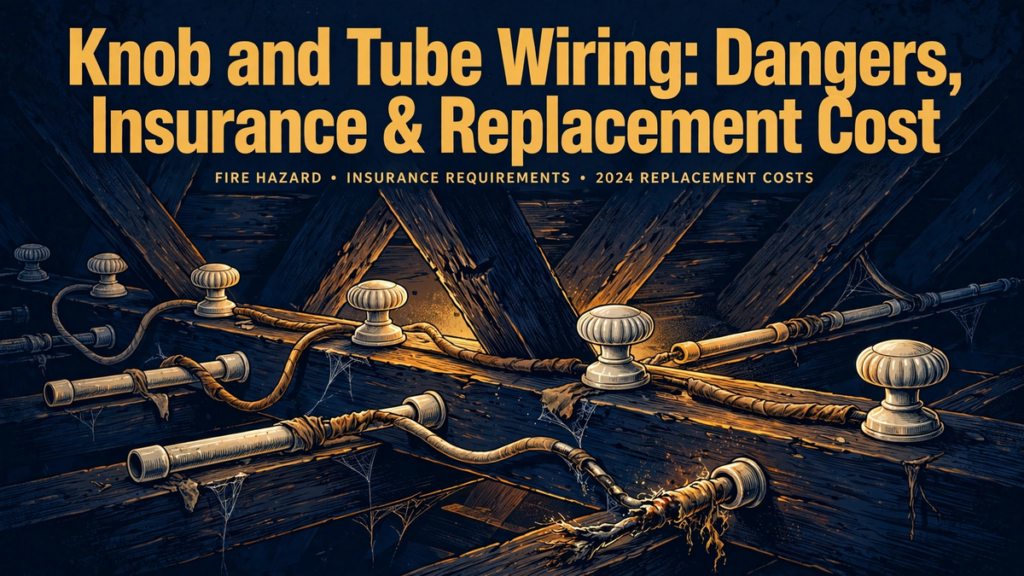
Knob and tube (K&T) is an open wiring method. Single copper conductors — one hot, one neutral — ran separately through the building, held off wood framing by porcelain knobs nailed to joists and studs. Where wire passed through framing, it went through a porcelain tube; where it entered a switch or fixture, it was covered with a flexible woven sleeve called “loom.”
Conductors were insulated with rubber under a cloth braid. There was no equipment grounding conductor anywhere — grounding was not part of residential design then. The wires were spaced inches apart in open air, and that open-air spacing was the cooling mechanism: heat dissipated freely into the surrounding air.
How to Recognize It
In an unfinished attic or basement, K&T is unmistakable: single dark fabric-covered wires running along joists on white or brown porcelain knobs, diving through porcelain tubes at framing. The cloth insulation is often cracked after a century of heat cycles. From living spaces, the clues are subtler: two-prong receptacles, push-button switches, and wiring with no visible cable sheath. A home inspection will flag it, but a licensed electrician’s assessment goes deeper — see our guide to electrical inspections.
Why It Is Dangerous Today
No ground wire. With no low-impedance fault path, a short to a metal fixture can energize it without tripping a breaker — the same reason modern electrical safety rules insist on grounding.
Buried in insulation. The cooling design depended on open air. Blown-in attic insulation over K&T traps heat and accelerates insulation breakdown — one of the most cited K&T hazards.
Brittle insulation. A century of thermal cycling dries rubber-and-cloth insulation until it cracks and flakes, leaving bare copper near wood.
Undersized for modern loads. K&T circuits were typically 14 AWG on 15-amp breakers, sized for lighting — not kitchens, HVAC, or EV chargers.
Improper modifications. Decades of DIY splices outside junction boxes and overloaded extensions compound every other risk. Unlike modern electrical wiring methods such as concealed conduit wiring, K&T has no protective enclosure.
What the NEC Says: Article 394
K&T is not automatically illegal. NEC Article 394, “Concealed Knob-and-Tube Wiring,” governs existing installations: wiring already in place may generally remain, but the article restricts new work and extensions and prohibits K&T in insulated wall and ceiling cavities. Local jurisdictions often go further — some require disconnection before insulation is added, others mandate removal when walls open for renovation. Check with your local building department.
Knob and Tube vs. Modern Wiring
| Feature | Knob and Tube (1880s–1940s) | Modern NM Cable |
|---|---|---|
| Grounding conductor | None | Included |
| Arrangement | Hot and neutral run separately in open air | All conductors in one sheathed cable |
| Insulation | Rubber with cloth braid, brittle with age | Thermoplastic, long-lived |
| Typical branch rating | 15 A (14 AWG) | 15–20 A, sized to load |
| Contact with insulation | Prohibited — overheats | Permitted |
| Splices | Often outside boxes | Must be in accessible junction boxes |
Insurance: The Hidden Cost
Even intact K&T often forces replacement through insurance. Many US carriers will not write or renew a policy on a home with active knob and tube wiring; others require an electrician’s certification or replacement within 30 to 60 days. The Electrical Safety Foundation International recommends a professional electrical inspection for any home 40 or more years old. For buyers, K&T on an inspection report can delay financing and become a closing contingency — get the wiring evaluated before finalizing a purchase, not after.
Replacement Cost
| Scope | Typical US Cost Range |
|---|---|
| Partial rewire (affected circuits only) | $3,000–$8,000 |
| Full rewire, typical 1,500–2,000 sq ft home | $8,000–$15,000+ |
| Full rewire with panel upgrade and wall repair | $15,000–$25,000+ |
Costs vary by region, home size, and wall access — plaster-and-lath and finished walls push higher. A rewire also brings the home to current code: grounded receptacles, GFCI/AFCI protection, and adequate capacity. Get multiple quotes from licensed electricians and confirm the work will be permitted and inspected under your locally adopted NEC edition.
Frequently Asked Questions
Is knob and tube wiring illegal?
No — existing K&T may generally remain under NEC Article 394. It becomes a problem when damaged, buried in insulation, improperly modified, or when local rules require removal during renovations.
Can knob and tube wiring be grounded?
Not practically — there is no approved way to add a grounding conductor to the old wiring. Replacement with modern grounded cable is the code-compliant solution.
Will insurance cover a house with knob and tube wiring?
Often not. Many insurers refuse new or renewal policies on active K&T; others demand certification or replacement within 30–60 days. Shop insurers early.
How long does knob and tube wiring last?
The copper lasts indefinitely, but rubber-and-cloth insulation has a finite life — most K&T in service is 80–140 years old, at or past the end of its reliable life.
Should I replace it before selling?
In most markets, yes — or price accordingly. Active K&T alarms buyers’ insurers and becomes a closing contingency; a permitted rewire removes the objection entirely.
Conclusion
Knob and tube wiring is a well-built relic with no ground wire, brittle insulation, and a cooling design that fails under modern attic insulation. The NEC tolerates existing installations under Article 394, but insurers, buyers, and local codes increasingly do not. Have a licensed electrician assess it, plan for replacement, and follow your locally adopted NEC edition — few upgrades improve safety, insurability, and resale value at once.


