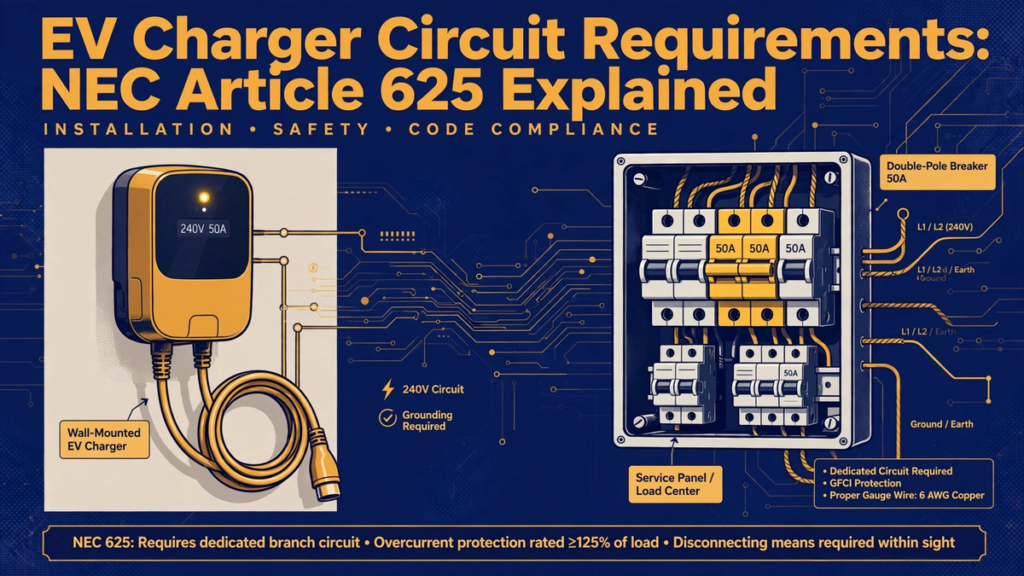

Installing an EV charger means adding one of the largest continuous loads your home will ever see — a Level 2 charger can draw 32 to 48 amps for six or eight hours straight, every night. That sustained demand is why the National Electrical Code devotes Article 625, “Electric Vehicle Power Transfer System,” to how the circuit must be sized, wired, and protected. Get the circuit wrong and you get nuisance tripping at best, overheated conductors at worst.
The 125% Rule
The NEC defines a continuous load as one continuing at maximum current for three hours or more (Article 100) — overnight EV charging easily qualifies. Because equipment heats up under sustained load, NEC 625.42 requires branch-circuit conductors and overcurrent protection for EV supply equipment (EVSE) to be sized at not less than 125% of the charger’s maximum current, working with the general sizing rule in 210.19(A)(1).
Multiply the charger output by 1.25 and round up to the next standard breaker size:
| Charger Output | Calculation | Minimum Breaker | Typical Copper Wire |
|---|---|---|---|
| 16 A | 16 × 1.25 = 20 A | 20 A | 12 AWG |
| 24 A | 24 × 1.25 = 30 A | 30 A | 10 AWG |
| 32 A | 32 × 1.25 = 40 A | 40 A | 8 AWG |
| 40 A | 40 × 1.25 = 50 A | 50 A | 6 AWG |
| 48 A | 48 × 1.25 = 60 A | 60 A | 6 AWG THHN in conduit (or 4 AWG NM) |
Watch temperature ratings: under NEC 110.14(C), NM (Romex) cable is limited to the 60°C column — 6 AWG NM at 55 amps suits a 50-amp circuit but not a 60-amp one. For a 48-amp charger on a 60-amp breaker, use 6 AWG THHN in conduit (65 amps at 75°C) or 4 AWG NM. See our NEC wire size chart for the ampacity columns.
Dedicated Circuit, Correct Breaker
EVSE needs a dedicated branch circuit — never shared with the dryer or garage receptacles. Never install an oversized breaker “to stop tripping”; it then no longer protects the wire. Match breaker brand and type to the panel, as with any circuit breaker installation.
Coordinate GFCI protection carefully: receptacles used for EV charging require GFCI protection under 625.54, but hardwired EVSE typically has internal ground-fault protection — stacking a GFCI breaker on top causes nuisance tripping. Know your charger’s protection scheme before choosing the breaker.
Does Your Panel Have Room?
Article 220 requires a formal load calculation before adding EVSE: the charger enters at 125% of its rating, added to existing calculated loads. If the total exceeds your service rating, you need a service upgrade or an energy management system (EMS) per Article 750.30, which dynamically limits EVSE current — the managed set point times 125% becomes the calculated load, often far cheaper than upgrading a 100-amp service (the dwelling minimum per NEC 230.79(C)). See load calculation for a house for the method, and check voltage drop on long runs to a detached garage.
Receptacle vs. Hardwired
Both are legal with different implications. A plug-connected EVSE needs a receptacle matched to the circuit — a 50-amp receptacle does not belong on a 40-amp circuit (clarified in 625.44) — plus GFCI protection and a heavy-duty specification-grade device rated for continuous high-current duty. Hardwired installation avoids the receptacle question, is required for the highest-power residential units, and sidesteps GFCI stacking since the EVSE’s internal protection stands alone. The DOE’s Alternative Fuels Data Center notes Level 2 equipment typically costs $500–$4,000 before installation — another reason to size the circuit right the first time.
Permits and Adjustable Settings
Most jurisdictions require an electrical permit; inspections check conductor sizing, overcurrent protection, GFCI provisions, clearances, and labeling. Many chargers have adjustable output (e.g., 16–48 A) — the NEC requires the configured setting on a durable rating label, and the circuit is sized for the setting actually used. Turn it up later and the circuit must be re-evaluated. Common failures: wire sized to output instead of 125%, NM cable beyond its 60°C rating, mismatched receptacle and circuit ratings, and no load calculation on file.
Choosing the Right Wire and Conduit for an EV Charger
Start with the conductor itself. For most Level 2 chargers, copper THHN in conduit is the workhorse choice: it handles heat well, pulls easily through bends, and lets you upsize later without tearing out cable. NM cable, commonly called Romex, is simpler to run inside finished walls, but remember it is limited to the 60°C ampacity column, so a 6 AWG NM cable carries less than the same size THHN in conduit. That is why the sizing table pairs 48-amp chargers with 6 AWG THHN or 4 AWG NM — the cable type changes the answer, not just the breaker size.
Conduit matters just as much as wire. Outdoor runs and garage walls exposed to damage call for rigid or EMT conduit, sized with room for the conductors plus a ground, and with pull points no more than about 100 feet apart so the wire can be replaced later. Keep the run as short and straight as practical: every extra bend adds pulling friction, and a long run to a detached garage may need the next wire size up to control voltage drop. Finally, leave a little spare capacity in the conduit and label both ends of the circuit at the panel and the charger. A charger installed today may be replaced by a faster one tomorrow, and a well-sized conduit is the cheapest upgrade you will ever buy.
Frequently Asked Questions
What breaker for a 40-amp EV charger?
A 50-amp breaker (40 × 125% = 50), with conductors of at least 50-amp ampacity — typically 6 AWG copper — on a dedicated circuit.
Can I install a charger on 100-amp service?
Sometimes — it depends on the Article 220 calculation: existing loads plus EVSE at 125% must fit the service rating. Gas-appliance homes often can; all-electric homes often need an EMS or upgrade.
Do I need a neutral wire?
Most Level 2 chargers are pure 240-volt loads needing only two hots plus ground (e.g., 6/2). Some need a neutral (6/3) — check the manual, and never substitute ground for neutral.
Is a GFCI breaker required for hardwired EVSE?
Generally no — listed hardwired EVSE includes integral ground-fault protection, and an added GFCI breaker usually causes nuisance tripping. GFCI is required for receptacle outlets used for EV charging.
Can I use my dryer outlet for EV charging?
Not permanently. Dryer receptacles are not rated for daily plug cycles and multi-hour continuous EV loads, share a general-purpose circuit, and lack the GFCI protection 625.54 requires. Install a dedicated EV circuit.
Does the 125% rule apply to adjustable chargers?
Yes — size to 125% of the configured setting on the rating label. A 48-amp-capable charger set to 32 amps needs only a 40-amp circuit; raising it later requires a circuit upgrade.
Conclusion
EV charger sizing comes down to one NEC Article 625 rule: treat the charger as a continuous load and size conductors and protection at 125% — 32 amps means a 40-amp circuit, 40 means 50, 48 means 60. Use a dedicated circuit, respect wire temperature ratings, verify service capacity with a real load calculation, and
pull a permit. Consult a licensed electrician under your locally adopted NEC edition — sized right, the circuit disappears and the car is simply full every morning.
For more on choosing and installing home charging equipment, see the U.S. Department of Energy’s Alternative Fuels Data Center.