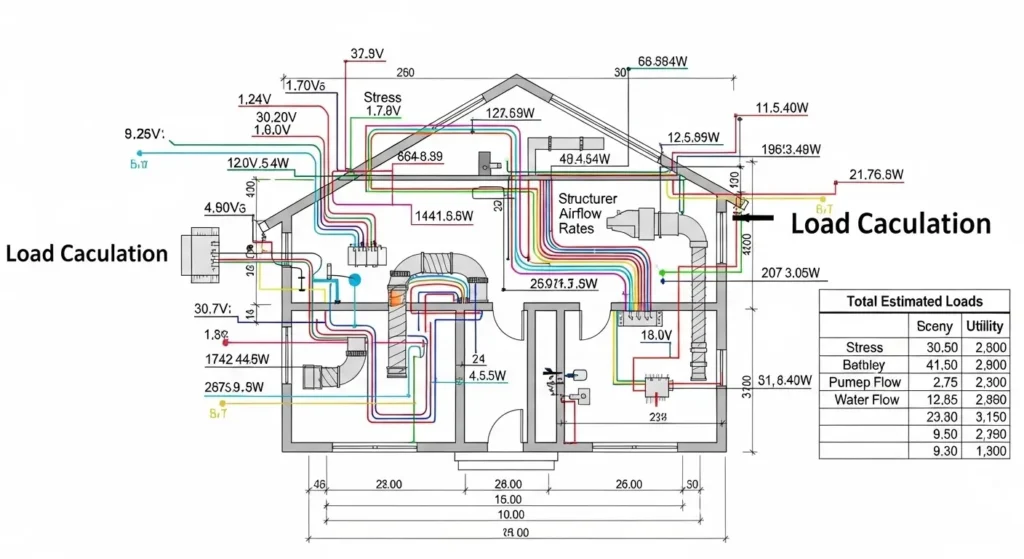

Imagine you are designing the electrical wiring for a new house. The owner wants air conditioners in every room, an electric oven in the kitchen, a water pump, and multiple lighting points. You install wiring without properly calculating the total load. After a few weeks, the main breaker starts tripping, wires heat up, and voltage becomes unstable.
This situation clearly shows the importance of Load Calculation for House.
Before selecting cables, circuit breakers, and the main distribution board, we must calculate the total electrical load of the house. Proper load calculation ensures safety, prevents overheating, reduces fire risk, and guarantees smooth operation of appliances.
In this article, you will learn the Load Calculation for House working principle, types of load calculations, components involved, practical formulas, applications, advantages and disadvantages, comparison methods, selection tips, troubleshooting, and future trends. I will explain everything in simple language, just like guiding a junior electrician at a real job site.
Load Calculation of a House
Load calculation of a house is an important step in electrical installation because it helps to determine how much electricity will be required to run all electrical appliances safely and efficiently. It also helps in selecting the correct size of inverter, generator, wiring, and circuit breakers. If the load is not calculated properly, it can cause overloading, frequent tripping, or even damage to electrical equipment.
In a house, electrical load mainly comes from different types of appliances such as lights, fans, air conditioners, refrigerators, televisions, washing machines, water pumps, and kitchen appliances. Each appliance consumes a specific amount of power, which is measured in watts (W) or kilowatts (kW). To calculate total load, we simply add the power ratings of all appliances that are used in the house.
For example, suppose a house has 10 LED bulbs of 10 watts each, 5 ceiling fans of 75 watts each, one refrigerator of 200 watts, one television of 150 watts, and a water pump of 500 watts. First, we calculate individual loads:
- Lights: 10 × 10W = 100W
- Fans: 5 × 75W = 375W
- Refrigerator: 200W
- Television: 150W
- Water Pump: 500W
Now we add all values:
Total Load = 100 + 375 + 200 + 150 + 500 = 1325 watts (1.325 kW)
After calculating total load, engineers usually add a safety margin of 20% to 25% to handle future expansion and sudden power demand. So, final load becomes approximately 1600 watts.
Load calculation is also important for inverter and battery selection. For example, if the total load is 1600 watts and backup time is required for 2 to 3 hours, then a suitable inverter with at least 2 kVA capacity and a proper battery bank should be selected.
Another important factor in load calculation is the type of load. There are two types: resistive load (like bulbs, heaters) and inductive load (like fans, motors, refrigerators). Inductive loads consume more starting current, so they must be considered carefully.
Proper load calculation ensures electrical safety, energy efficiency, and long life of appliances. It also helps in avoiding overload conditions and reduces electricity bills by balancing usage. Therefore, every house should have a proper load assessment before installing electrical wiring or backup systems.
How to Calculate Home Electrical Load: Complete Practical Guide
Calculating the home electrical load is an essential step in designing a safe and efficient wiring system. It helps determine the correct size of wires, circuit breakers, energy meters, and other protective devices. A proper load calculation also prevents circuit overloading and allows for future expansion.
Step 1: List All Household Electrical Appliances
Prepare a list of all electrical appliances used in your home. Note the quantity, power rating, and estimated current consumption of each device.
Common Household Appliances and Their Typical Ratings
| Appliance | Typical Power (W) | Approximate Current at 230 V (A) |
|---|---|---|
| LED Bulb | 10 W | 0.04 A |
| Tube Light (LED) | 20 W | 0.09 A |
| Ceiling Fan | 75 W | 0.33 A |
| Exhaust Fan | 40 W | 0.17 A |
| Television (LED) | 100 W | 0.43 A |
| Refrigerator | 150 W | 0.65 A |
| Wi-Fi Router | 15 W | 0.07 A |
| Laptop Charger | 65 W | 0.28 A |
| Desktop Computer | 250 W | 1.09 A |
| Washing Machine | 500 W | 2.17 A |
| Microwave Oven | 1200 W | 5.22 A |
| Electric Iron | 1000 W | 4.35 A |
| Electric Kettle | 1500 W | 6.52 A |
| Rice Cooker | 700 W | 3.04 A |
| Water Dispenser | 500 W | 2.17 A |
| Vacuum Cleaner | 1000 W | 4.35 A |
| Water Pump (0.5 HP) | 370 W | 1.61 A |
| Water Heater (Geyser) | 2000 W | 8.70 A |
| Hair Dryer | 1200 W | 5.22 A |
| Toaster | 800 W | 3.48 A |
| Air Cooler | 200 W | 0.87 A |
| Air Conditioner (1 Ton) | 1200 W | 5.22 A |
| Air Conditioner (1.5 Ton) | 1800 W | 7.83 A |
| Air Conditioner (2 Ton) | 2400 W | 10.43 A |
Step 2: Calculate the Total Connected Load
Multiply the power rating of each appliance by its quantity and add the results.
Example Calculation
| Appliance | Quantity | Power per Unit | Total Power |
|---|---|---|---|
| LED Bulbs | 10 | 10 W | 100 W |
| Ceiling Fans | 5 | 75 W | 375 W |
| Refrigerator | 1 | 150 W | 150 W |
| Television | 1 | 100 W | 100 W |
Total Connected Load
100 W + 375 W + 150 W + 100 W
Total Load = 725 Watts
Step 3: Convert Watts into Kilowatts (kW)
Since electrical loads are commonly expressed in kilowatts:
- 1000 W = 1 kW
Therefore:
- 725 W ÷ 1000 = 0.725 kW
Step 4: Add a Safety Margin
Electrical engineers usually add a safety margin of 20%–30% to accommodate future appliances and avoid overloading.
Example:
- Connected Load = 0.725 kW
- Safety Margin (25%) = 0.181 kW
Estimated Home Load
0.725 kW + 0.181 kW = 0.906 kW
Final Estimated Home Load ≈ 0.9 kW
Important Tips for Accurate Home Load Calculation
- Always check the actual rating label of each appliance.
- Include appliances that may be installed in the future.
- Add a 20%–30% safety margin.
- Avoid operating heavy appliances on overloaded circuits.
- Use correctly rated wires, MCBs, and distribution boards.
- Consult a qualified electrician for final load assessment and installation design.
Home load calculation is a simple but vital process for ensuring electrical safety and efficiency. By listing all appliances, calculating their total wattage, converting the value into kilowatts, and adding a safety margin, homeowners can estimate their electrical demand accurately. This information helps in selecting the proper wiring, protective devices, and power supply capacity for a safe and reliable home electrical system.
2. What Is Load Calculation for a House?
Load calculation for a house is the process of estimating the total electrical power required by all appliances, lighting fixtures, and equipment installed in a residential building. It helps determine the amount of electricity a house is expected to consume under normal operating conditions.
Simple Definition
House load calculation is a method used to determine the total electrical demand of a home, usually expressed in watts (W) or kilowatts (kW).
Why Is Load Calculation Important?
A proper load calculation ensures that the electrical system is safe, efficient, and capable of handling the required demand. It helps electrical engineers, electricians, and homeowners select the correct electrical components and avoid overloading.
Load calculation is used to determine:
- The correct main circuit breaker size
- The appropriate cable and wire size
- The required distribution board capacity
- The suitable energy meter rating
- The proper generator or inverter capacity
- The transformer requirement for larger residential projects
- Future expansion needs and additional electrical loads
Simple Explanation
Every electrical appliance in a house consumes a certain amount of power. When several appliances operate at the same time, the total electrical demand increases. By adding the power ratings of all connected devices, we can estimate the total load and design the electrical system accordingly.
Practical Example
Suppose a house contains the following appliances:
- 10 LED lights × 10 W = 100 W
- 4 ceiling fans × 75 W = 300 W
- 2 air conditioners × 1500 W = 3000 W
Total Connected Load
100 W + 300 W + 3000 W = 3400 W
Therefore, the estimated connected load of the house is:
3400 W or 3.4 kW
Based on this load value, the appropriate wiring size, protective devices, and electrical distribution equipment can be selected to ensure safe and reliable operation.
Load calculation is one of the most important steps in residential electrical design. It helps prevent overloading, improves safety, ensures efficient energy distribution, and allows homeowners to plan for future electrical requirements.
3. Load Calculation for House Working Principle
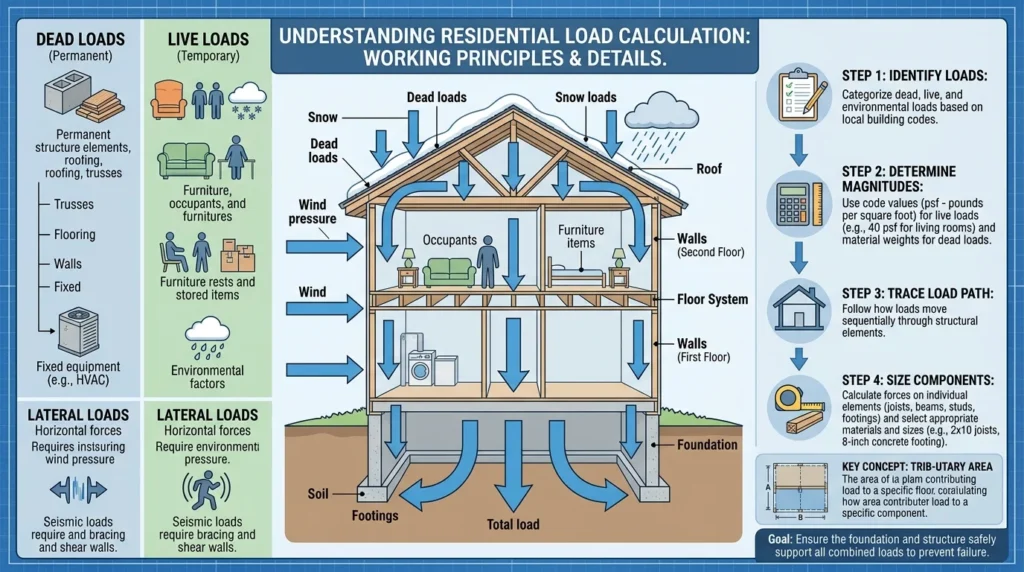
The Load Calculation for House working principle is based on summing individual appliance loads and applying demand factors.
Step-by-Step Process
- List all electrical appliances.
- Note their power ratings (W or kW).
- Add total connected load.
- Apply diversity or demand factor.
- Convert total power to current.
- Select cable and breaker accordingly.
Basic Formula
Current(I)=Power(P)/Voltage(V)
For single-phase system:I=P/230V
How to calculate home load?
Calculating home electrical load means finding the total power (watts or kilowatts) used by all appliances in your house. This helps you choose the correct wiring size, circuit breaker, inverter, generator, or solar system. ⚡
Below is the simple step-by-step method electricians use.
1. List All Electrical Appliances in Your Home
Write down every appliance and its power rating (Watts). You can find it on the nameplate or label of the device.
Example list:
| Appliance | Quantity | Power (W) | Total |
|---|---|---|---|
| LED Bulb | 10 | 12 W | 120 W |
| Ceiling Fan | 5 | 75 W | 375 W |
| Refrigerator | 1 | 200 W | 200 W |
| TV | 1 | 120 W | 120 W |
| Washing Machine | 1 | 500 W | 500 W |
| Air Conditioner | 1 | 1500 W | 1500 W |
2. Multiply Power by Quantity
Use this formula:Total Load=Power×Quantity
Example:
- Fan = 75 W × 5 = 375 W
3. Add All Appliance Loads
Add all totals together.
Example:
- Lights = 120 W
- Fans = 375 W
- Refrigerator = 200 W
- TV = 120 W
- Washing Machine = 500 W
- AC = 1500 W
Total Load:120+375+200+120+500+1500=2815W
So total home load = 2815 Watts (≈ 2.8 kW)
4. Convert Watts to Kilowatts (kW)
kW=1000Watts
Example:2815W÷1000=2.8kW
5. Add Safety Margin
Electricians usually add 20–25% extra capacity.
Example:2.8kW+25%≈3.5kW
So your house needs about 3.5 kW capacity.
6. Calculate Current (Optional for Wiring)
Formula:I=VP
Where:
- I = Current (Ampere)
- P = Power (Watts)
- V = Voltage (230V in Pakistan)
Example:I=2302815≈12.2A
So the load current ≈ 12 Amps.
Quick Example (Small House)
| Appliance | Total Load |
|---|---|
| Lights | 120 W |
| Fans | 300 W |
| TV | 120 W |
| Fridge | 200 W |
Total = 740 W ≈ 0.74 kW
✅ Summary
- List all appliances
- Note their power rating (W)
- Multiply by quantity
- Add all watts
- Convert to kW
- Add 20–25% safety margin
Easy Analogy
Think of water taps in a house.
- Each tap represents an appliance.
- If all taps run at full flow, total demand is high.
- In reality, not all taps run together.
Similarly, we apply diversity factor in electrical load calculation.
4. Types and Classification of House Load Calculation
House load calculation can be performed using different methods depending on the purpose of the electrical design. Each method provides valuable information for selecting the correct wiring, protective devices, and power supply capacity.
4.1 Connected Load Calculation
Connected load is the total power rating of all electrical appliances and equipment installed in a house, regardless of whether they operate simultaneously or not.
Formula:
Connected Load = Sum of the Power Ratings of All Appliances
Example:
If a house contains appliances with a combined power rating of 15,000 W, then:
Connected Load = 15,000 W = 15 kW
Importance:
- Helps estimate the total installed electrical capacity.
- Used for initial electrical planning and design.
- Assists in selecting the distribution board size.
4.2 Demand Load Calculation
In practical situations, all appliances do not operate at the same time. Demand load represents the actual load expected during normal usage conditions.
Formula:
Demand Load = Connected Load × Demand Factor
Example:
Connected Load = 15 kW
Demand Factor = 0.70
Demand Load = 15 × 0.70 = 10.5 kW
Importance:
- Provides a more realistic estimate of power consumption.
- Reduces unnecessary oversizing of electrical equipment.
- Commonly used in residential and commercial load assessments.
4.3 Maximum Demand Calculation
Maximum demand is the highest electrical load expected to occur at any one time during operation. It is a critical factor in system design and protection.
Example:
If the highest recorded load in a house is 12 kW, then:
Maximum Demand = 12 kW
Importance:
- Helps determine the size of the main circuit breaker.
- Used for selecting service cables and energy meters.
- Prevents overloading of the electrical installation.
4.4 Single-Phase Load Calculation
Single-phase load calculation is commonly used in small houses, apartments, and residential units with moderate power requirements. These systems typically operate on a 230 V single-phase supply.
Formula:
Current (A) = Power (W) ÷ Voltage (V)
Example:
Load = 4,600 W
Current = 4,600 ÷ 230
Current = 20 A
Applications:
- Small homes
- Apartments
- Residential lighting and socket circuits
4.5 Three-Phase Load Calculation
Three-phase load calculation is used in large houses, villas, and residential buildings with heavy electrical loads such as multiple air conditioners, water pumps, and large appliances. These systems generally operate on a 400 V three-phase supply.
Formula:
Current (A) = Power (W) ÷ (√3 × Voltage × Power Factor)
Example:
Load = 15,000 W
Voltage = 400 V
Power Factor = 0.8
Current = 15,000 ÷ (1.732 × 400 × 0.8)
Current ≈ 27 A
Applications:
- Large residential houses
- Villas
- Luxury homes with high power demand
- Buildings using heavy-duty equipment
Understanding the different types of house load calculations helps engineers and electricians design safer, more efficient, and cost-effective electrical systems. By selecting the appropriate calculation method, it becomes easier to choose the correct cables, breakers, meters, and protective devices while ensuring reliable operation and future expansion capability.
5. Main Components Considered in House Load Calculation
To perform an accurate Load Calculation for a House, it is important to identify all categories of electrical loads that contribute to the total power demand. Each component consumes a certain amount of electricity and must be included in the calculation to ensure the correct selection of cables, circuit breakers, distribution boards, and other protective devices.
5.1 Lighting Load
Lighting load includes all lighting fixtures installed throughout the house. Although modern LED lighting consumes less energy, it still contributes to the total connected load.
Common Examples:
- LED bulbs
- LED tube lights
- Decorative and accent lights
- Outdoor security lights
- Garden and landscape lighting
- Chandeliers and ceiling lights
Importance:
- Determines the lighting circuit capacity.
- Helps select appropriate lighting breakers and wiring sizes.
5.2 Socket (Plug) Load
Socket load refers to appliances connected through general-purpose outlets and receptacles. Since these devices are frequently used, they form a significant part of the residential electrical demand.
Common Examples:
- Television
- Refrigerator
- Mobile phone chargers
- Laptop chargers
- Wi-Fi routers
- Desktop computers
- Vacuum cleaners
- Small kitchen appliances
Importance:
- Assists in sizing socket circuits.
- Prevents overloading of outlet circuits.
5.3 Power Load
Power loads consist of high-wattage appliances that consume a large amount of electricity and often require dedicated circuits.
Common Examples:
- Air conditioners
- Electric geysers (water heaters)
- Electric ovens
- Microwave ovens
- Electric kettles
- Induction cooktops
- Washing machines
- Clothes dryers
Importance:
- Helps determine the size of dedicated breakers and cables.
- Ensures stable operation of heavy-duty appliances.
5.4 Motor Load
Motor loads include equipment driven by electric motors. These appliances draw higher starting currents and require special consideration during load calculations.
Common Examples:
- Water pumps
- Garage door motors
- Booster pumps
- Swimming pool pumps
- Exhaust and ventilation motors
Importance:
- Accounts for motor starting current requirements.
- Helps select suitable protective devices and cable sizes.
5.5 Future Expansion Load
A well-designed electrical system should always include additional capacity for future electrical needs. This prevents costly modifications and improves system flexibility.
Possible Future Additions:
- Additional air conditioners
- Extra lighting circuits
- Electric vehicle (EV) chargers
- Home office equipment
- Smart home devices
- New kitchen appliances
- Security and surveillance systems
Importance:
- Allows for future growth without major upgrades.
- Engineers typically add a safety margin of 20%–30% to the calculated load.
Every category of electrical load contributes to the overall power demand of a house. By considering lighting loads, socket loads, power loads, motor loads, and future expansion requirements, homeowners and electrical professionals can accurately estimate the total house load and design a safe, efficient, and reliable electrical system.
6. Advantages and Limitations of House Load Calculation
Understanding the advantages and limitations of house load calculation is essential for designing a safe, efficient, and reliable residential electrical system. Accurate load estimation helps homeowners and electrical professionals select the correct equipment while avoiding costly mistakes.
Advantages and Limitations of House Load Calculation
| Aspect | Advantages | Limitations / Disadvantages |
|---|---|---|
| Electrical Safety | Prevents circuit overloading and reduces the risk of electrical fires. | Incorrect calculations may create safety hazards and increase the risk of equipment failure. |
| Breaker Selection | Helps in selecting the correct size of MCBs and main circuit breakers. | Wrong load estimation can result in undersized or oversized protective devices. |
| Cable Sizing | Ensures the use of properly rated cables and conductors. | Requires accurate appliance ratings and detailed information. |
| Voltage Performance | Improves voltage stability and minimizes voltage drop issues. | Changes in appliance usage patterns can affect the accuracy of calculations. |
| System Reliability | Enhances the reliability and efficiency of the electrical installation. | Unexpected future loads may exceed the original design capacity. |
| Cost Efficiency | Reduces maintenance costs and avoids unnecessary equipment expenses. | Additional time and planning are required to perform accurate calculations. |
| Future Expansion | Supports future additions by allowing extra capacity in the design. | Future electrical demands can be difficult to predict accurately. |
| Appliance Protection | Helps appliances operate under safe electrical conditions, increasing their lifespan. | Failure to update calculations after renovations may lead to system overload. |
Real-World Benefits of Proper Load Calculation
| Benefit | Practical Impact |
|---|---|
| Safe Home Wiring | Reduces the chances of electrical shocks, overheating, and fire hazards. |
| Lower Maintenance Costs | Minimizes repair expenses caused by overloaded circuits and damaged equipment. |
| Stable Appliance Performance | Ensures household appliances receive adequate power for efficient operation. |
| Improved Energy Management | Helps distribute electrical loads more effectively throughout the house. |
| Better Planning | Simplifies future upgrades and electrical expansions. |
Proper house load calculation is a critical part of residential electrical design. It improves safety, enhances system performance, and ensures the correct selection of electrical equipment. Although it requires accurate data and careful planning, the long-term benefits far outweigh its limitations. A well-calculated electrical load helps prevent accidents, reduces maintenance costs, and provides a dependable power system for both present and future needs.
8. Applications of House Load Calculation
House load calculation is an essential part of residential electrical engineering. It is used in various applications to ensure the safe design, efficient operation, and proper sizing of electrical systems. Accurate load estimation helps engineers, electricians, and homeowners make informed decisions during planning and installation.
8.1 Residential Buildings
Load calculation is widely used in different types of residential properties to determine their electrical requirements and ensure a safe power distribution system.
Applications include:
- Small houses and single-family homes
- Apartments and residential flats
- Villas and luxury residences
- Multi-storey residential buildings
Importance:
- Helps determine the total electrical demand of the building.
- Ensures proper selection of wiring and protective devices.
8.2 Electrical Design Projects
Electrical designers use load calculations as the foundation for creating efficient and reliable residential electrical systems.
Applications include:
- Wiring and cable design
- Distribution board (DB) design
- Circuit breaker selection
- Electrical layout planning
- Voltage drop assessment
Importance:
- Ensures compliance with electrical design standards.
- Prevents under-sizing and over-sizing of equipment.
8.3 Solar Power System Planning
Load calculation plays a crucial role in designing residential solar energy systems by identifying the home’s actual energy requirements.
Applications include:
- Inverter sizing
- Solar panel capacity estimation
- Battery bank capacity calculation
- Backup time analysis
Importance:
- Optimizes solar system performance.
- Prevents unnecessary investment in oversized equipment.
8.4 Generator and Backup Power Sizing
Accurate load estimation is essential when selecting standby power systems for homes.
Applications include:
- Generator sizing
- UPS capacity selection
- Backup power planning
- Essential load identification
Importance:
- Ensures uninterrupted power during outages.
- Prevents generator overloading.
8.5 Utility Service and Meter Connection Approval
Electric utility companies often require load calculations before approving a new electrical connection or service upgrade.
Applications include:
- New meter connection requests
- Service capacity upgrades
- Additional load approvals
- Residential expansion projects
Importance:
- Helps utilities provide an appropriate power supply.
- Ensures compliance with local electrical regulations.
House load calculation is the foundation of every residential electrical design. From selecting the correct cables and breakers to planning solar systems, generators, and utility connections, accurate load estimation ensures safety, reliability, energy efficiency, and future expansion capability in modern homes.
9. Comparison Section
Difference Between Connected Load and Demand Load
Many beginners confuse these two terms.
| Feature | Connected Load | Demand Load |
|---|---|---|
| Definition | Total installed power | Expected running power |
| Calculation | Sum of all appliances | Connected load × Demand factor |
| Accuracy | Theoretical | Practical |
| Usage | Initial planning | Final design |
Understanding the difference between connected load and demand load is very important in Load Calculation for House.
10. Selection Guide for Accurate House Load Calculation
Accurate load calculation is essential for designing a safe, efficient, and future-ready residential electrical system. The following practical steps will help homeowners, students, electricians, and engineers estimate the house load correctly and select suitable electrical components.
10.1 Prepare a Complete Appliance List
Start by making a detailed list of all electrical appliances currently used in the house. Also include any equipment that may be added in the future.
Consider the following:
- Lighting fixtures
- Ceiling and exhaust fans
- Refrigerators
- Televisions
- Air conditioners
- Washing machines
- Water heaters
- Kitchen appliances
- Water pumps
- Future electrical additions
Why it matters:
A complete appliance list ensures that no load is overlooked during calculation.
10.2 Check the Power Rating of Each Appliance
Record the power consumption of every appliance from the manufacturer’s nameplate or user manual. The ratings are usually expressed in watts (W) or kilowatts (kW).
Example:
- LED Bulb = 10 W
- Ceiling Fan = 75 W
- Refrigerator = 150 W
- Air Conditioner = 1500 W
Why it matters:
Using actual ratings improves the accuracy of the load calculation.
10.3 Apply the Demand Factor
Do not assume that all appliances operate at the same time. Use an appropriate demand factor to estimate the realistic operating load.
Formula:
Demand Load = Connected Load × Demand Factor
Why it matters:
It prevents unnecessary oversizing of cables, breakers, and electrical equipment.
10.4 Convert Total Power into Current
After calculating the total load, convert the value into current to determine the required ratings of protective devices and conductors.
Single-Phase Formula:
Current (A) = Power (W) ÷ Voltage (V)
Three-Phase Formula:
Current (A) = Power (W) ÷ (√3 × Voltage × Power Factor)
Why it matters:
Current values are essential for selecting breakers and cable sizes.
10.5 Select the Appropriate Circuit Breaker
Choose a main circuit breaker with a rating slightly higher than the calculated load current.
Example:
- Calculated Current = 28 A
- Recommended Breaker = 32 A
Why it matters:
Proper breaker selection protects the electrical system against overloads and short circuits.
10.6 Select the Correct Cable Size
Choose cable sizes according to the calculated current, installation method, and cable length. Also consider voltage drop limitations and local electrical standards.
Why it matters:
Proper cable sizing prevents overheating, energy losses, and insulation damage.
10.7 Include a Safety Margin for Future Expansion
Electrical demand often increases over time. Add an extra capacity of approximately 20%–25% to accommodate future appliances and modifications.
Examples of Future Loads:
- Additional air conditioners
- Electric vehicle chargers
- Home office equipment
- Security systems
- Smart home devices
Why it matters:
A safety margin reduces the need for costly upgrades and ensures long-term reliability.
Quick Selection Checklist
| Step | Action |
|---|---|
| 1 | Prepare a complete appliance list |
| 2 | Record actual power ratings |
| 3 | Calculate the connected load |
| 4 | Apply an appropriate demand factor |
| 5 | Convert load into current |
| 6 | Select the proper breaker rating |
| 7 | Choose the correct cable size |
| 8 | Add a 20%–25% safety margin |
Important Tip for Beginners
Never estimate electrical load by guesswork. Always perform a proper load calculation using actual appliance ratings and practical design considerations. Accurate calculations improve safety, reduce costs, and ensure a reliable electrical system for both present and future needs.
Common Problems and Solutions in House Load Calculation
Accurate house load calculation is essential for designing a safe, efficient, and reliable residential electrical system. Incorrect load estimation can result in overloaded circuits, voltage drops, overheating of cables, frequent breaker tripping, poor equipment performance, and even electrical fires. Whether you are designing a new house or upgrading an existing electrical installation, understanding the common problems caused by inaccurate load calculations helps prevent costly repairs and ensures compliance with electrical safety standards.
The following are some of the most common problems encountered in residential electrical systems, along with their causes and practical solutions.
Problem 1: Main Circuit Breaker Trips Frequently
Possible Causes
- The total connected load exceeds the rated capacity of the main circuit breaker.
- Too many high-power appliances operate simultaneously.
- Incorrect house load calculation during electrical design.
- Faulty or undersized main circuit breaker.
- Short circuit or ground fault in the installation.
Solution
- Recalculate the total connected load of the house.
- Compare the actual load with the breaker rating.
- Upgrade the main circuit breaker if necessary, following local electrical codes.
- Distribute heavy appliances across different circuits.
- Inspect the system for short circuits or earth faults before replacing the breaker.
Proper load calculation prevents nuisance tripping and protects the electrical installation from overload conditions.
Problem 2: Voltage Drop When the Air Conditioner Starts
Possible Causes
- Undersized electrical cables.
- Excessive load connected to the same circuit.
- Long cable runs causing increased voltage drop.
- High starting current drawn by the air conditioner compressor.
Solution
- Calculate the circuit load accurately.
- Use the correct cable size based on current-carrying capacity and voltage drop calculations.
- Install a dedicated circuit for high-power appliances such as air conditioners.
- Reduce the length of cable where possible.
- Ensure proper tightening of electrical connections.
Maintaining acceptable voltage levels improves appliance performance and extends equipment life.
Problem 3: Lights Flicker When Motors or Pumps Start
Possible Causes
- High starting current of motors or water pumps.
- Overloaded branch circuits.
- Improper distribution of electrical loads.
- Loose electrical connections.
- Inadequate wiring size.
Solution
- Separate lighting circuits from heavy power circuits.
- Install dedicated circuits for motors and pumps.
- Balance electrical loads evenly across different circuits or phases.
- Tighten all electrical terminals.
- Upgrade wiring where necessary.
Proper circuit design minimizes voltage fluctuations and improves lighting stability.
Problem 4: Electrical Wires Become Hot
Possible Causes
- Incorrect load estimation.
- Undersized cables carrying excessive current.
- Loose electrical connections.
- Continuous operation above cable rating.
- Poor-quality conductors.
Solution
- Recalculate the electrical load accurately.
- Select cable sizes according to current-carrying capacity and installation standards.
- Inspect and tighten all electrical connections.
- Replace damaged or overheated cables.
- Avoid overloading circuits beyond their rated capacity.
Using correctly sized conductors reduces power losses and prevents overheating.
Problem 5: Solar Inverter Displays an Overload Error
Possible Causes
- Connected appliances exceed the inverter’s rated output capacity.
- Incorrect load calculation during system design.
- Simultaneous operation of multiple high-power appliances.
- Improper inverter sizing.
Solution
- Calculate the total connected load before selecting the inverter.
- Ensure the inverter capacity exceeds the expected maximum demand.
- Operate heavy appliances separately if necessary.
- Upgrade to a higher-capacity inverter when required.
Proper inverter sizing improves system reliability and extends equipment lifespan.
Problem 6: Frequent Fuse Blowing
Possible Causes
- Circuit overload.
- Short circuit.
- Incorrect fuse rating.
- Damaged appliance.
- Faulty wiring.
Solution
- Calculate the actual circuit load.
- Replace the fuse with the correct rating.
- Inspect wiring and connected appliances.
- Repair any short circuits before restoring power.
Problem 7: Low Voltage at Electrical Outlets
Possible Causes
- Long cable distances.
- Excessive electrical loading.
- Loose terminals.
- Undersized wiring.
- Supply voltage fluctuations.
Solution
- Perform voltage drop calculations.
- Increase conductor size if required.
- Tighten electrical connections.
- Reduce unnecessary loading on the circuit.
- Install voltage stabilizers where appropriate.
Problem 8: Uneven Load Distribution
Possible Causes
- Heavy appliances connected to a single circuit or phase.
- Poor electrical planning.
- Incorrect load balancing.
Solution
- Redistribute appliances across available circuits.
- Balance loads equally between phases in three-phase installations.
- Design circuits according to expected power demand.
Balanced loading improves efficiency and reduces stress on the electrical system.
Problem 9: Excessive Electricity Bills
Possible Causes
- Incorrect estimation of appliance power consumption.
- Continuous operation of high-power equipment.
- Inefficient appliances.
- Energy wastage due to poor load management.
Solution
- Review the house load calculation.
- Replace old appliances with energy-efficient models.
- Install smart energy monitoring systems.
- Switch off unused electrical equipment.
Proper load management helps reduce electricity consumption and monthly utility costs.
Problem 10: Difficulty Adding New Electrical Appliances
Possible Causes
- Electrical system designed without considering future expansion.
- Existing circuits already operating near maximum capacity.
Solution
- Include spare capacity during initial load calculation.
- Design the distribution board with additional circuit spaces.
- Upgrade the electrical service if future demand increases significantly.
Planning for future expansion prevents expensive modifications later.
Best Practices to Avoid House Load Calculation Problems
Following good electrical design practices can significantly reduce operational issues and improve the safety and efficiency of residential installations.
- Calculate the total connected load accurately before installation.
- Apply appropriate demand and diversity factors where permitted by electrical standards.
- Select circuit breakers according to the calculated load.
- Use correctly sized cables based on current-carrying capacity and voltage drop.
- Provide dedicated circuits for high-power appliances such as air conditioners, electric ovens, and water heaters.
- Balance loads evenly across circuits and phases.
- Allow spare capacity for future electrical expansion.
- Perform periodic inspection and maintenance of the electrical system.
- Follow national and international electrical wiring standards.
Important Note
Accurate house load calculation is the foundation of a safe and reliable residential electrical system. Regular inspection, proper load estimation, correct cable sizing, and appropriate selection of protective devices help prevent overloads, voltage drops, overheating, equipment damage, and unnecessary power interruptions. By following good electrical design practices and applicable wiring standards, homeowners, electricians, technicians, and engineers can improve system performance, reduce maintenance costs, increase energy efficiency, and ensure long-term electrical safety.
Future Trends in Residential Load Management
Residential electrical systems are rapidly transforming with the adoption of smart technologies, renewable energy sources, and intelligent energy management solutions. As electricity demand continues to grow, modern homes are becoming more energy-efficient, automated, and environmentally friendly. The future of residential load management focuses on reducing energy consumption, lowering electricity costs, improving power reliability, and supporting sustainable living.
Advancements in smart devices, artificial intelligence (AI), the Internet of Things (IoT), and renewable energy are enabling homeowners to monitor, control, and optimize electricity usage more effectively than ever before. These innovations not only improve energy efficiency but also enhance electrical safety and reduce the strain on the power grid.
Smart Energy Monitoring Systems
Modern homes are increasingly equipped with smart energy monitoring systems that provide real-time information about electricity consumption. These systems use smart meters and connected sensors to monitor the energy usage of individual appliances and the entire home.
Key benefits include:
- Real-time monitoring of electricity consumption.
- Mobile app and web-based access to energy data.
- Identification of high-energy-consuming appliances.
- Automatic alerts for abnormal power usage.
- Improved load balancing and energy management.
- Lower electricity bills through optimized energy use.
By understanding how and when electricity is consumed, homeowners can make informed decisions that improve efficiency and reduce unnecessary power usage.
Smart Meters and Advanced Metering Infrastructure (AMI)
Traditional electricity meters are gradually being replaced by smart meters, which automatically communicate energy usage data to utility companies.
Advantages include:
- Accurate real-time energy measurement.
- Automatic meter reading without manual inspection.
- Faster fault detection.
- Better demand-side management.
- Time-of-use electricity pricing.
- Improved billing accuracy.
Smart meters also support future smart grid technologies by enabling two-way communication between consumers and utility providers.
Energy-Efficient Appliances
Modern household appliances are being designed to deliver better performance while consuming significantly less electricity. High-efficiency refrigerators, air conditioners, washing machines, water heaters, LED lighting, and inverter-based appliances reduce the overall residential electrical load.
Benefits include:
- Lower energy consumption.
- Reduced electricity bills.
- Less heat generation.
- Longer equipment lifespan.
- Reduced environmental impact.
- Improved overall household efficiency.
Governments worldwide continue to encourage the adoption of energy-efficient appliances through energy labeling programs and efficiency standards.
Smart Home Automation
Home automation systems are becoming a standard feature in modern residential buildings. These systems automatically control lighting, heating, ventilation, air conditioning (HVAC), security systems, and household appliances based on occupancy, schedules, or user preferences.
Smart home systems can:
- Automatically switch off unused appliances.
- Control lighting based on occupancy.
- Optimize air conditioning and heating.
- Balance electrical loads during peak demand.
- Improve home security.
- Reduce unnecessary energy consumption.
Voice assistants and smartphone applications further enhance convenience by allowing homeowners to control electrical devices remotely.
Solar Power Integration
The increasing adoption of solar photovoltaic (PV) systems is changing the way residential electricity is generated and consumed. Many homes now combine utility grid power with rooftop solar panels and battery storage systems.
Advantages include:
- Reduced dependence on the electrical grid.
- Lower monthly electricity bills.
- Renewable and environmentally friendly energy.
- Reduced carbon emissions.
- Backup power during outages.
- Improved energy independence.
Hybrid solar systems intelligently manage power from solar panels, batteries, and the utility grid to maximize efficiency.
Home Battery Energy Storage Systems
Battery storage technology is becoming more affordable and efficient, allowing homeowners to store excess solar energy for later use.
Benefits include:
- Backup power during power failures.
- Better utilization of solar energy.
- Reduced peak electricity demand.
- Increased energy independence.
- Improved grid stability.
Battery systems work together with solar installations to provide uninterrupted electricity even during grid outages.
Electric Vehicle (EV) Charging Integration
As electric vehicles become more popular, residential electrical systems are increasingly being designed to support home EV charging stations.
Future homes will include:
- Smart EV charging systems.
- Scheduled charging during off-peak hours.
- Integration with rooftop solar systems.
- Load balancing between home appliances and vehicle charging.
- Bidirectional charging technologies (Vehicle-to-Home and Vehicle-to-Grid).
These technologies help reduce energy costs while improving the efficiency of residential power usage.
Artificial Intelligence (AI) for Energy Management
Artificial Intelligence is expected to play a major role in future residential load management.
AI-based systems can:
- Predict household electricity demand.
- Automatically optimize appliance operation.
- Detect abnormal energy usage.
- Improve load scheduling.
- Reduce electricity costs.
- Enhance overall system efficiency.
AI enables homes to become more intelligent by making real-time decisions based on energy consumption patterns.
Internet of Things (IoT) in Residential Electrical Systems
IoT technology connects electrical devices through the internet, allowing them to communicate and operate intelligently.
IoT-enabled homes provide:
- Remote appliance monitoring.
- Automatic fault notifications.
- Predictive maintenance.
- Energy usage analysis.
- Enhanced safety and convenience.
- Better integration with smart home ecosystems.
Connected devices create a more efficient and responsive residential electrical system.
Smart Grid Integration
Future residential electrical systems will become an important part of smart grids, where electricity flows in both directions between consumers and utility providers.
Smart grid integration enables:
- Real-time load balancing.
- Improved voltage regulation.
- Faster fault detection.
- Better renewable energy integration.
- Reduced power outages.
- More efficient electricity distribution.
This technology helps create a more reliable, resilient, and sustainable electrical infrastructure.
Sustainable and Green Homes
Future residential buildings will increasingly focus on sustainability through:
- Net-zero energy homes.
- Energy-efficient construction materials.
- LED lighting systems.
- Smart HVAC control.
- Renewable energy integration.
- Water and energy conservation technologies.
These developments reduce environmental impact while lowering household energy costs.
Future Outlook
The future of residential load management is centered on intelligent automation, renewable energy integration, and advanced energy management technologies. Smart meters, IoT-enabled devices, AI-based energy optimization, home automation systems, rooftop solar panels, battery energy storage, electric vehicle charging infrastructure, and smart grid connectivity will transform the way electricity is generated, distributed, and consumed in residential buildings.
As these technologies continue to evolve, homes will become safer, more energy-efficient, and increasingly self-sufficient. Intelligent load management systems will automatically monitor electrical demand, optimize energy usage, reduce electricity costs, improve power reliability, and support sustainable living. Understanding these future trends is essential for homeowners, electricians, technicians, and electrical engineers as they prepare for the next generation of modern residential electrical systems.
13. Conclusion
Load Calculation for House is the foundation of safe and efficient residential electrical design. It ensures correct selection of cables, breakers, and service capacity.
Understanding the Load Calculation for House working principle, applications, and the difference between connected load and demand load helps engineers design reliable systems.
Each house has different power needs, so proper calculation prevents overloading, reduces fire risk, and improves system performance.
As an electrical professional, always calculate carefully before installation. Strong knowledge of load estimation will make you a confident and responsible engineer in residential projects.