
Ask an electrician in London what protects you from electric shock and they will say earthing. Ask one in New York and they will say grounding. Are they talking about the same thing? Mostly yes — but the terminology hides real distinctions that matter, especially the difference between earthing equipment and grounding a system.
This confusion causes genuine mistakes: people bond neutral and earth in the wrong place, skip earth electrodes, or assume a “grounded” outlet is automatically safe. Let us clear it up properly — what each term means, where they differ, and how to get earthing right.
What Is Earthing?
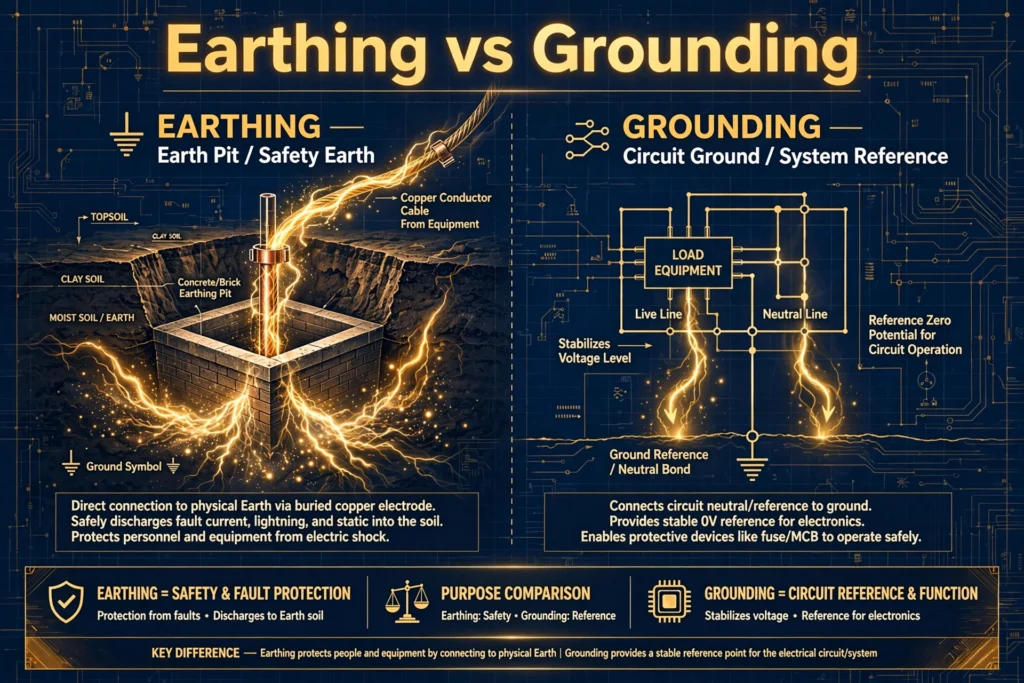
Earthing is the practice of connecting the exposed metal parts of electrical equipment — motor frames, panel enclosures, appliance bodies — to the earth through a low-resistance conductor. The term dominates in IEC-standard countries (UK, India, most of Europe and Asia).
The purpose is pure safety: if a live wire touches a metal casing (an insulation failure), the earthed casing provides a low-resistance path for fault current to flow. That large fault current trips the breaker or fuse almost instantly, disconnecting the danger. Without earthing, the casing would sit at full line voltage, waiting to electrocute whoever touches it.
An effective earthing installation has three parts: the earth electrode (rod, plate or pipe buried in soil), the earth conductor running from the installation to the electrode, and bonding that ties all exposed metalwork to that conductor. Our guide to industrial earthing systems covers how this scales up to factories and substations.
What Is Grounding?
Grounding is the same physical concept — connecting to the earth — but the term dominates in North American practice under the NEC (National Electrical Code). In everyday US speech, “grounding” covers everything: the green wire, the ground rod, the grounded outlet.
However, the NEC draws a sharper formal distinction than casual speech suggests:
- Equipment grounding = connecting metal enclosures to ground (exactly what IEC calls earthing).
- System grounding = intentionally connecting a current-carrying conductor — usually the neutral — to ground at the service entrance, which stabilizes voltages and gives fault current a return path.
So when an American electrician says “grounding,” they might mean either one, and the code treats them as related but distinct functions. This is where most of the earthing-vs-grounding confusion actually lives.
Earthing vs Grounding: Are They the Same?
In physics: yes. Both mean connecting electrical systems or equipment to the earth (the planet) to provide a safe reference and fault path. An earth rod in Mumbai and a ground rod in Texas do the identical job.
In terminology and code detail: not quite. The practical differences:
| Aspect | Earthing (IEC terminology) | Grounding (NEC terminology) |
|---|---|---|
| Region | UK, India, EU, most of Asia | USA, Canada |
| Core meaning | Connecting exposed metalwork to earth for safety | Same, plus formal system-grounding concept |
| Neutral treatment | Neutral earthed at source/transformer | Neutral grounded at service entrance (and only there) |
| The wire | Called the “earth wire” (green-yellow) | Called the “ground wire” (green or bare) |
| Key standard | IEC 60364 | NEC Article 250 |
The single most important technical point: earth/ground is not a spare neutral. The ground wire should carry current only during a fault. The neutral wire carries normal return current. Bonding them together anywhere except the single designated point (service entrance / main panel) creates parallel neutral paths, circulating currents and shock hazards — one of the most common wiring mistakes in both DIY and professional work.
Types of Earthing Electrodes
The earth connection is only as good as the electrode buried in the soil. Common types:
Rod earthing — a copper-bonded steel or galvanized iron rod (typically 3 m) driven vertically into the ground. Simple, cheap and the most common for homes.
Plate earthing — a copper or GI plate (e.g. 600 × 600 mm) buried vertically at ~3 m depth, surrounded by charcoal and salt layers to retain moisture and lower resistance. Common in India for larger installations.
Pipe earthing — a perforated GI pipe buried vertically, with salt and charcoal packing; water can be poured down the pipe in dry seasons to maintain conductivity.
Mat / grid earthing — a buried copper mesh covering a large area, used in substations where step-and-touch voltages must be controlled across the whole yard.
Whatever the type, the goal is the same: earth resistance as low as practical — often below 5 ohms for homes and below 1 ohm for substations and sensitive installations. Dry, rocky soil is the enemy; moisture-retaining backfill and longer/deeper electrodes are the fix. And always check your local wiring color codes so the earth conductor is correctly identified (green-yellow under IEC).
Why Proper Earthing Matters
Shock protection. Earthing ensures fault current is large enough to trip protection instantly. A high-resistance or missing earth means the breaker may never see enough current to trip — leaving metalwork live.
Equipment protection. Lightning strikes and switching surges need a low-impedance path to earth. Surge protection devices are useless without a solid earth to dump into.
Voltage stabilization. System grounding (neutral-to-earth connection) keeps phase voltages stable relative to earth and prevents floating-neutral overvoltages that destroy appliances.
Fire prevention. Faults that smolder instead of tripping breakers start fires. A good earth path converts a dangerous smoldering fault into a decisive trip.
Learn more about the underlying concepts in the Wikipedia articles on earthing systems and electrical ground.
Frequently Asked Questions
Is earthing the same as grounding?
Physically, yes — both connect equipment or systems to the earth for safety. The difference is terminology and code tradition: “earthing” is IEC language (UK, India, Europe), “grounding” is NEC language (North America), where the code additionally distinguishes equipment grounding from system grounding.
Can I use the neutral wire as an earth wire?
No — never. The neutral carries normal load current; the earth must carry current only during faults. Using neutral as earth energizes appliance casings with neutral voltage drop and defeats shock protection. They are bonded together at exactly one point (the main panel/service entrance) and kept separate everywhere else.
What is the difference between earthing and neutral?
The neutral is a current-carrying conductor that completes the circuit back to the source under normal operation. Earthing is a protective conductor that carries current only when something goes wrong (insulation failure). Different jobs, different wires, different rules.
How do I know if my home earthing is good?
Signs of bad earthing: tingling sensation from appliance bodies, flickering lights during faults, breakers that fail to trip on short circuits. The proper test is an earth resistance measurement with an earth tester (target: a few ohms). If your home has old wiring with no earth wire at all, get an electrician to retrofit it — this is not a DIY job.
Does a GFCI/RCD replace earthing?
No. An RCD/GFCI detects current leaking to earth and trips on tiny imbalances, which is excellent additional protection — but it works best with proper earthing, and many fault scenarios still need the low-resistance earth path to clear quickly. Think of the RCD as a complement to earthing, not a substitute.
Why does the US call it grounding instead of earthing?
Historical and code tradition. The NEC developed its own vocabulary (“grounded conductor” for neutral, “grounding conductor” for the protective wire) while IEC standards settled on “earthing.” Electricians on each side learn their own terms, but the copper in the ground does the same job worldwide.
Final Thoughts
Earthing and grounding are two names for one life-saving idea: give fault current a safe, low-resistance road into the earth so protection trips fast and people stay safe. Remember the distinctions that matter — earth is not neutral, bond them at only one point, keep earth resistance low, and follow your region’s code (IEC or NEC). Get those fundamentals right and the terminology debate becomes what it should be: just words.