
Imagine a simple home circuit with a light, a switch, and a power supply. When you turn on the light, current must travel through a complete electrical path. The neutral provides an important part of that path in many AC systems. Without a properly connected neutral, some circuits may not work correctly, and electrical equipment can become unsafe.
The term neutral meaning is important for electrical students, technicians, and engineers because neutral conductors are used in residential wiring, commercial buildings, distribution systems, and many industrial installations. Beginners often confuse neutral, earth, and ground, even though they have different purposes.
In this guide, you will learn what neutral means in electrical systems, how it works, the main types of neutral arrangements, its components and functions, advantages and disadvantages, applications, and common problems. You will also learn the difference between neutral and earth, basic selection considerations, and modern trends in neutral monitoring.
Understanding the neutral conductor is a basic skill for anyone working with AC electrical systems.
2. What Is Neutral Meaning?
In electrical engineering, neutral generally refers to a conductor connected to the neutral point of an AC electrical system.
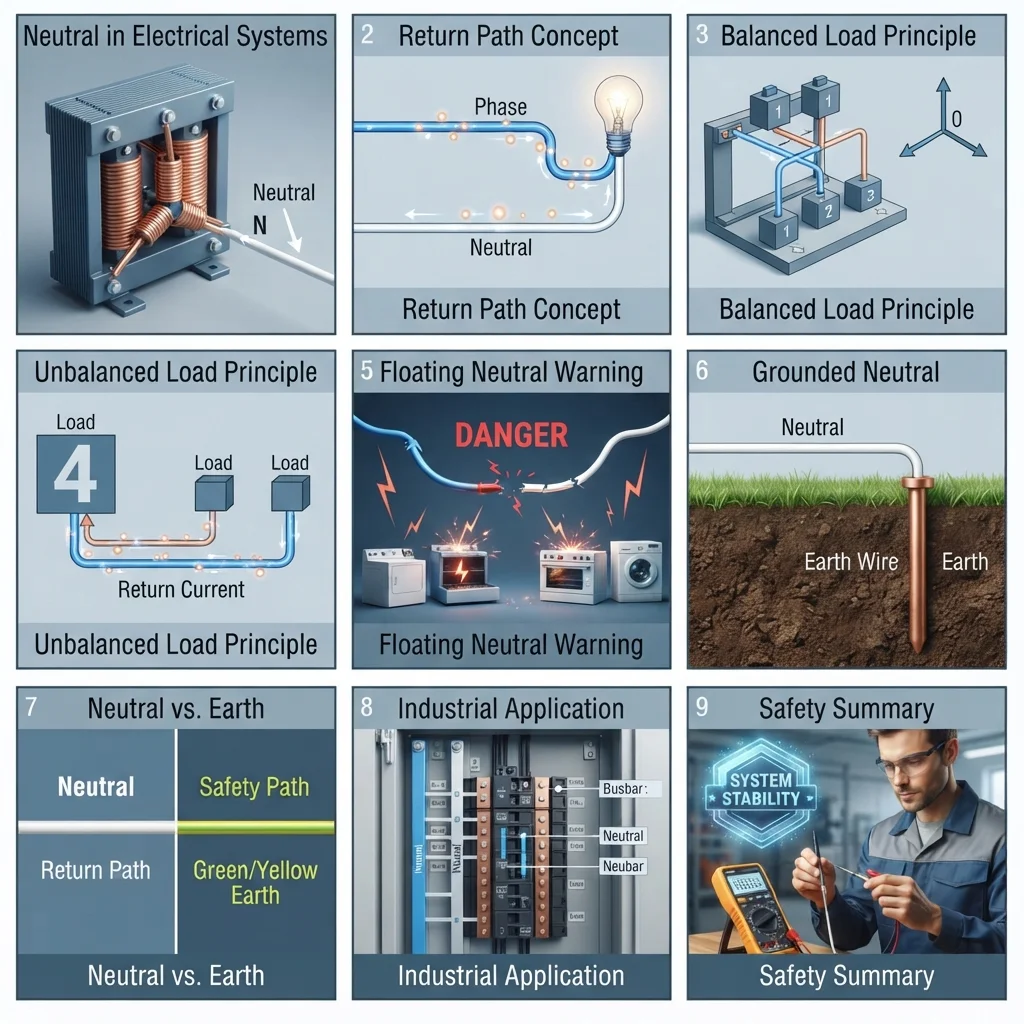
In a typical single-phase supply, the neutral provides a return path for current back toward the source.
For example, a basic circuit may contain:
- Phase conductor
- Neutral conductor
- Load
- Protective earth conductor
When a lamp is connected between phase and neutral, current flows through the lamp when the circuit is switched on.
Simple Definition
Neutral is a conductor that is normally connected to the neutral point of an electrical supply and can carry current during normal operation.
In a three-phase star-connected system, the neutral point is formed where the three phase windings meet.
The neutral voltage is often close to earth potential at the supply reference point, but neutral and earth are not automatically the same conductor.
Simple Practical Example
Suppose a house receives a single-phase supply.
The circuit may look like this:
Phase → Switch → Lamp → Neutral → Transformer/source
When the switch is closed, current flows through the lamp and returns through the neutral conductor.
The neutral therefore completes the normal operating circuit.
Why Is Neutral Important?
Neutral helps:
- Complete many AC circuits
- Provide a reference point
- Carry unbalanced current in three-phase systems
- Support single-phase loads
- Maintain correct voltage relationships
3. Neutral Working Principle
The neutral working principle is easier to understand by following the current path.
Step 1: Electrical Source Produces Voltage
An electrical source, such as a transformer, generates AC voltage.
In a common three-phase system, the transformer secondary may be connected in a star configuration.
Step 2: Neutral Point Is Established
The meeting point of the three transformer windings becomes the neutral point.
This point can be connected to earth according to the system’s grounding arrangement.
Step 3: Power Travels Through the Phase
The phase conductor carries electrical energy from the source toward the load.
For a simple single-phase load:
Phase → Load
Step 4: Current Returns Through Neutral
After passing through the load, current returns toward the source through the neutral conductor.
The complete path becomes:
Source → Phase → Load → Neutral → Source
Step 5: Balanced Loads Reduce Neutral Current
In a balanced three-phase system, the currents in the three phases are equal and separated by 120 electrical degrees.
Their vector sum is approximately zero.
Therefore, little or no current flows through the neutral conductor under ideal balanced conditions.
Step 6: Unbalanced Loads Produce Neutral Current
Real electrical systems often have different loads connected to different phases.
When the loads are unequal, the phase currents do not cancel completely.
The remaining current flows through the neutral.
This is why neutral sizing is important in practical electrical installations.
Easy Analogy
Think of electricity like water moving through a pipe system.
- Phase is like the supply pipe.
- Load is like a machine using the water.
- Neutral is like the return pipe.
- Earth is like an emergency safety route.
The analogy is not electrically exact, but it helps beginners understand the basic concept.
4. Types / Classification of Neutral Systems
Neutral arrangements can be classified in several ways depending on the electrical system and grounding method.
4.1 Solidly Grounded Neutral
A solidly grounded neutral is directly connected to earth with a very low impedance connection.
This arrangement is widely used in low-voltage power distribution.
Its main purpose is to establish a stable voltage reference and provide a path for fault current.
4.2 Resistance-Grounded Neutral
In this arrangement, a resistor is placed between the system neutral point and earth.
The resistor limits fault current during certain earth faults.
Resistance grounding is common in some industrial electrical systems where controlling fault current is important.
4.3 Reactance-Grounded Neutral
A reactor is used between the neutral point and earth.
The reactor limits earth-fault current through inductive reactance.
This method can be used in specific medium- and high-voltage applications.
4.4 Ungrounded Neutral
An ungrounded system does not intentionally connect the system neutral point directly to earth.
Such systems require careful engineering because an earth fault can produce unusual voltage conditions.
4.5 High-Resistance Grounded Neutral
High-resistance grounding uses a resistor with a relatively high resistance value.
It limits ground-fault current while allowing the system to continue operating for certain controlled fault conditions.
This arrangement is used in some industrial facilities.
5. Main Components Related to Neutral
Neutral is not a separate piece of equipment by itself. Several electrical components work together to establish, distribute, and protect the neutral system.
Neutral Point
The neutral point is the common point of a star-connected transformer or generator winding.
It provides the reference point for phase-to-neutral voltages.
Neutral Conductor
The neutral conductor carries current between the load and the neutral point of the source.
Its size must be selected according to the installation, load characteristics, applicable electrical codes, and expected neutral current.
Neutral Busbar
A neutral busbar provides a common connection point for multiple neutral conductors inside an electrical panel or switchboard.
It is normally insulated or arranged according to the system design.
Neutral Terminal
Neutral terminals provide connection points for individual circuits.
They are common in distribution boards and control panels.
Neutral-Ground Connection
A system may have a designed connection between neutral and earth at a specified location.
The exact arrangement depends on the electrical system and applicable standards.
This connection should never be added randomly because incorrect bonding can create unwanted current paths.
Protective Devices
Circuit breakers, fuses, residual-current devices, and other protective equipment may be used around circuits containing neutral conductors.
The exact protection arrangement depends on the system design.
6. Neutral Advantages
A correctly designed neutral system provides several important benefits.
- Completes single-phase circuits: Many loads operate between phase and neutral.
- Supports single-phase loads: Homes and buildings commonly use many phase-to-neutral circuits.
- Provides a voltage reference: The neutral point helps establish predictable phase-to-neutral voltages.
- Carries unbalanced current: In three-phase four-wire systems, neutral carries the resulting imbalance.
- Supports distribution systems: Neutral makes it practical to supply different single-phase loads from a three-phase source.
- Improves system operation: A properly designed neutral helps maintain expected voltage conditions.
- Simplifies building wiring: Multiple single-phase circuits can share a three-phase supply system when properly distributed.
These are some of the key neutral advantages and disadvantages that electrical designers consider when selecting a distribution arrangement.
7. Neutral Disadvantages / Limitations
Neutral is useful, but it also has limitations.
Neutral Can Carry Dangerous Voltage
A neutral conductor should never be assumed to be safe simply because it is called neutral.
A wiring fault, loose connection, incorrect installation, or abnormal condition can place dangerous voltage on it.
Neutral Overheating
In systems with nonlinear electronic loads, neutral current can become significant.
Harmonic currents can contribute to neutral heating, especially in installations with many electronic power supplies.
Loose Neutral Connections
A loose neutral connection can cause unstable voltages in some multi-load systems.
This can damage sensitive electrical equipment.
Incorrect Neutral-Earth Bonding
Unwanted neutral-to-earth connections can create parallel current paths.
This can cause protective devices to behave incorrectly and can create touch-voltage concerns.
Additional Conductor
A four-wire three-phase system requires a neutral conductor in addition to the three phase conductors.
This can increase cable and installation requirements.
8. Neutral Applications
Neutral conductors are used in many electrical systems.
Home Applications
Neutral is commonly found in:
- Lighting circuits
- Socket outlets
- Ceiling fans
- Household appliances
- Distribution boards
- Single-phase equipment
For example, a typical lighting circuit may connect the lamp between phase and neutral.
Commercial Applications
Commercial buildings use neutral systems for:
- Office lighting
- Computers
- Printers
- Small appliances
- HVAC controls
- General-purpose outlets
Because modern offices contain many electronic devices, engineers must consider neutral current and harmonics.
Industrial Applications
Industrial systems may use neutral arrangements for:
- Control circuits
- Lighting systems
- Single-phase auxiliary equipment
- Distribution transformers
- Industrial panels
Large industrial systems may use different grounding arrangements depending on voltage level, equipment, fault-current requirements, and operating philosophy.
Modern Technology
Neutral conductors also appear in systems containing:
- Variable frequency drives
- Switching power supplies
- Data centers
- UPS systems
- Automation equipment
- Solar power systems
- Smart electrical panels
Modern electronic loads make neutral-current analysis increasingly important.
9. Difference Between Neutral and Earth
One of the most common beginner questions is the difference between neutral and earth.
Although they may be connected at a defined point in some electrical systems, their purposes are different.
| Feature | Neutral | Earth |
|---|---|---|
| Main purpose | Normal current path | Safety and fault protection |
| Carries normal load current | Yes | Normally no |
| Connected to source neutral point | Yes | Not necessarily |
| Used for equipment operation | Yes | Normally no |
| Safety function | Secondary/system reference role | Primary protective role |
| Can carry fault current | Yes, depending on fault | Yes, during faults |
| Should be treated as safe | No | No |
| Incorrect connection | Can create serious problems | Can create serious problems |
Neutral vs Ground
The terms neutral, earth, and ground can vary by country and electrical system.
In everyday electrical work, “ground” is often used to mean the protective earth conductor.
However, engineers should identify the exact system and terminology rather than assuming that neutral and protective earth are interchangeable.
10. Selection Guide
Choosing the correct neutral arrangement is an engineering decision.
Beginners should consider the following factors.
1. Determine the System Voltage
Identify whether the system is:
- Low voltage
- Medium voltage
- High voltage
The grounding and neutral arrangement can change significantly with voltage level.
2. Calculate Expected Load
Determine the connected and demand load.
A higher load may require a larger neutral conductor or a different system design.
3. Check Load Balance
For a three-phase system, distribute single-phase loads as evenly as practical.
Better balance can reduce neutral current.
4. Consider Harmonics
Electronic equipment can produce harmonic currents.
For buildings with many computers, LED drivers, UPS systems, and other nonlinear loads, engineers should evaluate neutral heating and conductor sizing carefully.
5. Follow Electrical Standards
Always follow the applicable electrical code, installation standard, and local regulations.
Do not select conductor sizes or grounding arrangements based only on a simple rule of thumb.
6. Consider Future Expansion
A professional design should consider expected future loads.
This can prevent overloaded conductors and expensive modifications later.
11. Common Problems & Solutions
Why Does a Neutral Wire Carry Current?
A neutral carries current when it is part of the normal return path for a load.
Solution: This is normal when the circuit is correctly designed.
Why Does the Neutral Become Hot?
Possible causes include:
- Excessive load
- Loose connection
- Harmonic current
- Incorrect conductor sizing
- Unbalanced loads
Solution: A qualified electrician should measure current and inspect connections and conductor sizing.
What Happens When the Neutral Is Loose?
A loose neutral can cause unstable or unexpected voltages in circuits, particularly where multiple loads share a neutral.
Solution: Switch off the appropriate supply and have the connection inspected by a qualified person.
Can Neutral and Earth Be Connected Together?
They can be connected at a specific designed point in certain electrical systems.
However, connecting them randomly at downstream outlets or panels can create unwanted current paths.
Solution: Follow the system design and applicable electrical code.
Why Is Neutral Current High in an Office?
A large number of electronic devices can introduce harmonic currents.
Solution: Measure neutral current and perform harmonic analysis when necessary.
Can You Touch Neutral Safely?
No.
A neutral should always be treated as potentially energized.
Faults and incorrect wiring can place dangerous voltage on the conductor.
12. Future Trends in Neutral Systems
Electrical distribution is changing as more digital and electronic equipment is installed.
Smart Monitoring
Modern electrical panels can monitor:
- Neutral current
- Phase current
- Voltage
- Power factor
- Harmonic distortion
- Temperature
This allows maintenance teams to detect problems earlier.
Harmonic Monitoring
As buildings use more electronic equipment, harmonic monitoring is becoming increasingly important.
Engineers can use power-quality meters to identify excessive harmonic currents and other problems.
Digital Protection
Modern protection equipment can provide detailed measurements and event records.
This helps engineers troubleshoot neutral faults and abnormal operating conditions.
Smart Buildings
Smart buildings use sensors, automation systems, and connected electrical equipment.
These systems require reliable distribution and better power-quality monitoring.
Renewable Energy
Solar PV systems, battery storage, inverters, and other distributed-energy technologies are changing traditional power-distribution designs.
Engineers must understand how these systems interact with neutral and grounding arrangements.
Better Power Quality
Future electrical systems will place greater emphasis on:
- Harmonic control
- Voltage stability
- Energy efficiency
- Automated monitoring
- Predictive maintenance
- Safer grounding systems
13. Conclusion
The neutral is a fundamental part of many AC electrical systems. It normally connects to the neutral point of a source and provides a return path for current in many single-phase and unbalanced three-phase circuits.
Understanding neutral working principle helps electrical students and technicians understand how practical distribution systems operate. It is also important to know the difference between neutral and earth because these conductors have different functions.
Neutral systems can use different grounding arrangements, including solid grounding, resistance grounding, reactance grounding, and high-resistance grounding. The correct choice depends on voltage, load, fault requirements, standards, and the application.
In modern electrical installations, harmonic currents, electronic loads, renewable energy, and smart monitoring make neutral design even more important. Always treat a neutral conductor as potentially dangerous and follow proper electrical safety procedures.