
Open any switchboard and you will see at least three wires running side by side: live, neutral, and earth. Most people can guess what the live wire does — it carries power. But the neutral and earth wires confuse almost everyone, because both of them seem to “go back to zero” and both are connected to the ground at some point. Are they the same thing? Can you use one in place of the other?
The short answer is no. The neutral wire is a current-carrying conductor that completes the circuit back to the supply, while the earth wire is a safety conductor that should never carry current under normal conditions — it only carries current during a fault, to protect you from electric shock. Mixing them up is one of the most common and dangerous wiring mistakes.
In this guide, we will explain exactly what each wire does, how to tell them apart by their wiring color codes, why they must never be swapped, and the safety rules every homeowner and electrician should follow.
What Is the Neutral Wire?
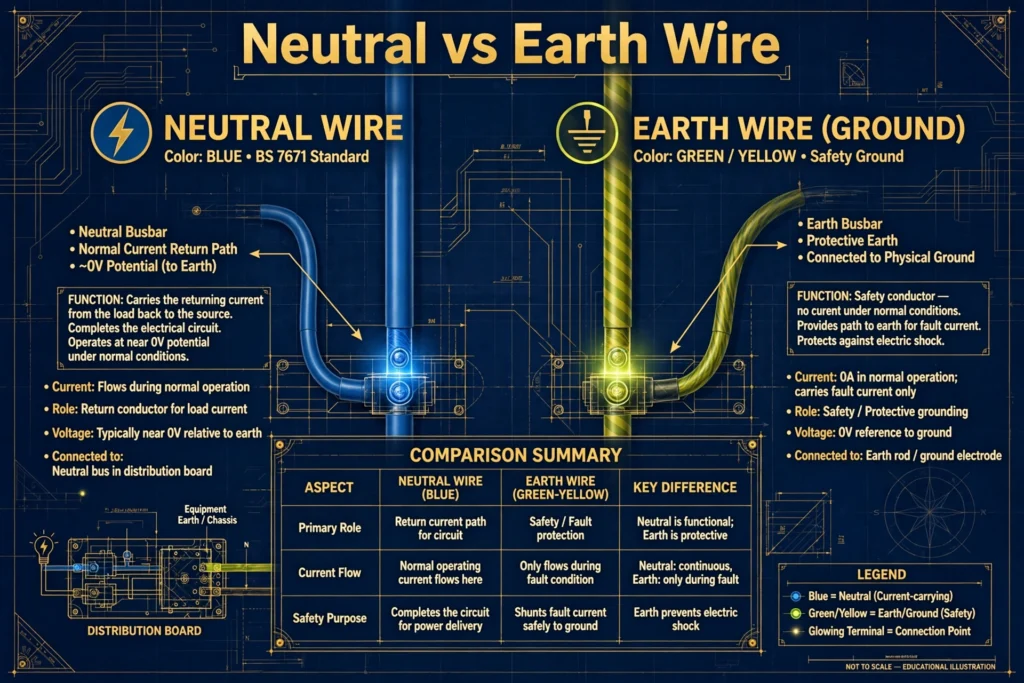
The neutral wire is the return path for electric current in an AC circuit. In a single-phase system, current flows out through the live (phase) wire, powers your appliance, and flows back to the source through the neutral wire. It is a normal, working conductor — under load, it carries the same current as the live wire.
At the supply transformer or the main distribution point, the neutral is bonded to earth (grounded). That is why the neutral sits at or near zero volts relative to the ground. But “near zero” is not the same as “zero”: when current flows through the neutral, the wire’s own resistance creates a small voltage drop, so the neutral can sit a few volts above earth potential — especially on long cable runs or unbalanced three-phase loads.
Key facts about the neutral wire:
- It carries load current during normal operation.
- It is insulated along its full length, just like the live wire.
- It is connected to earth at the source (the supply side), not at every appliance.
- If the neutral breaks while a load is connected, the appliance stops working — and the “dead” neutral on the load side can float up toward live potential, which is dangerous.
What Is the Earth (Ground) Wire?
The earth wire — called the ground wire in North America — is a protective safety conductor. It connects the metal body (chassis) of appliances and equipment directly to the earth electrode buried in the ground. Under normal conditions it carries no current at all. Its entire job is to provide a low-resistance escape path for fault current.
Here is how it saves lives: suppose the insulation inside a washing machine fails and the live wire touches the metal casing. Without an earth wire, the casing becomes live at 230 V, and anyone touching it gets a shock. With an earth wire connected, the fault current rushes through the earth wire to ground, creating a large current that trips the breaker or fuse instantly — disconnecting the supply before anyone is harmed.
Key facts about the earth wire:
- It carries no current in normal operation — only during a fault.
- It connects equipment bodies to the earth electrode via the ground wire path.
- It must be continuous and low-resistance from every socket back to the main earth terminal.
- A missing or broken earth wire gives no warning — everything works normally until the day a fault occurs.
Neutral vs Earth Wire: Key Differences at a Glance
| Feature | Neutral Wire | Earth (Ground) Wire |
|---|---|---|
| Purpose | Return path for load current | Safety path for fault current |
| Carries current normally? | Yes — same as the live wire | No — only during a fault |
| Connected to earth | At the supply source | At the installation’s earth electrode |
| Insulation | Fully insulated | Often bare or green/yellow insulated |
| If it breaks | Appliance stops working | No visible symptom — protection lost silently |
| Touching it | Can give a shock under load | Safe to touch (at earth potential) |
Color Codes for Neutral and Earth Wires
Color codes differ between the IEC standard (used in Europe, the UK, India, Pakistan and most of Asia) and the NEC standard (used in North America). Knowing both matters because imported equipment and online wiring diagrams may follow either one.
IEC / international colors:
- Earth: green-and-yellow striped (always)
- Neutral: blue
- Live: brown (single phase), or brown/black/grey (three phase)
NEC / North American colors:
- Earth (ground): green, or green with yellow stripe, or bare copper
- Neutral (grounded conductor): white or grey
- Live (hot): black, red, or blue (120/208 V systems)
One golden rule: the green-yellow (or green/bare) conductor is reserved exclusively for earth worldwide. Never use it as a neutral or live wire, and never use any other color as the earth wire. For a complete reference, see our guide to wiring color codes.
Can You Connect Neutral and Earth Together?
This is where many DIY mistakes happen. The answer depends on where you make the connection:
- At the main supply / service entrance: yes — and in fact it is required. The neutral is bonded to earth at the main panel (the TN-S / TN-C-S systems described in earthing systems standards). This single bonding point keeps the neutral near earth potential and gives fault current a path back to the source so breakers trip.
- Anywhere downstream (sockets, sub-panels, appliances): absolutely not. Connecting neutral to earth at a socket creates a parallel return path — part of the load current flows through the earth wire and through building metalwork and pipes. That defeats the entire safety system: RCDs/GFCIs will nuisance-trip (or worse, fail to protect), and metal parts can carry current.
Electricians call the forbidden downstream link a “borrowed neutral” or “combined neutral-earth,” and it is one of the first things an inspector looks for.
Safety Rules: What Happens If You Mix Them Up
Swapping or combining neutral and earth can cause:
- Electric shock from appliance bodies — fault current has no clean path to trip the breaker.
- RCD/ELCB failure — residual-current devices compare live vs neutral current; a neutral-earth link downstream blinds them.
- Fire risk — earth wires are sometimes thinner than neutrals; forcing load current through them overheats the conductor.
- Stray voltage on pipes and structures — load current through building steel and plumbing corrodes pipes and shocks anyone touching them.
Practical safety checklist:
- Always verify wires with a tester or multimeter — never trust colors alone, especially in old installations where colors may predate current standards.
- Keep the earth path continuous: every socket, every metal enclosure, bonded back to the main earth terminal.
- Size the earth conductor per code — never smaller than required.
- After any wiring work, test with an RCD tester and an earth continuity check.
- If you are wiring a home distribution board, follow a proper MCB wiring in a home distribution board layout with separate neutral and earth busbars.
Frequently Asked Questions
Is the neutral wire the same as the ground wire?
No. The neutral is a current-carrying return conductor for normal load current, while the ground (earth) wire is a safety conductor that carries current only during a fault. They are bonded together at the main supply but must remain separate everywhere else.
What color is the neutral wire vs the earth wire?
Under IEC standards, neutral is blue and earth is green-yellow striped. Under NEC (North America), neutral is white or grey and ground is green or bare copper.
Can I use the earth wire as a neutral?
Never. The earth wire is not designed to carry continuous load current, and using it as a neutral energizes appliance bodies and defeats shock protection. It is also a code violation everywhere.
Why does my neutral wire show a small voltage?
Because the neutral carries load current, its resistance causes a small voltage drop along the cable. A few volts between neutral and earth at a distant socket is normal; a large voltage indicates a loose or overloaded neutral.
Does a two-wire appliance need an earth connection?
Double-insulated appliances (marked with a square-in-square symbol) are designed to be safe without an earth wire and use only live and neutral. Anything with a metal body should be earthed.
What happens if the earth wire is disconnected?
Everything appears to work normally — which is exactly the danger. The protection is silently gone, and the first insulation fault can make an appliance body live without tripping any breaker.
Final Thoughts
The neutral and earth wires may both end up connected to the ground, but they do completely different jobs: the neutral is the highway that load current travels every day, while the earth wire is the emergency exit that should never be used — until the one moment it saves a life. Keep them correctly identified by their colors, bonded only at the main supply, and never interchange them. That single discipline is the foundation of every safe electrical installation, and it is exactly what standards like those documented by Schneider Electric and the international earthing systems framework are built around.