
Imagine you bring a small piece of paper close to a charged comb after combing your hair. The paper suddenly jumps and sticks to the comb. This simple everyday observation is a result of an invisible force acting around electric charges, known as the electric field. But how do engineers and scientists calculate this force? This is where the electric field formula becomes essential.
The electric field formula is one of the most important concepts in electrical engineering and physics. It helps us understand how electric charges interact, how forces are created, and how energy is transferred in electrical systems. From designing circuits to developing advanced technologies, this concept plays a vital role.
In this article, you will learn the electric field formula, its working principle, types, components, advantages and disadvantages, applications, and practical troubleshooting. Everything is explained in simple, clear language, just like a senior engineer guiding a junior.
What is Electric Field Formula?
Basic Electric Field Formula
E=qF
Where:
- E = Electric Field (N/C)
- F = Force (Newton)
- q = Charge (Coulomb)
Electric Field Due to a Point Charge
E=r2kQ
q1
q2
r
F=kr2q1q2≈−5.06+-
Where:
- E = Electric Field
- k=9times109textNm2/textC2 (constant)
- Q = Source Charge
- r = Distance from charge
Electric Field in Terms of Voltage
E=dV
Where:
d = Distance between plates
E = Electric Field
V = Voltage
E = \frac{F}{q}
Simple Explanation
It tells us how much force (F) is acting on a unit charge (q) placed in an electric field.
Practical Example
- A charged object creates a field around it
- If another charge enters this field, it experiences force
- The strength of that force per unit charge is called the electric field
Working Principle of Electric Field Formula
The electric field formula working principle is based on force and charge interaction.
Step-by-Step Explanation
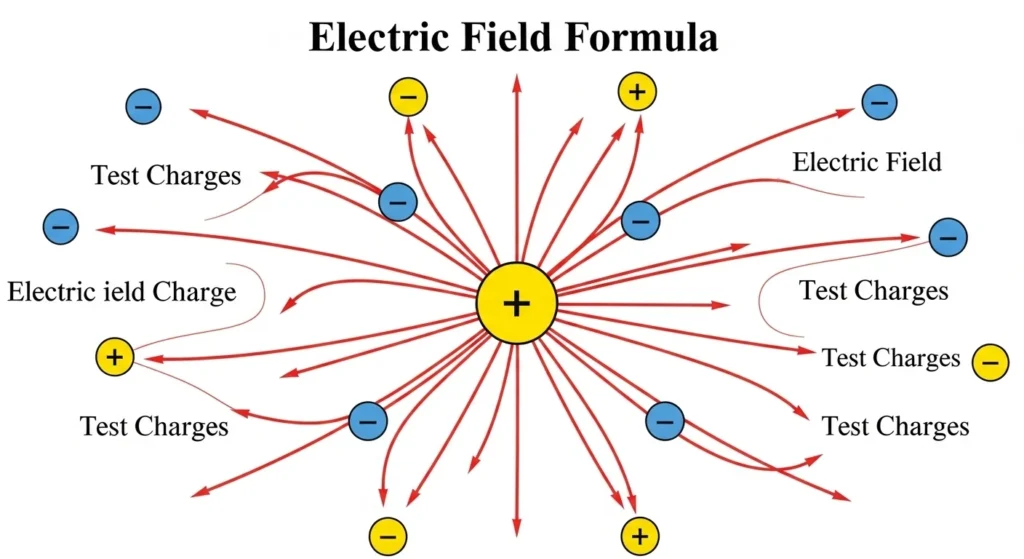
- A charge creates an electric field around it
- Another charge placed in this field experiences force
- The magnitude of this force depends on distance and charge value
- The electric field is calculated as force per unit charge
Electric Field Due to a Point Charge
genui{“math_block_widget_always_prefetch_v2”:{“content”:”E = \frac{kQ}{r^2}”}}
Where:
- (E) = Electric field
- (k) = Constant (Coulomb’s constant)
- (Q) = Source charge
- (r) = Distance from charge
Easy Analogy
Think of a magnet:
- It creates a magnetic field
- Objects near it feel a force
- Similarly, electric charges create electric fields
Types / Classification of Electric Field
1. Uniform Electric Field
- Same strength and direction everywhere
- Found between parallel plates
- Used in capacitors
2. Non-Uniform Electric Field
- Field strength changes with position
- Common in real-life situations
- Created by point charges
3. Electric Field Due to Point Charge
- Field radiates outward or inward
- Depends on charge polarity
4. Electric Field Between Plates
- Parallel lines of force
- Constant field strength
Main Components of Electric Field Formula
1. Electric Charge (Q)
- Source of electric field
- Can be positive or negative
2. Test Charge (q)
- Small charge used to measure field
- Should not disturb field
3. Force (F)
- Attraction or repulsion between charges
- Determines field strength
4. Distance (r)
- Field strength decreases with distance
- Inversely proportional to square of distance
Advantages of Electric Field Formula
The electric field formula advantages and disadvantages help in understanding its practical importance.
Advantages
- Helps calculate force on charges
- Essential for circuit design
- Useful in electrical engineering analysis
- Supports understanding of electric forces
- Important in modern electronics
Disadvantages / Limitations
- Assumes ideal conditions
- Difficult for complex charge systems
- Requires accurate measurements
- Not always easy to visualize
Applications of Electric Field Formula
The electric field formula applications are widely used in real life.
Home Applications
- Static electricity
- Electronic devices
- Capacitors
Industrial Applications
- Power systems
- Insulation design
- Electrical equipment testing
Modern Technology
- Semiconductor devices
- Communication systems
- Medical equipment
Comparison Section
Difference Between Electric Field and Electric Potential
| Feature | Electric Field | Electric Potential |
|---|---|---|
| Definition | Force per unit charge | Energy per unit charge |
| Formula | E = F/q | V = W/q |
| Unit | N/C | Volt |
| Nature | Vector | Scalar |
This explains the difference between electric field and electric potential clearly.
Selection Guide
How to Use Electric Field Formula (Tips for Beginners)
- Identify known values (force, charge, distance)
- Use correct formula based on situation
- Check units carefully
- Apply correct direction for vector quantity
- Practice numerical problems
Common Problems & Solutions (FAQs Style)
1. Why is electric field zero?
Reason: Charges cancel each other
Solution: Check symmetry
2. Why is field very strong?
Reason: Small distance from charge
Solution: Increase distance
3. Why wrong results in calculation?
Reason: Incorrect units
Solution: Use standard SI units
4. How to measure electric field?
Solution: Calculate using known values
Future Trends in Electric Field Applications
Advanced Electronics
- Smaller and efficient circuits
- Better control of electric fields
Renewable Energy
- Improved solar panel efficiency
- Better energy storage
Smart Systems
- Smart grids
- Intelligent control systems
Conclusion
The electric field formula is a fundamental concept that helps us understand how electric forces work. It explains how charges interact and how energy is transferred in electrical systems. By learning the electric field formula working principle, types, and applications, students and engineers can build a strong foundation in electrical engineering.
Although it may seem theoretical, this concept has real-world importance in electronics, power systems, and modern technology. Mastering it will help you solve practical problems and understand advanced topics more easily.