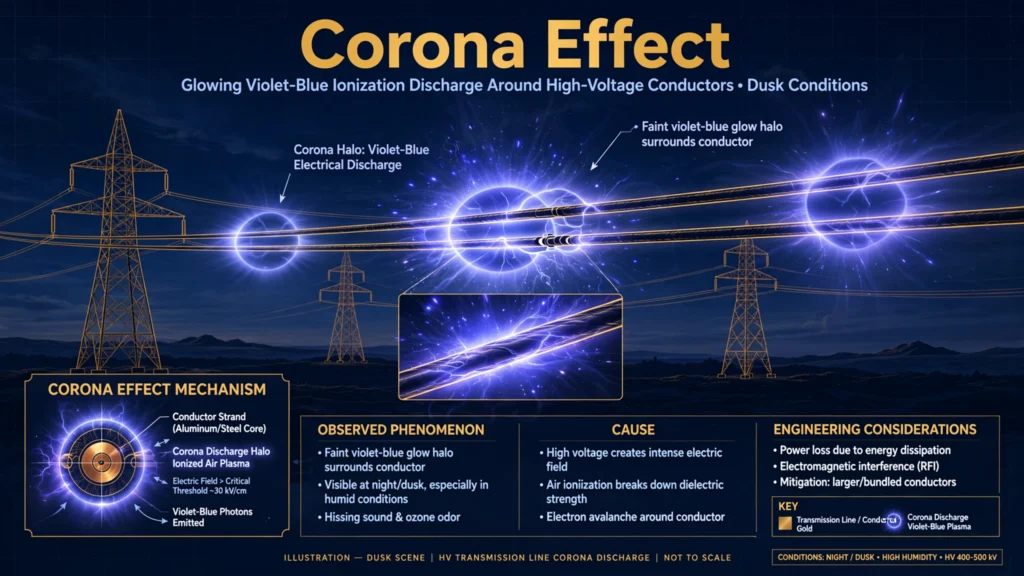

On a quiet night near an extra-high-voltage transmission line, you can sometimes hear it: a faint crackling, hissing hum — and if you look closely, a pale violet glow clinging to the conductors. That is the corona effect, one of the most fascinating phenomena in power engineering. The air itself around the wire is breaking down and becoming partially conductive.
Corona wastes energy, creates audible noise and radio interference, and produces ozone — yet it also reveals something profound about how electric fields interact with air. Transmission engineers spend considerable effort controlling it, because on a 500 kV line, corona losses can reach tens of kilowatts per kilometer. This guide explains what corona is, what causes it, its effects, and exactly how engineers reduce it.
What Is the Corona Effect?
The corona effect is a localized electrical discharge that occurs when the electric field strength at a conductor’s surface exceeds the dielectric strength of the surrounding air (about 3 kV/mm at standard conditions, or roughly 21 kV/cm rms as the critical disruptive value). The air molecules near the wire ionize, forming a conductive plasma sheath a few centimeters thick — while the air farther out remains insulating, so no full arc or flashover occurs.
Think of it as a “partial breakdown”: the field is strong enough to ionize air right at the conductor surface, but not strong enough to sustain a discharge across the whole gap. The result is the characteristic violet glow (from nitrogen emission), the hissing sound, and a continuous small leakage of power. The formal physics is described under corona discharge.
What Causes Corona: Critical Disruptive Voltage
Corona begins when the line voltage exceeds the critical disruptive voltage (Vc) — the voltage at which the surface field gradient reaches air’s breakdown strength. Peek’s law gives the classic formula:
Vc = 21.1 × δ × r × ln(d/r) kV (rms, per phase)
where r is conductor radius, d is spacing between conductors, and δ is the air density correction factor (δ = 1 at standard temperature and pressure).
Three insights fall straight out of this formula:
- Smaller conductors corona more — a thin wire concentrates the field at its surface (small r → higher gradient).
- Higher voltage lines corona more — the operating voltage must stay comfortably below Vc, which is why EHV lines need thick or bundled conductors.
- Weather matters — rain, fog, and high altitude lower δ (and water droplets distort the field), so corona is far worse in bad weather and at mountain altitudes. Engineers use a lower “critical visual voltage” for foul-weather design.
Effects of Corona: Power Loss, Noise, and Interference
Power Loss
Corona continuously bleeds energy — Peek’s empirical loss formula estimates it in kW/km as a function of frequency, radius, spacing, and how far the operating voltage exceeds Vc. Fair-weather loss on a well-designed line is small (a few kW/km), but in rain it can multiply tenfold. Over hundreds of kilometers, that is real money and real wasted generation.
Audible Noise
The crackling/hissing — a 100/120 Hz hum plus broadband noise — is corona’s most complained-about effect. It is worst in rain and fog, and it is a genuine environmental constraint: new EHV lines must meet audible-noise limits at the edge of the right-of-way, sometimes dictating conductor size more than electrical needs do.
Radio and Television Interference
Corona’s random micro-discharges spray broadband electromagnetic noise from kHz to hundreds of MHz, interfering with AM radio and (historically) analog TV reception near lines. Modern line design includes radio-interference voltage (RIV) limits.
Ozone and Nitrogen Oxides
Ionized air produces ozone (O₃) and nitrogen oxides. Around transmission lines the quantities are small and disperse quickly — a non-issue at grid scale — though in enclosed high-voltage equipment (like the insulation systems around a power transformer) corona must be suppressed to prevent insulation degradation.
Insulation Damage Over Time
On equipment rather than open lines, persistent corona erodes insulation — “corona cutting” of generator windings and cable terminations is a classic failure mode. This is why high-voltage apparatus is designed with smooth, rounded, field-graded surfaces.
Factors That Increase or Decrease Corona
| Factor | Effect on corona |
|---|---|
| Higher system voltage | Increases |
| Smaller conductor diameter | Increases sharply |
| Rain, fog, snow, dust on conductor | Increases |
| High altitude (thin air) | Increases |
| Larger conductor spacing | Decreases slightly |
| Smooth, clean conductor surface | Decreases |
| Bundled conductors | Decreases strongly |
How Engineers Reduce Corona
1. Bundled conductors. The single most effective weapon. Using 2, 4, or 6 sub-conductors per phase (spaced ~45 cm apart) makes the bundle behave electrically like one fat conductor — drastically lowering the surface gradient. Nearly all lines above 220 kV use bundles.
2. Larger conductor diameter. Hollow or expanded conductors (ACSR with a larger overall diameter for the same aluminum area) spread the field over more surface.
3. Smooth surfaces and corona rings. Sharp points concentrate fields enormously — hardware uses rounded fittings, and grading/corona rings at line ends and bushings smooth the field distribution.
4. Increased phase spacing. More spacing lowers the gradient, but it also raises tower costs and line inductance — a trade-off.
5. Higher operating discipline in foul weather. Operators accept higher losses in rain; design simply ensures clearances and insulation survive the worst case.
6. Good maintenance. Contaminated, damaged, or vibrating conductors corona more — cleaning and re-tensioning help.
Is Corona Ever Useful?
Surprisingly, yes — the same physics is harnessed deliberately:
- Electrostatic precipitators use corona discharge to charge dust particles in smokestacks so they can be collected — a major pollution-control technology.
- Ozone generators for water treatment intentionally create corona in oxygen.
- Photocopiers and laser printers use corona wires to charge the photoconductor drum.
- Corona’s current-limiting nature even provides a mild surge-softening effect on lines during lightning transients.
The difference between nuisance and tool is control: engineers suppress corona where it wastes energy and exploit it where ionization is the goal.
Frequently Asked Questions
What is the corona effect in simple words?
When the voltage on a power line is very high, the electric field at the wire’s surface becomes strong enough to ionize the surrounding air, creating a glowing, hissing partial discharge. That is corona — air breaking down locally without a full spark.
Why does corona happen more in rainy weather?
Water droplets on the conductor distort and concentrate the electric field, and moist air breaks down more easily. Rain can increase corona loss and audible noise many times over fair-weather levels.
Does corona cause power loss?
Yes. Corona continuously leaks energy as heat, light, sound, and chemical reactions. On EHV lines it is measured in kilowatts per kilometer and factored into the line’s economic design.
What is the difference between corona and arcing?
Corona is a partial, localized discharge confined to the high-field region near the conductor — the air farther away stays insulating. Arcing (flashover) is a complete breakdown bridging the full gap, carrying large current. Corona is a faint glow; an arc is a violent spark.
How do bundled conductors reduce corona?
A bundle of sub-conductors acts like a single conductor with a much larger effective radius, which lowers the electric field strength at the surface below the ionization threshold — the same voltage, far less corona.
Is the glow of corona dangerous to people on the ground?
The glow and hiss themselves are harmless at ground level — the fields there are tiny. The real hazards near EHV lines are the same as always: never approach fallen lines or climb towers, per standard electrical safety rules.
Final Thoughts
The corona effect is a perfect example of engineering at the edge of physics: push voltages higher for efficient bulk power transfer, and the air itself starts to conduct. Understanding critical disruptive voltage, Peek’s law, and the bundle-conductor solution turns a mysterious violet glow into a solved design problem. And as researchers from Britannica to modern EHV designers document, mastering corona is what makes today’s ultra-high-voltage grids — and the power transformers and how transformers work knowledge behind them — possible at all.