
Imagine you are running a large water pump in an industrial plant. You press a small push button, and suddenly the motor starts running. You are not directly handling the high current flowing to the motor. Instead, a small control signal activates a device that switches the motor’s power supply safely. That device is called a contactor.
A contactor is an important electrical switching device used in motor control, industrial automation, HVAC systems, pumps, lighting systems, heating equipment, and other high-power applications. It allows a low-power control circuit to operate a high-power electrical load.
Understanding what is a contactor is essential for electrical students, engineers, technicians, and beginners. A contactor can provide reliable remote switching and is designed for frequent operation in many electrical control systems.
In this guide, you will learn the contactor working principle, function of a contactor, types of contactors, main components, applications, advantages and disadvantages, selection methods, common problems, and future trends in simple language.
What Is a Contactor?
A contactor is an electrically controlled switching device used to make or break a power circuit. It is mainly designed to control high-current electrical loads such as motors, pumps, compressors, heaters, lighting systems, and industrial machinery.
Unlike a manual switch, a contactor is operated electrically through a coil. When the coil receives the correct control voltage, it creates a magnetic field that moves the contact mechanism and changes the state of the main contacts.
Simple Explanation
A contactor can be understood as a heavy-duty electrically controlled switch.
For example, in a motor control circuit:
- A push button provides a control signal.
- The contactor coil becomes energized.
- The magnetic field moves the armature.
- The main contacts close.
- Power reaches the motor.
- The motor starts running.
When the coil is de-energized, the contacts open and disconnect the load.
What Is the Function of a Contactor?
The main function of a contactor is to safely switch electrical power to a load using a separate control circuit.
This allows a small control signal to operate a much larger electrical load.
The major functions of a contactor include:
- Switching motors ON and OFF
- Controlling pumps and compressors
- Switching heaters and lighting loads
- Providing remote electrical control
- Supporting automatic control systems
- Allowing frequent switching operations
- Connecting electrical loads to a power supply
- Working with overload relays and other protection devices
- Supporting PLC-based industrial automation
What Does a Contactor Do?
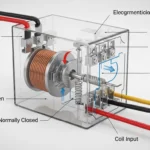
A contactor receives a control voltage at its coil. The energized coil produces a magnetic field that moves the armature and changes the position of the contacts.
For example, when a motor starter receives a start command, the contactor closes its main contacts. This connects the motor to the power supply and allows the motor to operate.
When the stop command is given or the control voltage is removed, the contactor opens the contacts and disconnects the motor.
Therefore, the simple answer to what does a contactor do is:
A contactor uses a low-power control signal to switch a high-power electrical circuit ON or OFF.
Contactor Working Principle
The contactor working principle is based mainly on electromagnetism.
The operation can be understood through these steps.
Control Signal Activation
First, a control signal is applied to the contactor coil.
The control signal may come from:
- Push buttons
- Switches
- Timers
- Sensors
- PLCs
- Motor control circuits
- Automatic control systems
The control voltage must match the coil’s rated voltage.
Magnetic Field Formation
When voltage is applied to the coil, current flows through the coil winding.
The coil produces a magnetic field. This creates an electromagnetic force that attracts the movable armature toward the fixed magnetic core.
Armature Movement
The contactor armature is a movable mechanical part connected to the contact assembly.
When the coil becomes energized, the magnetic force pulls the armature toward the electromagnet. This movement changes the position of the main and auxiliary contacts.
Unlike an electric motor armature, a contactor armature does not continuously rotate. It normally moves a short distance between two positions.
Contact Closing
As the armature moves, the normally open main contacts close.
The closed contacts complete the power circuit and allow current to flow to the connected load.
For example:
Power supply → Contactor → Motor
The motor can now receive electrical power and start operating.
Load Operation
Once the main contacts close, electrical power reaches the load.
Depending on the application, the load may be:
- Electric motor
- Water pump
- Compressor
- Heater
- Fan
- Lighting system
- Industrial machine
When the coil is de-energized, the magnetic field disappears. The spring mechanism returns the armature and contacts to their normal position, disconnecting the load.
Simple Analogy
Think of a contactor like a remote-controlled heavy-duty switch:
- Push button: Sends the command
- Coil: Receives the command
- Magnetic field: Creates the pulling force
- Armature: Moves the mechanism
- Main contacts: Switch the power
- Motor/load: Performs the useful work
This is the basic contactor working principle.
Types of Contactors
Contactors can be classified according to their electrical application, construction, and switching method.
Common types include:
- AC contactors
- DC contactors
- Vacuum contactors
- Magnetic contactors
AC Contactors
An AC contactor is designed to switch alternating-current electrical loads.
AC contactors are widely used for:
- Three-phase motors
- Pumps
- Compressors
- Air conditioners
- Fans
- Industrial machines
- Heating systems
They use an electromagnetic coil to operate the contacts. When the coil is energized, the main contacts close and connect the AC load to the power supply.
AC contactors are commonly used in motor starters and industrial control panels.
DC Contactors
A DC contactor is designed to switch direct-current electrical circuits.
DC contactors are commonly found in:
- Electric vehicles
- Battery systems
- Solar energy systems
- Energy storage systems
- Forklifts
- Railway equipment
- Industrial DC systems
DC switching requires careful arc control because DC current does not naturally pass through zero like AC current. Therefore, DC contactors may use special contact designs and arc-suppression methods.
Vacuum Contactors
A vacuum contactor uses switching contacts enclosed inside a vacuum interrupter or vacuum bottle.
The vacuum helps extinguish the electrical arc when the contacts open. Vacuum contactors are commonly used in medium-voltage applications and systems that require reliable and frequent switching.
Applications include:
- Large motors
- Industrial plants
- Mining equipment
- Power systems
- Medium-voltage motor control
Magnetic Contactors
A magnetic contactor operates using an electromagnetic coil and movable contact mechanism.
It is one of the most common types used in industrial motor control.
Magnetic contactors are frequently used with overload relays to provide motor starting and stopping control.
They are found in:
- Motor starters
- Pumps
- Conveyors
- HVAC systems
- Elevators
- Industrial automation
Main Components of a Contactor
A contactor contains several important components that work together to switch the electrical load.
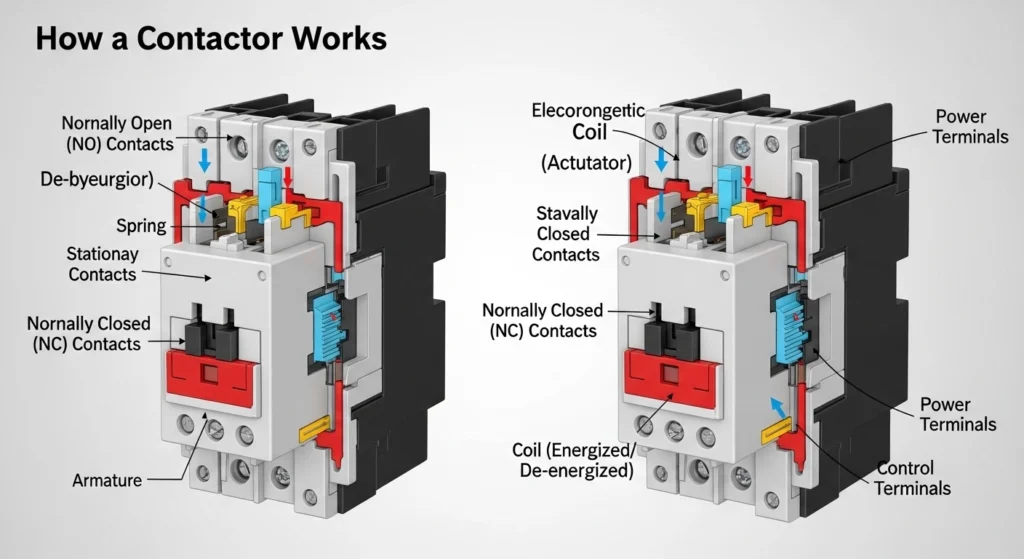
Coil
The coil is the control element of the contactor.
When the correct voltage is applied, the coil produces a magnetic field that moves the armature.
Main Contacts
Main contacts carry the load current.
They connect or disconnect the power supply from the electrical load. Their current and voltage ratings must be suitable for the application.
Auxiliary Contacts
Auxiliary contacts are mainly used in control and signaling circuits.
They may be:
- Normally Open (NO)
- Normally Closed (NC)
Auxiliary contacts can be used for holding circuits, interlocking, status indication, and control logic.
Armature
The armature is the movable mechanical part of the contactor.
When the coil is energized, electromagnetic force pulls the armature toward the magnetic core. This movement operates the contacts.
Spring Mechanism
The spring returns the armature and contacts to their normal position when the coil is de-energized.
This allows the contactor to open the power circuit when the control signal is removed.
Arc Suppression System
Opening and closing electrical contacts can produce an electrical arc, especially when switching high-current loads.
Contactors use suitable contact designs and arc-control methods to reduce the effects of arcing and improve contact life.
Advantages of Contactors
Contactors provide several benefits in electrical control systems.
Safe Control of High-Power Loads
A low-power control circuit can operate a high-power load without requiring the operator to manually switch the load current.
Remote Operation
Contactors can be controlled from a remote location using push buttons, sensors, timers, or PLCs.
Automation
They can easily be integrated into automatic control systems.
Frequent Switching
Contactors are designed for repeated switching operations when correctly selected for the application.
Easy Motor Control
They are widely used in motor starters for starting and stopping motors.
Integration With Protection Devices
Contactors can be combined with overload relays, circuit breakers, fuses, and other protective equipment.
Disadvantages of Contactors
Despite their advantages, contactors also have some limitations.
- Mechanical parts can wear over time.
- Contacts may experience electrical arcing.
- Operation can produce audible noise.
- Regular inspection may be required in demanding applications.
- Incorrect sizing can cause premature contact failure.
- They may not be suitable for every type of high-speed switching application.
Contactor Applications
Contactors are used in many residential, commercial, and industrial electrical systems.
Motor Control
Motor control is one of the most common applications.
Contactors are used to control:
- Water pumps
- Fans
- Compressors
- Conveyors
- Industrial motors
- HVAC motors
HVAC Systems
Air-conditioning and refrigeration systems use contactors to control compressors, fans, and other electrical loads.
Industrial Automation
Contactors can be integrated into automated systems to control motors, heaters, pumps, and machines.
Lighting Systems
Large lighting installations may use contactors to switch groups of lights from a control panel.
Heating Systems
Contactors can control electrical heaters and heating elements where the required current exceeds the capacity of the control switch.
Renewable Energy Systems
Contactors are also used in some solar, battery-storage, and renewable-energy control systems for switching and isolation functions.
Electric Vehicles
Specialized DC contactors are used in high-voltage battery systems to connect and disconnect the battery from the vehicle’s electrical system.
Difference Between Contactor and Relay
A contactor and relay both use electrically operated contacts, but they are generally designed for different applications.
| Feature | Contactor | Relay |
|---|---|---|
| Typical application | Power switching | Control and signal switching |
| Load capacity | Generally higher | Generally lower |
| Common use | Motors and heavy loads | Control circuits and signals |
| Contact construction | Designed for power switching | Designed mainly for control switching |
| Arc control | More important for high-power loads | Usually less demanding |
| Auxiliary contacts | Common | Common |
| Motor control | Widely used | Less common for large motors |
The exact difference depends on the device’s ratings and design, so the current, voltage, utilization category, and application should always be checked.
Contactor Selection Guide
Choosing the correct contactor is important for safe and reliable operation.
Consider the following factors.
Load Current
Check the operating current of the connected load and select a contactor with an appropriate rating.
Load Type
A motor, heater, lighting circuit, and other loads can have different switching requirements.
Coil Voltage
Check whether the control circuit uses the required AC or DC coil voltage.
Common control voltages vary by system, so always check the manufacturer’s specifications.
Number of Poles
Choose the required number of main contacts according to the electrical circuit.
Switching Frequency
If the contactor will operate frequently, select a model designed for the expected number of operations.
Environmental Conditions
Consider temperature, dust, moisture, vibration, enclosure requirements, and installation location.
Protection
A contactor itself should not be treated as a complete protection device. Appropriate fuses, circuit breakers, overload protection, and other protective equipment may be required depending on the application.
Common Contactor Problems and Solutions
Why Does a Contactor Not Pull In?
Possible causes include:
- Incorrect control voltage
- Low coil voltage
- Damaged coil
- Loose wiring
- Faulty control switch
- Mechanical obstruction
Check the control voltage and wiring first, then inspect the coil and mechanical mechanism according to the manufacturer’s instructions.
Why Do Contactor Contacts Burn?
Possible causes include:
- Excessive load current
- Incorrect contactor rating
- Frequent switching beyond the rated duty
- Electrical arcing
- Loose connections
Use a contactor with the correct rating and inspect the circuit for abnormal current or connection problems.
How Do You Test a Contactor?
Basic checks may include:
- Checking the coil supply voltage
- Checking coil continuity or resistance
- Inspecting the main contacts
- Checking auxiliary contacts
- Inspecting mechanical movement
- Looking for signs of overheating or contact damage
Always isolate and safely de-energize the circuit before performing electrical inspection or testing.
Contactor Safety Tips
Proper installation and maintenance are important for reliable contactor operation.
- Use the correct contactor rating.
- Match the coil voltage to the control circuit.
- Use suitable overload protection for motors.
- Follow the manufacturer’s wiring diagram.
- Tighten electrical connections correctly.
- Inspect contacts for excessive wear.
- Keep the control panel clean and properly ventilated.
- Never work on an energized circuit unless the work is specifically designed and authorized for live operation.
- Follow applicable electrical safety procedures and local regulations.
Future Trends in Contactor Technology
Contactor technology continues to develop as electrical systems become more automated and energy-efficient.
Smart Contactors
Modern control systems can combine contactors with sensors and monitoring technologies to provide information about switching operations, load conditions, and system status.
Solid-State Switching
Solid-state switching uses semiconductor devices instead of mechanical contacts.
Unlike traditional contactors, solid-state devices have no moving contacts. This can provide fast switching and eliminate mechanical contact wear, although heat management and application-specific limitations must be considered.
Mechanical contactors remain important because they are well suited to many power-switching applications and provide physical separation of the power circuit when open.
Smart Automation Systems
Modern factories use PLCs, sensors, industrial networks, and automated control systems to operate electrical equipment.
Contactors can form part of these systems by switching motors, pumps, heaters, and other loads according to commands from control equipment.
Renewable Energy and Battery Systems
The growth of solar power, battery storage, and electric vehicles is increasing the use of specialized DC contactors.
These contactors are designed for applications where reliable DC switching and arc control are important.
Frequently Asked Questions
What is a contactor?
A contactor is an electrically controlled switching device used to connect or disconnect a power circuit, especially for motors and other high-power loads.
What is the function of a contactor?
The main function of a contactor is to switch a high-power electrical load using a separate control circuit. It is commonly used for motors, pumps, compressors, heaters, and lighting systems.
What does a contactor do in a motor?
A contactor connects or disconnects the motor from its power supply. A control signal energizes the coil, causing the main contacts to close and supply power to the motor.
What is the difference between a contactor and a relay?
A contactor is generally designed for higher-power switching, while a relay is commonly used for control and signal circuits. The exact difference depends on the ratings and design of the devices.
What are the main parts of a contactor?
The main parts include the coil, magnetic core, armature, main contacts, auxiliary contacts, spring mechanism, and arc-control components.
Can a contactor control a motor?
Yes. Motor control is one of the most common applications of contactors. They are widely used in motor starters and industrial control systems.
Why does a contactor make a clicking sound?
The sound usually occurs because the mechanical armature and contacts move when the coil is energized or de-energized. Excessive noise, however, can indicate a mechanical or electrical problem that should be inspected.
Can a contactor be used for DC?
Yes. DC contactors are specifically designed for direct-current switching. They require suitable arc-control methods because DC arcs can be difficult to extinguish.
Why Are Contactors Important?
Contactors make it possible to control high-power electrical equipment through relatively small control signals. This is particularly useful in industrial automation, motor control, HVAC systems, pumps, and modern energy systems.
Instead of manually switching a large motor circuit, an operator or automated controller can send a control signal to the contactor. The contactor then performs the power-switching operation.
This combination of control, automation, and power switching makes contactors an important part of modern electrical systems.
Conclusion
A contactor is a very important switching device used in electrical and industrial automation systems. It allows safe remote control of high-power circuits using low-power signals.
We discussed what is a contactor, contactor working principle, types of contactors, contactor applications, and contactor advantages and disadvantages. We also compared contactor and relay and explained selection guidelines.
For electrical students and junior engineers, understanding contactors is essential for learning motor control and industrial automation.
Focus on practical circuit testing and safety practices. Strong knowledge of contactors helps build a solid foundation in power system and control engineering.
Keep learning and practicing real-world electrical systems.