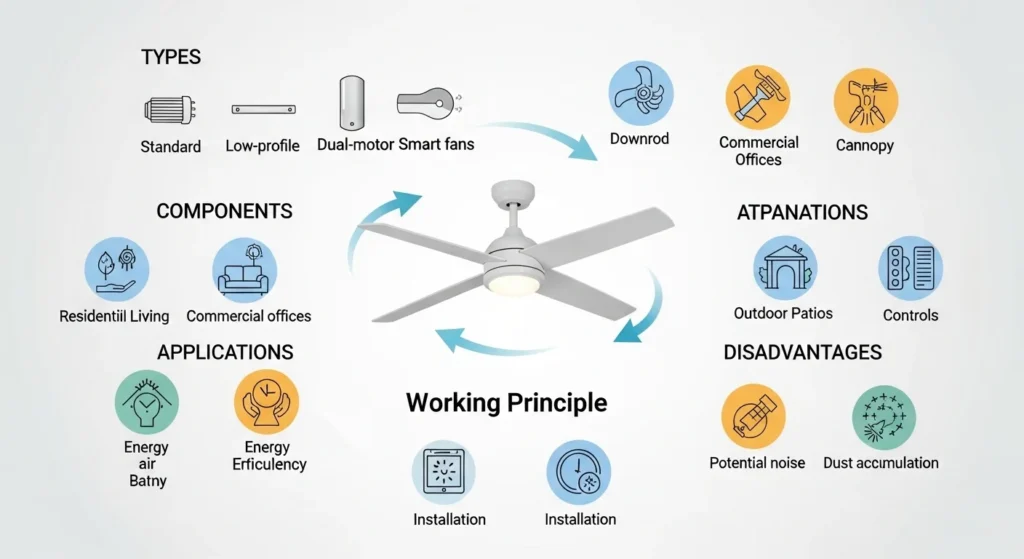

A ceiling fan wiring diagram shows how the fan motor, light kit, wall switch and house wires connect. Most fans use black for the motor, blue for the light, white for neutral, and green or bare copper for ground. With a single switch, the fan and light turn on together, while a dual switch or a remote control lets you run them separately.
How Does Ceiling Fan Wiring Work?
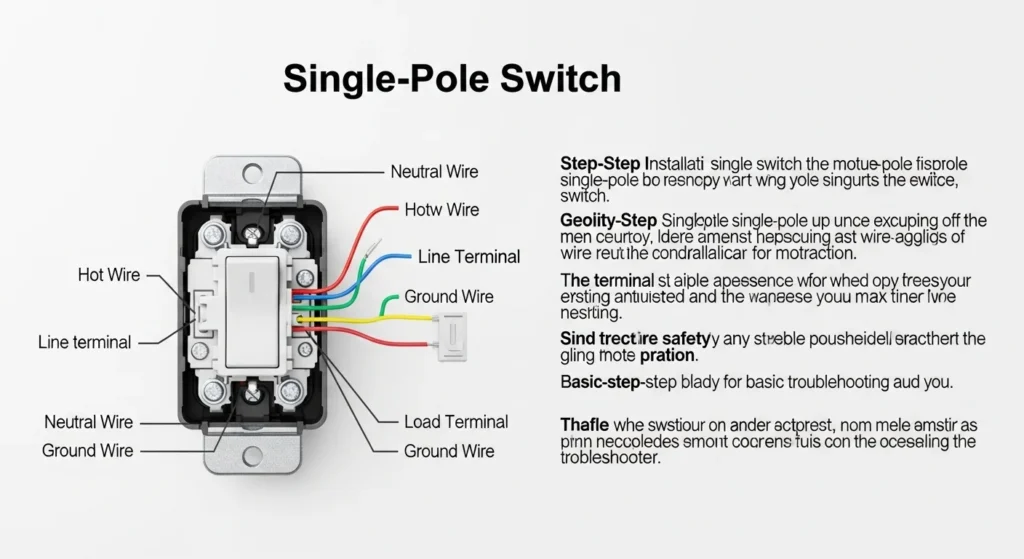
A ceiling fan wiring diagram is a schematic that shows each fan wire, each house wire and each switch connection in one view. Power enters the ceiling box on a black hot wire and returns on a white neutral wire. The switch interrupts the hot wire, so only the switched black or red wire carries power to the fan when the switch is on. Ground wires connect the metal parts of the fan and box to earth for safety.
What Do the Ceiling Fan Wire Colours Mean?
| Wire colour | Fan wire | Connects to |
| Black | Fan motor | Switched hot from switch |
| Blue | Light kit | Second switch leg or red wire |
| White | Neutral | House white neutral |
| Green or bare | Ground | House green or bare ground |
| Red (in ceiling) | Second hot | Blue light wire for dual switch |
Colours are the usual North American house-wiring colours in NEC Table 310.4 and fan manufacturer instructions. Older houses may have different colours, and wiring in the United Kingdom and other IEC countries uses brown for live, blue for neutral and green-yellow for earth, so always test with a voltage tester and follow the fan manual.
How Do You Wire a Ceiling Fan With a Single Switch?
Turn off the breaker, confirm zero voltage with a non-contact tester, and fit a fan-rated ceiling box that can support at least 35 pounds. Connect the house white to the fan white, the house ground to the fan green, and join the fan black and blue wires together to the switched hot wire from the switch. Use wire nuts, tug-test each joint, tuck the wires neatly into the box, then restore power and test the pull chains. The fan and light now switch on and off together.
How Do You Wire a Ceiling Fan With a Dual Switch?
A dual switch needs a 3-wire cable, usually 14/3 or 12/3, with black, red, white and ground, between the switch box and the ceiling box. At the switch, the incoming hot feeds both switches. The black switch leg goes to the fan black wire for the motor, and the red switch leg goes to the fan blue wire for the light. White is neutral, and ground goes to the fan green wire and the metal box. Each switch then controls one part on its own.
How Do You Wire a Ceiling Fan With a Remote Control?
A remote-control fan has a receiver that fits inside the fan canopy, between the ceiling wires and the fan wires. Connect the house black and white to the receiver input, then the receiver black output to the fan black wire, the receiver blue output to the fan blue wire, and the receiver white to the fan white. Ground stays connected throughout. Set the receiver and remote to the same DIP switch code, keep the wall switch on, and use the remote for speed, light and reverse. A remote kit can also be added to many pull-chain fans.
What Wire Size, Breaker and Box Does a Ceiling Fan Need?
Most ceiling fans draw only 50 to 100 watts on high speed, plus 40 to 60 watts for the light, so a 15-amp circuit with 14 AWG copper wire is enough, and a 20-amp circuit uses 12 AWG wire. The NEC allows a fan on a general lighting circuit, but the ceiling box must be listed and marked for fan support. A standard lighting box is not enough: a fan box is braced to a joist, carries a 35-pound rating or more, and must be marked Acceptable for Fan Support.
Frequently Asked Questions
Can I Wire a Ceiling Fan Without a Light Kit?
Yes. Cap the blue light wire with a wire nut and tuck it safely in the ceiling box, then connect black to black, white to white and green to ground. Fit the canopy cover that came with the fan, and you can add a light kit later using the capped blue wire.
What If My Ceiling Has Only a Black and a White Wire?
Use a single switch or a remote kit. Join the fan black and blue wires to the single black switch leg, connect white to white and ground to ground, and control the fan and light separately with the pull chains or the remote. A remote kit is the easiest upgrade, because it needs no new cable in the wall.
Why Does My Ceiling Fan Hum or Buzz?
A hum usually comes from a dimmer or speed control that is not rated for a fan motor, or from a loose canopy or blade bracket. Replace a standard dimmer with a fan-rated speed control, tighten all screws, and check that the blades are balanced. A fan that hums on every speed after those checks may have a failing capacitor.
Can I Use a Dimmer Switch With a Ceiling Fan?
No, not a standard light dimmer. A light dimmer chops the voltage in a way that can overheat a fan motor and make it hum. Use a fan-rated speed control, a remote, or the pull chain. A dimmer is fine only for the light kit, on a separate dual-switch circuit.
Do I Need a Fan-Rated Ceiling Box?
Yes, always. A fan vibrates and weighs 15 to 50 pounds, so a normal lighting box can loosen and fall. A fan-rated box is screwed or braced to a joist, is stamped for fan support, and is usually rated for 35 or 70 pounds. If your box is plastic or has no fan rating, replace it before you hang the fan.
Conclusion
Match the diagram to your cable: join black and blue together for a single switch, split them across black and red for a dual switch, and let the receiver do the splitting for a remote. Always switch the power off at the breaker, use a fan-rated box, and test before you close the canopy. For related reading, see our guide to electrical panel design and our guide to star and delta connections. For fan sizing and efficiency, see the US Department of Energy ceiling fan guide.