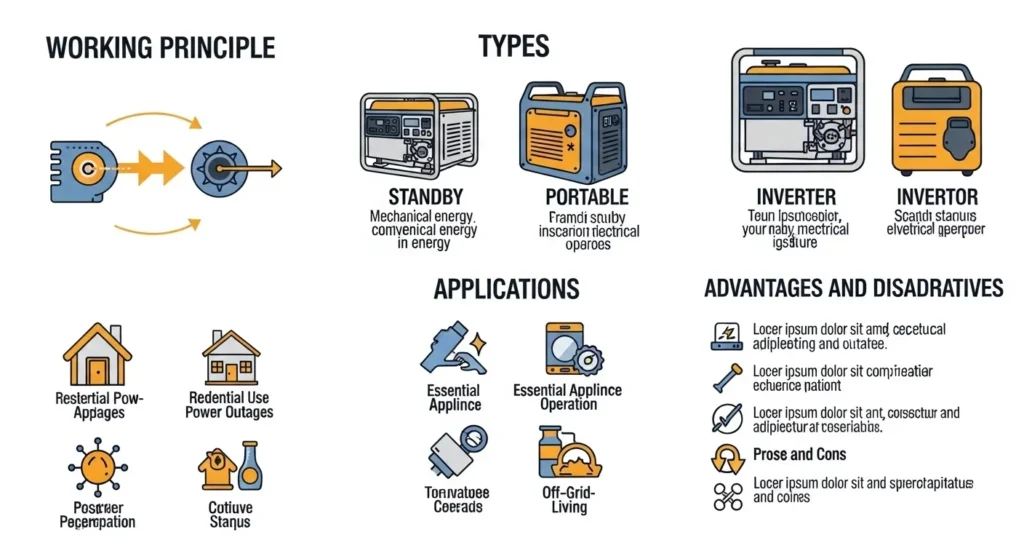

A transfer switch is a safety device that connects a home generator to your house wiring during a power outage. It lets you power chosen circuits, such as lights, a refrigerator and a well pump, without backfeeding electricity into the utility grid, which can injure line workers. Manual switches cost less and are operated by hand, while automatic switches restore power on their own.
How Does a Transfer Switch Work?
A transfer switch is a device that safely transfers a building’s electrical load between two power sources, the utility supply and a standby generator, so that only one source feeds the circuits at any time.
In normal operation, the switch connects the house to the utility supply. When the utility fails, a manual switch is moved by hand to the generator position after the generator is started and warmed up. An automatic switch senses the outage, starts the generator, waits about 10 to 30 seconds for stable voltage and frequency, and then moves the load to the generator. When utility power returns and stays stable for about 5 minutes, the automatic switch transfers the load back and shuts the generator down after a short cool-down period.
What Is the Difference Between Manual and Automatic Transfer Switches?
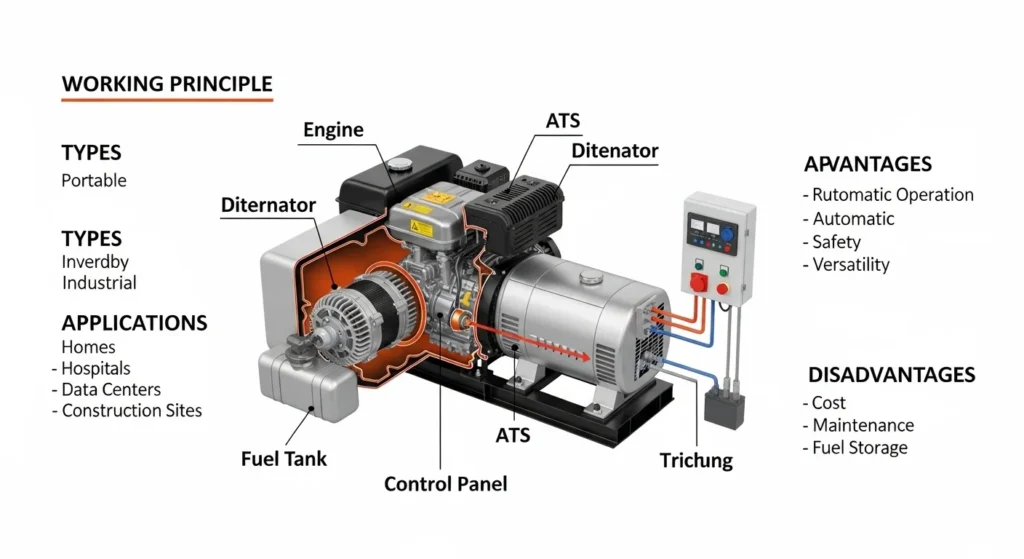
A manual transfer switch is a simple metal enclosure with a lever or a set of breakers and a mechanical interlock. You start the portable generator outdoors, plug in the power inlet, and move the switch from utility to generator. It cannot start the generator for you, and it will not switch back by itself. That keeps the cost down and the failure points few, but someone must be home, awake and able to operate it safely in bad weather.
An automatic transfer switch, or ATS, adds a controller that monitors utility voltage and frequency around the clock. On an outage it sends a start signal to a standby generator, confirms stable output, and transfers the load in 10 to 30 seconds. Most home ATS units use open transition, which breaks the utility connection before making the generator connection, so the two sources are never paralleled. Closed-transition units exist for hospitals and data centres, but they cost far more and need utility approval.
| Feature | Manual transfer switch | Automatic transfer switch |
| Operation | By hand | Automatic, senses outage |
| Generator start | Manual start | Automatic start |
| Transfer time | 1 to 5 minutes | 10 to 30 seconds |
| Typical cost, parts only | 200 to 400 US dollars | 600 to 1,500 US dollars |
| Best for | Portable generators, budget homes | Standby generators, unattended homes |
Prices are typical US retail ranges for the switch hardware alone in 2026, based on manufacturer list prices from Generac, Kohler and Reliance Controls; installation, wiring and permits are extra.
How Do You Size a Transfer Switch for a Home Generator?
Size the switch to the generator and to the load it will feed, not to the whole house unless you buy a whole-house unit. List the circuits you must keep running, add their running watts, then add the largest starting watts, because motors need 2 to 3 times their running power to start. Divide watts by volts to get amps: a 7,500-watt load at 240 volts draws 31.25 amps, so a 50-amp switch gives safe headroom. Common home sizes are 30 amps for 7,500 watts, 50 amps for 12,000 watts, and 100 or 200 amps for whole-house standby systems.
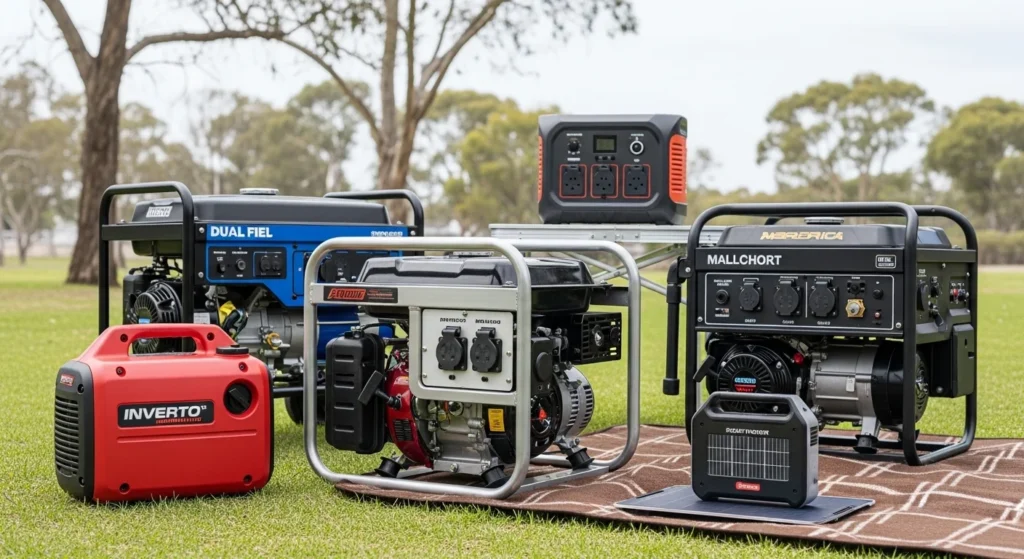
Typical home loads help the maths. A refrigerator draws about 200 watts running and 1,200 watts starting, a well pump about 1,000 watts running and 2,000 watts starting, a sump pump about 800 watts running and 1,300 watts starting, and LED lighting for a whole floor about 300 watts. Add the running watts of everything you will run together, then add only the largest starting watts once, because motors rarely start at the same instant. Figures are typical nameplate values from appliance manufacturers and the US Department of Energy.
How Is a Transfer Switch Installed Safely?
A transfer switch must be installed by a licensed electrician, with the utility supply isolated and locked out. The switch is wired between the meter, the main panel and the generator inlet, and the generator must run outdoors at least 20 feet from doors and windows, because engine exhaust contains carbon monoxide. In the United States, NEC Article 702 covers optional standby systems and requires a means to prevent backfeed, plus a permit and inspection in most areas. Never connect a generator with a double-ended cord, which is known as a suicide cord, and never plug it into a wall outlet.
How Much Does a Transfer Switch Cost?
A manual 30-amp transfer switch usually costs 200 to 400 US dollars for parts, while a 50-amp manual unit costs 300 to 600 dollars. An automatic switch for a standby generator costs 600 to 1,500 dollars for a 100-amp unit and 1,200 to 2,500 dollars for a 200-amp whole-house unit. Professional installation adds 500 to 1,500 dollars, depending on wiring length, panel work and local permit fees, so a typical installed manual system totals 800 to 1,500 dollars and an installed automatic system totals 2,000 to 4,500 dollars.
Frequently Asked Questions
Do I Need a Transfer Switch for a Portable Generator?
Yes, if you want to power hard-wired house circuits such as lights, a refrigerator or a furnace. Without a transfer switch, the only safe way to use a portable generator is with extension cords to individual appliances. A switch also prevents backfeed, which can energise utility lines and injure line workers.
Can I Install a Transfer Switch Myself?
In most places, no. The work involves the main service panel and live utility conductors, and it usually needs a permit and inspection. A licensed electrician can fit a 30-amp manual switch in about 2 to 4 hours, and an automatic switch in about 4 to 8 hours, depending on wiring and panel access.
What Size Transfer Switch Do I Need for a 7,500-Watt Generator?
A 30-amp switch is usually enough, because 7,500 watts at 240 volts draws 31.25 amps at full load, and most 7,500-watt generators are rated 30 amps on their 240-volt outlet. Choose a 50-amp switch if you expect to run close to full load for hours, or if you plan to upgrade to a larger generator later.
How Long Does an Automatic Transfer Switch Take to Restore Power?
Usually 10 to 30 seconds after the outage starts. The controller waits a few seconds to confirm the outage is real, starts the generator, checks voltage and frequency, and then transfers the load. A short delay is intentional: it stops the generator starting for a flicker that lasts only a second or two.
Can an Automatic Transfer Switch Work With a Portable Generator?
Usually not directly. Most portable generators need a manual pull or key start and have no automatic start input, so an ATS cannot start them. A few inverter generators with remote-start kits can work with a compatible ATS, but check the generator manual first. For most portable units, a manual switch is the right match.
Conclusion
Choose a manual switch for a portable generator and a tight budget, and an automatic switch for a standby generator and a home that must stay powered when no one is there. Size it from real running and starting watts, have it installed by a licensed electrician, and test it under load twice a year. For related reading, see our guide to electrical panel design at https://electrowa.com/electrical-panel-design/ and our guide to star and delta connections at https://electrowa.com/star-and-delta-connection/ . For the official standby-system rules, see the National Electrical Code, NFPA 70, Article 702 at https://www.nfpa.org/codes-and-standards/nfpa-70-standard-development/70