
Imagine a hot summer afternoon in a small workshop or home kitchen. The air feels heavy, and the room becomes uncomfortable within minutes. Instead of installing an expensive air-conditioning system, many people simply switch on a wall fan. Within seconds, the moving air creates a cooling effect and improves comfort.
Wall fans are one of the most practical and energy-efficient ventilation solutions used in homes, offices, and industrial environments. They are designed to be mounted on walls, saving floor space while delivering strong airflow across a room.
For electrical students, technicians, and engineers, understanding wall fans is important because they are commonly used in electrical installations and ventilation systems. Even though the device looks simple, it contains several electrical and mechanical components working together.
In this article, you will learn the wall fans working principle, their types, major components, advantages and disadvantages, applications, troubleshooting tips, and how to choose the right wall fan for different environments. The explanation is written from a practical engineering perspective so beginners can easily understand the concept and real-world usage.
2. What is a Wall Fan?
A wall fan is an electric fan that is mounted on a wall and designed to circulate air throughout a room. It uses an electric motor to rotate blades, which push air forward and create airflow.
Unlike table fans or pedestal fans, a wall fan does not occupy floor space. This makes it especially useful in small rooms, workshops, kitchens, classrooms, and commercial areas.
In simple terms, a wall fan works like a mechanical air mover. The rotating blades pull air from the back and push it forward, creating a cooling breeze that improves ventilation.
Practical Example
Consider a classroom with 40 students. Installing multiple wall fans helps distribute air evenly across the room without blocking movement or taking up valuable floor space.
Because of this design advantage, wall fans are widely used in places where both air circulation and space efficiency are important.
3. Wall Fans Working Principle
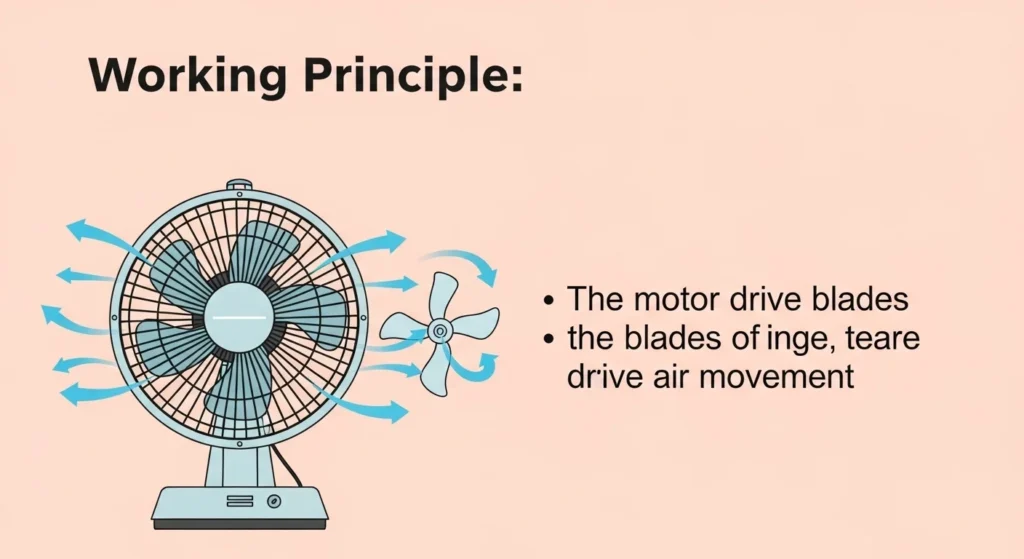
The wall fans working principle is based on the conversion of electrical energy into mechanical rotation through an electric motor.
When electrical current flows through the motor, it produces a rotating magnetic field that turns the motor shaft. The fan blades attached to the shaft rotate and push air forward.
Detailed Working Process of an Electric Fan
1. Power Supply Initiation
The operation of an electric fan begins when the user turns on the wall switch or fan regulator. Electrical energy from the main power supply flows through the wiring and reaches the fan motor. The regulator can also control the speed of the fan by adjusting the amount of voltage supplied to the motor.
2. Motor Activation and Magnetic Field Generation
Once electricity reaches the motor, current flows through the motor windings. This current creates a rotating magnetic field inside the motor. The interaction between the magnetic field and motor components generates the force required to start the fan’s operation.
3. Rotor Rotation
The rotating magnetic field acts on the rotor, which is the moving part of the motor. As a result, the rotor begins spinning around its shaft. The speed of rotation depends on the motor design and the fan speed setting selected by the user.
4. Rotation of Fan Blades
The fan blades are securely attached to the motor shaft. When the rotor spins, the shaft also rotates, causing the blades to move at high speed. The shape and angle of the blades are specially designed to move air efficiently.
5. Air Circulation and Cooling Effect
As the blades rotate, they push air forward and create a continuous airflow throughout the room. This airflow improves ventilation, enhances air circulation, and produces a cooling effect by increasing the evaporation of moisture from the skin, making the environment feel more comfortable.
Simple Analogy
Think of a wall fan like a paddle moving through water. When the paddle moves, it pushes water forward. Similarly, the fan blades push air forward to create a cooling breeze.
Some modern wall fans also include oscillation mechanisms, allowing the fan to rotate left and right to distribute air evenly across a wider area.
4. Types / Classification of Wall Fans
Wall fans are available in several types depending on their design, control method, and application.
Oscillating Wall Fan: A Space-Saving and Efficient Cooling Solution
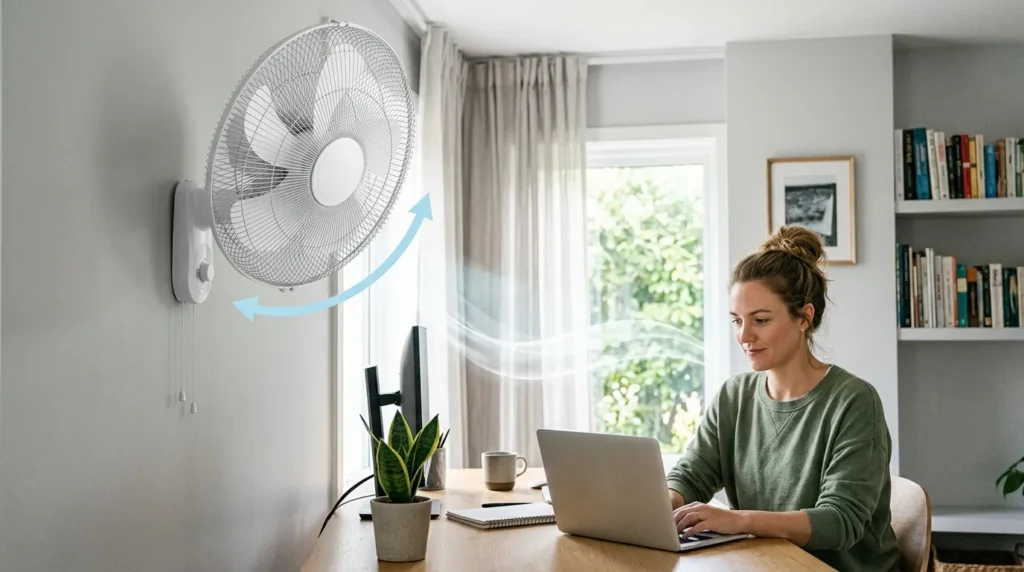
An Oscillating Wall Fan is a type of electric fan that is mounted on a wall and designed to provide wide-area air circulation through an automatic side-to-side movement known as oscillation. Unlike stationary wall fans that direct airflow in a fixed direction, an oscillating wall fan continuously rotates its head from left to right, allowing cool air to be distributed evenly throughout a room. This feature makes it an excellent choice for homes, offices, classrooms, restaurants, workshops, hospitals, and other indoor environments where effective ventilation and cooling are required. Because the fan is mounted on a wall, it does not occupy valuable floor space, making it especially useful in small rooms or crowded areas.
The operation of an oscillating wall fan is based on an electric motor that converts electrical energy into mechanical motion. When the fan is switched on, the motor rotates the fan blades at high speed, generating a steady stream of air. At the same time, an oscillation mechanism connected to the motor causes the fan head to move gradually from side to side. This movement helps spread airflow over a larger area, ensuring that multiple people in the room can benefit from the cooling effect. Many oscillating wall fans also allow users to disable the oscillation feature when concentrated airflow in a specific direction is desired.
Modern oscillating wall fans are equipped with several advanced features that improve convenience and performance. These may include multiple speed settings, adjustable tilt angles, remote control operation, timer functions, and energy-efficient motors. Some models also incorporate quiet-operation technology, making them suitable for bedrooms, offices, and study areas where minimal noise is important. The adjustable settings allow users to customize airflow according to their comfort needs and room conditions.
One of the major advantages of an oscillating wall fan is its ability to improve air circulation while consuming less electricity compared to air conditioning systems. It helps reduce heat buildup, enhances ventilation, and creates a more comfortable indoor environment. Additionally, wall-mounted installation keeps the fan safely out of reach of children and prevents accidental obstruction. Due to its affordability, durability, low maintenance requirements, and efficient cooling performance, the oscillating wall fan remains one of the most practical and widely used ventilation devices in residential and commercial settings around the world.
Non-Oscillating Wall Fan: Simple, Powerful, and Directional Airflow Solution
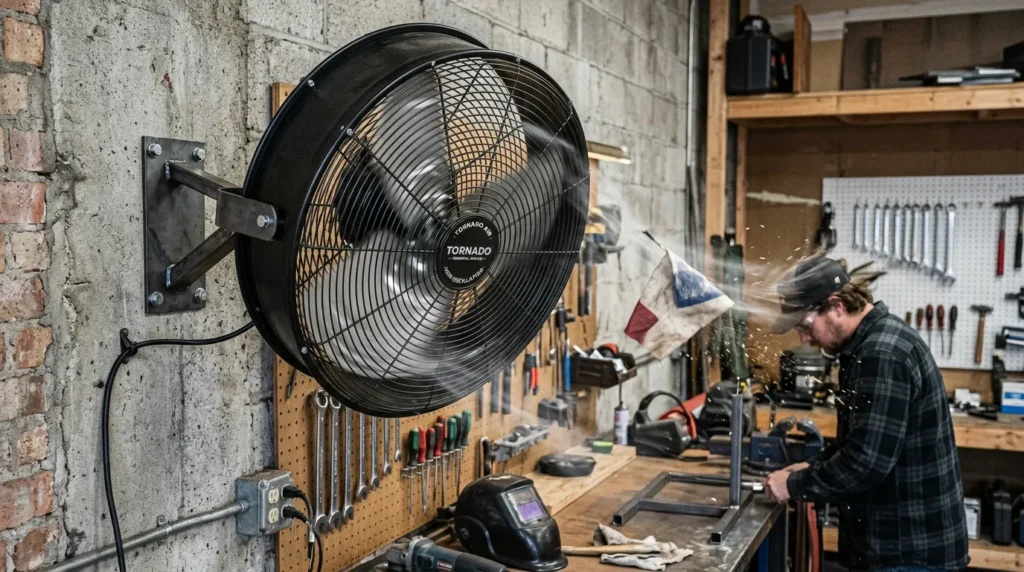
A Non-Oscillating Wall Fan is a fixed-position electric fan that is mounted on a wall and designed to deliver airflow in a single, constant direction. Unlike oscillating wall fans, it does not move side to side. Instead, it continuously blows air toward one fixed area, making it ideal for targeted cooling in homes, offices, shops, factories, and small commercial spaces where focused airflow is required.
The working of a non-oscillating wall fan is based on a simple electric motor system. When the fan is switched on, electrical energy is supplied to the motor, which converts it into mechanical energy. This causes the fan blades to rotate at high speed. As the blades spin, they cut through the air and push it forward in a steady stream. Since there is no oscillation mechanism involved, all the airflow remains concentrated in one direction, providing strong and consistent cooling to a specific area.
One of the main advantages of a non-oscillating wall fan is its simplicity. With fewer moving parts compared to oscillating models, it is generally more durable, requires less maintenance, and has a lower chance of mechanical failure. This makes it a reliable option for long-term use in environments where continuous airflow is needed without frequent adjustments.
Non-oscillating wall fans are also highly energy-efficient. They consume relatively low electricity while still providing strong air circulation. Because the airflow is fixed, they are especially useful in places where people are seated or working in a specific direction, such as cashier counters, workstations, or production lines.
These fans often come with adjustable speed settings, allowing users to control airflow intensity based on comfort and room temperature. Some models also include tilt adjustment, enabling users to manually change the vertical direction of airflow for better coverage within a fixed zone.
Another important benefit is space-saving installation. Since the fan is mounted on the wall, it does not occupy floor space and remains safely out of reach, making it suitable for crowded or compact areas. It also improves safety by reducing the risk of accidental contact or obstruction.
In conclusion, a non-oscillating wall fan is a practical, cost-effective, and durable cooling solution that provides strong directional airflow. It is best suited for environments where consistent, focused ventilation is more important than wide-area air distribution, making it a reliable choice for both residential and industrial applications.
Remote-Control Wall Fan: Smart, Convenient, and Modern Cooling Solution
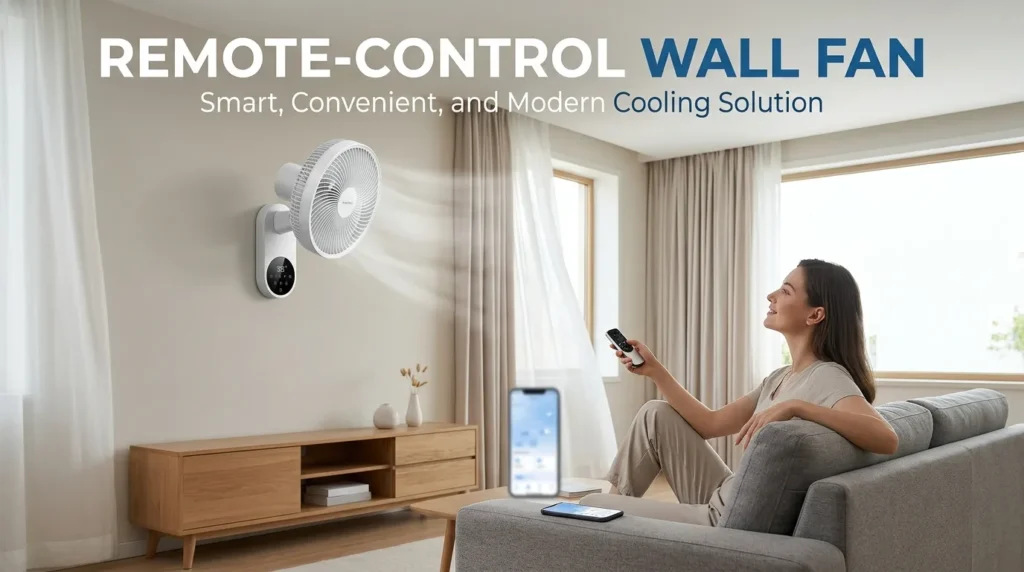
A Remote-Control Wall Fan is an advanced type of wall-mounted electric fan that allows users to operate and adjust settings using a remote control device. Unlike traditional fans that require manual operation, this modern fan provides greater convenience, comfort, and flexibility by enabling users to control speed, oscillation, timer settings, and power functions from a distance. It is widely used in homes, offices, hotels, classrooms, and commercial spaces where easy and efficient cooling control is required.
The working principle of a remote-control wall fan is based on a standard electric motor system combined with an electronic receiver unit. When the fan is switched on, electricity powers the motor, which rotates the blades to generate airflow. At the same time, the built-in receiver detects signals sent from the remote control. These signals allow users to change fan speed, turn oscillation on or off, activate timers, or switch the fan on and off without touching the unit directly. This makes operation highly convenient, especially when the fan is installed at a height.
One of the main advantages of a remote-control wall fan is ease of use. Users can adjust settings comfortably from anywhere in the room, making it ideal for bedrooms, living rooms, and offices. It eliminates the need to get up repeatedly to change speed or direction, improving user experience and accessibility, especially for elderly individuals or people with mobility challenges.
Modern remote-control wall fans often include multiple speed settings, sleep modes, energy-saving functions, and programmable timers. These features help users optimize power consumption while maintaining comfort. Some advanced models also include digital displays and silent operation technology, making them suitable for quiet environments like study rooms and bedrooms.
Another important benefit is space efficiency and safety. Since the fan is wall-mounted, it saves floor space and reduces the risk of accidental contact. The remote-control feature further enhances safety by minimizing physical interaction with the fan unit.
In conclusion, a remote-control wall fan is a smart and efficient cooling solution that combines traditional airflow performance with modern convenience. Its ease of operation, energy efficiency, and advanced features make it an excellent choice for residential and commercial environments seeking comfort and modern functionality.
Industrial Wall Fan: Powerful Air Circulation for Large-Scale Cooling
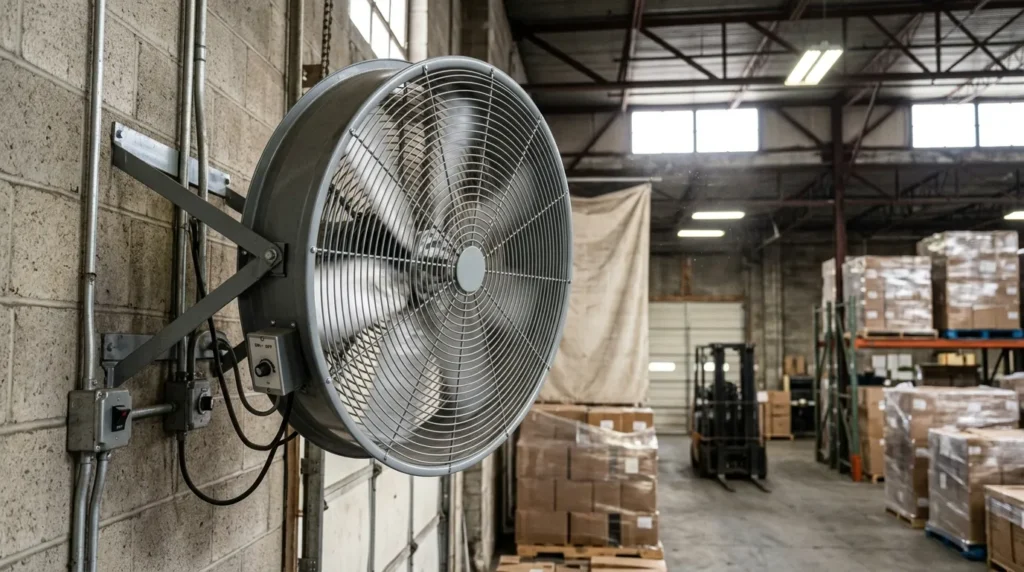
An Industrial Wall Fan is a heavy-duty, high-performance electric fan designed to provide strong and continuous airflow in large spaces such as factories, warehouses, workshops, gyms, commercial kitchens, and production areas. Unlike household fans, industrial wall fans are built to handle demanding environments where high temperatures, poor ventilation, and large occupancy levels require powerful air movement for comfort and safety.
The working of an industrial wall fan is based on a robust electric motor that generates high torque to rotate large fan blades at high speed. When the fan is powered on, electricity flows into the motor, converting electrical energy into mechanical energy. This rotation causes the large blades to spin forcefully, pushing a high volume of air across long distances. The result is strong airflow that helps regulate temperature, improve ventilation, and remove hot air buildup from industrial spaces.
One of the key features of industrial wall fans is their durability. They are constructed using strong materials such as metal blades, reinforced grills, and heavy-duty motor housings. This ensures they can operate continuously for long hours without overheating or losing efficiency. Because of their wall-mounted design, they save valuable floor space and keep the working area clear, which is especially important in busy industrial environments.
Industrial wall fans often come with multiple speed settings that allow users to control airflow intensity based on environmental conditions. Some advanced models also include oscillation features, tilt adjustment, and thermal overload protection to enhance performance and safety. These fans are designed to withstand dust, heat, and continuous operation, making them highly reliable in tough working conditions.
Another major advantage of industrial wall fans is improved air quality and worker comfort. By maintaining steady air circulation, they help reduce heat stress, remove stagnant air, and create a more productive working environment. In factories and warehouses, this can significantly improve employee efficiency and safety.
In conclusion, an industrial wall fan is an essential cooling solution for large-scale environments. Its powerful motor, durable construction, and ability to deliver high-volume airflow make it ideal for industrial and commercial applications where effective ventilation is critical for performance and comfort.
Smart Wall Fan
Newer smart wall fans can connect to mobile applications or smart home systems. These fans allow users to control speed, schedule operation, and monitor power consumption.
5. Main Components of a Wall Fan (Updated Explanation)
A wall fan may look simple from the outside, but it is made up of several important components that work together to ensure smooth, safe, and efficient operation.
Electric Motor
The electric motor is the most important part of a wall fan. It is often called the “heart” of the fan because it converts electrical energy into mechanical energy. This mechanical motion is what makes the fan blades rotate and produce airflow. A high-quality motor ensures better performance, durability, and energy efficiency.
Fan Blades
The fan blades are responsible for generating airflow. As they rotate, they push air forward and create a cooling effect in the room. The design, size, and angle of the blades play a major role in determining how strong and efficient the airflow will be. Well-designed blades help improve air circulation and reduce energy loss.
Oscillation Mechanism
The oscillation mechanism allows the fan head to move from side to side automatically. This movement helps distribute air across a wider area instead of focusing it in just one direction. It improves overall room ventilation and increases comfort for multiple people in the same space.
Protective Grill
The protective grill is a safety cover placed around the fan blades. Its main purpose is to prevent accidental contact with the rotating blades, ensuring user safety. It also helps protect the internal parts of the fan from dust and external damage while allowing free airflow.
Mounting Bracket
The mounting bracket is used to securely fix the fan to a wall. It is designed to hold the fan firmly in place, even during high-speed operation. A strong and stable bracket is essential for safety, especially in homes, offices, and industrial environments.
Speed Control Regulator
The speed control regulator is a device that allows users to adjust the speed of the fan. By controlling the electrical current supplied to the motor, it helps regulate airflow intensity according to comfort needs. Some modern fans use electronic regulators for smoother and more efficient control.
Additional Electronic Controls (Modern Feature)
In modern wall fans, additional electronic components may also be included, such as remote receivers, timers, and digital control panels. These features enhance convenience, improve energy efficiency, and make the fan easier to operate.
Each component of a wall fan plays an important role in ensuring safe operation, strong airflow, and user comfort. Together, these parts make the wall fan a reliable and efficient cooling device for residential, commercial, and industrial use.
6. Advantages and Disadvantages of Wall Fans (Updated in Table Format)
Advantages of Wall Fans
| Advantage | Explanation |
|---|---|
| Space Saving Design | Wall-mounted installation keeps the floor area free and improves room organization. |
| Efficient Air Circulation | Provides strong airflow that improves ventilation and comfort in the room. |
| Energy Efficient | Consumes less electricity compared to air conditioning systems, making it cost-effective. |
| Easy Installation | Can be installed in homes, offices, and industrial areas with basic mounting support. |
| Affordable Cooling Solution | Lower purchase and operating cost compared to HVAC or cooling systems. |
| Wide Air Coverage | Oscillating models distribute air across a larger area for better cooling effect. |
| Low Maintenance | Simple mechanical design makes cleaning and servicing easy and inexpensive. |
Disadvantages / Limitations of Wall Fans
| Limitation | Explanation |
|---|---|
| No Temperature Reduction | Wall fans circulate air but do not actually cool or reduce room temperature. |
| Limited Coverage in Large Areas | Airflow may not effectively reach every corner in large or open spaces. |
| Noise at High Speed | Some models produce noticeable sound when operating at maximum speed. |
| Wall Installation Required | Needs proper drilling and mounting, which may not be suitable for all walls. |
| Dust Accumulation | Fan blades and grill require regular cleaning to maintain performance and hygiene. |
Wall fans remain a widely used cooling solution due to their affordability and efficiency, but selecting the right type depends on space size and cooling requirements.
8. Applications of Wall Fans (Detailed but Simple Version)
Wall fans are widely used in many different places because they are affordable, easy to install, and very effective for improving air circulation. They help keep indoor and semi-open areas cool and comfortable without using too much electricity.
Residential Applications
In homes, wall fans are commonly used because they save space and provide steady airflow throughout the room.
- Bedrooms: They help maintain a comfortable sleeping environment by providing continuous cool air.
- Living Rooms: They improve air movement, especially when many people are sitting in one place.
- Kitchens: Wall fans help remove heat, steam, and cooking odors, making the kitchen more comfortable.
- Garages: They improve ventilation in closed or semi-closed spaces where heat and fumes can build up.
Commercial Applications
Wall fans are very useful in commercial areas where customer comfort and proper airflow are important.
- Restaurants: They keep dining areas cool and comfortable for guests.
- Shops and Stores: They improve air circulation, making shopping more pleasant for customers.
- Classrooms: They help students and teachers stay focused by maintaining fresh air.
- Offices: They create a comfortable working environment and improve productivity.
Industrial Applications
In industrial environments, wall fans play an important role in controlling heat and improving ventilation.
- Factories: They help reduce high temperatures created by machines and equipment.
- Warehouses: They improve airflow in large storage spaces where heat can build up.
- Workshops: They provide cooling for workers who operate heavy tools and machines.
Special Applications
Wall fans are also used in several special environments where extra ventilation is needed.
- Outdoor Sitting Areas: They provide airflow in semi-open spaces like patios and terraces.
- Gymnasiums: They help keep athletes cool during exercise and training.
- Agricultural Buildings: They improve ventilation in farms, barns, and storage areas for crops and animals.
Overall, wall fans are highly versatile and can be used in almost every type of environment. Their ability to provide strong airflow, save space, and reduce energy consumption makes them one of the most practical cooling solutions for homes, businesses, and industries.
9. Comparison Section
Understanding the difference between wall fan and ceiling fan helps engineers choose the right ventilation solution.
| Feature | Wall Fan | Ceiling Fan |
|---|---|---|
| Installation | Mounted on wall | Mounted on ceiling |
| Air Direction | Horizontal airflow | Downward airflow |
| Space Requirement | Saves floor space | Requires ceiling height |
| Air Coverage | Focused airflow | Wide room coverage |
| Typical Use | Small rooms, workshops | Living rooms, bedrooms |
Both fans serve similar purposes, but their installation and airflow patterns are different.
10. Wall Fan Selection Guide (Updated and Improved)
Choosing the right wall fan is very important because different spaces have different cooling needs. A proper selection ensures better airflow, energy efficiency, and long-lasting performance.
1. Consider Room Size
Room size is one of the most important factors when selecting a wall fan.
- Small rooms can use standard-size fans
- Large rooms require fans with bigger blade diameter
- Bigger spaces need stronger motor power for proper airflow
A correctly sized fan ensures the air reaches all corners of the room effectively.
2. Check Motor Power
The motor is the main part of the fan, so its power matters a lot.
- Higher wattage motors usually provide stronger airflow
- Low-power motors are suitable for small rooms
- A good motor ensures smooth and long-lasting performance
Always choose a motor that matches your cooling requirement.
3. Airflow Performance (CFM Rating)
Air delivery is measured in CFM (Cubic Feet per Minute).
- Higher CFM = stronger air movement
- Important for large rooms and industrial areas
- Helps ensure better cooling and ventilation
Always compare CFM ratings before buying a fan.
4. Oscillation Function
Oscillation improves air distribution in the room.
- Helps air move side to side
- Covers a wider area
- Useful for shared spaces like living rooms and offices
If you need wide cooling, choose an oscillating model.
5. Noise Level
Noise is an important factor, especially for quiet environments.
- Low-noise fans are best for bedrooms and offices
- High-speed fans may produce more sound
- Silent operation improves comfort and focus
Always check noise level before purchase.
6. Build Quality and Durability
The material of the fan affects its lifespan.
- Plastic body fans are suitable for home use
- Metal body fans are better for industrial areas
- Strong grills and brackets ensure safety and stability
Industrial environments always require heavy-duty fans.
Selecting the right wall fan depends on room size, motor power, airflow capacity, noise level, and build quality. A proper choice ensures better cooling performance, energy savings, and long-term durability for any environment.
11. Common Problems & Solutions
Like any electrical device, wall fans may develop problems over time.
Fan Not Starting
Possible Causes
- Faulty switch
- Damaged capacitor
- Motor winding issue
Solution
Check power supply and replace the capacitor if necessary.
Fan Running Slowly
Possible Causes
- Dust on blades
- Weak capacitor
- Low voltage supply
Solution
Clean blades and test the capacitor.
Excessive Noise
Possible Causes
- Loose screws
- Worn bearings
Solution
Tighten mounting hardware and lubricate bearings.
Oscillation Not Working
Possible Cause
Broken oscillation gear.
Solution
Replace the oscillation mechanism.
Regular maintenance significantly increases the lifespan of wall fans.
12. Future Trends in Wall Fan Technology and Innovations
Wall fan technology is rapidly evolving due to advancements in electrical engineering, automation, and energy-efficient design. As modern lifestyles demand smarter and more convenient cooling solutions, manufacturers are continuously improving wall fans to make them more powerful, intelligent, durable, and environmentally friendly. In the coming years, wall fans are expected to become an important part of smart homes and energy-efficient building systems.
1. Brushless DC (BLDC) Motor Technology
One of the most important innovations in modern wall fans is the use of Brushless DC (BLDC) motors. These motors are replacing traditional induction motors because they offer higher efficiency and better performance.
- Consume significantly less electricity
- Produce less heat during long operation
- Provide smoother and quieter performance
- Require less maintenance due to fewer moving parts
- Offer a longer operational lifespan
BLDC motors help reduce electricity bills while maintaining strong airflow, making them ideal for both residential and commercial use.
2. Smart Control and Automation Systems
Future wall fans are becoming more intelligent with the integration of smart technology. These systems allow users to control fans in more advanced and convenient ways.
- Smartphone control through mobile applications
- Wi-Fi and Bluetooth connectivity for remote access
- Voice control through smart assistants like Alexa or Google Assistant
- Programmable timers and automatic scheduling
- Speed adjustment based on room temperature sensors
These smart features allow users to manage their comfort without physically interacting with the fan, improving convenience and energy management.
3. Advanced Energy Efficiency Technologies
Energy efficiency is one of the biggest priorities in modern fan design. Manufacturers are focusing on reducing electricity consumption while improving airflow performance.
- Low-power consumption designs
- Intelligent speed control systems
- Energy-saving modes for night or low-use periods
- Eco-friendly materials and manufacturing processes
- Improved motor efficiency for reduced power waste
These advancements not only reduce electricity costs but also support environmental sustainability by lowering energy usage.
4. Aerodynamic Blade Design Improvements
Fan blade technology is also undergoing major improvements to enhance airflow efficiency and reduce noise.
- Aerodynamically shaped blades for smoother air cutting
- Higher air delivery (CFM) with less energy use
- Reduced vibration and operational noise
- Better balance for long-term stability
- Improved air distribution across larger areas
These new blade designs make wall fans more effective, especially in large rooms and industrial environments.
5. Noise Reduction and Silent Operation Technology
Future wall fans are being designed with advanced noise control systems.
- Silent motor technology
- Vibration-free operation
- Sound-insulated motor housing
- Balanced blade rotation systems
This makes them ideal for bedrooms, offices, libraries, and hospitals where quiet environments are important.
6. Sensor-Based and Automatic Operation
Another future trend is the integration of smart sensors into wall fans.
- Temperature-based automatic speed control
- Motion sensors to detect room occupancy
- Adaptive airflow adjustment based on room conditions
- Automatic shut-off when no one is present
These features improve energy savings and provide a more comfortable user experience.
7. Eco-Friendly and Sustainable Design
Manufacturers are also focusing on environmentally responsible production.
- Use of recyclable materials
- Reduced carbon footprint in manufacturing
- Energy-efficient packaging and transport
- Longer-lasting components to reduce waste
This shift supports global efforts toward sustainability and green technology.
The future of wall fans is moving toward smart, efficient, and environmentally friendly solutions. With innovations like BLDC motors, smart control systems, aerodynamic blades, and sensor-based automation, wall fans are becoming more advanced than ever before. These developments will make them not only a cooling device but also an intelligent part of modern smart living environments.
13. Conclusion
Wall fans remain one of the most practical and reliable solutions for air circulation in homes, offices, and industrial spaces. Their simple design, energy efficiency, and affordable cost make them a popular choice for improving comfort and ventilation.
Understanding the wall fans working principle, major components, types, and wall fans applications is important for electrical students, engineers, and technicians. Although wall fans cannot replace air-conditioning systems, they provide effective airflow and cooling comfort when installed and used correctly.
From a professional engineering perspective, selecting the right fan requires evaluating room size, airflow requirements, motor power, and installation location. Proper maintenance such as cleaning blades, checking capacitors, and tightening mounting hardware ensures long-term reliability.
As technology advances, modern wall fans will become more energy-efficient, quieter, and smarter, making them an even more valuable part of everyday electrical systems.