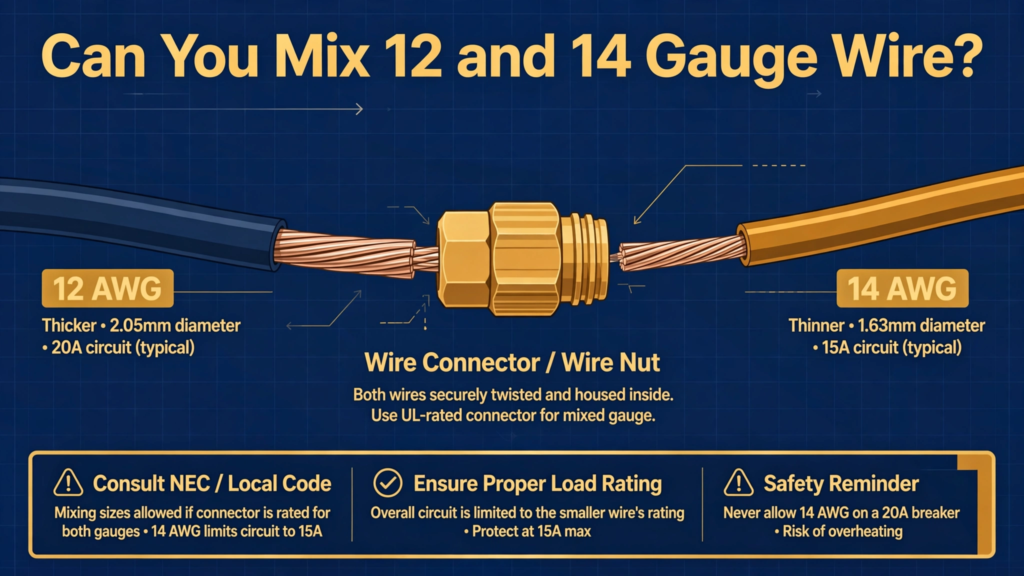

You are adding an outlet, you have some 12-gauge cable left over from another project, and the existing circuit is wired with 14-gauge. Can you just splice them together? The short answer is yes — mixing 12 and 14 gauge wire on the same circuit is allowed, but only under one strict condition: the breaker protecting that circuit must be sized for the smallest wire in the run.
Get that one rule wrong and you have a genuine fire hazard. Here is the NEC logic behind it and how to do it safely.
The Smallest Wire Rule
A conductor’s ampacity — the current it can carry continuously without overheating — is set by its size. Thinner wire (higher AWG number) has higher resistance and heats up more for the same current. NEC 240.4(D) sets hard maximums on overcurrent protection for small conductors, regardless of any other calculation:
| Wire Size (copper) | Maximum Breaker Size |
|---|---|
| 14 AWG | 15 amps |
| 12 AWG | 20 amps |
| 10 AWG | 30 amps |
The principle is simple: the breaker must protect the weakest wire in the entire circuit. If any segment of the run is 14 AWG, the whole circuit must be on a 15-amp breaker. A 20-amp breaker on a circuit containing 14-gauge wire would let 16–20 amps flow through that thin section — enough to cook the insulation — without ever tripping. That is the fire scenario the code is written to prevent.
Flip it around: running 12-gauge wire on a 15-amp breaker is perfectly fine. Oversizing wire is never a problem; undersizing protection is. Our NEC wire size chart lists these pairings for every common size.
Why Would You Mix Gauges Anyway?
There are a few legitimate reasons:
- Long runs and voltage drop. Upsizing part of a run to 12 AWG on a 15-amp circuit reduces voltage drop over long distances — a common trick for outdoor lighting or far-end outlets. See our voltage drop formula guide for the math.
- Using up leftover cable. If you have a half-coil of 12-2 NM-B sitting around, there is no code reason you cannot use it on a 15-amp circuit.
- Pigtails. Splicing a short 14-gauge pigtail onto a 12-gauge circuit wire to land it on a device is fine — as long as the breaker is 15 amps.
- Future-proofing. Some electricians rough in 12 AWG for lighting circuits so the wiring could support 20 amps later; until then the circuit stays on a 15-amp breaker.
Rules for a Safe Mixed-Gauge Circuit
1. Breaker matches the smallest wire
This is the non-negotiable one. 14 AWG anywhere in the run = 15-amp breaker, maximum. Label the panel so a future homeowner does not “upgrade” it to 20 amps on a whim.
2. Splice properly
All splices go in accessible junction boxes — never buried in a wall. Use wire connectors (wire nuts) listed for the size combination you are joining, and confirm both wires are fully captured. Our electrical wiring guide covers box and splicing basics.
3. Watch box fill
Bigger wire eats more box volume. When you add 12-gauge conductors to a box sized for 14-gauge, recalculate fill per NEC 314.16 — overcrowded boxes trap heat and fail inspections.
4. Do not mix aluminum and copper casually
If either wire is aluminum, you need connectors listed for aluminum-to-copper (such as AlumiConn) and antioxidant compound. Straight wire nuts on aluminum-to-copper joints are a well-known failure point.
What About Separate Circuits in the Same Box?
A related question: can a 15-amp circuit (14 AWG) and a 20-amp circuit (12 AWG) share the same junction box without being spliced together? Yes — the NEC does not prohibit different circuits sharing a box, as long as box fill is respected, neutrals stay with their own circuit, and all equipment grounds are bonded together. Just do not cross-connect the hot conductors.
For general guidance on sizing any conductor run correctly, see our cable size calculation article.
How to Check Which Gauge Is Already in the Wall
Before you splice anything, confirm what is already there. Read the printing on the cable jacket: NM-B cable is marked with its gauge, such as 14-2 or 12-2, along with the number of conductors. If the jacket is faded or hidden inside a box, measure the bare copper with a wire gauge tool, or compare the conductor against a known sample — never guess by eye alone, because 12 and 14 AWG look surprisingly similar once the insulation is stripped. Also check the breaker: a 15-amp breaker hints at 14-gauge wire, and a 20-amp breaker should mean 12-gauge, but only a physical check confirms it, since breakers can be wrong for the wire they protect.
If you find a mismatch — say, a 20-amp breaker feeding 14-gauge wire — stop and fix the breaker first, before adding anything to the circuit. Swap it for a 15-amp breaker, or replace the undersized wire with 12 AWG if the load truly needs 20 amps. Label the panel directory with the smallest gauge present, for example ’15A MAX — contains 14 AWG’, so the next person to open the panel does not assume the whole run is 12-gauge. A five-minute check with a gauge tool and a look at the breaker is far cheaper than a melted splice discovered years later.
FAQs
Can you mix 12 and 14 gauge wire on a 20-amp breaker?
Absolutely not. This is a code violation and a fire hazard. NEC 240.4(D) caps 14 AWG copper at 15 amps of protection — a 20-amp breaker would let the 14-gauge section overheat without tripping.
Can you mix 12 and 14 gauge wire on a 15-amp breaker?
Yes. The 15-amp breaker protects the 14-gauge section, and the 12-gauge section is simply oversized — which is always allowed.
Does mixing wire gauges affect performance?
Electrically, the circuit behaves according to the smallest conductor: it is a 15-amp circuit, period. Mixing in heavier 12-gauge sections can slightly reduce voltage drop, which is a mild benefit, not a penalty.
Can I splice 14-gauge pigtails onto 12-gauge wires at a receptacle?
Yes, if the circuit is protected at 15 amps. Short pigtails of a smaller gauge are common when landing wires on devices with tight terminals — the breaker rating is what matters, not the pigtail length.
Should I label a mixed-gauge circuit in the panel?
Strongly recommended. Write “15A MAX — contains 14 AWG” on the panel directory. The biggest real-world risk is someone later seeing 12-gauge wire in the panel and swapping in a 20-amp breaker, not knowing 14-gauge hides downstream.
Conclusion
Mixing 12 and 14 gauge wire is perfectly acceptable under the NEC as long as the entire circuit is protected at the rating of the smallest conductor — 15 amps when 14 AWG is present anywhere in the run. Upsizing wire is safe; upsizing the breaker beyond what the smallest wire allows is not. Splice in proper boxes, respect box fill, and label the panel clearly. When in doubt, have a licensed electrician review the circuit against your locally adopted NEC edition.
For the official text of the standard, see NFPA 70 from the National Fire Protection Association.


