
Choosing the right breaker size is one of the most common — and most misunderstood — questions in residential electrical work. Too small and it trips constantly; too large and it may never trip when it should, letting wiring overheat. The correct size is not a guess: it follows the National Electrical Code and the rating of the wire it protects.
This guide covers the two rules that determine breaker size, a breaker size chart by appliance, and the simple math electricians use to size a circuit from an appliance nameplate. Confirm your plan with a licensed electrician under the NEC edition adopted in your area.
The Two Rules That Decide Breaker Size
Rule 1: The Breaker Protects the Wire, Not the Appliance
A circuit breaker exists to protect the conductors (wires) from overheating — not the appliance, which usually has its own internal protection. That is why breaker size and wire gauge are locked together by NEC 240.4(D), the small-conductor rule:
| Copper Wire Gauge (AWG) | Maximum Breaker Size |
|---|---|
| 14 AWG | 15 amps |
| 12 AWG | 20 amps |
| 10 AWG | 30 amps |
A 30-amp breaker on 14 AWG wire is a code violation and fire hazard. You may always use a larger wire than required, but never a larger breaker than the wire allows.
Rule 2: The 125% Rule for Continuous Loads
A continuous load is one expected to run for three hours or more. NEC 210.19(A)(1) and 210.20(A) require branch-circuit conductors and overcurrent devices to be sized at no less than 100% of the noncontinuous load plus 125% of the continuous load.
Example: a 4,500-watt, 240-volt water heater draws 18.75 amps (4,500 ÷ 240). Storage water heaters are continuous loads under NEC 422.13, so 18.75 × 1.25 = 23.44 amps → next standard size up: a 30-amp double-pole breaker with 10 AWG copper. See our NEC wire size chart.
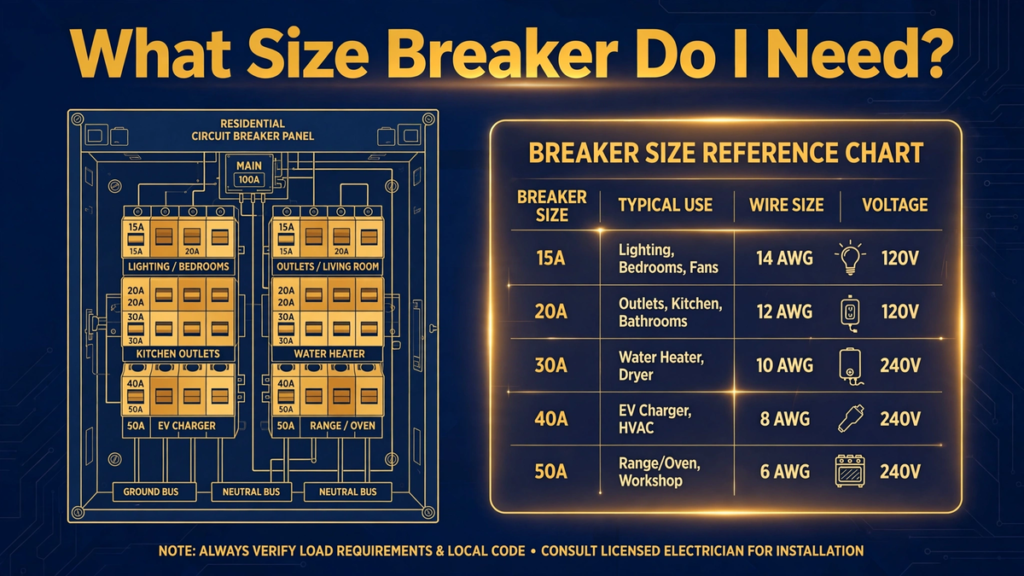
Breaker Size Chart by Appliance
Always verify against the appliance nameplate — NEC 110.3(B) requires equipment to be installed per its listing, and the nameplate wins over any generic chart.
| Appliance / Circuit | Breaker Size | Minimum Copper Wire |
|---|---|---|
| General lighting and receptacles | 15A, single-pole | 14 AWG |
| Kitchen small-appliance circuits | 20A, single-pole | 12 AWG |
| Bathroom receptacle circuit | 20A, single-pole | 12 AWG |
| Microwave (dedicated) | 20A, single-pole | 12 AWG |
| Dishwasher (dedicated) | 15A or 20A, single-pole | 14 or 12 AWG |
| Garbage disposal | 15A or 20A, single-pole | 14 or 12 AWG |
| Electric clothes dryer | 30A, double-pole | 10 AWG |
| Electric water heater (4,500W) | 30A, double-pole | 10 AWG |
| Electric range / cooktop | 40–50A, double-pole | 8 or 6 AWG |
| Central air conditioner | Per nameplate MOCP | Per nameplate MCA |
| Level 2 EV charger | 40–60A, double-pole | 8 or 6 AWG |
For breaker mechanisms and types, see our guide to circuit breaker types and working.
How to Calculate Breaker Size Yourself
Step 1 — Find the amps. From the nameplate: amps = watts ÷ volts.
Step 2 — Apply 125% for continuous loads such as water heaters, EV chargers, and electric heating. A 48-amp EV charger needs a 60-amp circuit (48 × 1.25 = 60).
Step 3 — Round up to the next standard breaker size (15, 20, 30, 40, 50, 60 amps). A 23.44-amp calculated load takes a 30-amp breaker.
Step 4 — Match the wire to the breaker. A 30-amp breaker needs at least 10 AWG copper; a 60-amp EV circuit needs at least 6 AWG. Our cable size calculation guide covers the full method. Special case — air conditioners follow NEC Article 440: size the wire to the MCA and the breaker to the MOCP on the nameplate.
Common Sizing Mistakes
Oversizing “for safety.” A 50-amp breaker on a 4,500-watt water heater is not safer — it is dangerous, because it may never trip on a fault that a 30-amp breaker would catch.
Upsizing the breaker to stop tripping. Frequent tripping means the circuit is overloaded; the fix is less load or a new dedicated circuit — never a bigger breaker on the same wire.
Wrong pole count or ignoring the nameplate. A 240-volt load needs a double-pole breaker disconnecting both hot legs, and any maximum breaker size on the nameplate is mandatory per NEC 110.3(B). Planning several new circuits? Check service capacity with our house load calculation guide.
FAQs
What size breaker do I need for a 4,500-watt water heater?
A 30-amp double-pole breaker with 10 AWG copper. It draws 18.75 amps at 240 volts; as a continuous load per NEC 422.13 the circuit is sized at 125% (23.44 amps), so the next standard size up is 30 amps.
Can I put a 20-amp breaker on 14 AWG wire?
No. NEC 240.4(D) limits 14 AWG copper to 15-amp protection. The wire can overheat before a 20-amp breaker trips — a code violation and fire hazard.
What size breaker does an electric dryer need?
A 30-amp double-pole breaker on a dedicated 240-volt circuit with 10 AWG copper — confirm with the nameplate.
Does an EV charger need a bigger breaker than its rated amps?
Yes — EV charging is a continuous load, so the circuit must be 125% of the charger’s rating: a 48-amp charger needs a 60-amp circuit with 6 AWG copper.
Can I swap a 15-amp breaker for 20 amps to stop tripping?
Only if every part of the circuit is rated for 20 amps (12 AWG wire minimum). Swapping the breaker alone on 14 AWG wire violates NEC 240.4(D) — add a dedicated circuit instead.
Conclusion
Breaker sizing rests on two principles: the breaker protects the wire, and continuous loads get a 125% margin. Find the amps from the nameplate, multiply by 1.25 for continuous loads, round up to the next standard size, and pair it with wire rated for that breaker. For 240-volt appliances, EV chargers, or service upgrades, have a licensed electrician verify the plan under your locally adopted NEC edition — the official text is available through the NFPA’s National Electrical Code resources.