
Imagine sitting in a small workshop or home during a very hot summer afternoon. The temperature is high, and the air feels dry and uncomfortable. Turning on an air conditioner may not always be affordable because it consumes a large amount of electricity. Instead, many people switch on an air cooler, which quickly provides a refreshing breeze and reduces the room temperature.
Air coolers have become a popular cooling solution in homes, small offices, workshops, and outdoor environments. They are simple devices that use water evaporation to cool the air. Compared to air conditioners, air coolers consume less electricity and are easier to maintain.
For electrical students, engineers, technicians, and beginners, understanding how an air cooler works is important. Air coolers demonstrate basic engineering concepts such as evaporative cooling, airflow systems, electric motors, water circulation, and heat transfer.
In this article, we will explain the air cooler working principle, types, main components, advantages, disadvantages, and applications. We will also discuss the difference between air cooler and air conditioner, which helps beginners understand when each system should be used. By the end of this guide, you will have a clear understanding of how air coolers operate and why they are widely used.
An air cooler, also known as an evaporative cooler, is a simple and energy-efficient device used to cool indoor spaces by utilizing the natural process of water evaporation. It is widely used in homes, offices, and small commercial areas, especially in hot and dry climates where humidity levels are low. Unlike air conditioners, which use refrigerants and compressors, air coolers rely on the circulation of air through water-soaked cooling pads to reduce temperature. This makes them more eco-friendly and cost-effective.
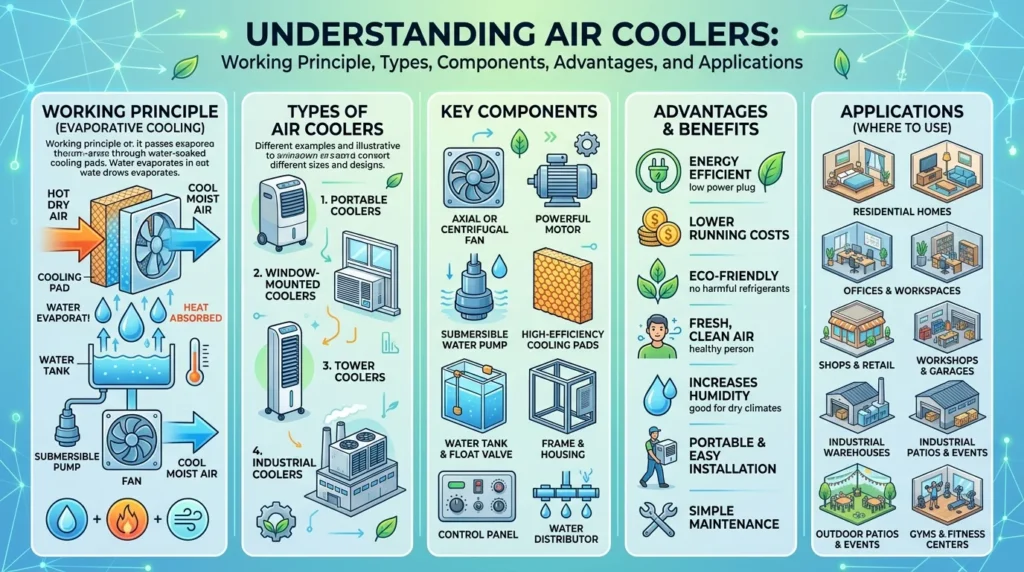
The working principle of an air cooler is based on evaporation. When warm air is drawn into the cooler with the help of a fan, it passes through moist cooling pads. As the air flows through these pads, water evaporates, absorbing heat from the air and lowering its temperature. The cooled air is then circulated into the room, creating a refreshing and comfortable environment. For better performance, air coolers require proper ventilation, as fresh air is needed for continuous cooling.
Air Cooler
Air coolers consist of several key components, including a water tank, cooling pads, a fan or blower, a water pump, and a motor. The water pump circulates water from the tank to keep the pads wet, while the fan pushes air through the pads and into the room. Some modern air coolers also come with additional features like remote control, adjustable speed settings, ice chambers, and air purification filters.
One of the main advantages of air coolers is their low power consumption. They use significantly less electricity compared to air conditioners, making them an economical choice for daily use. They are also easy to maintain, as they do not require complex servicing. Additionally, air coolers add moisture to the air, which can be beneficial in dry environments.
However, air coolers are less effective in humid conditions because evaporation slows down when the air already contains a high amount of moisture. They also require regular cleaning to prevent the buildup of dust and bacteria in the cooling pads. Overall, air coolers are an affordable, eco-friendly, and efficient cooling solution for many households, offering a balance between comfort and energy savings.
What is an Air Cooler?
An air cooler, also called an evaporative cooler, is a cooling device that reduces air temperature using the natural process of water evaporation.
Unlike air conditioners that use refrigerants and compressors, air coolers use water, air, and a fan to produce cooling.
Simple Explanation
An air cooler pulls warm air through water-soaked cooling pads. As the air passes through these pads, the water evaporates and absorbs heat from the air. This process produces cooler and more comfortable air.
Practical Example
For example, in a small room or outdoor sitting area, an air cooler can blow cool air by drawing hot air through wet cooling pads. This reduces the temperature and increases humidity slightly, making the environment more comfortable.
Because air coolers require only electricity for the fan and water pump, they are energy-efficient and cost-effective cooling devices.
Air Cooler Working Principle
The air cooler working principle is based on evaporative cooling. When water evaporates, it absorbs heat from the surrounding air. This reduces the air temperature.Air cooler working principle is based on the simple concept of evaporation, where water absorbs heat from the surrounding air and cools it down. An air cooler consists of main parts such as a water tank, cooling pads, fan, and a pump. When the cooler is switched on, the water pump circulates water from the tank and continuously wets the cooling pads (usually made of wood wool or honeycomb material). At the same time, a fan or blower pulls hot and dry air from the surroundings and passes it through these wet pads. As the hot air moves through the pads, water starts to evaporate, and during this process, it absorbs heat from the air. This results in a significant drop in air temperature, producing cool and fresh air that is then blown into the room. This cooling method is known as evaporative cooling and works best in hot and dry climates where humidity is low. Unlike air conditioners, air coolers do not use refrigerants or compressors, making them more energy-efficient and environmentally friendly. They also allow fresh air circulation instead of recirculating the same indoor air. However, their performance decreases in humid conditions because the air already contains moisture, reducing the rate of evaporation. Overall, the air cooler is a simple, cost-effective, and natural cooling device that uses water and airflow to provide relief from heat.
3. Air Cooler Working Principle
The air cooler working principle is based on the process of evaporative cooling, where water absorbs heat from warm air during evaporation. This natural cooling method reduces air temperature and provides a refreshing environment with significantly lower energy consumption compared to traditional air conditioning systems.
How Does an Air Cooler Work? Step-by-Step Cooling Process
An air cooler works mainly through evaporative cooling, a natural process in which water absorbs heat from warm air as it changes from liquid into vapor. Unlike an air conditioner, which uses a refrigerant-based cooling cycle, an air cooler uses water, cooling pads, airflow, and evaporation to reduce the temperature of incoming air.
The cooling process is most effective in hot and dry climates, where the air has enough capacity to absorb additional moisture. The complete working process can be explained in the following steps.
1. Warm Air Is Drawn Into the Air Cooler
The process begins when the cooler’s fan or blower draws warm air from the surrounding environment into the unit.
The incoming air may be hot and dry, particularly during summer. This air contains thermal energy that can be reduced through evaporation as it passes through the cooler’s wet pads.
2. Water Is Distributed Over the Cooling Pads
A small water pump draws water from the cooler’s tank and distributes it over the cooling pads.
The pads are made from absorbent materials that retain water across a large surface area. Keeping the pads sufficiently wet increases the contact area between water and incoming air, which supports more effective evaporation.
3. Warm Air Passes Through the Wet Pads
The fan forces or draws the warm air through the wet cooling pads.
As the air moves through the moist pad material, it comes into close contact with the water present on the pad surfaces. This interaction creates the conditions required for evaporative cooling.
4. Water Evaporates and Absorbs Heat
Some of the water on the cooling pads changes from liquid into water vapor.
For evaporation to occur, the water requires energy. Much of this energy is taken from the sensible heat of the passing air. As a result, the air loses heat while gaining moisture.
This evaporative heat transfer is the basic cooling principle of an air cooler.
5. The Air Temperature Decreases
After passing through the wet cooling pads, the air is generally cooler than the incoming air.
The amount of cooling depends on several factors, including:
- Outdoor air temperature
- Relative humidity
- Airflow rate
- Cooling-pad condition
- Water distribution
- Pad surface area
- Cooler design
Air coolers generally perform better when outdoor humidity is low because dry air can absorb more water vapor.
6. Cool, Humidified Air Enters the Room
The fan then moves the cooled air out of the cooler and into the room.
Because evaporation adds moisture to the air, the delivered air is usually cooler and more humid than the incoming air. For effective ventilation, windows or doors are often kept partially open so that humid indoor air can escape and fresh air can enter.
7. Water Is Continuously Recirculated
While the cooler operates, the water pump continuously circulates water from the tank to the cooling pads.
Water that does not evaporate flows back into the tank, where it can be pumped through the pads again. This creates a continuous water-circulation process.
A portion of the water may need to be replaced periodically because of evaporation, splashing, and water drainage.
8. The Cooling Cycle Continues
As long as the fan, water pump, and water supply continue operating, the cooler can continuously draw in warm air, pass it through the wet pads, and deliver cooler humidified air into the space.
The overall process can be summarized as:
Warm Air → Wet Cooling Pads → Water Evaporation → Heat Absorption → Cooler Humidified Air → Room
This simple combination of airflow, water circulation, and evaporation allows an air cooler to provide cooling with relatively simple equipment and generally lower energy consumption than conventional refrigerated air-conditioning systems.
Simple Analogy
Think about the cooling sensation you feel when water evaporates from your skin after swimming or sweating. As the water evaporates, it absorbs heat from your body, making you feel cooler. An air cooler works on exactly the same principle, except it cools the surrounding air instead of your skin.
Key Concept Behind Air Cooler Operation
The effectiveness of an air cooler depends on the rate of water evaporation. The hotter and drier the surrounding air, the greater the evaporation and the stronger the cooling effect. This is why air coolers perform best in regions with low humidity and high temperatures.
In summary, an air cooler operates by drawing warm air through water-soaked cooling pads, where evaporation absorbs heat from the air, producing a continuous flow of cool and refreshing air into the room.
Types of Air Coolers
Air coolers are available in several types depending on size, airflow, and application.
Personal Air Coolers: Compact and Efficient Cooling Solutions for Individual Use
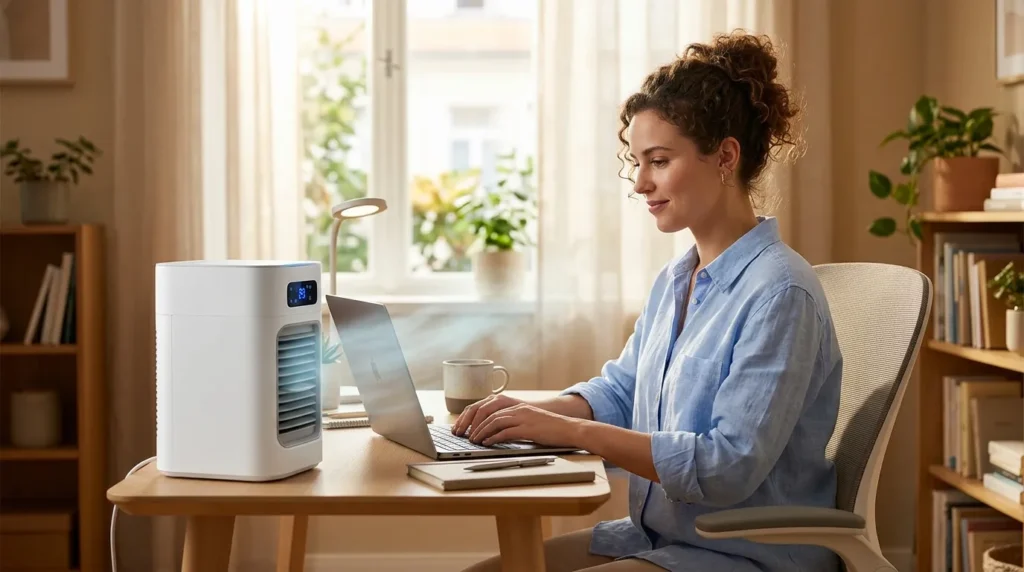
Personal air coolers are small and designed for cooling small rooms or individual spaces.
Features include:
- Compact size
- Low power consumption
- Portable design
They are commonly used in bedrooms or study rooms.
What Is a Personal Air Cooler?
A personal air cooler is a compact, portable, and energy-efficient cooling appliance designed to provide cooling for a single person, a small room, or a limited indoor area. It works on the evaporative cooling principle, in which warm air passes through water-soaked cooling pads and loses heat through the natural process of evaporation before being released as cooler air.
Unlike air conditioners that use compressors, refrigerants, and complex cooling cycles, personal air coolers rely on a simple combination of water, cooling pads, a fan, and air circulation to reduce air temperature. This makes them more economical, environmentally friendly, and easier to maintain than many conventional cooling systems.
Personal air coolers are specially designed for localized cooling, meaning they are intended to cool the area around one or a few people rather than an entire house or large hall. Their compact size allows them to fit easily in bedrooms, study rooms, home offices, dormitories, kitchens, small shops, and personal workspaces. Because they are lightweight and often equipped with wheels or handles, users can move them easily from one room to another according to their cooling needs.
Most personal air coolers contain several basic components, including:
- Water tank
- Cooling pads
- Fan or blower
- Water pump
- Air vents
- Control panel
The water pump continuously circulates water from the tank to the cooling pads, keeping them wet during operation. As warm air passes through these pads, part of the water evaporates and absorbs heat from the air. The fan then delivers the cooled and slightly humidified air into the surrounding space, creating a more comfortable environment.
Compared with larger desert air coolers or room coolers, personal air coolers have:
- Smaller dimensions
- Lower airflow capacity
- Compact water tanks
- Reduced power consumption
- Easier portability
Because of these characteristics, they are particularly suitable for users who need cooling for a specific location rather than for an entire building.
One of the biggest advantages of personal air coolers is their low electricity consumption. Most models use only a fraction of the power required by an air conditioner, making them an economical option for reducing energy costs during hot weather. Their operation is also considered environmentally friendly because they do not rely on chemical refrigerants that may have environmental impacts.
Modern personal air coolers often include additional features such as:
- Multiple fan speed settings
- Automatic swing or oscillation
- Water level indicators
- Dust filters
- Timer functions
- Ice compartments
- Remote controls
- Digital displays
- Smart controls in advanced models
These features improve user comfort and provide greater control over cooling performance.
Personal air coolers generally perform best in hot and dry climates, where the evaporation process is most effective. In areas with high humidity, their cooling performance may be reduced because moist air cannot absorb as much additional water vapor.
The popularity of personal air coolers continues to increase because they offer several practical benefits, including:
- Affordable purchase cost
- Low operating expenses
- Easy installation
- Portability
- Simple maintenance
- Energy efficiency
- Eco-friendly operation
Although personal air coolers cannot provide the same cooling capacity as large air conditioners or industrial cooling systems, they offer an effective and economical solution for personal comfort in small spaces.
In simple terms, a personal air cooler is a small evaporative cooling device designed to provide convenient, portable, and energy-efficient cooling for individuals or small rooms, making it a practical choice for everyday use during hot weather conditions.
Desert Air Coolers: High-Capacity Cooling Solutions for Large Spaces
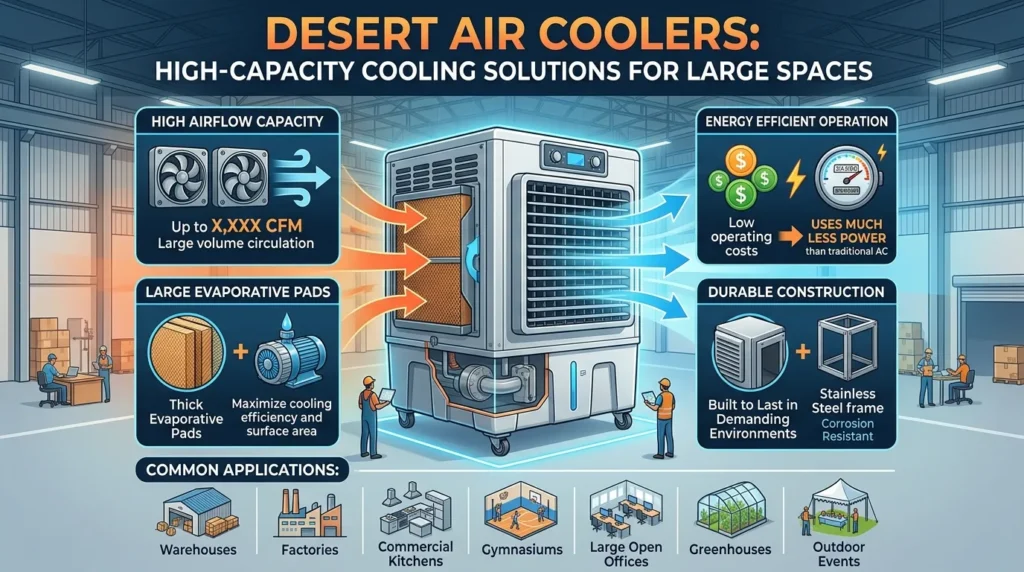
A desert air cooler is a high-capacity evaporative cooling appliance designed to provide effective cooling in hot and dry climates. It uses the natural process of water evaporation to reduce the temperature of incoming air. Warm outdoor air is drawn into the cooler by a powerful fan or blower and passed through water-saturated cooling pads. As some of the water evaporates, it absorbs heat from the air, producing cooler and more humidified air that is then circulated into the surrounding space.
Compared with personal or small room air coolers, desert air coolers are larger and designed to move a much greater volume of air. They typically have large water tanks, high-airflow fans, and larger cooling pads, allowing them to cool spacious areas such as living rooms, halls, offices, shops, workshops, warehouses, and semi-open areas.
Main Features of Desert Air Coolers
Common features of desert air coolers include:
- Large-capacity water tank
- High airflow rate
- Large cooling pads
- Powerful fan or blower
- Multiple fan-speed settings
- Water-level indicator
- Automatic water pump
- Oscillating air louvers
- Ice or cooling compartments on some models
- Remote-control operation on modern models
- Honeycomb or other high-efficiency cooling pads
The large cooling-pad surface provides greater contact between the incoming air and water, which can improve evaporative cooling when suitable environmental conditions are present.
How Does a Desert Air Cooler Work?
The working principle of a desert air cooler is based on evaporative cooling. A water pump draws water from the tank and distributes it over the cooling pads. The pads remain wet while the cooler is operating.
At the same time, the fan draws warm air from outside or the surrounding environment through the wet pads. As the air passes through the pads, some of the water evaporates. Evaporation requires heat energy, which is taken from the incoming air. As a result, the air temperature decreases before the fan delivers the cooled air into the room.
The basic process is:
Warm Air → Wet Cooling Pads → Water Evaporation → Heat Absorption → Cooler Air → Room
For best results, desert coolers are normally used with adequate ventilation. Because the cooling process adds moisture to the air, some fresh-air exchange is important, particularly when the cooler is used indoors for extended periods.
Large Water Tank for Longer Operation
One of the most noticeable features of a desert air cooler is its large water tank. A larger tank allows the cooler to operate for longer periods without requiring frequent manual refilling.
This is particularly useful in hot weather when the cooler may run continuously for several hours. However, actual operating time depends on the tank capacity, water consumption, fan speed, temperature, humidity, and operating conditions.
High Airflow Capacity
Desert air coolers are designed to deliver a high volume of air. Their powerful fans or blowers help distribute cooled air across larger areas.
High airflow makes these coolers suitable for:
- Large living rooms
- Offices
- Shops
- Restaurants
- Workshops
- Warehouses
- Garages
- Semi-open areas
- Outdoor gatherings
The effectiveness of a particular model depends on its airflow rating, cooling-pad design, room size, ventilation, and local climate.
Large Cooling Pads
Large cooling pads provide a greater surface area for air and water interaction. When the pads remain adequately wet, they allow more water to evaporate as warm air passes through them.
Many modern desert coolers use honeycomb cooling pads, while other models may use different evaporative-pad materials. Pad condition is important because dirty, damaged, or poorly wetted pads can reduce cooling performance and airflow.
Best Climate for Desert Air Coolers
Desert air coolers perform best in hot and dry environments because dry air can absorb more moisture through evaporation.
As humidity increases, the amount of additional water vapor that the air can absorb decreases. Consequently, evaporative cooling becomes less effective in humid climates.
This is why desert air coolers are particularly popular in regions where summer temperatures are high but relative humidity is relatively low.
Applications of Desert Air Coolers
Desert air coolers can be used in many residential, commercial, and industrial environments.
Residential Applications
They can be used to cool:
- Living rooms
- Large bedrooms
- Family rooms
- Patios
- Balconies
- Garages
Commercial Applications
Businesses may use them in:
- Shops
- Restaurants
- Offices
- Small commercial halls
- Workshops
Industrial Applications
Larger evaporative coolers can also be useful in:
- Warehouses
- Workshops
- Manufacturing areas
- Garages
- Semi-open industrial spaces
They are particularly useful where large quantities of fresh air are required and full air conditioning would be expensive or impractical.
Advantages of Desert Air Coolers
Desert air coolers offer several benefits when used in suitable climates:
- Lower electricity consumption: They generally use less electrical power than conventional refrigerated air conditioners.
- Large-area cooling: High airflow allows them to serve larger spaces than compact personal coolers.
- Low operating cost: Their simple evaporative cooling system can be economical to operate.
- Large water capacity: Larger tanks reduce the frequency of refilling.
- Fresh-air operation: They generally work by moving outside air through wet pads rather than continuously recirculating indoor air.
- Simple maintenance: Their construction is generally less complex than that of compressor-based air conditioners.
- No conventional refrigerant cycle: Cooling is achieved through water evaporation rather than a vapor-compression refrigeration system.
Limitations of Desert Air Coolers
Despite their benefits, desert air coolers are not suitable for every environment.
Their main limitations include:
- Reduced cooling effectiveness in high humidity
- Increased indoor humidity
- Requirement for regular water supply
- Cooling performance depends strongly on ventilation
- Regular cleaning of cooling pads and water tanks is necessary
- They do not provide the same temperature control as conventional air conditioning
- Large models require more floor space
Therefore, choosing between a desert cooler and an air conditioner should depend on the climate, room size, ventilation, cooling requirements, water availability, and operating budget.
Maintenance Requirements
Regular maintenance helps maintain cooling performance and improve hygiene. Important maintenance tasks include cleaning the water tank, inspecting the pump, cleaning or replacing cooling pads when necessary, checking the fan and motor, and removing mineral deposits or accumulated dirt.
Fresh, clean water should be used where practical, and stagnant water should not be allowed to remain in the tank for unnecessarily long periods.
A desert air cooler is a high-airflow evaporative cooling system designed primarily for large spaces and hot, dry climates. Its large water tank, powerful fan, and large cooling pads allow it to provide substantial airflow while generally consuming less electricity than conventional air conditioning.
When used in the right climate with adequate ventilation and proper maintenance, a desert air cooler can provide an economical and practical cooling solution for homes, shops, offices, workshops, warehouses, and other large or semi-open spaces.
Tower Air Cooler for Residential and Commercial Applications
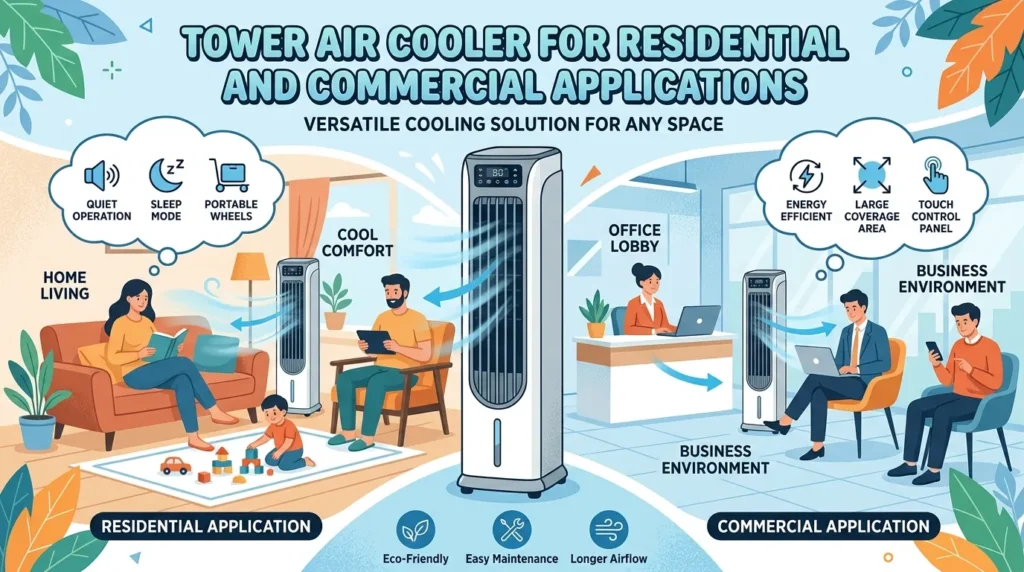
What Is a Tower Air Cooler? Features, Working, Benefits, and Applications
A tower air cooler is a modern, slim, and space-saving evaporative cooling appliance designed to provide comfortable airflow in homes, offices, bedrooms, apartments, shops, and other small to medium-sized spaces. It is called a “tower” air cooler because of its tall and narrow vertical design, which allows it to provide airflow while occupying relatively little floor space.
Unlike bulky traditional air coolers, tower models are designed with modern interiors in mind. Their vertical construction makes them easy to place beside a wall, near a desk, next to a bed, or in a corner where floor space is limited. They are particularly suitable for apartments, offices, and modern rooms where both appearance and functionality are important.
How Does a Tower Air Cooler Work?
A tower air cooler generally works using the evaporative cooling principle. A fan draws warm air from the surrounding environment and directs it through water-saturated cooling pads or an evaporative media system.
As the warm air passes through the wet cooling material, some of the water evaporates. The evaporation process absorbs heat from the air, reducing its temperature. The fan then distributes the cooler, humidified air into the room.
The basic cooling process is:
Warm Air → Wet Cooling Media → Water Evaporation → Heat Absorption → Cooler Air → Room
The cooling effect is generally stronger when the surrounding air is hot and dry because dry air can absorb more moisture.
Main Features of a Tower Air Cooler
Modern tower air coolers may include several features designed to improve comfort and convenience.
Common features include:
- Slim vertical design
- Multiple fan-speed settings
- Oscillation function
- Adjustable air direction
- Remote control
- Digital control panel
- Water-level indicator
- Timer function
- Ice chamber in some models
- Energy-efficient motor
- Washable or replaceable filters
- Compact water tank
The exact features vary between models and manufacturers.
Space-Saving Vertical Design
One of the biggest advantages of a tower air cooler is its slim and vertical construction. Because the unit occupies less floor space than many conventional coolers, it can be used in rooms where space is limited.
This makes tower coolers suitable for:
- Apartments
- Bedrooms
- Study rooms
- Home offices
- Small living rooms
- Shops
- Office workspaces
Their modern appearance also allows them to blend more easily with contemporary furniture and interior designs.
Airflow Direction and Oscillation
Tower air coolers are often designed to distribute air over a relatively wide area. Depending on the model, adjustable louvers or oscillation can move the airflow from side to side.
This helps distribute cool air more evenly rather than directing the entire airflow toward one fixed location.
Users can generally select different fan speeds depending on the desired level of airflow and cooling.
Energy-Efficient Cooling
Tower air coolers generally consume significantly less electricity than conventional compressor-based air conditioners because they do not use a refrigeration compressor to produce the cooling effect.
Their main electrical loads are typically the fan and water pump, although power consumption varies by model and operating mode.
This makes them an economical option for users who need personal or localized cooling during hot weather.
Best Climate for Tower Air Coolers
Like other evaporative coolers, tower air coolers perform best in hot and relatively dry climates.
When humidity is low, water can evaporate more easily from the cooling media, producing a stronger cooling effect. In humid environments, evaporation becomes less effective because the air already contains a significant amount of moisture.
For this reason, users in humid climates may prefer conventional air conditioning or another cooling technology depending on their requirements.
Advantages of a Tower Air Cooler
Tower air coolers offer several practical benefits:
- Space-saving design: The slim body requires relatively little floor space.
- Modern appearance: Their vertical design fits well with contemporary interiors.
- Lower energy consumption: They generally use less electricity than refrigerated air conditioners.
- Easy portability: Many models can be moved between rooms.
- Adjustable airflow: Multiple fan speeds and airflow settings provide better control.
- Simple operation: Controls are generally easy to understand and use.
- Affordable cooling: Purchase and operating costs can be lower than those of many air-conditioning systems.
- No conventional refrigerant system: Cooling is achieved through water evaporation.
Limitations of Tower Air Coolers
Despite their advantages, tower air coolers also have some limitations.
Their cooling performance can decrease when:
- Outdoor humidity is high
- The water tank is empty
- Cooling media becomes dirty
- Airflow is restricted
- The room has poor ventilation
Because evaporative cooling adds moisture to the air, adequate ventilation is important when using the cooler indoors for extended periods.
Applications of Tower Air Coolers
Tower air coolers are commonly used in areas where compact cooling is required.
Homes and Apartments
They can be used in bedrooms, living rooms, study areas, and other residential spaces where floor space is limited.
Offices
Their slim design makes them convenient for individual workspaces, small offices, and meeting areas.
Shops
Small retail shops can use tower coolers to provide localized cooling for customers and employees.
Bedrooms and Study Rooms
The adjustable airflow and compact design make them suitable for personal cooling during sleeping, studying, or working.
Tower Air Cooler Maintenance
Regular maintenance is important for maintaining cooling performance and air quality. The water tank should be cleaned regularly, and the cooling media should be inspected and cleaned according to the manufacturer’s instructions.
Important maintenance tasks include:
- Cleaning the water tank
- Checking the water pump
- Cleaning the cooling pads or media
- Removing dust from air inlets
- Inspecting the fan
- Checking for unusual noise or vibration
- Using clean water
- Draining and cleaning the tank when the cooler will not be used for an extended period
Proper maintenance can also help prevent unpleasant odors and buildup inside the water system.
Tower Air Cooler vs Traditional Air Cooler
The main difference is generally design, airflow arrangement, and intended space usage. Traditional room coolers may have wider bodies and larger water tanks, while tower coolers emphasize a slim vertical structure and convenient placement.
A tower cooler is often a better choice when space and appearance are important, while a larger traditional cooler may be preferable when higher airflow and longer operation from a larger water tank are the main priorities.
A tower air cooler is a practical and modern evaporative cooling solution that combines a slim vertical design, adjustable airflow, low energy consumption, and convenient operation. It is particularly suitable for apartments, bedrooms, offices, shops, and other spaces where floor area is limited.
Like other evaporative coolers, it performs best in hot, dry conditions and requires regular cleaning and adequate ventilation. When used in a suitable climate, a tower air cooler can provide an economical and convenient alternative to conventional air conditioning for localized cooling.
Window Air Cooler: Working Principle, Features, Advantages, and Applications
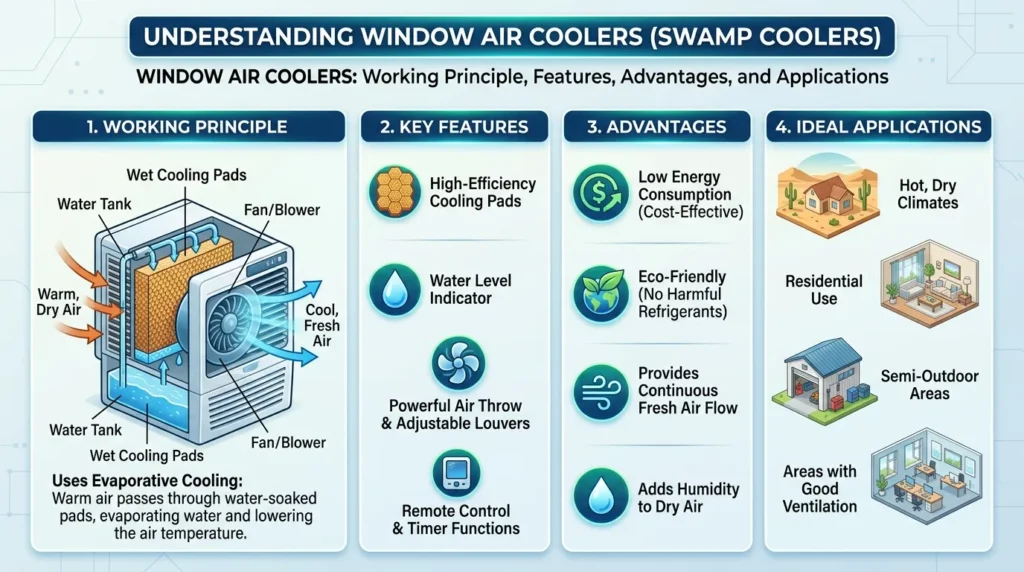
What Is a Window Air Cooler? Working, Features, Benefits, and Applications
A window air cooler is an evaporative cooling appliance designed to be installed in a window opening or suitable wall-mounted position. It is designed to provide a continuous supply of cooler, fresh air while using relatively little floor space inside the room. Unlike portable air coolers that sit entirely inside a room, a window air cooler is positioned so that the main body is located at or toward the outside, while the cooled-air outlet directs air into the indoor space.
Window air coolers are commonly used in bedrooms, living rooms, offices, classrooms, shops, workshops, and other medium-sized spaces where good airflow and fresh-air circulation are required. Their installation also makes them useful where indoor floor space is limited.
How Does a Window Air Cooler Work?
A window air cooler works on the principle of evaporative cooling. A fan draws warm outdoor air through water-saturated cooling pads. As the air passes through the wet pads, some of the water evaporates and absorbs heat from the air.
This process lowers the air temperature before the fan pushes the cooled air into the room.
The basic working process is:
Warm Outdoor Air → Wet Cooling Pads → Water Evaporation → Heat Absorption → Cooler Air → Room
Because the cooler uses outdoor air, it can also provide continuous air exchange. However, adequate openings for air to leave the room are important for effective evaporative cooling.
Main Components of a Window Air Cooler
A typical window air cooler consists of several important components that work together to provide cooling.
Water Tank
The water tank stores the water required for the evaporative cooling process. Its capacity determines how long the cooler can operate before the water needs to be refilled.
Water Pump
The pump circulates water from the tank to the cooling pads, keeping the pads sufficiently wet during operation.
Cooling Pads
Cooling pads provide a large surface area where air comes into contact with water. Honeycomb pads and other evaporative media may be used depending on the cooler design.
Fan or Blower
The fan draws warm air through the cooling pads and delivers the cooled air into the room.
Electric Motor
The motor drives the fan or blower. Its power rating affects airflow and overall cooling performance.
Air Louvers
Louvers help direct the cooled air into the room. Depending on the design, they may allow manual or automatic adjustment of airflow direction.
Control System
The control panel allows users to operate the fan, water pump, speed settings, and other available functions.
Window Installation Saves Floor Space
One of the main advantages of a window air cooler is its installation arrangement. Since the cooler is mounted in or near a window opening, it does not occupy as much indoor floor space as a conventional portable cooler.
This makes it useful for:
- Bedrooms
- Small apartments
- Offices
- Classrooms
- Shops
- Living rooms
The installation should be strong and secure, and the opening should be appropriately sealed around the unit while still allowing the ventilation arrangement required by the cooler.
Fresh Air Circulation
Window air coolers are designed to draw air from outside and deliver cooled air indoors. This can provide a continuous supply of fresh outdoor air, unlike many refrigerated air-conditioning systems that primarily recirculate indoor air.
Fresh-air operation can be particularly useful in spaces where air movement and ventilation are important. However, the cooling effectiveness depends heavily on outdoor temperature, humidity, airflow, and the room’s ventilation arrangement.
Large Airflow Capacity
Many window air coolers are designed to move a relatively large volume of air. This makes them suitable for rooms that require stronger air circulation than a small personal cooler can provide.
The actual cooling area depends on factors such as:
- Airflow capacity
- Room size
- Ceiling height
- Outdoor temperature
- Relative humidity
- Insulation
- Number of occupants
- Ventilation
Choosing a cooler based on its rated airflow and the manufacturer’s recommended room size can help achieve better performance.
Energy-Efficient Cooling
Window air coolers generally consume less electricity than conventional compressor-based air conditioners because they use evaporation rather than mechanical refrigeration to cool the air.
The primary electrical components are generally the fan or blower and water pump, although energy consumption varies according to the model and operating settings.
This can make window air coolers an economical choice in suitable hot and dry climates.
Best Climate for Window Air Coolers
Window air coolers work best in hot and relatively dry climates. When humidity is low, water can evaporate more easily from the cooling pads, producing a stronger cooling effect.
In humid conditions, the air already contains a considerable amount of moisture, so evaporation becomes less effective. As a result, cooling performance may be significantly reduced.
Advantages of Window Air Coolers
Window air coolers provide several practical benefits:
- Space-saving installation: They require little indoor floor space.
- Fresh-air circulation: They can bring outdoor air directly into the room.
- High airflow: Many models are designed for medium or large spaces.
- Lower energy consumption: They generally consume less electricity than refrigerated air conditioners.
- Affordable operation: Their simple cooling mechanism can result in lower running costs.
- Simple construction: Fewer complex refrigeration components can make maintenance easier.
- Adjustable airflow: Fans and louvers allow users to control air movement.
- Suitable for dry climates: They can provide effective cooling where humidity is low.
Limitations of Window Air Coolers
Despite their advantages, window air coolers also have some limitations.
Their performance can decrease when:
- Outdoor humidity is high
- Cooling pads are dirty
- Water circulation is inadequate
- Airflow is restricted
- The room has insufficient ventilation
- The water tank becomes empty
Because evaporative cooling adds moisture to the air, suitable ventilation is important for maintaining comfortable indoor conditions.
Applications of Window Air Coolers
Window air coolers can be used in a variety of residential and commercial environments.
Residential Applications
They are suitable for bedrooms, living rooms, apartments, and other residential spaces where floor space is limited.
Commercial Applications
Shops, offices, classrooms, restaurants, and small commercial spaces can use window coolers for economical cooling and air circulation.
Workshops and Work Areas
Window air coolers can also be useful in workshops and other areas where continuous airflow and fresh-air exchange are desirable.
Maintenance of a Window Air Cooler
Regular maintenance helps maintain cooling efficiency and prevent unpleasant odors or water-system problems.
Important maintenance tasks include:
- Cleaning the water tank
- Cleaning or replacing cooling pads according to the manufacturer’s instructions
- Checking the water pump
- Removing dust from air inlets
- Inspecting the fan and motor
- Checking electrical connections
- Draining the water system when the cooler is not being used for an extended period
Using clean water and maintaining the cooling pads properly can help improve performance and extend the service life of the unit.
A window air cooler is a practical evaporative cooling system designed to provide fresh-air circulation, efficient cooling, and space-saving installation. Its ability to draw outdoor air through wet cooling pads makes it particularly suitable for hot and dry climates.
With features such as large airflow capacity, water circulation, adjustable fan speeds, and directional louvers, window air coolers can provide economical cooling for bedrooms, living rooms, offices, classrooms, shops, and other medium-sized spaces. However, like all evaporative coolers, their effectiveness depends strongly on outdoor humidity and proper ventilation.
Main Components of an Air Cooler and Their Functions
An air cooler consists of several important components that work together to provide efficient cooling through the evaporative cooling process. Each component plays a specific role in drawing warm air, cooling it through water evaporation, and distributing the cooled air throughout the room. Understanding these components helps homeowners, technicians, and engineering students better understand air cooler operation, maintenance, and troubleshooting.
Fan or Blower
The fan or blower is one of the most important parts of an air cooler. Its primary function is to draw warm air from the surrounding environment and force it through the wet cooling pads. After the air is cooled, the fan pushes the cool air into the room. Depending on the cooler design, either an axial fan or a centrifugal blower may be used. The fan is powered by an electric motor and directly affects the airflow and cooling performance of the unit.
Cooling Pads
Cooling pads are the heart of the evaporative cooling system. These pads are made from highly absorbent materials such as cellulose or aspen wood fibers that can retain water efficiently. As warm air passes through the wet pads, water evaporates and absorbs heat from the air, reducing its temperature. High-quality cooling pads improve cooling efficiency, airflow, and overall cooler performance.
Water Pump
The water pump continuously circulates water from the water tank to the cooling pads. It ensures that the pads remain evenly wet throughout the operation of the cooler. Without a properly functioning pump, the cooling pads would dry out, significantly reducing the cooling effect. The pump plays a vital role in maintaining consistent cooling performance.
Water Tank
The water tank serves as the reservoir that stores the water required for the cooling process. The size of the tank determines how long the cooler can operate before needing a refill. Larger air coolers typically have larger tanks, allowing extended operation during hot weather. Some modern coolers include water level indicators to help users monitor water availability.
Electric Motor
The electric motor provides the mechanical power needed to operate the fan or blower. It converts electrical energy into rotational motion, enabling airflow through the cooling system. The motor is designed for continuous operation and is one of the key components that determines the efficiency and durability of the air cooler.
Air Louvers
Air louvers are adjustable vents located at the air outlet of the cooler. Their function is to control and direct the flow of cooled air throughout the room. Many air coolers feature automatic swing louvers that move from side to side, helping distribute cool air more evenly and improving overall comfort.
Control Panel
The control panel allows users to operate and adjust various functions of the air cooler. Through the control panel, users can select fan speeds, activate cooling modes, control air swing functions, and monitor system operation. Modern air coolers often include digital displays, touch controls, timers, and remote-control functionality for added convenience.
Additional Components in Modern Air Coolers
Many advanced air coolers include extra features such as dust filters, ice chambers, humidity controls, automatic water level sensors, and smart control systems. These additional components enhance cooling performance, improve air quality, and provide greater user comfort.
Importance of Proper Component Maintenance
Regular maintenance of all air cooler components helps ensure efficient operation and extends equipment lifespan. Cleaning cooling pads, checking the water pump, maintaining the motor, and keeping the water tank clean can significantly improve cooling performance and reduce operational problems.
Air Cooler Advantages
Understanding air cooler advantages and disadvantages helps engineers evaluate when to use these systems.An air cooler is a simple and cost-effective cooling device that works on the principle of water evaporation, making it a popular choice in hot and dry regions. One of the biggest advantages of an air cooler is its energy efficiency. Compared to air conditioners, air coolers consume much less electricity, which helps reduce monthly power bills significantly. This makes them an ideal option for households with limited budgets or areas with frequent electricity issues. Another important benefit is that air coolers provide fresh and natural air. Unlike air conditioners that recirculate the same indoor air, air coolers pull in fresh air from outside and cool it using water-soaked pads. This process not only cools the air but also maintains better air quality, making it healthier for breathing, especially for people with respiratory issues.
Air coolers are also environment-friendly, as they do not use harmful refrigerant gases like CFCs or HCFCs, which can damage the ozone layer. Instead, they rely on natural cooling through water evaporation, making them a greener choice. Additionally, they are easy to install and maintain. Most air coolers are portable and do not require complex installation like air conditioners. Users can easily move them from one room to another, which adds to their convenience. Maintenance is also simple, involving regular cleaning of water tanks and cooling pads.
Another advantage is that air coolers help maintain optimal humidity levels in dry climates. They add moisture to the air, preventing dryness of skin, throat, and eyes, which is common when using air conditioners. This makes them more comfortable for long-term use. Air coolers are also affordable, both in terms of initial cost and maintenance expenses. They are much cheaper than air conditioners, making them accessible to a wider range of users.
In conclusion, air coolers offer multiple benefits, including low energy consumption, fresh air circulation, eco-friendliness, easy portability, and affordability. They are especially suitable for hot and dry climates and provide a practical cooling solution for everyday use.
Key Advantages
- Low electricity consumption
- Affordable cost compared to air conditioners
- Simple installation
- Eco-friendly cooling method
- Portable design in many models
- Easy maintenance
- No refrigerant required
Real-World Benefits
Air coolers are particularly useful in regions with dry climates, where evaporative cooling works most effectively.
Disadvantages / Limitations
Despite their benefits, air coolers also have some limitations.Air coolers, although affordable and energy-efficient, also have several disadvantages that users should understand before choosing them as a cooling solution. One of the main drawbacks is their limited cooling performance, especially in humid climates. Air coolers work on the principle of evaporation, which is effective only in dry conditions. In areas with high humidity, the cooling effect becomes weak, and instead of providing comfort, the air may feel sticky and uncomfortable. This makes air coolers less suitable for coastal regions or places with high moisture levels in the air.
Another significant disadvantage is the dependence on proper ventilation. Air coolers require a continuous flow of fresh air to function effectively. If used in a closed room without proper ventilation, they can increase humidity and make the environment uncomfortable. This is different from air conditioners, which work efficiently in closed spaces. As a result, users must keep windows or doors slightly open, which may not always be convenient, especially in dusty or noisy areas.
Air coolers also require regular maintenance and cleaning. The water tank, cooling pads, and filters need to be cleaned frequently to prevent the growth of bacteria, mold, and unpleasant odors. If not maintained properly, the cooler can spread unhealthy air and cause respiratory issues. Additionally, stagnant water in the tank can become a breeding ground for mosquitoes, which poses health risks.
Another limitation is that air coolers are less effective in extremely high temperatures. When the outside temperature is very high, the cooling effect may not be strong enough to provide complete comfort, especially during peak summer afternoons. Moreover, air coolers can be noisy, as the fan and water pump generate sound during operation, which can disturb sleep or concentration for some users.
Air coolers also consume a continuous supply of water, which can be inconvenient in areas with water shortages. Users need to refill the tank regularly, especially during long hours of use. In addition, they may not provide uniform cooling across large rooms, as their cooling range is limited compared to air conditioners.
In conclusion, while air coolers are economical and eco-friendly, they come with disadvantages such as poor performance in humid conditions, need for ventilation, regular maintenance, noise, and water dependency. Understanding these limitations helps users make a better and more informed decision.
9. Disadvantages and Limitations of Air Coolers
Although air coolers are energy-efficient, environmentally friendly, and cost-effective cooling devices, they also have certain limitations that should be considered before purchasing one. Understanding these disadvantages helps users determine whether an air cooler is suitable for their specific climate, room size, and cooling requirements.
Cooling Performance Depends on Humidity
The cooling efficiency of an air cooler is directly related to the evaporation process. In dry climates, evaporation occurs quickly and provides excellent cooling. However, when humidity levels are high, evaporation becomes less effective, reducing the cooler’s overall performance.
Less Effective in Humid Environments
Air coolers perform best in hot and dry regions. In areas with high humidity, such as coastal locations, the cooling effect may be limited because the air already contains a large amount of moisture. As a result, air conditioners may provide better comfort in such conditions.
Requires Regular Water Refilling
Since air coolers rely on water evaporation, the water tank must be kept adequately filled. During extremely hot weather, water consumption may increase, requiring more frequent refilling to maintain effective cooling.
Lower Cooling Capacity Than Air Conditioners
While air coolers can significantly reduce air temperature, they generally cannot achieve the same cooling level as refrigerated air conditioning systems. Air conditioners are capable of providing more precise temperature control and stronger cooling performance.
Noise Generation
Large desert coolers and industrial air coolers may produce noticeable noise due to high-speed fans, blowers, and water pumps. Although modern models are quieter than older units, noise levels can still be higher than some air conditioning systems.
Periodic Cooling Pad Replacement
Cooling pads gradually wear out due to continuous exposure to water, dust, and minerals. To maintain efficient operation, cooling pads must be cleaned regularly and replaced when they become damaged or excessively clogged.
Increased Indoor Humidity
Because air coolers add moisture to the air, prolonged use may increase indoor humidity levels. In poorly ventilated spaces, this can sometimes create discomfort and reduce cooling effectiveness.
Overall Limitation
Despite these drawbacks, air coolers remain an excellent cooling solution for dry and well-ventilated environments where energy efficiency, affordability, and eco-friendly operation are important considerations.
10. Air Cooler Applications in Residential, Commercial, and Industrial Sectors
Air coolers are widely used across various sectors because they provide economical and energy-efficient cooling. Their ability to cool large volumes of air while consuming relatively little electricity makes them suitable for numerous residential, commercial, and industrial applications.
Residential Applications
In homes, air coolers provide comfortable cooling during hot weather while maintaining lower operating costs than air conditioning systems. They are commonly installed in bedrooms, living rooms, dining areas, study rooms, balconies, and outdoor patios. Personal, tower, and desert air coolers are particularly popular for residential use because they offer flexible cooling options for different room sizes.
Commercial Applications
Many commercial establishments use air coolers to improve comfort for customers and employees. Shops, retail stores, restaurants, cafes, offices, educational institutions, clinics, and small warehouses frequently utilize air coolers because they provide effective cooling without significantly increasing electricity expenses. Window and desert air coolers are commonly used in these environments.
Industrial Applications
Industrial facilities often require cooling solutions for large open spaces where traditional air conditioning may be impractical or too expensive. Large-capacity air coolers are used in factories, assembly lines, manufacturing plants, workshops, warehouses, packaging facilities, and industrial halls. They help reduce heat stress, improve worker comfort, and create a more productive working environment.
Outdoor and Semi-Open Area Applications
Air coolers are also highly effective in outdoor and semi-open spaces where air conditioning systems cannot operate efficiently. They are commonly used at construction sites, event venues, outdoor dining areas, sports facilities, exhibition halls, and temporary structures.
Agricultural Applications
In some agricultural settings, air coolers are used to improve ventilation and reduce temperatures in greenhouses, poultry farms, livestock shelters, and storage facilities. Maintaining suitable temperatures helps improve productivity and protect sensitive agricultural products.
Why Air Coolers Are Widely Used
The popularity of air coolers comes from their combination of low operating costs, energy efficiency, simple maintenance, and environmentally friendly cooling technology. They provide an economical alternative to air conditioning systems while delivering effective cooling in suitable climate conditions.
In summary, air coolers are extensively used in homes, offices, shops, restaurants, warehouses, factories, workshops, agricultural facilities, and outdoor spaces because they offer affordable, energy-efficient, and environmentally responsible cooling solutions.
Difference Between Air Cooler and Air Conditioner
Understanding the difference between air cooler and air conditioner is important for selecting the right cooling system.
| Feature | Air Cooler | Air Conditioner |
|---|---|---|
| Cooling Method | Evaporative cooling | Refrigeration cycle |
| Power Consumption | Low | High |
| Installation | Simple | Complex |
| Cost | Affordable | Expensive |
| Cooling Performance | Moderate | Strong |
| Best Climate | Dry areas | Any climate |
Air coolers are ideal for energy-efficient cooling in dry climates, while air conditioners provide stronger cooling.
11. Air Cooler Selection Guide: How to Choose the Right Air Cooler
Selecting the right air cooler is essential for achieving efficient cooling, energy savings, and long-term satisfaction. Different air coolers are designed for different room sizes and environmental conditions, so understanding the key selection factors can help users make an informed decision. Whether you are purchasing an air cooler for a home, office, shop, or industrial area, considering airflow capacity, water tank size, cooling pad quality, and portability can significantly improve cooling performance.
Room Size and Cooling Area
One of the most important factors when choosing an air cooler is the size of the room. Small personal coolers are suitable for bedrooms and study rooms, while larger desert coolers are better for living rooms, halls, workshops, and commercial spaces. Selecting a cooler with insufficient capacity may result in poor cooling performance.
Water Tank Capacity
The water tank stores the water used for evaporative cooling. A larger tank allows the cooler to operate for longer periods without requiring frequent refilling. For continuous daytime use, a larger water tank is generally more convenient and efficient.
Cooling Pad Quality
Cooling pads play a crucial role in determining the effectiveness of an air cooler. High-quality honeycomb cooling pads offer better water absorption, improved airflow, greater cooling efficiency, and a longer service life compared to traditional cooling pad materials.
Airflow Capacity (CFM)
Airflow capacity is usually measured in CFM (Cubic Feet per Minute). A higher CFM rating indicates that the cooler can circulate more air, making it suitable for larger spaces. Choosing the correct airflow capacity ensures proper cooling coverage throughout the room.
Portability and Mobility
If the cooler needs to be moved between rooms, portability becomes important. Many modern air coolers include wheels and lightweight designs that allow easy transportation and flexible use in different locations.
Additional Features
Modern air coolers may include remote controls, digital displays, timers, ice chambers, humidity controls, and automatic water level indicators. These features improve convenience and overall user experience.
12. Common Air Cooler Problems and Troubleshooting Solutions
Although air coolers are generally reliable and easy to maintain, they may occasionally develop operational issues. Understanding common problems and their solutions can help users restore normal operation quickly and reduce maintenance costs.
Why Is the Air Cooler Not Cooling Properly?
Poor cooling performance is one of the most common issues experienced by users. This problem may occur due to dry cooling pads, insufficient water supply, clogged pads, blocked air vents, or inadequate airflow.
Solution:
Check the water level, ensure the water pump is functioning correctly, clean the cooling pads, and remove any obstructions from air vents. Regular maintenance helps maintain optimal cooling efficiency.
Why Does the Air Cooler Produce a Bad Smell?
Unpleasant odors are usually caused by stagnant water, bacterial growth, mold accumulation, or dirty cooling pads. Poor cleaning practices can lead to contamination inside the cooler.
Solution:
Clean the water tank regularly, replace old water, wash or replace cooling pads, and disinfect the interior components according to the manufacturer’s recommendations.
Why Is the Fan Not Working?
A non-operating fan may result from power supply issues, damaged wiring, faulty switches, or a malfunctioning electric motor.
Solution:
Inspect the power connection, check the fuse or circuit breaker, examine electrical wiring, and test the motor. Replace damaged components if necessary.
Why Is Water Leaking from the Cooler?
Water leakage may occur due to cracks in the water tank, damaged hoses, loose fittings, or overflow problems.
Solution:
Inspect the water tank, pump connections, and water distribution system. Repair or replace damaged components and ensure all connections are properly secured.
Why Is the Water Pump Not Working?
A faulty water pump prevents water from reaching the cooling pads, reducing cooling performance.
Solution:
Check the pump for blockages, inspect electrical connections, and replace the pump if it is defective.
Why Is the Cooler Making Excessive Noise?
Noise can be caused by loose fan blades, worn motor bearings, improper installation, or accumulated debris.
Solution:
Tighten loose components, clean the fan assembly, lubricate moving parts if required, and replace worn components.
13. Future Trends in Air Cooler Technology
Air cooler technology continues to evolve as manufacturers focus on improving efficiency, user convenience, environmental sustainability, and smart functionality. Future air coolers are expected to provide better cooling performance while consuming less energy and requiring less maintenance.
Smart Air Coolers and IoT Integration
Modern air coolers are increasingly incorporating smart technologies such as Wi-Fi connectivity, smartphone applications, voice control, and remote monitoring. Users can control cooling settings, monitor water levels, and manage operation from anywhere using mobile devices.
Advanced Cooling Pad Technology
New-generation cooling pads are being developed with improved water retention, enhanced durability, and greater evaporation efficiency. These innovations help maximize cooling performance while extending the lifespan of cooling components.
Energy-Efficient Motors
Manufacturers are introducing advanced brushless DC motors and high-efficiency fan systems that consume less electricity while delivering improved airflow. These motors reduce operating costs and contribute to environmental sustainability.
Intelligent Water Management Systems
Future air coolers may feature automated water management systems that monitor water quality, optimize water usage, and automatically refill tanks when connected to a water supply source.
Hybrid Cooling Technologies
Hybrid cooling systems that combine evaporative cooling with advanced air circulation and supplemental cooling technologies are being developed to improve performance in a wider range of climate conditions, including areas with higher humidity.
Eco-Friendly and Sustainable Designs
Growing environmental awareness is encouraging the use of recyclable materials, energy-efficient components, and environmentally friendly manufacturing processes. Future air coolers are expected to offer higher performance with a smaller environmental footprint.
AI-Based Performance Optimization
Artificial intelligence may allow future air coolers to automatically adjust fan speeds, airflow patterns, and cooling settings based on room temperature, humidity, and user preferences, ensuring maximum comfort and efficiency.
In summary, advances in smart controls, efficient motors, improved cooling pads, intelligent water management, and hybrid cooling technologies are shaping the future of air coolers, making them more efficient, environmentally friendly, and user-friendly than ever before.
Conclusion
Air coolers remain one of the most affordable and energy-efficient cooling solutions available today. Their simple design, low power consumption, and eco-friendly operation make them ideal for homes, offices, and industrial spaces in dry climates.
In this article, we discussed the air cooler working principle, types, components, advantages, disadvantages, and applications. Understanding these systems helps electrical students and technicians learn about evaporative cooling, electric motors, airflow systems, and basic HVAC technology.
We also explained the difference between air cooler and air conditioner, which helps determine the best cooling solution for different environments.
For beginners in electrical and HVAC fields, studying air coolers provides a strong foundation in cooling technology. With proper maintenance and correct usage, air coolers can provide reliable and comfortable cooling for many years.