
Imagine electricity generated at a power plant at 11 kV. It cannot be transmitted directly over long distances at this voltage because losses will be high. So, engineers use a transformer to increase the voltage to 132 kV or even higher. Near your home, another transformer reduces that high voltage to 230V so you can safely use fans, lights, and appliances.
This simple example shows how important transformers are in our daily life. Without them, modern power systems would not work efficiently or safely.
Understanding the types of transformers is essential for electrical students, engineers, technicians, and beginners. Different applications require different transformer designs. In this detailed guide, you will learn the types of transformers, transformer working principle, classification, components, applications, advantages and disadvantages, and practical selection tips — explained in simple and clear English.
What Are the Types of Transformers? (2026 Guide)
Definition of Types of Transformers
A transformer is a static electrical device that transfers electrical energy from one circuit to another through electromagnetic induction. It changes the voltage level—either increasing (step-up) or decreasing (step-down)—while keeping the frequency of the AC supply constant.
The term “types of transformers” refers to the various transformer designs and classifications based on their function, voltage transformation, construction, cooling method, phase, winding arrangement, insulation, and specific applications. Each type is designed to meet different electrical and industrial requirements, from powering household appliances to transmitting electricity over long distances.
Transformers are essential components of modern power systems because they enable the efficient generation, transmission, distribution, and utilization of electrical energy.
Simple Explanation
In simple terms, a transformer is a device that changes the voltage level of Alternating Current (AC) electricity without changing its frequency.
Depending on the application, a transformer can:
- Increase low voltage to high voltage (Step-Up Transformer)
- Decrease high voltage to low voltage (Step-Down Transformer)
- Isolate two electrical circuits for improved safety (Isolation Transformer)
- Measure current and voltage for protection and metering (Instrument Transformer)
A transformer operates only with Alternating Current (AC) because it requires a continuously changing magnetic field to induce voltage in the secondary winding.
Practical Examples
Transformers are used in almost every electrical system.
Some common examples include:
- Mobile phone chargers use small step-down transformers to reduce the mains voltage before it is converted to the required DC voltage.
- Electrical substations use large power transformers to increase voltage for long-distance transmission and decrease it for safe distribution to consumers.
- Industrial plants use distribution transformers to supply power to heavy machinery and equipment.
- Hospitals and laboratories use isolation transformers to improve electrical safety and reduce the risk of electric shock.
- Electric utility companies use current transformers (CTs) and potential transformers (PTs) for accurate metering and protection of high-voltage systems.
Transformer Working Principle (2026 Guide)
How Does a Transformer Work?
The working principle of a transformer is based on Faraday’s Law of Electromagnetic Induction. According to this principle, when a changing electric current flows through the primary winding, it creates a changing magnetic field inside the transformer’s laminated iron core. This changing magnetic field links with the secondary winding and induces an electromotive force (EMF), producing voltage at the output.
Since electromagnetic induction requires a continuously changing magnetic field, transformers operate only with Alternating Current (AC). A transformer cannot function with a constant DC supply because direct current does not produce the changing magnetic flux necessary to induce voltage in the secondary winding.
Step-by-Step Working Process
The operation of a transformer can be explained in the following steps:
Step 1: AC Supply is Applied to the Primary Winding
An alternating voltage is applied to the primary winding of the transformer. The AC current begins to flow through the winding.
Step 2: Magnetic Flux is Produced
The alternating current flowing through the primary winding generates a continuously changing magnetic field (magnetic flux) within the laminated iron core.
Step 3: Magnetic Flux Travels Through the Core
The magnetic flux is efficiently carried by the transformer core, which provides a low-reluctance path between the primary and secondary windings.
Step 4: Electromagnetic Induction Occurs
The changing magnetic flux cuts across the turns of the secondary winding, inducing an electromotive force (EMF) according to Faraday’s Law.
Step 5: Output Voltage is Produced
The induced EMF generates an alternating voltage across the secondary winding. When a load is connected, current flows through the secondary circuit, delivering electrical power to the connected equipment.
Easy Analogy
Imagine two people standing side by side with a rope stretched between them.
When the first person continuously moves the rope up and down, waves travel through the rope and reach the second person. Even though the second person never touches the first person directly, energy is transferred through the movement of the rope.
A transformer works in a similar way. The primary winding creates a changing magnetic field, and the secondary winding receives energy through that magnetic field without any direct electrical connection between the two windings.
Voltage Transformation Principle
The output voltage of a transformer depends on the turns ratio between the primary and secondary windings.
- If the secondary winding has more turns than the primary winding, the transformer increases the voltage (Step-Up Transformer).
- If the secondary winding has fewer turns than the primary winding, the transformer reduces the voltage (Step-Down Transformer).
- If both windings have an equal number of turns, the voltage remains approximately the same (Isolation Transformer).
Key Points of Transformer Working
- Operates on the principle of electromagnetic induction.
- Requires Alternating Current (AC) for operation.
- Maintains the same frequency at both input and output.
- Transfers electrical energy without direct electrical contact between windings.
- Uses a laminated iron core to improve magnetic coupling and reduce energy losses.
- Can either increase or decrease voltage depending on the winding turns ratio.
- Provides efficient and reliable power transfer in electrical systems.
A transformer is a static electrical device that transfers electrical energy between circuits using electromagnetic induction. By changing the voltage level while maintaining the same frequency, transformers enable the efficient transmission, distribution, and utilization of electrical power. Available in various types based on their design and application, transformers play a crucial role in residential, commercial, industrial, and utility power systems, making them one of the most important components of modern electrical engineering.
Types / Classification of Transformers
Transformers can be classified in many ways. Let’s understand each type clearly.
Based on Voltage Level
One of the most common ways to classify transformers is based on the voltage level they provide. Depending on whether they increase or decrease the supply voltage, transformers are mainly divided into Step-Up Transformers and Step-Down Transformers. These transformers are essential components of electrical power generation, transmission, distribution, and industrial applications.
Step-Up Transformer (2026 Guide)
What is a Step-Up Transformer?
A Step-Up Transformer is a type of transformer that increases the voltage from the primary winding to the secondary winding while decreasing the current proportionally. It operates on the principle of electromagnetic induction and is widely used in electrical power generation, renewable energy systems, industrial applications, and high-voltage transmission networks.
The primary purpose of a step-up transformer is to convert low-voltage AC power into high-voltage AC power, enabling efficient transmission of electricity over long distances with minimal energy losses.
How Does a Step-Up Transformer Work?
The working principle of a step-up transformer is based on Faraday’s Law of Electromagnetic Induction.
When an Alternating Current (AC) flows through the primary winding, it creates a continuously changing magnetic field inside the laminated iron core. This magnetic field links with the secondary winding, inducing an electromotive force (EMF).
In a step-up transformer, the secondary winding has more turns than the primary winding. Because of this higher turns ratio, the voltage induced in the secondary winding becomes greater than the input voltage.
At the same time, while the voltage increases, the current decreases proportionally so that the overall power remains nearly constant (ignoring small losses).
The voltage transformation is expressed by the transformer equation:
[
\frac{V_2}{V_1}=\frac{N_2}{N_1}
]
Where:
- V₁ = Primary Voltage
- V₂ = Secondary Voltage
- N₁ = Number of Primary Turns
- N₂ = Number of Secondary Turns
Since N₂ > N₁, the secondary voltage is higher than the primary voltage.
Main Components of a Step-Up Transformer
A typical step-up transformer consists of the following components:
- Primary winding
- Secondary winding
- Laminated iron core
- Insulating materials
- Transformer oil or air-cooling system (depending on the design)
- Protective enclosure or tank
- Bushings and terminals
Each component contributes to efficient power transfer, insulation, cooling, and safe operation.
Key Features of a Step-Up Transformer
- Increases AC voltage.
- Reduces current proportionally.
- Operates only with Alternating Current (AC).
- Uses electromagnetic induction.
- Secondary winding has more turns than the primary winding.
- Highly efficient for long-distance power transmission.
- No moving mechanical parts.
- Long service life with minimal maintenance.
Advantages of a Step-Up Transformer
Step-up transformers offer several important advantages in electrical power systems.
- Increases voltage efficiently.
- Reduces transmission current.
- Minimizes power losses (I²R losses).
- Improves long-distance power transmission efficiency.
- Reliable and durable operation.
- High energy efficiency.
- Low maintenance due to the absence of moving parts.
- Supports renewable energy and industrial applications.
Disadvantages of a Step-Up Transformer
Despite its advantages, a step-up transformer has some limitations.
- Operates only with AC supply.
- Cannot function with direct current (DC).
- Requires high-quality insulation for high-voltage operation.
- Installation cost is relatively high.
- Cooling systems are necessary for large transformers.
- High-voltage equipment requires additional safety measures.
Applications of a Step-Up Transformer
Step-up transformers are widely used wherever higher voltage is required for efficient power transfer.
Common applications include:
- Electrical power generation stations.
- High-voltage transmission systems.
- Electrical substations.
- Solar photovoltaic (PV) power plants.
- Wind energy generation systems.
- Hydroelectric power plants.
- Industrial power distribution.
- Inverters and UPS systems.
- High-voltage laboratory testing equipment.
- Railway electrification systems.
Practical Example
In a power generation station, electricity is typically generated at 11 kV or 15.75 kV. Before it enters the transmission network, a step-up transformer increases the voltage to 132 kV, 220 kV, 400 kV, or even higher.
By increasing the voltage, the transmission current is reduced significantly, minimizing power losses and allowing electricity to travel hundreds of kilometers efficiently before reaching distribution substations.
A Step-Up Transformer is an essential electrical device that increases AC voltage while reducing current through the principle of electromagnetic induction. Because the secondary winding contains more turns than the primary winding, the output voltage becomes higher than the input voltage. Step-up transformers play a critical role in modern power systems by enabling efficient long-distance electricity transmission, reducing energy losses, and supporting power generation, renewable energy, and industrial applications.
Step-Down Transformer (2026 Guide)
What is a Step-Down Transformer?
A Step-Down Transformer is a type of transformer that reduces the voltage from the primary winding to the secondary winding while increasing the current proportionally. It operates on the principle of electromagnetic induction and is widely used in electrical distribution systems, residential power supplies, commercial buildings, industrial facilities, and electronic equipment where lower voltage is required for safe and efficient operation.
The primary purpose of a step-down transformer is to convert high-voltage AC power into low-voltage AC power, making electricity suitable for homes, offices, factories, and electrical appliances.
How Does a Step-Down Transformer Work?
The working principle of a step-down transformer is based on Faraday’s Law of Electromagnetic Induction.
When an Alternating Current (AC) is applied to the primary winding, it produces a continuously changing magnetic field inside the laminated iron core. This magnetic field links with the secondary winding, where it induces an electromotive force (EMF).
In a step-down transformer, the secondary winding has fewer turns than the primary winding. Due to this lower turns ratio, the voltage induced in the secondary winding becomes lower than the input voltage.
As the voltage decreases, the current increases proportionally, allowing electrical power to be delivered efficiently while maintaining nearly constant power (excluding small transformer losses).
The voltage transformation is expressed by the transformer equation:
[
\frac{V_2}{V_1}=\frac{N_2}{N_1}
]
Where:
- V₁ = Primary Voltage
- V₂ = Secondary Voltage
- N₁ = Number of Primary Turns
- N₂ = Number of Secondary Turns
Since N₂ < N₁, the secondary voltage is lower than the primary voltage.
Main Components of a Step-Down Transformer
A typical step-down transformer consists of the following components:
- Primary winding
- Secondary winding
- Laminated iron core
- Insulating materials
- Cooling system (air-cooled or oil-cooled)
- Transformer tank or protective enclosure
- Bushings and terminals
Each component contributes to efficient energy transfer, electrical insulation, cooling, and safe operation.
Key Features of a Step-Down Transformer
- Decreases AC voltage to a lower level.
- Increases current proportionally.
- Operates only with Alternating Current (AC).
- Works on the principle of electromagnetic induction.
- Primary winding has more turns than the secondary winding.
- Delivers safe voltage for end users.
- Highly efficient with low maintenance.
- Available in various power ratings for domestic, commercial, and industrial use.
Advantages of a Step-Down Transformer
Step-down transformers provide numerous benefits in electrical power systems.
- Reduces high voltage to safe and usable levels.
- Supplies electricity safely to homes and businesses.
- High operating efficiency.
- Reliable and durable performance.
- Requires minimal maintenance due to its simple construction.
- Improves electrical safety for equipment and users.
- Supports stable voltage distribution.
- Long service life with proper maintenance.
Disadvantages of a Step-Down Transformer
Although highly effective, step-down transformers have some limitations.
- Operates only with AC power.
- Cannot function with Direct Current (DC).
- Large transformers require adequate cooling systems.
- Efficiency decreases if overloaded.
- Improper maintenance can lead to insulation failure and overheating.
- Installation costs can be high for large-capacity transformers.
Applications of a Step-Down Transformer
Step-down transformers are among the most widely used transformers in electrical systems.
Common applications include:
- Electrical distribution substations.
- Residential power supply systems.
- Commercial buildings.
- Industrial power distribution.
- Mobile phone chargers.
- Laptop adapters.
- Television and electronic equipment.
- UPS systems.
- Battery charging systems.
- Welding machines.
- Control panels and automation systems.
- Railway electrification.
- Renewable energy systems.
Practical Example
After electricity is transmitted over long distances at 132 kV, 220 kV, or 400 kV, it reaches a distribution substation where a step-down transformer reduces the voltage to 33 kV and then to 11 kV.
Finally, local distribution transformers further reduce the voltage to 415 V (three-phase) or 230 V (single-phase), making it safe for homes, offices, shops, and small industries.
Another common example is a mobile phone charger, where a small transformer reduces the input AC voltage before it is converted into low-voltage DC required for charging the battery.
A Step-Down Transformer is an essential electrical device that converts high-voltage AC into lower-voltage AC through the principle of electromagnetic induction. Since the primary winding contains more turns than the secondary winding, the output voltage decreases while the current increases. Step-down transformers play a crucial role in electrical distribution by delivering safe and reliable power to residential, commercial, and industrial consumers. Their high efficiency, reliability, and wide range of applications make them one of the most important components of modern electrical power systems.
Based on Construction
Core-Type Transformer
A core-type transformer is a type of transformer in which the windings are placed around the two limbs of the magnetic core. In this design, the core forms a rectangular frame, and both the primary and secondary windings are wound on separate limbs of the core. It is one of the most commonly used transformer constructions in electrical systems due to its simple design, efficient cooling, and ease of maintenance. The working principle of a core-type transformer is based on Mutual Induction, where a changing current in the primary winding produces a magnetic flux that induces voltage in the secondary winding.
In a core-type transformer, the magnetic core is made of laminated silicon steel sheets to reduce energy losses due to eddy currents and hysteresis. The primary winding is connected to the input AC supply, while the secondary winding delivers the output voltage. When AC current flows through the primary winding, it generates an alternating magnetic flux in the core. This flux passes through both limbs of the core and links with the secondary winding, inducing an electromotive force (EMF). The voltage induced in the secondary winding depends on the turns ratio between the primary and secondary coils.
One of the key advantages of a core-type transformer is its good heat dissipation. Since the windings are exposed on the outer parts of the core, cooling becomes easier, which improves efficiency and performance. It also allows easy inspection and repair of windings. Additionally, this type of transformer requires less core material compared to some other designs, making it cost-effective.
However, there are some disadvantages as well. The windings are more exposed, so they require better insulation and protection from external damage. Also, mechanical strength is slightly lower compared to shell-type transformers.
Overall, a core-type transformer is a reliable and widely used design in power distribution and electrical applications. Its simple construction, efficient performance, and ease of maintenance make it suitable for both small and large-scale transformer systems.
- Windings placed around the core
- Simple construction
- Easy maintenance
Shell-Type Transformer
A shell-type transformer is a type of transformer in which the magnetic core surrounds the windings, forming a protective “shell” around them. In this design, both the primary and secondary windings are placed on the central limb of the core, while the magnetic flux flows through two outer limbs, creating a double magnetic path. This structure provides better mechanical strength and improved magnetic performance compared to some other transformer designs. The working principle of a shell-type transformer is based on Mutual Induction, where a changing current in the primary winding produces a magnetic field that induces voltage in the secondary winding.
The core of a shell-type transformer is made of laminated silicon steel sheets to reduce energy losses such as eddy current and hysteresis losses. The windings are usually arranged in a sandwich or interleaved form, where layers of primary and secondary coils are placed alternately. This arrangement improves coupling between the windings and reduces leakage flux, resulting in better efficiency and voltage regulation. Since the windings are enclosed within the core, they are well protected from external damage and environmental effects.
One of the main advantages of a shell-type transformer is its strong mechanical construction and better protection of windings. It also has lower leakage reactance and improved performance under heavy loads. Additionally, the compact design makes it suitable for high-power and high-voltage applications. However, there are some disadvantages as well. The construction is more complex compared to a core-type transformer, and cooling is relatively difficult because the windings are enclosed within the core. Maintenance and repair can also be more challenging.
Overall, a shell-type transformer is widely used in power systems where high efficiency, strength, and reliability are required. Its robust design, better magnetic coupling, and improved performance make it suitable for industrial and heavy-duty electrical applications.
- Core surrounds the windings
- Better mechanical strength
- Used in high-voltage applications
Based on Application
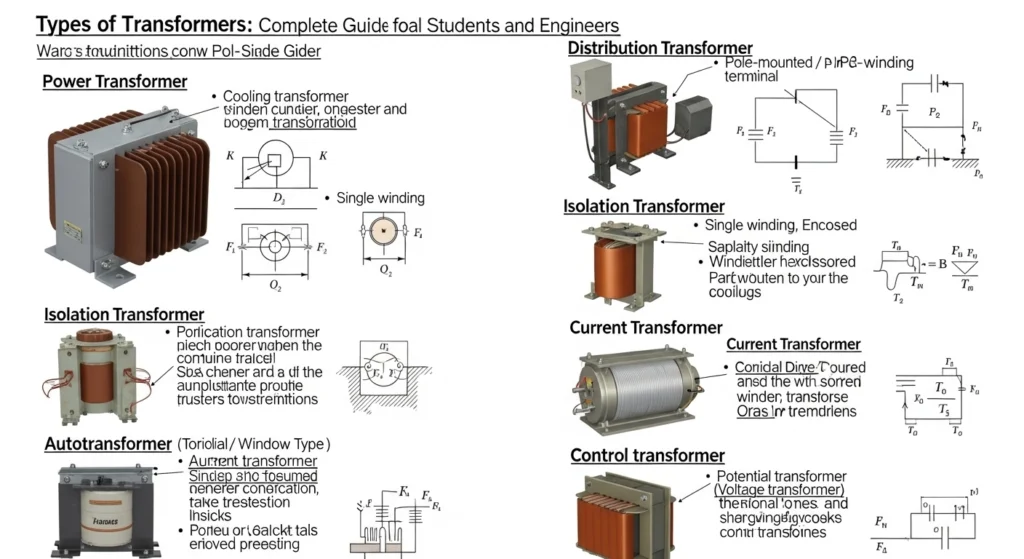
Power Transformer
A power transformer is a high-capacity electrical device used in power generation and transmission systems to transfer electrical energy between circuits at different voltage levels. It is mainly designed to operate at high voltages (above 33 kV) and is used in power stations and transmission networks. The main purpose of a power transformer is to step up the voltage for long-distance transmission or step it down for distribution. Its working principle is based on Mutual Induction, where a changing magnetic field in the primary winding induces voltage in the secondary winding.
A power transformer consists of a laminated steel core, primary winding, secondary winding, insulation system, and cooling system. The core provides a path for magnetic flux, while the windings carry electrical current. When alternating current flows through the primary winding, it creates a magnetic field that induces voltage in the secondary winding. The voltage level depends on the turns ratio between the windings. Power transformers are designed to operate efficiently at full load for long periods, which makes them different from distribution transformers that work under varying loads.
One of the most important features of a power transformer is its high efficiency, usually above 95–99%, because it is designed to minimize energy losses. It uses advanced cooling methods such as oil cooling, air cooling, or forced cooling systems to handle heat generated during operation. These transformers are typically installed in power stations, substations, and grid networks where large amounts of electrical energy are handled.
The advantages of a power transformer include high efficiency, reliable operation, and ability to handle large voltage and power levels. It plays a key role in reducing transmission losses and ensuring stable power supply over long distances. However, it also has some disadvantages. It is large in size, expensive to install, and requires regular maintenance and protection systems to ensure safe operation.
Overall, a power transformer is an essential component of the electrical power system. It enables efficient transmission and distribution of electricity, ensuring that power generated at plants reaches consumers safely and effectively.
- Used in transmission network
- High voltage and high power
- Installed in substations
Distribution Transformer
A distribution transformer is an electrical device used to step down high voltage electricity to a lower voltage level that can be safely used in homes, offices, shops, and small industries. It is an important part of the power distribution system and is usually installed near residential or commercial areas. The main function of a distribution transformer is to provide the final voltage transformation before electricity reaches the consumer. Its working principle is based on Mutual Induction, where a changing magnetic field in the primary winding induces voltage in the secondary winding.
A distribution transformer consists of a laminated steel core, primary winding, secondary winding, insulation system, and cooling arrangement. The primary winding receives high voltage from the transmission or sub-transmission system, while the secondary winding delivers reduced voltage suitable for end users (such as 415V or 230V). These transformers are designed to operate at low load conditions for most of the time, with high efficiency at partial loads. They are commonly oil-immersed or dry-type, depending on the application and installation environment.
One of the key features of a distribution transformer is its ability to provide stable and safe voltage supply to consumers. It ensures that electrical appliances receive the correct voltage level, preventing damage and improving performance. These transformers are usually installed on poles, ground-mounted substations, or inside buildings. They are designed for continuous operation with minimal maintenance requirements.
The advantages of distribution transformers include high efficiency at low loads, reliable performance, and long service life. They help reduce voltage from transmission levels to usable levels, making electricity safe for everyday use. However, they also have some limitations. They are not designed for heavy overloads and may suffer from losses if not properly maintained. Overheating and insulation failure can also occur if load conditions are not properly managed.
Overall, a distribution transformer plays a vital role in the electrical power system. It ensures safe, efficient, and reliable delivery of electricity from the grid to consumers, making it an essential component of modern power distribution networks.
- Used near consumer areas
- Lower voltage levels
- Smaller size compared to power transformer
Instrument Transformer
An instrument transformer is a special type of transformer used in electrical power systems to measure high voltage and high current safely. It is designed to step down these large electrical quantities to a lower, manageable value that can be easily measured by standard instruments like voltmeters, ammeters, wattmeters, and energy meters. Instrument transformers are mainly used for protection and measurement purposes in substations and power systems. Their working principle is based on Mutual Induction, where a changing magnetic field in the primary winding induces a proportional voltage or current in the secondary winding.
There are two main types of instrument transformers: Current Transformer (CT) and Potential Transformer (PT) or Voltage Transformer (VT). A current transformer reduces high current values to a standard low current (usually 5A or 1A) so that measuring instruments can safely read the current in the circuit. On the other hand, a potential transformer reduces high voltage to a standard low voltage (such as 110V) for measurement and protection devices. Both types ensure safety by isolating the measuring instruments from the high-voltage power system.
Instrument transformers are made using a magnetic core, primary winding, and secondary winding. The primary winding is connected to the high-voltage circuit, while the secondary winding is connected to measuring or protection devices. These transformers are designed with high accuracy so that the measurements are reliable and precise. They also provide electrical isolation, which protects both equipment and operators from dangerous high voltages.
One of the major advantages of instrument transformers is safety. They allow engineers and technicians to measure high electrical values without direct exposure to dangerous voltages and currents. They also improve accuracy in measurement and are essential for protective relays that detect faults in the system. However, they must be used carefully, as incorrect connection or open-circuit operation of a current transformer can be hazardous.
Overall, instrument transformers are essential components in modern power systems. They ensure safe monitoring, accurate measurement, and effective protection of electrical networks, making them highly important in power generation, transmission, and distribution systems.
Used for measurement and protection.
Current Transformer (CT)
A Current Transformer (CT) is a type of instrument transformer used to measure high alternating current (AC) in power systems safely. It reduces large current values to a small, standardized value that can be easily measured by instruments like ammeters and used in protective relays. The main purpose of a CT is to ensure safe monitoring and protection of electrical systems without directly connecting measuring devices to high-current lines. Its working principle is based on Mutual Induction, where current in the primary winding produces a magnetic field that induces a proportional current in the secondary winding.
A current transformer has two windings: the primary winding and the secondary winding. The primary winding is usually connected in series with the power line and carries the actual high current. The secondary winding is connected to measuring instruments or protection devices and produces a reduced current, typically 5A or 1A. The ratio between primary and secondary current depends on the number of turns in the windings. For example, a CT with a ratio of 1000:5 means that when 1000A flows in the primary, 5A flows in the secondary.
One of the most important features of a CT is safety. It isolates high-voltage circuits from measuring equipment, protecting both instruments and operators. CTs are widely used in substations, power plants, and industrial electrical systems for monitoring load current and detecting faults. They also play a key role in protective relays that help disconnect faulty circuits and prevent damage to equipment.
The advantages of current transformers include high accuracy, safe operation, and ability to handle very high currents. They are compact and reliable, making them suitable for modern power systems. However, there is an important safety precaution: the secondary of a CT should never be left open while the primary is energized, as it can generate dangerously high voltage.
Overall, a Current Transformer is an essential device in electrical engineering. It ensures safe current measurement, reliable system protection, and efficient monitoring of power systems in generation, transmission, and distribution networks.
Potential Transformer (PT)
A Potential Transformer (PT), also known as a Voltage Transformer (VT), is an instrument transformer used to measure high alternating voltage safely in power systems. It steps down high voltage levels to a low, standardized voltage that can be easily measured by voltmeters, wattmeters, energy meters, and protection relays. The main purpose of a PT is to provide accurate voltage measurement and electrical isolation between high-voltage power circuits and measuring instruments. Its working principle is based on Mutual Induction, where a changing magnetic field in the primary winding induces a proportional voltage in the secondary winding.
A potential transformer consists of a primary winding connected across the high-voltage line and a secondary winding connected to measuring or protection devices. The primary winding handles the high voltage, while the secondary winding produces a reduced and safe voltage, usually 110V or 63.5V depending on the system. The voltage ratio between primary and secondary depends on the number of turns in the windings. For example, a PT with a ratio of 11kV/110V reduces 11,000 volts to 110 volts for safe measurement.
One of the most important functions of a PT is safety. It isolates high-voltage circuits from operators and instruments, preventing electrical hazards. It also ensures accurate voltage measurement, which is essential for proper monitoring and control of electrical power systems. PTs are widely used in substations, power plants, and industrial electrical systems for metering and protection purposes.
The advantages of potential transformers include high accuracy, reliable performance, and safe operation. They allow sensitive measuring devices to work without direct exposure to high voltage. However, they must be properly rated and installed, as incorrect usage can affect measurement accuracy and system safety.
Overall, a Potential Transformer is a vital component in electrical engineering. It ensures safe voltage measurement, system protection, and accurate monitoring in power generation, transmission, and distribution networks.
These reduce high current or voltage to safe levels for meters and relays.
Based on Cooling Method
Oil-Immersed Transformer
An oil-immersed transformer is a type of transformer in which the core and windings are completely submerged in insulating oil inside a sealed tank. This oil acts as both an insulator and a cooling medium, helping the transformer operate safely and efficiently under high load conditions. It is widely used in power stations, substations, and industrial applications where large amounts of electrical energy need to be handled. The working principle of an oil-immersed transformer is based on Mutual Induction, where alternating current in the primary winding produces a magnetic field that induces voltage in the secondary winding.
The main components of an oil-immersed transformer include the magnetic core, primary winding, secondary winding, insulating oil, and tank. The transformer oil plays a very important role. It provides insulation between live parts and also removes heat generated during operation. When the transformer is under load, heat is produced in the windings and core. The oil absorbs this heat and transfers it to the outer tank surface, where it is dissipated into the surrounding air. In large transformers, cooling radiators and fans are also used to improve heat dissipation.
One of the biggest advantages of an oil-immersed transformer is its high efficiency and excellent cooling capability. The oil prevents overheating and increases the life of the transformer. It also provides strong insulation, allowing the transformer to handle high voltages safely. These transformers are reliable and suitable for continuous heavy-duty operation. However, they also have some disadvantages. They require regular maintenance, and there is a risk of oil leakage or fire if not properly maintained. The oil can also degrade over time and needs testing or replacement.
Overall, oil-immersed transformers are essential in modern power systems. Their strong insulation, effective cooling, and ability to handle high power levels make them a preferred choice for large-scale electrical transmission and distribution networks.
- Windings immersed in oil
- Oil provides cooling and insulation
- Used in large power systems
Dry-Type Transformer
A dry-type transformer is a type of transformer that does not use any liquid such as oil for cooling or insulation. Instead, it uses air and solid insulation materials like epoxy resin to protect the core and windings. This makes it safer and more environmentally friendly compared to oil-filled transformers. Dry-type transformers are commonly used in buildings, hospitals, shopping malls, metro stations, and industrial plants where fire safety is very important. The working principle of a dry-type transformer is based on Mutual Induction, where alternating current in the primary winding creates a magnetic field that induces voltage in the secondary winding.
In a dry-type transformer, the core is made of laminated silicon steel to reduce losses, and the windings are insulated using materials like varnish or epoxy resin. The primary winding receives input voltage, while the secondary winding delivers the required output voltage. Since there is no oil, the heat generated during operation is removed by natural air circulation or forced air cooling using fans. This makes the transformer simpler in design and easier to install indoors.
One of the main advantages of a dry-type transformer is its high safety level. Since it does not contain oil, there is no risk of fire or oil leakage, making it suitable for indoor and sensitive environments. It also requires less maintenance and is more environmentally friendly. Additionally, it has good performance in polluted or humid areas because it is sealed and protected from moisture and dust.
However, dry-type transformers also have some limitations. Their cooling efficiency is lower compared to oil-immersed transformers, so they are usually used for lower to medium power ratings. They can also be more expensive for the same capacity.
Overall, a dry-type transformer is a safe, reliable, and eco-friendly solution for modern electrical systems, especially in places where fire safety and clean operation are important.
- Air-cooled
- Used indoors
- Low maintenance
Based on Phases
Single-Phase Transformer
A single-phase transformer is an electrical device used to transfer electrical energy between two circuits using a single alternating current (AC) phase. It is mainly used to step up or step down voltage levels in residential, commercial, and light industrial applications. The basic working principle of a single-phase transformer is based on Mutual Induction, where a changing current in the primary winding creates a magnetic field that induces voltage in the secondary winding.
A single-phase transformer consists of a laminated iron core, primary winding, and secondary winding. The primary winding is connected to the AC supply, while the secondary winding delivers the output voltage. When AC current flows through the primary coil, it produces an alternating magnetic flux in the core. This flux links both windings and induces an electromotive force (EMF) in the secondary winding. The voltage transformation depends on the turns ratio between the primary and secondary coils. If the secondary has more turns than the primary, the voltage increases (step-up), and if it has fewer turns, the voltage decreases (step-down).
One of the key advantages of a single-phase transformer is its simple design and easy installation. It is compact, cost-effective, and requires low maintenance. These transformers are commonly used in household power supply systems, small electronic devices, lighting systems, and low-power applications. They are also used in rural electrification where power demand is relatively low.
However, there are some limitations. A single-phase transformer is not suitable for heavy industrial loads or large power transmission systems. It has lower efficiency compared to three-phase transformers when used for high-power applications. Also, it is less stable for large-scale power distribution.
Overall, a single-phase transformer is an essential and widely used electrical device. It provides safe and efficient voltage conversion for everyday applications, making it a key component in modern electrical distribution systems.
- Used in homes
- Small load applications
Three-Phase Transformer
A three-phase transformer is an electrical device used to transfer electrical energy between two three-phase systems at different voltage levels. It is widely used in power generation, transmission, and industrial applications where large amounts of electricity are required. The main purpose of a three-phase transformer is to step up or step down voltage in a three-phase power system while maintaining efficiency and stability. Its working principle is based on Mutual Induction, where a changing magnetic field in the primary windings induces voltage in the secondary windings.
A three-phase transformer can be constructed in two main ways: either by combining three single-phase transformers or by using a single unit with a shared magnetic core. It consists of primary and secondary windings for each phase, arranged on a laminated iron core. When a three-phase AC supply is given to the primary windings, it produces a rotating magnetic field in the core. This magnetic field induces voltage in the secondary windings, providing three-phase output at the required voltage level. The voltage transformation depends on the turns ratio of the windings.
One of the main advantages of a three-phase transformer is its high efficiency and ability to handle large power loads. It is more economical and compact compared to using three separate single-phase transformers. It also provides better voltage regulation and smoother power delivery, which is important for industrial machines and large electrical systems. These transformers are commonly used in power stations, substations, manufacturing plants, and heavy industries.
However, there are some disadvantages as well. Three-phase transformers are more complex in design and require careful installation and maintenance. If one phase fails, it can affect the entire system. They are also more expensive than single-phase transformers for small-scale applications.
Overall, a three-phase transformer is a crucial component in modern power systems. It ensures efficient, stable, and large-scale transmission and distribution of electrical energy, making it essential for industrial and utility-level power networks.
- Used in industries
- High power applications
Based on Special Purpose
Auto Transformer
An auto transformer is a type of electrical transformer in which both primary and secondary windings are connected in a single continuous winding. Unlike conventional transformers, it does not have separate primary and secondary coils. Instead, a portion of the same winding acts as both primary and secondary, depending on the connection point. It is commonly used to step up or step down voltage levels efficiently in power systems, industrial applications, and motor starting systems. The working principle of an auto transformer is based on Mutual Induction, where a changing magnetic field in the winding induces voltage along different sections of the same coil.
In an auto transformer, the single winding is tapped at different points to provide required voltage levels. When AC voltage is applied, current flows through the winding and creates a magnetic flux in the core. This flux induces voltage across different parts of the same winding. Depending on the tap position, the output voltage can be higher or lower than the input voltage. If the output is taken from a portion of the winding, it acts as a step-down transformer, and if taken from the full winding, it can act as a step-up transformer.
One of the major advantages of an auto transformer is its high efficiency because it uses less copper and has lower losses compared to conventional transformers. It is also smaller, lighter, and more cost-effective for the same power rating. Auto transformers provide better voltage regulation and are commonly used in applications like voltage control, induction motor starting, and interconnecting systems with small voltage differences.
However, there are some limitations. The main disadvantage is the lack of electrical isolation between primary and secondary sides, which can be a safety risk. Also, if a fault occurs, it can directly affect both sides of the circuit. Because of this, auto transformers are not suitable for all applications, especially where isolation is required.
Overall, an auto transformer is an efficient and economical solution for voltage control and power transfer. Its simple design, reduced material usage, and high performance make it useful in many industrial and electrical engineering applications.
- Single winding
- Smaller size
- Used in voltage regulation
Isolation Transformer
An isolation transformer is a special type of transformer designed to provide electrical isolation between the primary (input) and secondary (output) circuits while maintaining the same voltage level. Its main purpose is to improve safety and protect equipment and users from electric shock, noise, and voltage disturbances. The working principle of an isolation transformer is based on Mutual Induction, where electrical energy is transferred from one coil to another through a magnetic field without direct electrical connection.
An isolation transformer consists of a primary winding and a secondary winding wound separately on a laminated iron core. When alternating current flows through the primary winding, it produces a changing magnetic flux in the core. This flux induces an equal voltage in the secondary winding. In most cases, the input and output voltages are the same (for example, 230V to 230V), but the key feature is galvanic isolation, meaning there is no direct electrical path between the two sides. This separation helps to prevent electric shock and reduces the risk of damage from faults.
One of the major advantages of an isolation transformer is safety. It protects users from direct contact with live electrical circuits. It also helps reduce electrical noise, voltage spikes, and interference, making it very useful for sensitive electronic equipment like medical devices, laboratory instruments, and communication systems. Isolation transformers are also used in industrial environments to protect control circuits and improve system stability.
However, there are some limitations. Isolation transformers are generally bulkier and more expensive than standard transformers of the same rating. They also do not change voltage levels unless specifically designed to do so. Additionally, they still require proper installation and maintenance to ensure safe operation.
Overall, an isolation transformer is an important safety device in electrical systems. It provides electrical separation, enhances protection, and improves the reliability of sensitive equipment, making it essential in both industrial and critical applications.
- Provides electrical isolation
- Used for safety
Understanding the difference between power transformer and distribution transformer is important for exams and practical field work.
Main Components of a Transformer (2026 Guide)
A transformer is made up of several important components that work together to transfer electrical energy efficiently from one circuit to another through electromagnetic induction. Each component performs a specific function, such as creating a magnetic path, transferring energy, providing insulation, dissipating heat, or ensuring safe electrical connections.
Understanding these components is essential for electrical students, engineers, and technicians because they directly affect the transformer’s performance, efficiency, and reliability.
1. Transformer Core
What is a Transformer Core?
The transformer core is the magnetic part of the transformer that provides a low-resistance path for magnetic flux generated by the primary winding. It is usually made of laminated silicon steel sheets, which help reduce energy losses caused by eddy currents and hysteresis.
The laminated construction improves efficiency by minimizing heat generation and ensuring effective magnetic coupling between the primary and secondary windings.
Main Functions
- Provides a closed magnetic path for flux.
- Transfers magnetic flux between the windings.
- Reduces eddy current losses.
- Minimizes hysteresis losses.
- Improves transformer efficiency.
- Supports the windings mechanically.
2. Primary Winding
What is the Primary Winding?
The primary winding is the input coil of the transformer that is connected to the AC power supply. When alternating current flows through this winding, it creates a changing magnetic field inside the transformer core.
The number of turns in the primary winding, together with the secondary winding, determines whether the transformer operates as a step-up or step-down transformer.
Main Functions
- Receives electrical power from the AC source.
- Produces a changing magnetic field.
- Transfers electrical energy to the core.
- Initiates the electromagnetic induction process.
- Determines the input voltage characteristics.
3. Secondary Winding
What is the Secondary Winding?
The secondary winding is the output coil of the transformer. It receives the changing magnetic flux from the transformer core and converts it back into electrical energy through electromagnetic induction.
The output voltage depends on the ratio of the secondary turns to the primary turns. The secondary winding supplies electrical power to the connected load.
Main Functions
- Receives magnetic flux from the transformer core.
- Produces the output voltage.
- Delivers electrical power to the load.
- Determines the output voltage level.
- Completes the energy transfer process.
4. Insulation System
What is Transformer Insulation?
The insulation system consists of insulating materials placed between the windings, core, and other conductive parts of the transformer. Common insulating materials include paper, varnish, epoxy resin, pressboard, and insulating oil.
Proper insulation prevents electrical leakage, short circuits, flashovers, and dielectric breakdown, ensuring safe and reliable transformer operation.
Main Functions
- Prevents short circuits between windings.
- Electrically isolates transformer components.
- Reduces the risk of electrical faults.
- Improves operational safety.
- Increases the service life of the transformer.
- Withstands high operating voltages.
5. Transformer Oil (Oil-Filled Transformers)
What is Transformer Oil?
Transformer oil is a specially refined insulating mineral oil or synthetic insulating fluid used in oil-filled transformers. It performs two essential functions: cooling and electrical insulation.
As the transformer operates, heat generated by the windings and core is absorbed by the oil and transferred to the transformer tank and cooling system. The oil also provides insulation between energized components, reducing the possibility of electrical breakdown.
Main Functions
- Cools the transformer.
- Provides electrical insulation.
- Dissipates heat efficiently.
- Prevents overheating.
- Protects internal components.
- Extends transformer life.
- Suppresses electrical arcing inside the tank.
6. Transformer Tank and Bushings
What are the Tank and Bushings?
The transformer tank is the strong metal enclosure that houses the transformer core, windings, insulation, and transformer oil. It protects the internal components from dust, moisture, weather conditions, and mechanical damage.
Bushings are insulated devices mounted on the transformer tank that allow electrical conductors to pass safely through the grounded metal enclosure without causing electrical leakage or short circuits.
Main Functions of the Transformer Tank
- Protects internal transformer components.
- Holds transformer oil.
- Dissipates heat to the surrounding air.
- Prevents contamination by dust and moisture.
- Provides mechanical strength and durability.
Main Functions of Bushings
- Provide safe external electrical connections.
- Insulate high-voltage conductors from the transformer tank.
- Prevent electrical leakage and flashover.
- Ensure safe transmission of electrical power into and out of the transformer.
How the Main Components of a Transformer Work Together
All transformer components work together in a coordinated sequence to transfer electrical energy efficiently and safely.
Step-by-Step Working Process
- The primary winding receives AC electrical power from the source.
- The primary winding generates a changing magnetic field.
- The laminated transformer core carries the magnetic flux efficiently.
- The changing magnetic flux induces voltage in the secondary winding.
- The secondary winding supplies electrical power to the connected load.
- The insulation system prevents electrical leakage and short circuits.
- Transformer oil removes heat and provides additional insulation (in oil-filled transformers).
- The tank protects all internal components, while the bushings provide safe external electrical connections.
The main components of a transformer include the transformer core, primary winding, secondary winding, insulation system, transformer oil, tank, and bushings. Each component performs a critical role in transferring electrical energy efficiently through electromagnetic induction while ensuring safe, reliable, and long-lasting operation. Together, these components enable transformers to provide efficient voltage transformation for residential, commercial, industrial, and power transmission applications.
Advantages of Transformers
Here are the main transformer advantages and disadvantages. First, advantages:
- Efficient voltage conversion
- No moving parts
- Low maintenance
- High efficiency (up to 98%)
- Reliable and long life
- Essential for power transmission
Real-world benefit: Without transformers, long-distance power transmission would be impossible.
Disadvantages / Limitations
- Works only with AC
- Heavy and bulky (large units)
- Oil leakage risk (oil type)
- Initial cost can be high
- Efficiency reduces under light load
Engineers must consider these factors during selection.
Applications of Different Types of Transformers (2026 Guide)
Different types of transformers are used throughout the electrical power system, from electricity generation to transmission, distribution, and end-user applications. They are also essential in residential, commercial, industrial, renewable energy, and electronic systems. Each transformer type is designed to perform a specific function, ensuring safe, efficient, and reliable electrical power transfer.
1. Residential (Home) Applications
Transformers are widely used in homes to provide safe operating voltages for electrical appliances and electronic devices.
Common Residential Applications
- Mobile phone chargers
- Laptop adapters
- Television power supplies
- Doorbell transformers
- LED lighting systems
- UPS (Uninterruptible Power Supply) systems
- Home inverters
- Air conditioners
- Smart home devices
- Home security systems
Benefits
- Provides safe operating voltage.
- Protects household appliances.
- Improves electrical efficiency.
- Enhances user safety.
2. Commercial Applications
Commercial buildings require transformers to supply reliable power for daily operations.
Common Commercial Applications
- Office buildings
- Shopping malls
- Hospitals
- Hotels
- Schools and universities
- Banks
- Data processing centers
- Commercial lighting systems
- HVAC (Heating, Ventilation, and Air Conditioning) systems
Benefits
- Stable power distribution.
- Reliable operation of electrical equipment.
- Improved energy management.
- Reduced power interruptions.
3. Industrial Applications
Industries use different types of transformers to operate heavy electrical machinery and manufacturing equipment.
Common Industrial Applications
- Motor control centers (MCCs)
- Welding machines
- Industrial automation systems
- CNC machines
- Manufacturing plants
- Steel mills
- Cement factories
- Mining equipment
- Chemical processing plants
- Industrial furnaces
Benefits
- Supplies appropriate operating voltage.
- Supports high-power industrial loads.
- Improves equipment efficiency.
- Enhances operational reliability.
4. Power System Applications
Transformers are one of the most important components of electrical power systems.
Common Power System Applications
- Step-up voltage at generating stations.
- Step-down voltage at transmission substations.
- Electrical power distribution.
- Grid voltage regulation.
- Current and voltage measurement using instrument transformers.
- Relay protection systems.
- Power transmission over long distances.
- Distribution to residential and commercial consumers.
Benefits
- Reduces transmission losses.
- Improves voltage regulation.
- Enables efficient long-distance power transfer.
- Ensures reliable electrical distribution.
5. Renewable Energy Applications
Modern renewable energy systems depend heavily on transformers for efficient power conversion and grid integration.
Common Renewable Energy Applications
- Solar photovoltaic (PV) power plants.
- Wind farms.
- Hydroelectric power stations.
- Battery Energy Storage Systems (BESS).
- Microgrids.
- Smart grids.
- Hybrid renewable energy systems.
Benefits
- Supports renewable energy integration.
- Improves grid stability.
- Increases energy efficiency.
- Enables safe power transmission.
6. Transportation Applications
Transformers are widely used in modern transportation systems to provide reliable electrical power.
Common Transportation Applications
- Electric vehicle (EV) charging stations.
- Electric railways.
- Metro rail systems.
- High-speed trains.
- Airport electrical infrastructure.
- Marine electrical systems.
Benefits
- Provides safe charging voltage.
- Supports high-power transportation systems.
- Improves energy efficiency.
- Ensures reliable electrical operation.
7. Information Technology and Communication Applications
The IT and communication industries require stable power supplies to protect sensitive electronic equipment.
Common Applications
- Data centers.
- Server rooms.
- Telecommunication towers.
- Internet infrastructure.
- Broadcasting stations.
- Computer power supplies.
- Networking equipment.
Benefits
- Stable power supply.
- Equipment protection.
- Reduced downtime.
- Improved system reliability.
8. Special Applications
Certain transformers are designed for specialized electrical applications.
Examples
- Medical equipment.
- Laboratory testing.
- Audio systems.
- Isolation transformers.
- Furnace transformers.
- Rectifier transformers.
- Instrument transformers (CTs and PTs).
- High-voltage testing laboratories.
The applications of different types of transformers extend across residential, commercial, industrial, power generation, transmission, renewable energy, transportation, information technology, and specialized electrical systems. From charging a mobile phone to transmitting electricity over hundreds of kilometers, transformers play a critical role in ensuring safe, efficient, and reliable voltage conversion. As smart grids, renewable energy, and electric vehicles continue to expand, the importance of transformers in modern electrical infrastructure will only continue to grow.
Comparison Section
Difference Between Power Transformer and Distribution Transformer
| Feature | Power Transformer | Distribution Transformer |
| Location | Transmission station | Near consumers |
| Voltage Level | Very high | Medium to low |
| Load | Full load operation | Variable load |
| Size | Large | Smaller |
| Efficiency Focus | At full load | At all-day load |
This comparison helps in understanding application differences.
Selection Guide
Choosing the right transformer depends on:
- Required voltage level
- Power rating (kVA)
- Installation location
- Cooling method
- Budget
- Safety requirements
Tips for Beginners
- Always check load requirement first.
- Calculate future expansion load.
- Consider efficiency and losses.
- Follow local electrical standards.
Never select a transformer only based on price.
Common Transformer Problems and Solutions (FAQs – 2026 Guide)
Transformers are highly reliable electrical devices, but they can develop faults due to overloading, poor maintenance, insulation failure, environmental conditions, or aging. Identifying these problems early helps improve transformer performance, extend its service life, and prevent costly breakdowns.
Q1: Why Does a Transformer Overheat?
Possible Causes
Transformer overheating is one of the most common problems and may occur due to:
- Overloading beyond the rated capacity.
- Poor ventilation or inadequate cooling.
- Low transformer oil level (oil-filled transformers).
- Blocked radiators or cooling fans.
- High ambient temperature.
- Internal winding faults or insulation deterioration.
Solution
- Reduce the connected load to within the transformer’s rated capacity.
- Check the cooling system, radiators, cooling fans, and oil pumps.
- Inspect and maintain the transformer oil level.
- Clean cooling fins and ventilation openings.
- Monitor transformer temperature regularly.
- Perform preventive maintenance and insulation testing.
Q2: Why Does a Transformer Produce a Humming Sound?
Possible Causes
A slight humming sound is normal during transformer operation because of magnetostriction, where the transformer core expands and contracts as the magnetic field changes.
Excessive humming may be caused by:
- Loose core laminations.
- Loose mounting bolts.
- Mechanical vibration.
- Overloading.
- Harmonic distortion in the electrical supply.
Solution
- Tighten core clamping bolts and mounting hardware.
- Inspect the transformer foundation.
- Check for loose mechanical components.
- Ensure the transformer is not overloaded.
- Analyze the power supply for excessive harmonics.
Q3: Why Is the Transformer Oil Level Decreasing?
Possible Causes
A decreasing oil level may result from:
- Oil leakage from gaskets, valves, or bushings.
- Damaged seals.
- Evaporation caused by overheating.
- Cracks in the transformer tank.
- Improper maintenance.
Solution
- Inspect the transformer tank for oil leaks.
- Replace damaged seals and gaskets.
- Repair leaking valves or bushings.
- Refill the transformer with approved insulating oil if necessary.
- Monitor oil levels during routine inspections.
Q4: What Causes Voltage Drop in a Transformer?
Possible Causes
Voltage drop can occur because of:
- Transformer overloading.
- Poor voltage regulation.
- Long distribution lines.
- Loose electrical connections.
- High starting current of large motors.
- Incorrect transformer sizing.
Solution
- Balance electrical loads properly.
- Operate the transformer within its rated capacity.
- Tighten electrical connections.
- Upgrade to a transformer with an appropriate rating if necessary.
- Regularly monitor voltage levels and load conditions.
Q5: Why Does a Transformer Trip Frequently?
Possible Causes
Frequent transformer tripping may be caused by:
- Short circuits.
- Overcurrent conditions.
- Earth faults.
- Internal winding faults.
- Protective relay operation.
- Severe overload.
Solution
- Inspect the transformer for electrical faults.
- Check protective relays and circuit breakers.
- Test winding insulation resistance.
- Eliminate overload conditions.
- Repair damaged components before restarting the transformer.
Q6: Why Does Transformer Insulation Fail?
Possible Causes
Transformer insulation can deteriorate due to:
- Aging.
- Excessive heat.
- Moisture contamination.
- Electrical surges.
- Poor maintenance.
Solution
- Perform regular insulation resistance (IR) testing.
- Keep moisture out of the transformer.
- Replace damaged insulation materials.
- Maintain proper operating temperatures.
- Schedule preventive maintenance inspections.
Future Trends in Transformer Technology (2026 and Beyond)
Transformer technology is rapidly evolving to meet the growing demand for smarter power grids, renewable energy integration, higher efficiency, and environmentally friendly electrical systems. Modern transformers are becoming more intelligent, compact, and energy-efficient while supporting digital monitoring and predictive maintenance.
1. Smart Transformers
Smart transformers use advanced sensors, communication systems, and digital monitoring technologies to improve the reliability and efficiency of electrical power systems.
Key Features
- Real-time performance monitoring.
- Remote operation and control.
- Automatic voltage regulation.
- AI-based fault detection.
- Predictive maintenance.
- IoT connectivity.
- Cloud-based performance analysis.
Benefits
- Improved system reliability.
- Faster fault detection.
- Reduced maintenance costs.
- Increased operational efficiency.
- Better power quality management.
2. Eco-Friendly Insulating Fluids
Traditional mineral oil is gradually being replaced by environmentally friendly insulating fluids.
Modern Insulating Fluids
- Natural ester oil.
- Synthetic ester oil.
- Biodegradable insulating fluids.
Advantages
- Environmentally friendly.
- Biodegradable.
- Higher fire safety.
- Improved insulation performance.
- Longer transformer life.
- Reduced environmental impact.
3. Compact and High-Efficiency Transformer Designs
Advances in magnetic materials and manufacturing techniques are enabling the development of smaller, lighter, and more efficient transformers.
Modern Improvements
- High-efficiency magnetic cores.
- Amorphous metal core technology.
- Improved insulation materials.
- Reduced energy losses.
- Higher power density.
- Lightweight construction.
- Better cooling performance.
Benefits
- Lower operating costs.
- Reduced installation space.
- Improved efficiency.
- Longer service life.
4. Integration with Renewable Energy Systems
As renewable energy continues to expand, transformers are being designed specifically for clean energy applications.
Applications
- Solar photovoltaic (PV) power plants.
- Wind farms.
- Hydroelectric stations.
- Battery Energy Storage Systems (BESS).
- Microgrids.
- Smart grids.
- Electric vehicle (EV) charging infrastructure.
Benefits
- Improved renewable energy integration.
- Stable voltage regulation.
- Higher grid reliability.
- Better energy management.
- Support for sustainable power systems.
5. Digital Monitoring and Predictive Maintenance
Modern transformers increasingly use intelligent monitoring systems that continuously analyze operating conditions.
Advanced Monitoring Features
- Online temperature monitoring.
- Oil quality analysis.
- Dissolved Gas Analysis (DGA).
- Moisture monitoring.
- Load monitoring.
- Partial discharge detection.
- Remote diagnostics.
- Predictive maintenance using Artificial Intelligence (AI).
Benefits
- Early fault detection.
- Reduced downtime.
- Lower maintenance costs.
- Improved transformer reliability.
- Extended equipment lifespan.
The future of transformer technology is focused on higher efficiency, intelligent monitoring, environmental sustainability, and seamless integration with modern power systems. Innovations such as smart transformers, biodegradable insulating fluids, compact high-efficiency designs, renewable energy integration, and AI-based predictive maintenance are transforming the electrical industry. These advancements will make future transformers safer, more reliable, energy-efficient, and better suited to support the growing demands of smart grids and sustainable electrical infrastructure.
Conclusion
Understanding the types of transformers is fundamental for every electrical student and engineer. Transformers change voltage levels efficiently and safely using the principle of electromagnetic induction. We discussed classification based on voltage, construction, application, cooling, and phase.
We also covered transformer working principle, types of transformers applications, and transformer advantages and disadvantages. Proper selection ensures system safety, reliability, and efficiency.
As a junior engineer, always focus on load calculation, cooling method, and safety standards before selecting a transformer. Mastering this topic will strengthen your knowledge in power systems and electrical engineering.