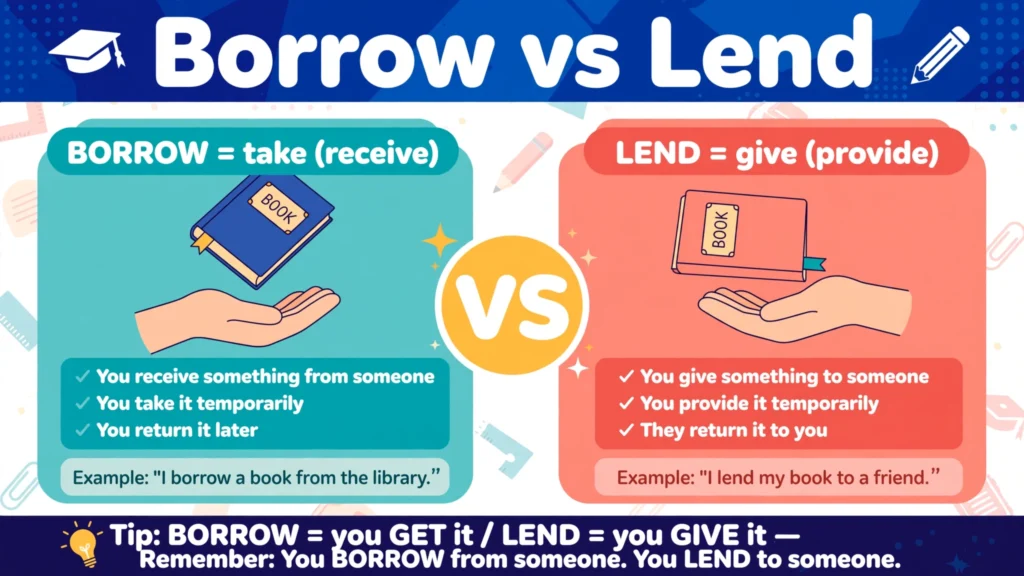

“Can you borrow me your pen?” If that sentence sounds fine to you, you are making one of the most common mistakes in English. The correct version is “Can you lend me your pen?” — and the difference between borrow and lend is worth getting right, because mixing them up instantly marks you as a learner.
The distinction is simple once you see it: it is all about the direction of the action.
What Does Borrow Mean?
Borrow means to take something from someone with the intention of returning it later. The borrower is the receiver.
- Can I borrow your pen for a minute? (I take it, I will return it.)
- She borrowed $50 from her brother. (She received the money temporarily.)
- We borrowed a tent for the camping trip. (We took it to use.)
- He borrows books from the library every week. (He takes them home temporarily.)
- May I borrow your charger? Mine is broken.
Key grammar point: you borrow from someone. “Borrow from,” never “borrow to.”
- I borrowed some sugar from my neighbor. ✓
- I borrowed my neighbor some sugar. ✗ (This reverses the meaning!)
What Does Lend Mean?
Lend means to give something to someone temporarily, expecting it back. The lender is the giver.
- Can you lend me your pen for a minute? (You give it, I return it.)
- He lent $50 to his sister. (He gave the money temporarily.)
- They lent us their tent for the trip. (They gave it to us.)
- The library lends books to members. (It gives them out temporarily.)
- She lent me her charger yesterday.
Key grammar point: you lend to someone (or use the double-object form: “lend me your pen”).
- He lent $50 to his sister. ✓
- He lent his sister $50. ✓ (Both are correct.)
Note the past tense: lend → lent (not “lended”). This irregular form trips up many learners.
Borrow vs Lend: Key Differences at a Glance
| Borrow | Lend | |
|---|---|---|
| Core meaning | To take temporarily | To give temporarily |
| Direction | Receiver ← thing | Giver → thing |
| Who acts? | The person receiving | The person giving |
| Preposition | Borrow from someone | Lend to someone |
| Past tense | Borrowed | Lent (irregular) |
| Example | I borrowed a book from Ali. | Ali lent a book to me. |
| Memory trick | Borrow = Bring toward me | Lend = Let it go |
Think of it as a mirror: both sentences below describe the same event from opposite sides.
- Sara borrowed my bike. (Sara’s perspective — she received.)
- I lent my bike to Sara. (My perspective — I gave.)
If you want to understand how these action words fit into sentences, our guides on main verbs and helping verbs will help.
Borrow vs Lend vs Loan
English adds one more wrinkle: loan.
- As a noun, “loan” is the thing itself: “I got a loan from the bank.” / “She gave me a loan of $100.”
- As a verb, “loan” means the same as “lend” and is common in American English: “The bank loaned me the money.” In British English, “lent” is preferred.
So: the bank lends (or loans) money; you borrow money from the bank; the money itself is a loan.
Common Mistakes to Avoid
- “Can you borrow me your pen?” ✗ → “Can you lend me your pen?” ✓ (You want them to give, so use lend.)
- “I lent a book from the library.” ✗ → “I borrowed a book from the library.” ✓ (You received it, so use borrow.)
- “He borrowed me $20.” ✗ → “He lent me $20.” ✓ (He gave; you received.)
- “She lended me her car.” ✗ → “She lent me her car.” ✓ (Past tense of lend is lent.)
- “Can I lend your notes?” ✗ → “Can I borrow your notes?” ✓ (You want to take them temporarily.)
The golden rule: if you are the receiver, you borrow; if you are the giver, you lend. Say the sentence from your own perspective and the right word usually appears.
Love untangling confusing pairs? See also desert vs dessert and chose vs choose.
Quick Practice: Test Yourself
Choose borrow or lend (use the correct tense), then check your answers.
- Could you ___ me your umbrella? It’s raining.
- I ___ $500 from my cousin last week.
- She ___ her notes to everyone before the exam.
- The museum ___ ancient coins to the exhibition.
- He ___ my bike yesterday and returned it today.
Answers: 1. lend (you want them to give) · 2. borrowed (you received) · 3. lent (she gave; past of lend) · 4. lent (the museum gave) · 5. borrowed (he received)
Got them all? You have mastered the direction rule. If any felt tricky, remember: receiver borrows, giver lends.
Frequently Asked Questions
Is “borrow me” ever correct?
No. “Borrow” means to receive, so “borrow me your pen” is backwards. The correct request is “lend me your pen” (asking them to give) or “Can I borrow your pen?” (asking to receive).
What is the past tense of lend?
Lent. “She lent me her umbrella.” “Lended” is a common error — avoid it.
What is the difference between lend and loan?
As verbs they mean the same thing (to give temporarily); loan as a verb is more American, lend is universal. As a noun, only loan works: “a bank loan.”
Can you borrow money from a bank?
Yes — from your perspective, you borrow money from the bank, and the bank lends money to you. The arrangement itself is called a loan.
Is it “borrow from” or “borrow to”?
Always “borrow from.” You borrow from the giver: “I borrowed a jacket from my friend.”
Why do people confuse borrow and lend?
Many languages use a single word for both directions (like “emprunter” in French or “leihen” in German), so speakers of those languages naturally carry the confusion into English. The direction rule — receiver borrows, giver lends — fixes it.
Final Thoughts
Borrow = take (you receive). Lend = give (they receive; past tense lent). One action, two directions, zero confusion — once you always ask yourself: am I the giver or the receiver? Answer that, and you will never say “borrow me your pen” again.