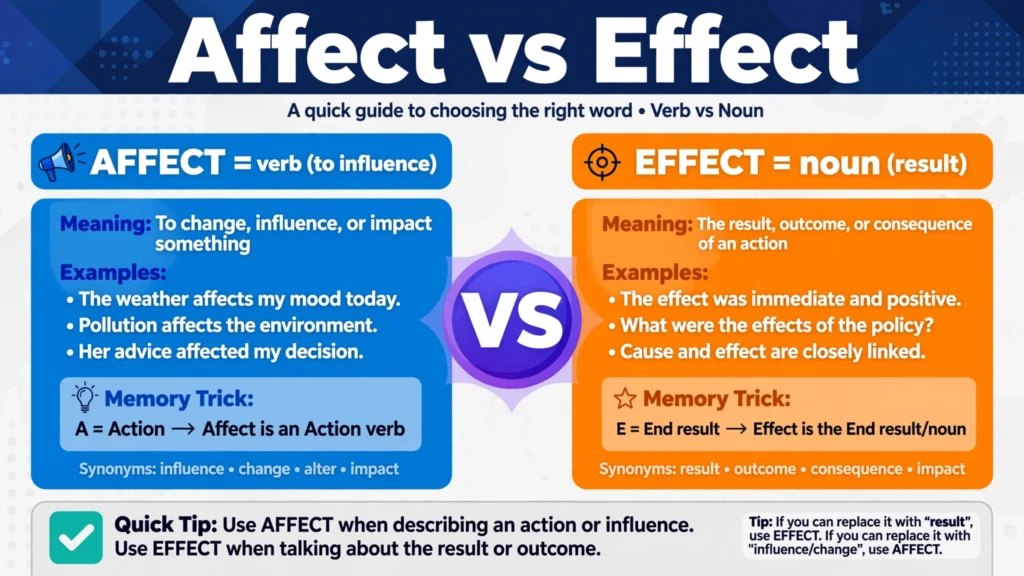

Few word pairs cause as much trouble as affect and effect. They sound almost identical, look nearly the same, and both deal with the world of cause and consequence. Even native speakers mix them up — which is exactly why mastering this pair will make your English stand out.
The good news: the core rule is beautifully simple. Let’s break it down.
What Does Affect Mean?
Affect is almost always a verb meaning to influence, to change, or to have an impact on something.
Think of it this way: Affect is an Action.
- The bad weather affected our travel plans. (The weather influenced the plans.)
- Smoking affects your health. (Smoking influences your health.)
- The new policy will affect thousands of workers. (The policy will change things for them.)
- Lack of sleep affects your concentration. (It influences how well you concentrate.)
- The movie deeply affected the audience. (It moved them emotionally.)
In every case, “affect” is the doing word — something is acting upon something else. If you need a refresher on how action words work, see our guide on what a verb is.
What Does Effect Mean?
Effect is almost always a noun meaning a result, consequence, or outcome.
Memory hook: Effect is the End result.
- The effect of the storm was widespread flooding. (The result was flooding.)
- Exercise has a positive effect on mental health. (A positive result.)
- The new law came into effect in January. (It became active — note this fixed phrase.)
- Special effects made the movie look realistic. (Visual results/tricks.)
- One side effect of the medicine is drowsiness. (A secondary result.)
“Effect” is the thing that happens because of a cause. It is the outcome sitting at the end of the chain.
Affect vs Effect: Key Differences at a Glance
| Affect | Effect | |
|---|---|---|
| Part of speech | Usually a verb | Usually a noun |
| Core meaning | To influence or change | A result or outcome |
| Memory trick | Affect = Action | Effect = End result |
| Example | Rain affected the match. | The effect was a delay. |
| Question it answers | What is influencing? | What happened as a result? |
| Common phrase | “adversely affect” | “take effect”, “in effect” |
A handy test: try substituting the words. If “influence” fits, use affect. If “result” fits, use effect.
- “The criticism deeply ___ed him.” → “The criticism deeply influenced him.” → affected ✓
- “The ___ of the criticism was lasting.” → “The result of the criticism was lasting.” → effect ✓
The Tricky Exceptions
Just when you think you have it, English throws two curveballs. They are rare, but worth knowing:
- “Effect” as a verb — meaning to bring about or cause. Example: “The new CEO effected major changes in the company.” (She brought about the changes.) You will mostly see this in formal or legal writing.
- “Affect” as a noun — a psychology term meaning observable emotion. Example: “The patient displayed a flat affect.” (Showed little emotion.) You will almost never need this outside psychology.
For everyday writing and exams, the simple rule covers 99% of cases: affect = verb (influence), effect = noun (result).
Common Mistakes to Avoid
- “The weather effected our plans.” ✗ → “The weather affected our plans.” ✓ (The weather influenced, not brought about.)
- “What was the affect of the decision?” ✗ → “What was the effect of the decision?” ✓ (You are asking about the result.)
- “This will have a negative affect.” ✗ → “This will have a negative effect.” ✓ (After “a/an/the,” you almost always need the noun.)
- “The movie effected me deeply.” ✗ → “The movie affected me deeply.” ✓ (It influenced your emotions.)
Notice the pattern in mistake #3: after articles like a, an, or the, the noun effect is nearly always correct — “the effect,” “an effect,” “side effects.”
Quick Memory Tricks
- Affect is an Action (verb). Effect is the End result (noun).
- RAVEN: Remember Affect = Verb, Effect = Noun.
- If you can put “the” in front of it, it is probably effect (the effect, the side effect).
- When in doubt in formal writing, restructure the sentence to dodge the pair entirely — even professionals do this.
If you like untangling confusing pairs, you will also enjoy our guides on their vs there, your vs you’re, and breath vs breathe.
Quick Practice: Test Yourself
Fill in affect or effect, then check your answers below.
- The new tax law will ___ small businesses.
- What was the ___ of the announcement on share prices?
- Stress can ___ your immune system.
- The medicine takes ___ within thirty minutes.
- The coach’s speech deeply ___ the players.
Answers: 1. affect (influence) · 2. effect (result) · 3. affect (influence) · 4. effect (“takes effect” = becomes active) · 5. affected (influenced emotionally)
Scored 5/5? The pair is yours. Missed a couple? Re-read the table section once more — the substitution test (“influence” vs “result”) solves nearly every case.
Frequently Asked Questions
Is it “affect change” or “effect change”?
It depends on meaning. “Affect change” means to influence ongoing change. “Effect change” (verb) means to bring change about — common in formal writing: “The committee hopes to effect change.”
Can “effect” ever be a verb?
Yes, but rarely. As a verb, effect means “to bring about”: “to effect a repair,” “to effect change.” Do not confuse this with the everyday noun use.
What is an easy way to remember affect vs effect?
Use RAVEN: Remember Affect = Verb, Effect = Noun. Or simply: affect is the action, effect is the end result.
Is “side affect” or “side effect” correct?
Side effect is correct — it is a noun phrase meaning a secondary result, as in “a side effect of the drug.”
Which is correct: “the weather affects” or “the weather effects”?
“The weather affects” is correct in everyday use (the weather influences things). “Effects” as a verb would mean the weather brings about something, which is not the intended meaning.
Do native speakers confuse affect and effect?
Constantly. It is one of the most common errors in English, appearing in emails, essays, and even published articles. Getting it right immediately signals careful, polished writing.
Final Thoughts
Affect is the action — to influence. Effect is the end result — the outcome. Two tiny words, one simple rule, and a lifetime of clearer writing ahead. Next time you hesitate, run the substitution test (“influence” or “result”?), and you will choose correctly every time.