
The words chose vs choose look almost identical, but they have one important difference: tense. Both words come from the same verb, but they are used at different times.
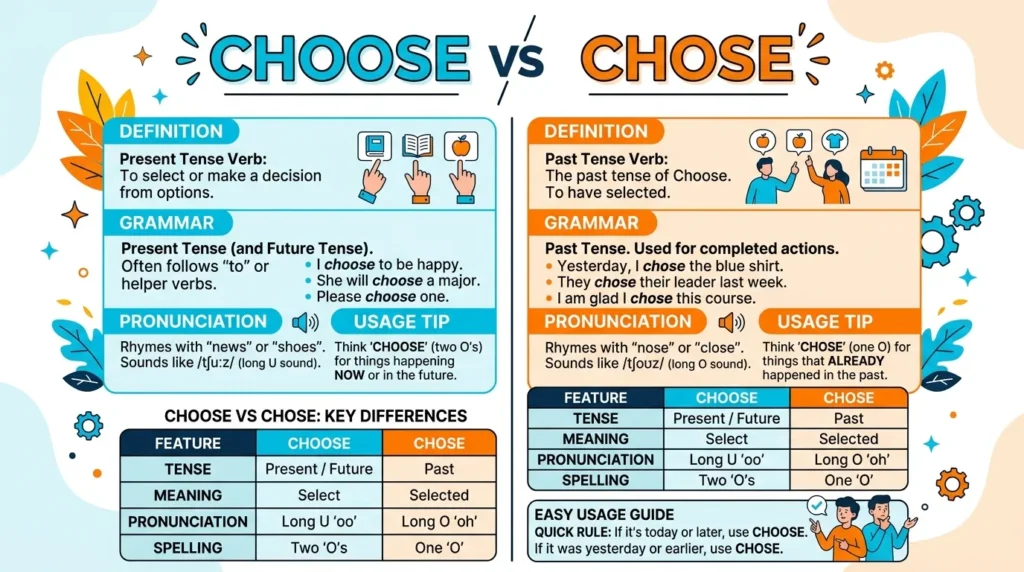
Choose is the present-tense form. It means to select something now or in the future. Chose is the simple past form. It means the selection already happened.
For example, you might say, “I will choose a new phone tomorrow.” But after making the decision, you would say, “I chose the blue phone.”
Many people search for “chose vs choose” because the words differ by only one letter, and their pronunciation is also different. This can make them easy to mix up in emails, school assignments, social media posts, and professional writing.
The good news is that the rule is simple. If the action is happening now or has not happened yet, use choose. If the action happened in the past, use chose.
This guide explains the difference, pronunciation, origins, common mistakes, examples, and easy ways to remember which word to use.
Chose vs Choose – Quick Answer
The quickest way to remember the difference is:
- Choose = present tense
- Chose = past tense
What Does Choose Mean?
Choose is the present form of the verb.
It means to select or decide between two or more options.
Examples:
- I choose tea every morning.
- Please choose one option.
- You can choose any seat.
- I will choose a new laptop tomorrow.
What Does Chose Mean?
Chose is the simple past form of choose.
It describes a selection that happened in the past.
Examples:
- I chose tea this morning.
- She chose the red dress yesterday.
- They chose a new leader last week.
- He chose the best option.
Easy Rule
Think about when the choice happened:
Choose = now or later
Chose = already happened
The Origin of Chose vs Choose
The words choose and chose come from the same verb and have a long history in English.
Origin of Choose
Choose comes from Old English ceosan, meaning to choose, select, or decide.
Over many centuries, the spelling and pronunciation changed as English developed.
The modern form choose became the standard present-tense form.
Origin of Chose
Chose developed as the past form of the same verb.
English has many verbs that change their vowel when they move from present to past.
For example:
- Choose → Chose
- Speak → Spoke
- Break → Broke
- Drive → Drove
These are called irregular verbs because they do not form the past tense simply by adding -ed.
Why Are They Spelled Differently?
The spelling difference reflects an old pattern in English verb forms.
The vowel changes:
Choose → Chose
This is why you cannot write choosed as the normal past tense.
Correct:
She chose the blue car.
Incorrect:
She choosed the blue car.
British English vs American English Spelling
There is no major British-American spelling difference between choose and chose.
Both British and American English use the same forms.
| Meaning | British English | American English |
|---|---|---|
| Present | Choose | Choose |
| Past | Chose | Chose |
| Past participle | Chosen | Chosen |
| Present example | I choose this one. | I choose this one. |
| Past example | I chose this one. | I chose this one. |
The main issue is verb tense, not regional spelling.
British English Example
She chose to study engineering.
American English Example
She chose to study engineering.
Both sentences are correct.
Which Spelling Should You Use?
Choose between choose and chose based on the time of the action.
Use Choose for the Present
Use choose when someone is making a choice now or when talking about a regular choice.
Examples:
I usually choose coffee.
Please choose your favorite color.
They choose a new captain every year.
Use Choose for the Future
The word choose is also used after future words such as will, can, may, or should.
Examples:
I will choose tomorrow.
You can choose any option.
We may choose a different plan.
She should choose carefully.
Use Chose for the Past
Use chose when the choice has already happened.
Examples:
I chose the blue shirt yesterday.
She chose the cheaper option.
They chose a new manager last month.
Use Chosen After Have, Has, or Had
A common mistake is using chose after have, has, or had.
The correct past participle is chosen.
Correct:
I have chosen a new car.
Correct:
She had chosen the best option.
Incorrect:
I have chose a new car.
The complete verb pattern is:
Choose → Chose → Chosen
Common Mistakes with Chose vs Choose
Mistake 1: Using Chose for the Present
Incorrect:
I chose this option every time.
If you mean a regular present choice, use choose.
Correct:
I choose this option every time.
Mistake 2: Using Choose for the Past
Incorrect:
Yesterday, I choose the red one.
Correct:
Yesterday, I chose the red one.
The word yesterday tells us the action happened in the past.
Mistake 3: Writing “Choosed”
Incorrect:
She choosed the blue dress.
Correct:
She chose the blue dress.
Choosed is not the standard past tense of choose.
Mistake 4: Using Chose After Have
Incorrect:
I have chose my subject.
Correct:
I have chosen my subject.
Remember:
Choose → Chose → Chosen
Mistake 5: Using Chose After Will
Incorrect:
I will chose later.
Correct:
I will choose later.
After will, use the base form choose.
Chose vs Choose in Everyday Examples
The difference becomes clearer when you see the words in common situations.
In Emails
Present:
Please choose a suitable meeting time.
Past:
We chose Tuesday for the meeting.
In News
Present:
Voters will choose their representatives.
Past:
Voters chose their representatives last week.
On Social Media
Present:
Which color would you choose?
Past:
I chose the blue one!
In Formal Writing
Present:
Customers can choose from several available plans.
Past:
The committee chose the most suitable proposal.
In Everyday Conversation
Which one will you choose?
I already chose one.
Both sentences are correct because they refer to different times.
Chose vs Choose Pronunciation
Pronunciation is another useful way to separate these words.
Choose
Choose is pronounced approximately:
/tʃuːz/
It rhymes with words such as:
- Shoes
- Blues
- News
Example:
Please choose one.
Chose
Chose is pronounced approximately:
/tʃoʊz/
It has a sound similar to:
- Rose
- Nose
- Goes
Example:
She chose the red one.
Quick Pronunciation Trick
Think:
Choose = “chews”
Chose = “chohz”
The vowel sound changes, just as the spelling changes.
Chose vs Choose Comparison Table
| Feature | Choose | Chose |
|---|---|---|
| Grammar | Present/base form | Simple past |
| Meaning | Select now or later | Selected in the past |
| Pronunciation | /tʃuːz/ | /tʃoʊz/ |
| Example | I choose tea. | I chose tea. |
| Future use | I will choose. | Not normally used |
| Past use | Not normally used alone | I chose yesterday. |
| Related form | Chosen | Chosen is the past participle |
Choose vs Chose vs Chosen
Many learners confuse all three forms.
Choose
Use choose as the base or present form.
I choose the best option.
Chose
Use chose for the simple past.
I chose the best option yesterday.
Chosen
Use chosen as the past participle, usually with have, has, or had.
I have chosen the best option.
Complete Table
| Verb Form | Example |
|---|---|
| Choose | I choose this one. |
| Chose | I chose this one yesterday. |
| Chosen | I have chosen this one. |
A useful pattern is:
Choose → Chose → Chosen
Chose vs Choose – Google Trends & Usage Data
Searches for chose vs choose are common among English learners because the words have similar spelling but different tense and pronunciation.
The confusion is especially common when people are writing:
- Emails
- School assignments
- Job applications
- Essays
- Social media posts
- Business documents
- English-language tests
Why Choose Is Common
Choose appears in present and future contexts.
Common phrases include:
- Choose an option
- Choose a color
- Choose a career
- Choose wisely
- Choose your seat
- Choose a plan
Why Chose Is Common
Chose appears when writers describe decisions that happened in the past.
Common phrases include:
- Chose to leave
- Chose a career
- Chose the winner
- Chose the best option
- Chose a different path
Search Intent
People searching this keyword usually want to know:
- Which word is correct?
- What is the past tense of choose?
- How do you pronounce each word?
- Is choosed correct?
- When should chosen be used?
The answer to the most important question is:
The past tense of choose is chose.
How to Remember Chose vs Choose
A simple timeline can help.
Before the Choice
I will choose tomorrow.
During the Choice
I choose this one.
After the Choice
I chose this one yesterday.
With Have or Had
I have chosen this one.
So remember:
Choose = present/future
Chose = past
Chosen = past participle
FAQs About Chose vs Choose
Is chose the past tense of choose?
Yes. Chose is the simple past tense of choose.
Example:
I chose the blue car yesterday.
What is the difference between chose and choose?
Choose is the present or base form, while chose is the simple past form.
I choose tea every morning.
I chose tea yesterday.
Is “choosed” a word?
Choosed is not the standard past tense of choose. The correct past tense is chose.
Is it choose or chose for the future?
Use choose for the future.
Example:
I will choose later.
Is it choose or chose for yesterday?
Use chose when the action happened yesterday.
Example:
I chose the red shirt yesterday.
What is the past participle of choose?
The past participle is chosen.
Example:
She has chosen a new career.
How do you pronounce choose and chose?
Choose sounds like “chooz,” while chose sounds like “chohz.”
Is “I have chose” correct?
No. The correct form is:
I have chosen.
After have, use the past participle chosen, not chose.
Conclusion
Understanding chose vs choose is easy when you focus on verb tense.
Choose is the base and present form. Use it for choices happening now, regular choices, or choices that will happen in the future. For example, you can say, “I choose tea every morning” or “I will choose tomorrow.”
Chose is the simple past form of choose. Use it when the decision happened in the past. For example, “I chose the blue car yesterday.”
There is also a third form worth remembering: chosen. It is the past participle and normally follows have, has, or had. For example, “She has chosen a new course.”
British and American English use the same spellings. The main difference is grammar and pronunciation, not regional usage.
The easiest formula to remember is:
Choose → Chose → Chosen
Think of a timeline: choose now, chose before, chosen with have/has/had. This simple rule will help you use the correct word in emails, essays, professional writing, and everyday conversations.